1 free read left. Create a free account for unlimited reading + AI research.
Create free accountWhitepaper DiGRA
1 free read left. Create a free account for unlimited reading + AI research.
Create free accountWhitepaperDiGRA
Players arrange characters, settings, and actions in a visualized book to meet prompts such as "Story of a Tragedy."
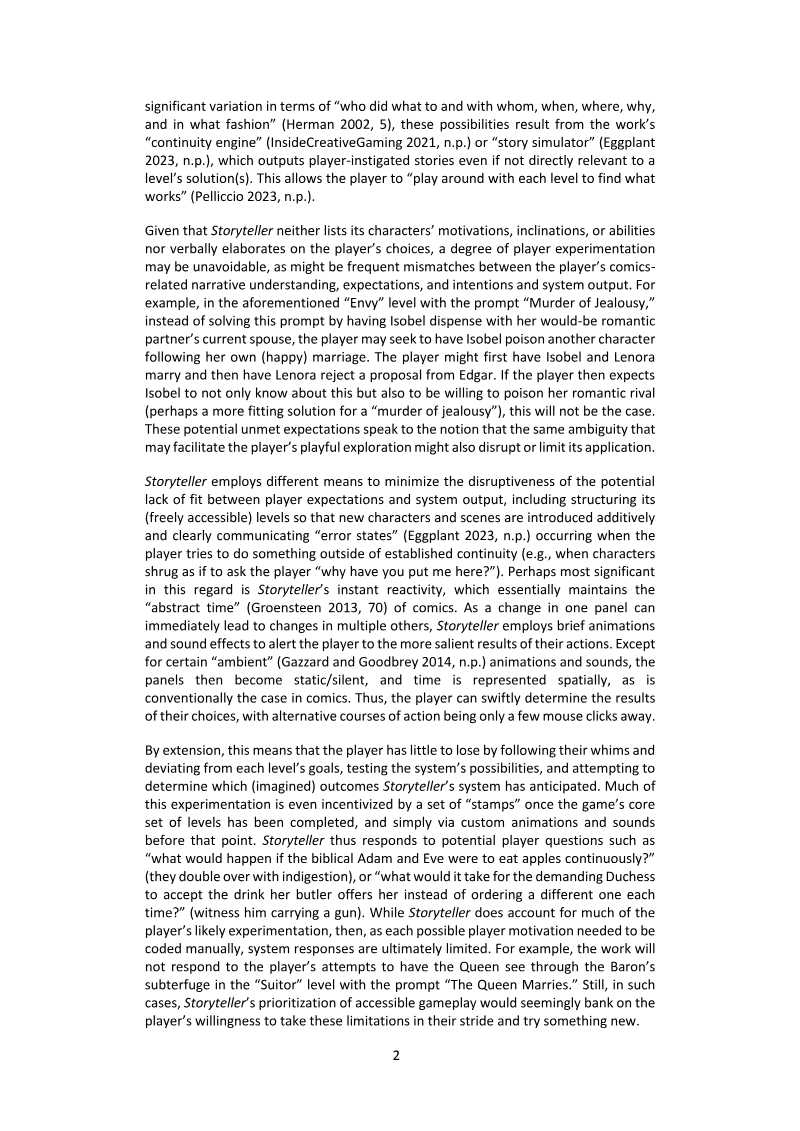
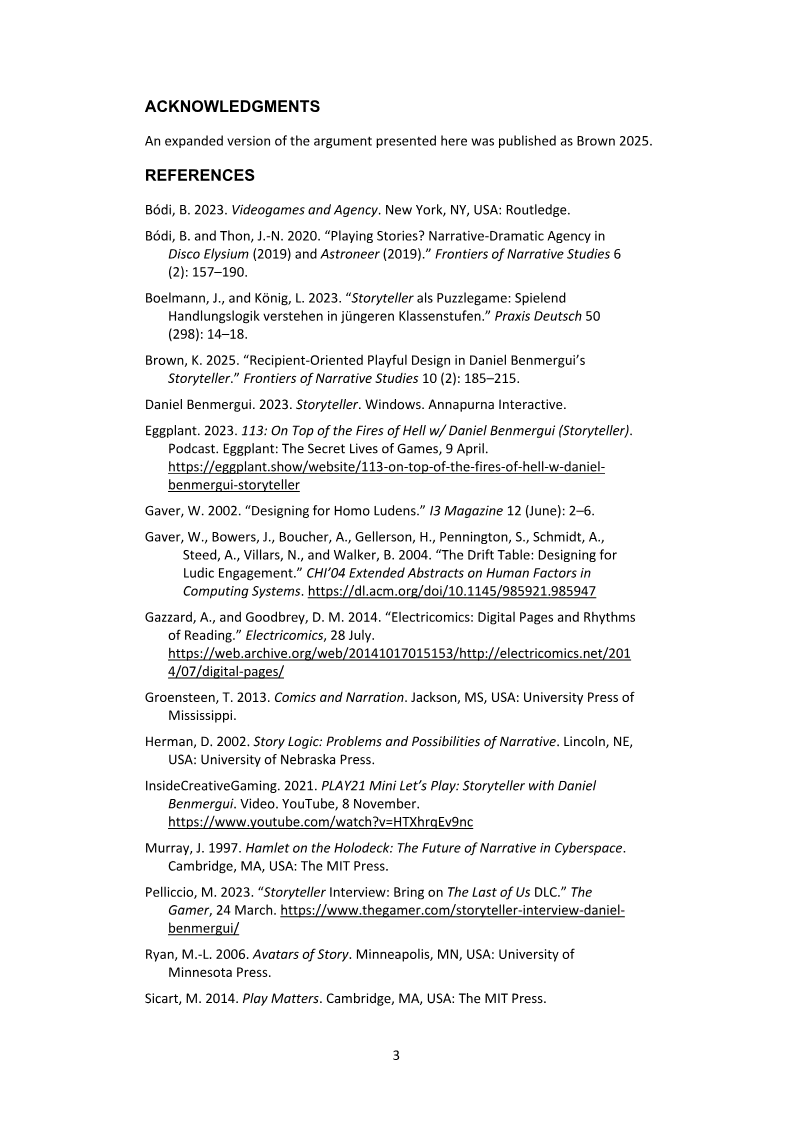
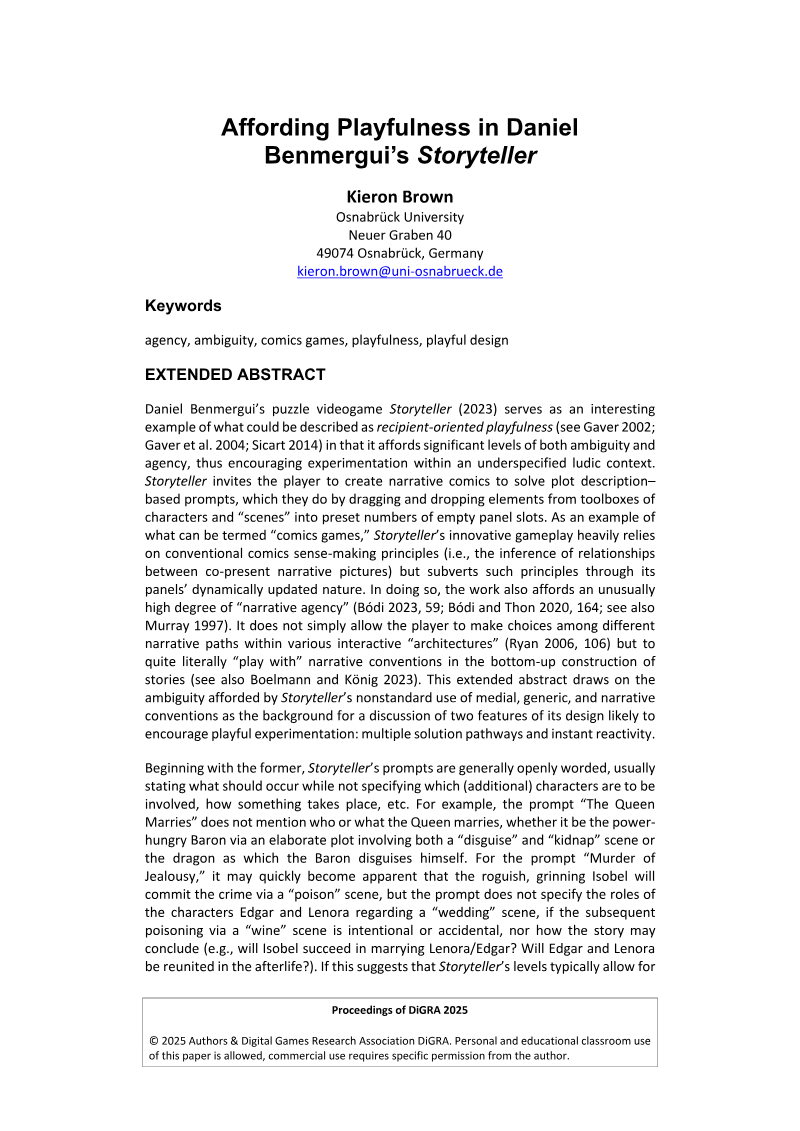
This paper examines Storyteller, an independent puzzle game by Daniel Benmergui in which players arrange characters, settings, and actions within a visualized book to satisfy predefined dramatic prompts such as "Story of a Tragedy." Its central argument is that modular narrative systems, read through cybernetic frameworks of first- and second-order feedback, simultaneously constrain and empower players, and that even tightly bounded systems can become sites of ethical and creative expression. The author positions Storyteller as an alternative to the open-world decision trees and complex narrative RPGs that dominate existing scholarship on player agency.
The analysis draws on Murray, Ryan, Galloway, Aarseth, Bateson, and Sicart to frame modular storytelling as a scaffolded negotiation between system and player. Methodologically, the study uses intertextual analysis of 15 ethically charged levels and five selected player engagements drawn from commentaries, discussions, and livestreams on YouTube and Xiaohongshu. These materials are treated as cultural artifacts rather than empirical behavioral datasets, so the findings are interpretive and preliminary rather than statistically generalizable.
Key observations include three layers of narrative surprise, namely causal deviations between modular elements, success or failure in meeting narrative goals, and inconsistencies in applying prior narrative logic to new contexts. The paper also describes self-limitation as a form of ethical expression, citing examples in which a player consistently chose to have male characters die first and LGBTQ+ players prioritized same-sex marriages to reflect personal values. The author argues that iterative failure and adjustment, in Bateson's recursive learning sense, deepen engagement and transform predefined fragments into prompts for self-expression.
The paper concludes with a layered model of narrative interaction in which players act as ethical agents rather than only problem-solvers. It frames systemic control and player agency as interrelated rather than oppositional, and offers practical implications for narrative designers and indie developers seeking reflective, value-driven play within minimalist mechanics.

DiGRA · 2026

DiGRA · 2026



DiGRA · 2026



DiGRA · 2026



DiGRA · 2026



DiGRA · 2026



DiGRA · 2026



DiGRA · 2026

DiGRA · 2026



DiGRA · 2026



DiGRA · 2026

DiGRA · 2026
Game Developers Conference · 2016