Key insights
6 slides
The subject
The book traces Dungeons & Dragons back to early wargaming and fantasy fiction.
Jon Peterson's Playing at the World presents itself as an extensive history of the game's origins. It moves from early wargaming through the rise of role-play.
1 / 6
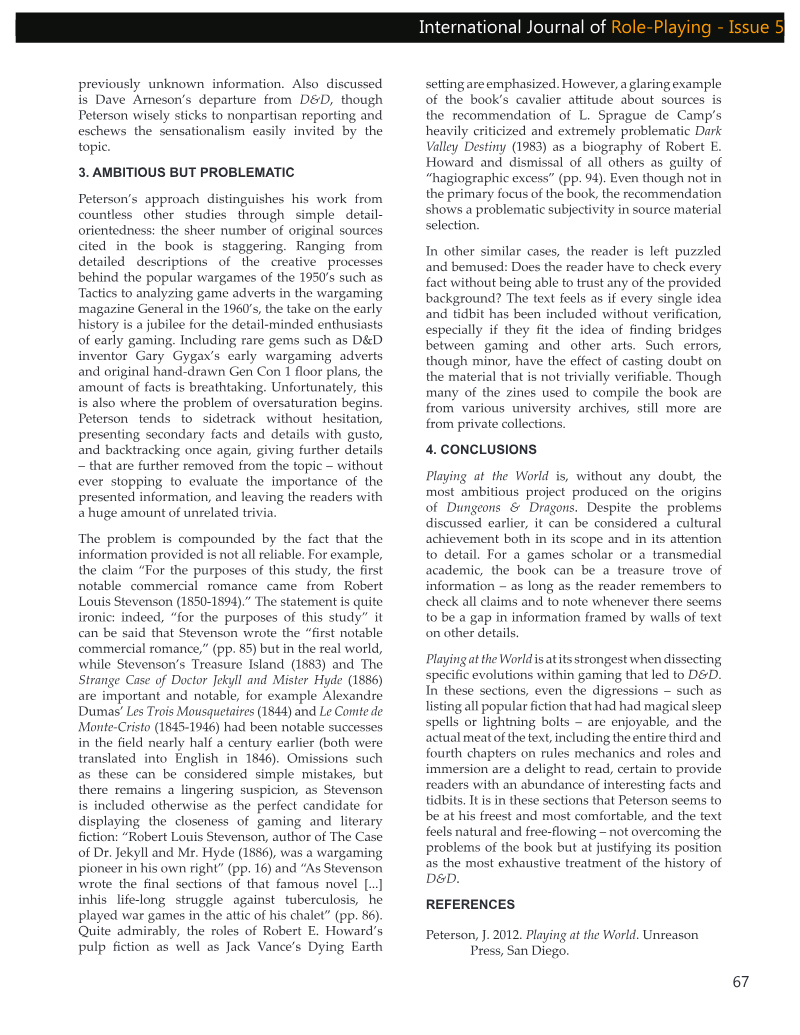
- 01Jon Peterson's Playing at the World is an extensive history of Dungeons & Dragons' origins, covering roughly the late eighteenth century through 1977, from Kriegsspiel and early wargaming through Chainmail, the rise of role-play, and the game's early growth in the mid-1970s.
- 02The book draws on a large body of primary sources, including fanzines, magazines, and private correspondence, which reviewers regard as a major achievement and a valuable resource for researchers.
- 03Reviewers consider the middle chapters on rules mechanics, the evolution of gaming, and the development of role-playing to be the book's strongest and most engaging sections.
- 04The detailed coverage of the Braunstein sessions, the Society for Creative Anachronism, and early Gen Con events is especially valued by researchers and enthusiasts.
- 05The main criticism is editorial: the book struggles to separate major facts from minor ones, burying important points within dense source lists and tangents.
- 06Reviewers note selective sourcing and errors, including recommending a heavily criticized Robert E. Howard biography and making an erroneous claim about the first notable commercial romance, so they advise readers to independently verify claims, especially hard-to-check ones.
- 07Reviewers conclude the book is most useful to games scholars and transmedia researchers who read it critically, valuing its exhaustive scope while cautioning about its lapses in source discernment and verification.
Ask AI about this article
Summary
Jon Peterson's Playing at the World is presented as an extensive history of the origins of Dungeons & Dragons, tracing the game's roots through early wargaming, fantasy fiction, psychodrama, and collaborative storytelling. The work spans roughly from the late eighteenth century through 1977, covering Kriegsspiel, the development of wargames up to Chainmail, the emergence of role-play in the mid-twentieth century, and the game's reception and early growth in the mid-1970s. Drawing on a large body of primary sources, including fanzines, magazines, and private correspondence, the book is regarded as a significant undertaking whose sheer scope and attention to detail make it a valuable resource.
The reviewers identify its strengths most clearly in the middle chapters on rules mechanics, the evolution of gaming, and the development of role-playing, where Peterson's treatment is described as engaging and well-grounded. The book's detailed coverage of the Braunstein sessions, the Society for Creative Anachronism, and early Gen Con events is singled out as particularly valuable for researchers and enthusiasts.
The principal criticisms concern the book's editorial judgment. Reviewers argue that it struggles to separate major facts from minor ones, often blending them within dense lists of sources and tangents, which can obscure important points. They also point to a selective use of sources, citing a recommendation of a heavily criticized biography of Robert E. Howard and an erroneous claim about the first notable commercial romance. Such errors, though small, lead the reviewers to advise readers to verify claims independently, particularly those not easily checked.
Overall, the reviewers conclude that the book is an ambitious and culturally significant achievement, most useful to games scholars and transmedia researchers who approach it critically. Its exhaustive scope is considered its greatest asset, while its lapses in source discernment and verification are seen as its main limitation.