Loading the document
Key insights
6 slides
The rising barrier
Lack of standardized middleware creates high barriers for mobile game developers.
Developing mobile games for handheld devices like PDAs is complex.
Key problem. The absence of standardized game middleware for mobile hardware creates a high barrier to entry for developers.
1 / 6
- 01OpenTrek is a Rapid Application Development (RAD) platform that abstracts hardware complexities and provides built-in support for graphics and peer-to-peer networking to lower mobile game development barriers.See it on page 8
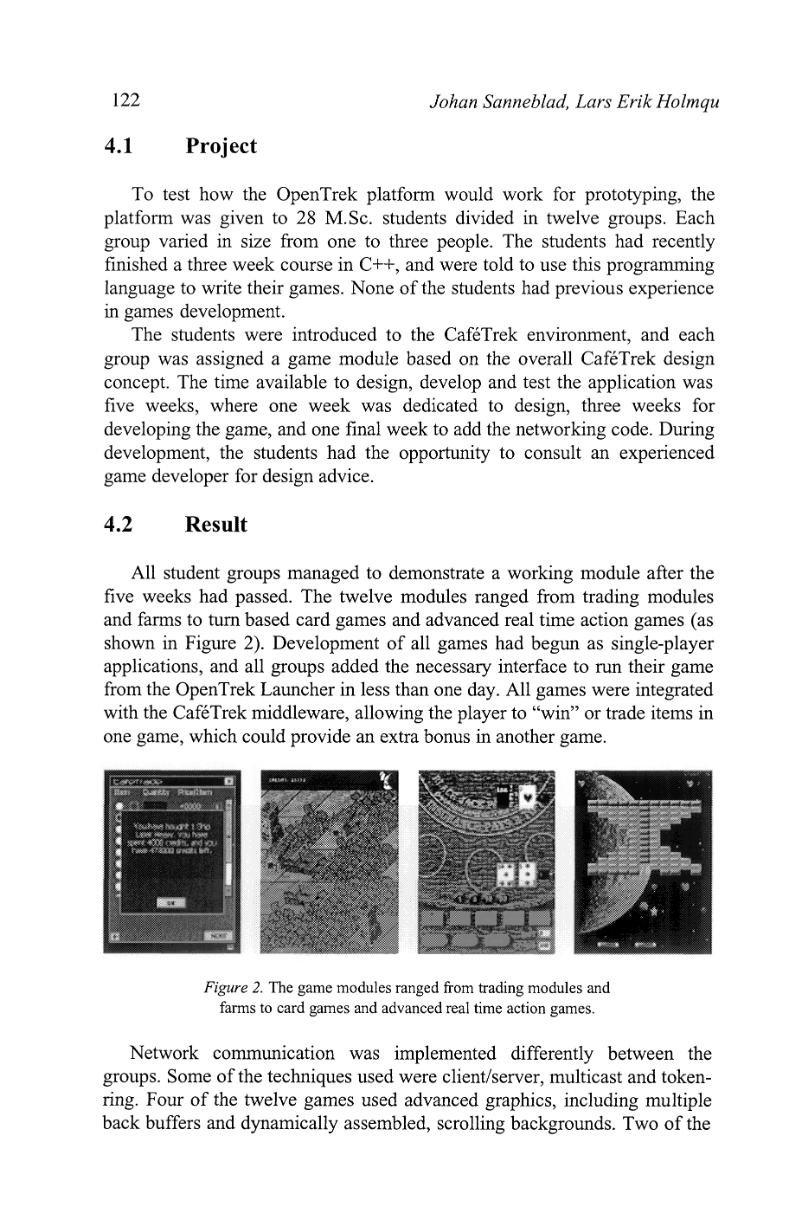
- 02An educational study involving 28 M.Sc. students demonstrated that participants with no prior game development experience could successfully build 12 distinct, functional game modules over a five-week period.See it on page 6
- 03The platform utilizes a high-level C++ class hierarchy and automated session management, allowing developers to prioritize game design over low-level hardware integration.See it on page 3
- 04Student projects successfully implemented diverse networking models, including multicast and client/server architectures, alongside advanced graphical features like smooth scrolling and multiple back buffers.See it on page 6
- 05The platform's layered architecture supports cross-platform compatibility, enabling the transition of initial prototypes into final, shippable software products.See it on page 8
- 06OpenTrek specifically targets the unique capabilities of handheld devices, such as physical mobility and ad-hoc wireless connectivity, to facilitate rapid concept visualization.See it on page 1
Ask AI about this report
Summary
OpenTrek serves as a Rapid Application Development (RAD) platform designed to simplify the creation of mobile games for handheld devices, such as Personal Digital Assistants (PDAs). The primary thesis is that the lack of standardized game middleware for mobile hardware creates a high barrier to entry for developers, which can be mitigated by a specialized platform that abstracts hardware complexities and provides built-in support for graphics and ad-hoc peer-to-peer networking. By offering a high-level C++ class hierarchy and automated session management, the platform enables developers to focus on game design rather than low-level hardware integration.
The platform’s efficacy was evaluated through an educational study involving 28 M.Sc. students divided into twelve groups. Over a five-week period, participants with no prior game development experience successfully utilized the platform to build twelve distinct, functional game modules. These modules ranged from simple trading games to complex real-time action titles, all of which were integrated into a unified environment called CafeTrek. Key technical findings from the student projects included the successful implementation of various networking techniques—such as multicast and client/server models—and the use of advanced graphical features like smooth scrolling and multiple back buffers.
The study concludes that OpenTrek effectively lowers the threshold for mobile game prototyping, allowing for the rapid visualization of concepts that leverage the unique capabilities of handheld devices, such as physical mobility and ad-hoc wireless connectivity. The platform’s layered architecture supports cross-platform compatibility, facilitating the transition of prototypes into final, shippable software products. Future development aims to expand support to additional mobile hardware and conduct further evaluations on the real-world application of ad-hoc network games in everyday environments.