1 free read left. Create a free account for unlimited reading + AI research.
Create free accountWhitepaper DiGRA
1 free read left. Create a free account for unlimited reading + AI research.
Create free accountWhitepaperDiGRA
Distilling the key insights…
In "Player and Figure: An Analysis of a Scene in Kentucky Route Zero," the author develops a two-axis, four-aspect model of the player-figure relation in games, arguing that earlier theories have conflated two distinct dualities: the ontological status of a playable figure as both self and other (avatar versus character), and the player's mode of relating to that figure as either subjective or objective. Drawing on phenomenological and hermeneutic thinkers including Zahavi, Husserl, Merleau-Ponty, and Ricoeur, the paper applies this framework to a close reading of Conway in Act 1, Scene 2 of Kentucky Route Zero, with the aim of showing how the player's relation to a single figure can be simultaneously objective and subjective, and simultaneously self and other.
The analysis shows that the game's point-and-click commands establish a phenomenological subject-position distinct from the player's own, while a shared narrative voice draws the player into Conway's focalized perspective. Through Genette's concept of internal focalization and Lankoski's notion of alignment, the author argues that the difference between "symbolic" and "tangible" interaction is one of degree rather than kind, and that the player's perspective grows increasingly aligned with Conway's as the scene progresses through goal-directed engagement and visual framing.
The study further contends that the player's dialogue choices co-produce Conway as a coherent projective identity, completed only through a specific playthrough, and that the game's self-reflexive use of outmoded media, including its presentation of dialogue as a typewritten screenplay, positions the player as both actor and audience to her own performance. These claims rest mainly on theoretical framing drawn from Aarseth, Gee, Murray, and Waern, applied to close readings rather than empirical data.
The concluding argument holds that the player and Conway become porously linked, folding the player's ludic subjectivity into the game's dramatic text and producing an autoscopic experience of viewing the self as object. Using Calleja's concept of alterbiography, the author examines a scene in which the camera merges with Conway's viewpoint and he vanishes from view, leaving the player to inhabit his perspective fully. The paper's central conclusion is that the player relates to Conway through four interrelated aspects, which together constitute the aesthetic and formal nature of the player-figure relationship.
Each row is a game or company this document names, each column a document, oldest first. A mark means that document names it. Select a row to see those documents.
DiGRA · 2016
DiGRA · 2016
DiGRA · 2016
DiGRA · 2016
DiGRA · 2016
DiGRA · 2016
DiGRA · 2016
DiGRA · 2016
DiGRA · 2016
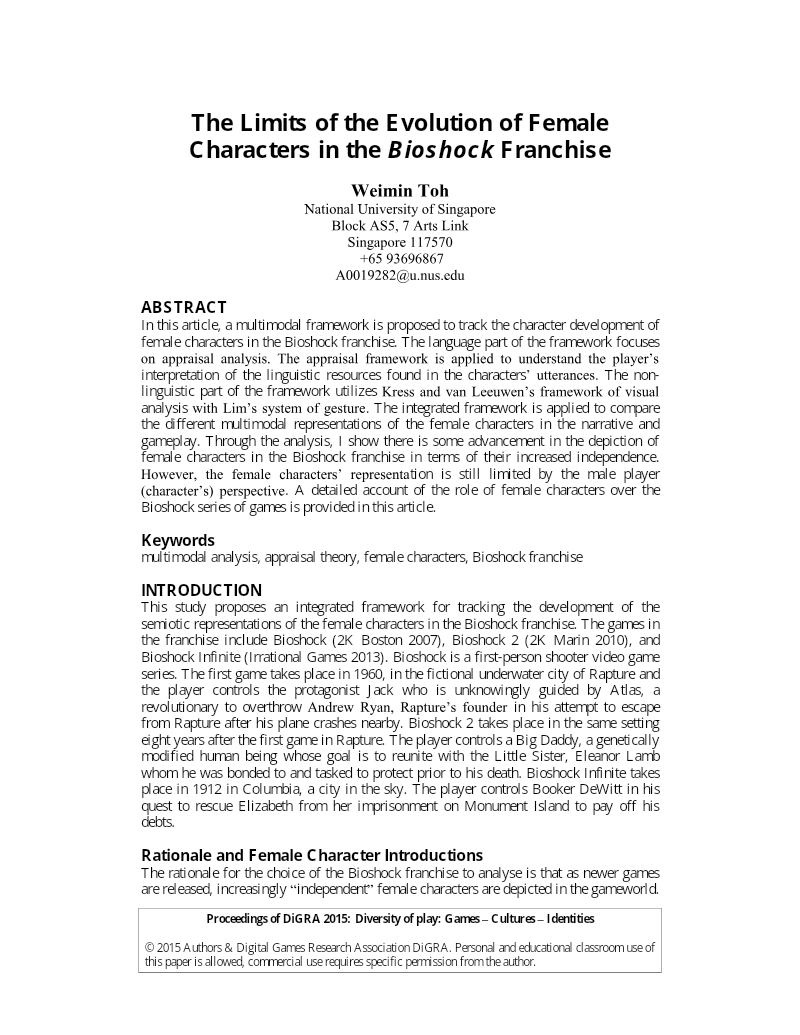
DiGRA · 2015
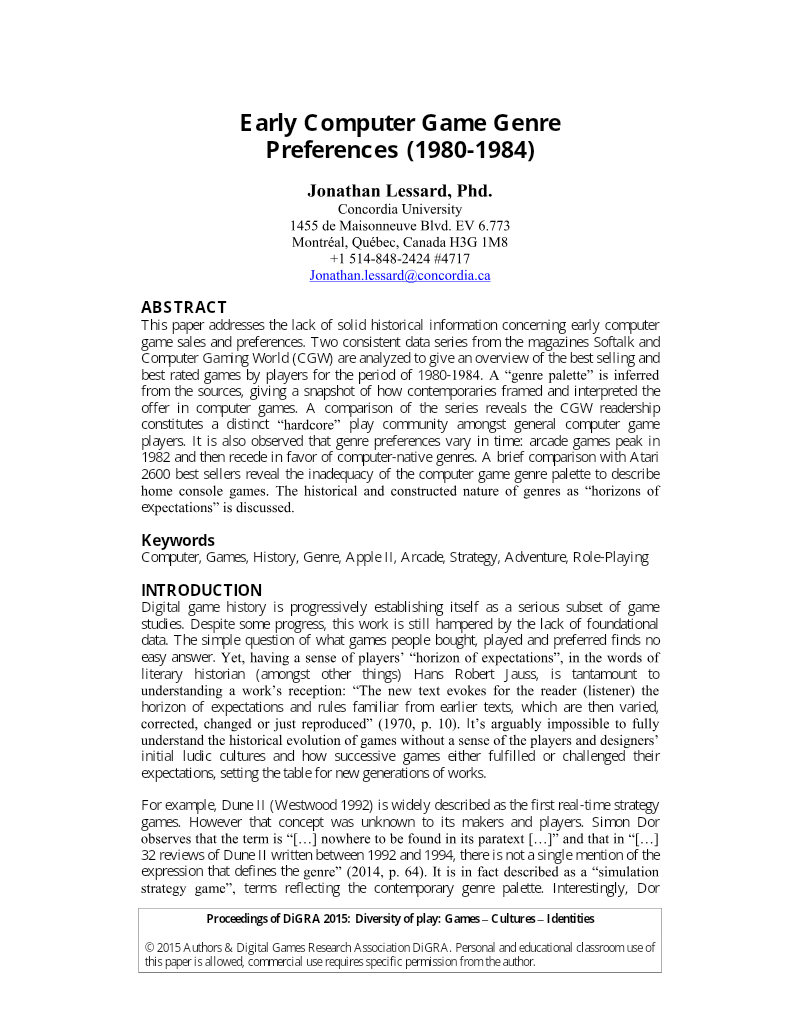
DiGRA · 2015
DiGRA · 2015