1 free read left. Create a free account for unlimited reading + AI research.
Create free accountWhitepaper European Conference on Games Based Learning (ECGBL)
1 free read left. Create a free account for unlimited reading + AI research.
Create free accountWhitepaperEuropean Conference on Games Based Learning (ECGBL)
It is a marker-less handheld augmented reality game for early secondary school students. It has three sequential levels set in a kitchen, a forest, and a laboratory.
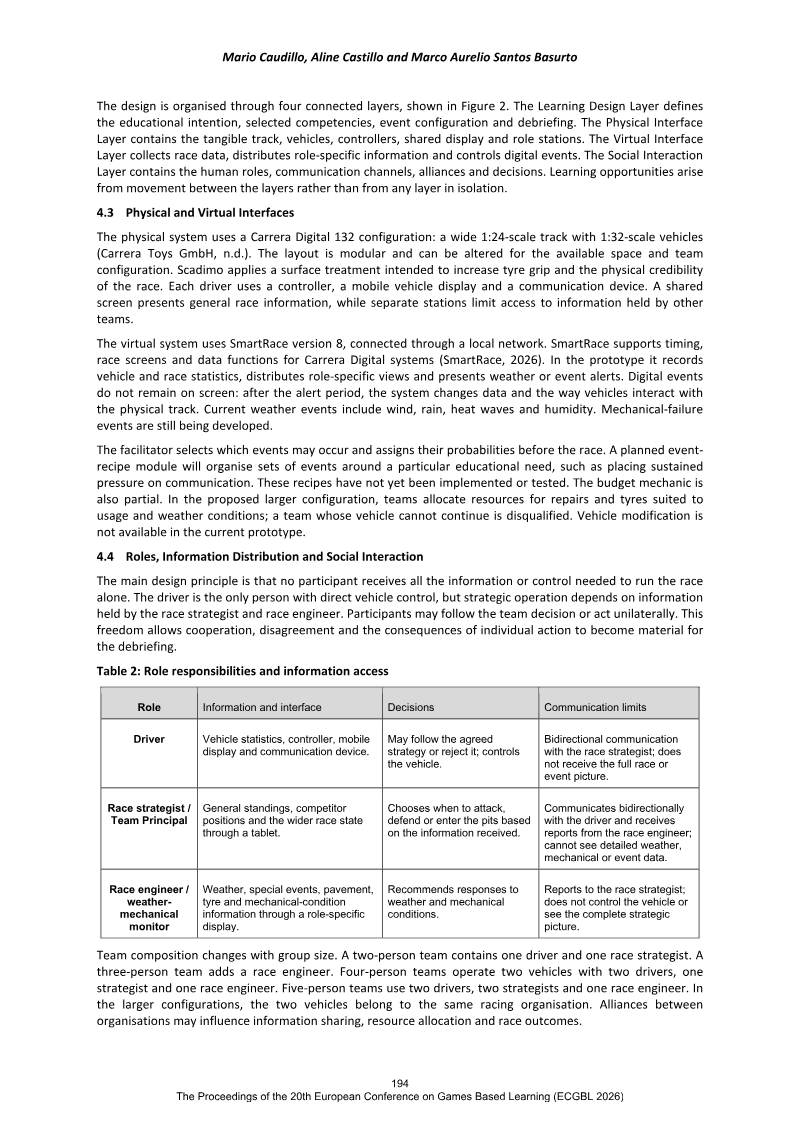
Marie's ChemLab is a marker-less handheld augmented reality game designed to teach basic acidity and pH concepts to early secondary school students. The paper presents the game's design, its adaptation from the TrainAR interaction framework to support gamified, rule-based play, and an evaluation of its usability and classroom feasibility. The game consists of three sequential levels set in a kitchen, a forest, and a laboratory, in which students compare the acidity of fruits, use pH paper and natural blackberry juice as indicators, and rank kitchen products. Development followed a user-centered design approach, with content developed alongside teachers and each level based on an existing classroom lesson plan to ease curricular integration.
The evaluation involved 239 students aged roughly 11 to 15 from Dutch secondary schools, who played the game on iPads during a single science lesson with a 30-minute limit. Most students finished within 20 minutes, no hardware comfort problems were reported, and all students could play simultaneously with only occasional researcher intervention for technical issues. Usability, measured with an adapted children's System Usability Scale, averaged 54.7 (SD = 15.19), which falls in the "OK" range and is considered marginally acceptable. Scores did not differ significantly across age groups. However, the adapted scale showed low internal reliability (Cronbach's alpha of .446), so these usability results must be interpreted with caution.
The authors conclude that handheld AR games combining visualization with embodied interaction can be successfully implemented in ordinary classrooms, though usability has room for improvement. Identified challenges include difficulty aiming the crosshair at virtual objects, a known issue for children using handheld AR, and the authors suggest that future versions could incorporate adaptive instruction tailored to individual abilities. The study does not measure learning gains, so its contribution is limited to design, feasibility, and usability.

European Conference on Games Based Learning (ECGBL) · 2026



European Conference on Games Based Learning (ECGBL) · 2026

European Conference on Games Based Learning (ECGBL) · 2026



European Conference on Games Based Learning (ECGBL) · 2026



European Conference on Games Based Learning (ECGBL) · 2026



European Conference on Games Based Learning (ECGBL) · 2026



European Conference on Games Based Learning (ECGBL) · 2026



European Conference on Games Based Learning (ECGBL) · 2026



European Conference on Games Based Learning (ECGBL) · 2026



European Conference on Games Based Learning (ECGBL) · 2026



European Conference on Games Based Learning (ECGBL) · 2026



European Conference on Games Based Learning (ECGBL) · 2026
European Conference on Games Based Learning (ECGBL) · 2026
European Conference on Games Based Learning (ECGBL) · 2024
European Conference on Games Based Learning (ECGBL) · 2024