1 free read left. Create a free account for unlimited reading + AI research.
Create free accountArticle Eludamos: Journal for Computer Game Culture
1 free read left. Create a free account for unlimited reading + AI research.
Create free accountArticleEludamos: Journal for Computer Game Culture
The study's central thesis is that players collectively determine which virtual harms count as victimization. External authorities are not described as the primary agent.
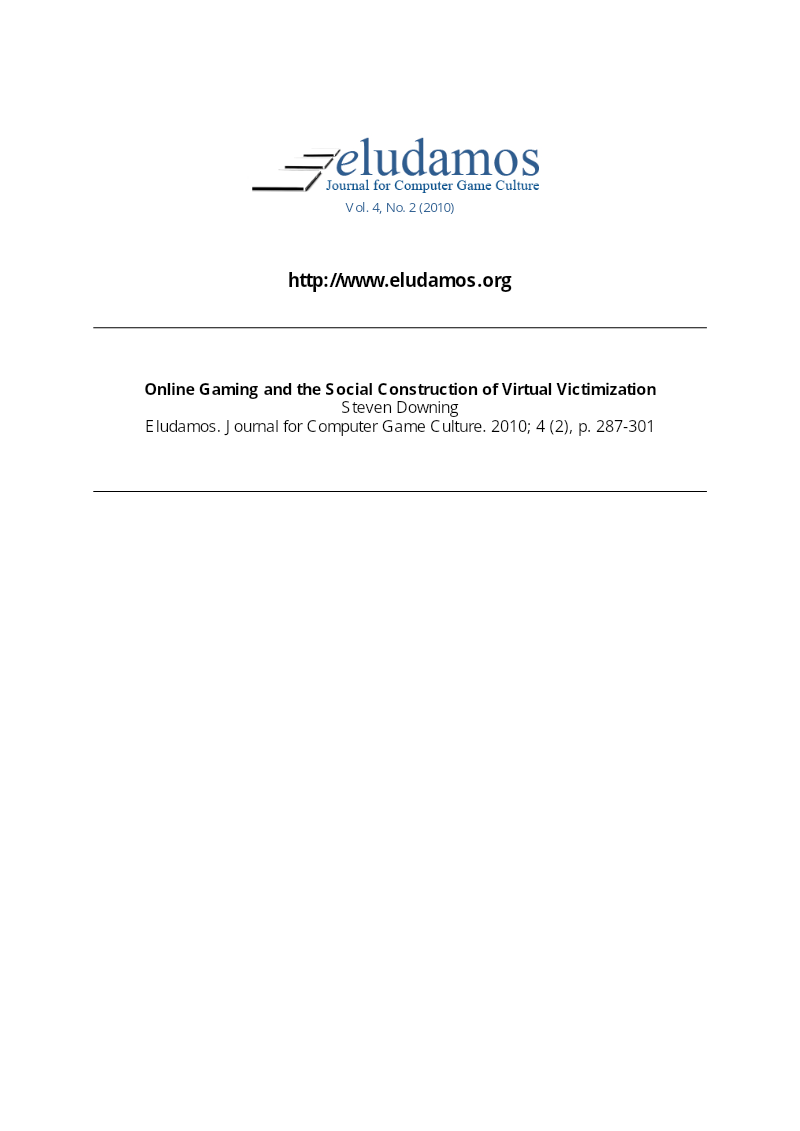
Downing's study examines how players in online games collectively determine which virtual harms count as genuine victimization, challenging a cybercrime literature that has concentrated on remote offenses such as child sexual exploitation and online fraud. Drawing on an ethnography conducted from within a thieves' guild in Ultima Online, supplemented by forum threads, chat transcripts, and surveys, the work frames meaning-making along two dimensions: internal subcultural negotiation among players and external offline cultural norms. The central thesis is that the gaming community itself is the primary agent defining victimization within its own boundaries.
The findings show that virtual theft of in-game property is typically regarded as more consequential than virtual assault, a judgment largely rooted in the time and emotional investment required to acquire items. Players evaluate whether harms are "real" by weighing that investment, a play-versus-work distinction, and the presence of a human being behind each avatar. Opinions diverge: some players treat in-game harm as separate from offline ethics, while others import offline moral frameworks. Overall, victimization is recognized as contextually meaningful within the game, though generally judged less serious than comparable offline harm. Con-style theft is shown to exploit the bridge between online and offline emotional attachment.
The study's evidence base is anchored in the Ultima Online community, with a sample of 189 guild members, roughly 100 forum threads, and about 15 surveys, and it is supplemented by a 2010 survey of 5,000 gamers across Europe and North America, of whom 60 percent reported purchasing in-game items. The analysis draws implications for game design, suggesting that item loss can generate player-driven emotional investment, and for criminology, where virtual property protection is identified as an emerging policy question.
Each row is a game or company this document names, each column a document, oldest first. A mark means that document names it. Select a row to see those documents.

Eludamos: Journal for Computer Game Culture · 2026

Eludamos: Journal for Computer Game Culture · 2026

Eludamos: Journal for Computer Game Culture · 2026

Eludamos: Journal for Computer Game Culture · 2026

Eludamos: Journal for Computer Game Culture · 2026

Eludamos: Journal for Computer Game Culture · 2026

Eludamos: Journal for Computer Game Culture · 2026

Eludamos: Journal for Computer Game Culture · 2025

Eludamos: Journal for Computer Game Culture · 2025

Eludamos: Journal for Computer Game Culture · 2025

Eludamos: Journal for Computer Game Culture · 2025

Eludamos: Journal for Computer Game Culture · 2025
The Game Business · 2026