1 free read left. Create a free account for unlimited reading + AI research.
Create free accountArticle Eludamos: Journal for Computer Game Culture
1 free read left. Create a free account for unlimited reading + AI research.
Create free accountArticleEludamos: Journal for Computer Game Culture
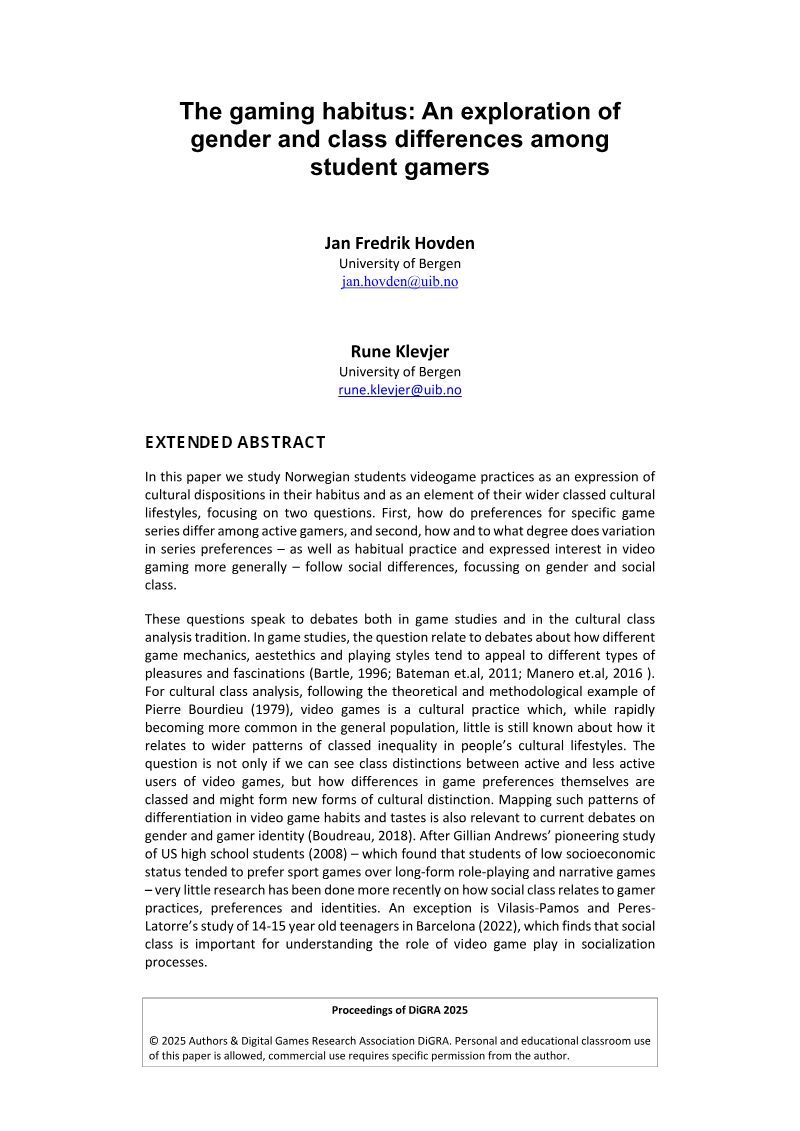
The study applies Bourdieu's theory of practice and forms of capital to how players are socialised into gaming. It draws on 1,019 valid responses analysed with multiple correspondence analysis.
A Swedish study applying Bourdieu's theory of practice and forms of capital examines how players are socialised into gaming culture, drawing on a 2023 web questionnaire with 1,019 valid responses and multiple correspondence analysis. The sample was non-random, recruited through purposive and snowball methods, and skewed heavily toward men (about 74%) and respondents aged 20 to 30. Its central argument is that gamers become gamers through structured social processes, and that the resulting culture both reflects and constrains players' present dispositions and future trajectories within the gaming field.
The analysis finds that Swedish gaming culture is clearly structured by gender and age but not visibly by social class, birthplace, or upbringing. The principal axes separate high-capital, esports-oriented devoted gaming from casual play, while a second dimension contrasts family-embedded cultural entry with solitary, sporty engagement. Age-related generational differences drive much of this structure, with teenagers more devoted to gaming and more likely to identify as gamers. Economic capital, including income-generating motives, esports education, and peripheral equipment, and social capital, particularly the distinction between online and offline friendships, contribute most strongly to the first axis.
Gender emerges as the strongest differentiator of practice. Male players entered gaming more independently of family, favoured competitive multiplayer genres such as MOBA, FPS, and MMO as well as militainment, and invested more heavily in premium equipment. Female and non-binary players more often reported family influence, preferred single-player, artistic, or life-simulation games, and were less likely to identify as gamers. The absence of class-based distinctions is presented as a notable departure from earlier research, suggesting that gaming culture in this context may transcend class, though the author cautions that the non-random sample, the lack of significance testing, and the qualitative character of correspondence analysis limit generalisability.

Eludamos: Journal for Computer Game Culture · 2026

Eludamos: Journal for Computer Game Culture · 2026

Eludamos: Journal for Computer Game Culture · 2026

Eludamos: Journal for Computer Game Culture · 2026

Eludamos: Journal for Computer Game Culture · 2026

Eludamos: Journal for Computer Game Culture · 2026

Eludamos: Journal for Computer Game Culture · 2025

Eludamos: Journal for Computer Game Culture · 2025

Eludamos: Journal for Computer Game Culture · 2025

Eludamos: Journal for Computer Game Culture · 2025

Eludamos: Journal for Computer Game Culture · 2025
Eludamos: Journal for Computer Game Culture · 2025
GAMEHEARTS · 2026