1 free read left. Create a free account for unlimited reading + AI research.
Create free accountArticle Eludamos: Journal for Computer Game Culture
1 free read left. Create a free account for unlimited reading + AI research.
Create free accountArticleEludamos: Journal for Computer Game Culture
The study contrasts widely reported harassment at major international conventions with survey findings on Finnish local gatherings.
This study examines safety at game industry events in Finland, motivated by a contrast between widely reported harassment at major international conventions and survey findings suggesting that Finnish women and gender-diverse developers feel safer at local gatherings than in their workplaces. Drawing on a 2023 WiGFi survey of 130 Finnish game industry respondents, including 53% women, 7% gender-diverse people, and 38% LGBTQIA+ identifying participants, alongside 34 interviews with underrepresented industry members, the research focuses particularly on IGDA Finland meetups. These events are treated as both social parties and consequential sites for career development, and the analysis is situated within party studies and local production studies.
Most respondents rated IGDA Finland events as safe, with 93% selecting the two highest safety ratings, rising to 96% among women. However, women and gender-diverse respondents described experiences of sexual harassment, and some reported serious career consequences. Women with international experience reported considerably less safety abroad, and gender-diverse and LGBTQIA+ respondents reported lower perceived safety than others, with only 25% of gender-diverse respondents choosing the highest rating. The authors caution that small sample sizes limit the strength of these subgroup conclusions.
The research finds that perceived safety depends on individual precautions such as limiting alcohol consumption or avoiding certain events, on networks of trusted peers, on institutional measures including codes of conduct and industry-wide protocols, and on a broader culture of friendliness and authenticity. Emotional safety and belonging matter especially to LGBTQIA+ and underrepresented participants, and the industry's self-perceived inclusivity may obscure these concerns. The study concludes that relying on individual coping places an unfair burden on underrepresented people, and it proposes a community accountability model in which safety is treated as an organisational and communal responsibility, supported by institutional rules and shared values, with further comparative research recommended.

Eludamos: Journal for Computer Game Culture · 2026

Eludamos: Journal for Computer Game Culture · 2026

Eludamos: Journal for Computer Game Culture · 2026

Eludamos: Journal for Computer Game Culture · 2026

Eludamos: Journal for Computer Game Culture · 2026

Eludamos: Journal for Computer Game Culture · 2026

Eludamos: Journal for Computer Game Culture · 2025

Eludamos: Journal for Computer Game Culture · 2025

Eludamos: Journal for Computer Game Culture · 2025

Eludamos: Journal for Computer Game Culture · 2025

Eludamos: Journal for Computer Game Culture · 2025
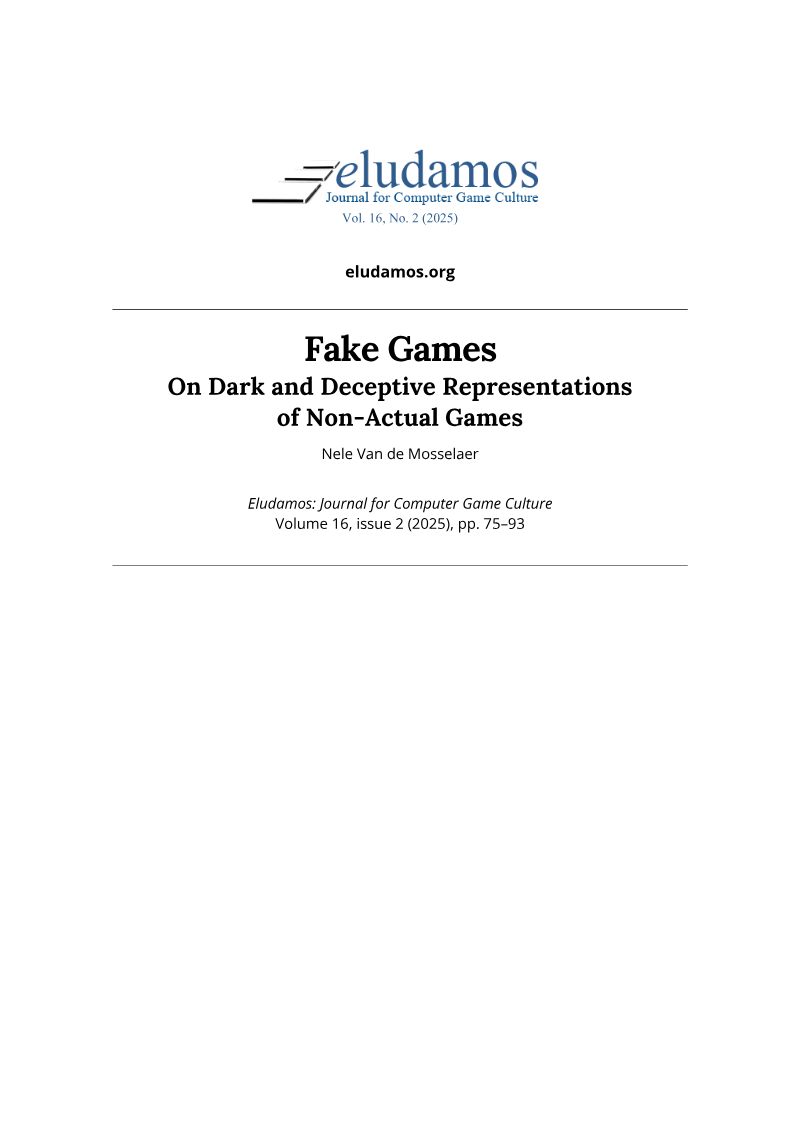
Eludamos: Journal for Computer Game Culture · 2025
GAMEHEARTS · 2026