1 free read left. Create a free account for unlimited reading + AI research.
Create free account
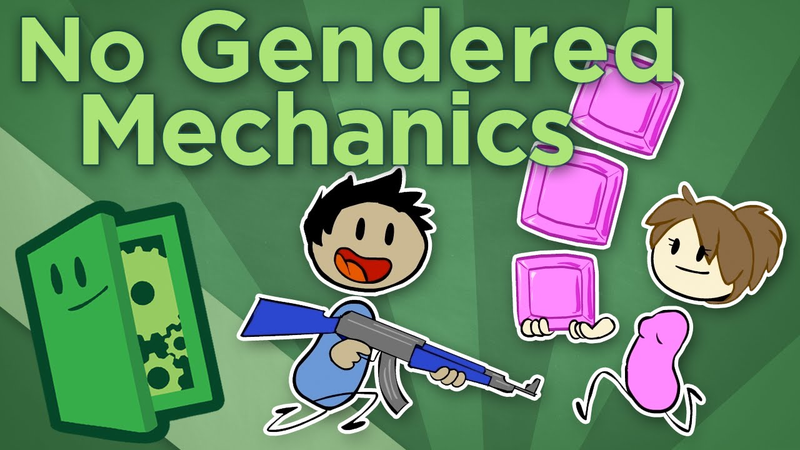
No Gendered Mechanics - How Genre Stereotypes Limit Games and Players - Extra Credits
Key insights
6 takeaways- 01The game industry's practice of categorizing mechanics as inherently gendered—such as labeling shooters as masculine and match-three games as feminine—is a self-perpetuating cycle that restricts creative development.
- 02Abandoning artificial gender constraints allows the industry to expand the commercial and artistic potential of all game genres by reaching more inclusive player bases.
- 03Titles like Kingdom Hearts, Portal, and Puzzle Quest prove that mechanics can successfully attract diverse audiences when the thematic presentation is decoupled from traditional gender stereotypes.
- 04Gendered associations are products of cultural theming and marketing strategies rather than the mechanics themselves, which are inherently gender-neutral.
- 05Designers often conflate core gameplay mechanics with the gender-coded themes they were originally paired with, leading to a narrow scope of development that limits innovation.
- 06Developers can foster broader audience engagement and creative experimentation by applying established mechanics to unconventional narrative contexts, such as using hidden-object mechanics in a post-apocalyptic survival setting.
Ask AI about this video
Transcript
I think one of the most limiting things in modern game design is our radically oversimplified view of gender. And I'm not just talking about portrayals of female characters or objectification or gender stereotypes or any of that. We still have an abundance of problems in those areas, of course, no question. Our failings in those areas limit us, and there's a lot of change and growth that we need to go through. But today I want to talk about a specific aspect of gender stereotyping which we almost never discuss in these conversations, mechanic stereotyping. We regularly hear designers talk about mechanics as if certain mechanics were only viable for specific genders. I hear things like first-person shooters are for boys and match-three games are for girls with shocking regularity. In fact, it's become so ubiquitous that it's passed into the realm of unspoken rule. It's just become a tacit collective assumption amongst our industry. But this commonly held belief isn't just limiting, it's flat-out wrong. Why? Because we see counterexamples to it all
the time. Industry wisdom says that action RPGs are boy games, and yet Kingdom Hearts has an enormous female following. They say first-person shooters only appeal to men, but as soon as you get one that's not about violent conflict like Portal, suddenly you see massive appeal across gender lines. And if match-three mechanics are just for women, why did Puzzle Quest have a largely male audience? I could go on for a long time listing off all the exceptions to these silly rules, but you get the point. So, where did these stereotypes come from? Well, they come from the theming these mechanics are traditionally associated with and from the initial cultures that grew up around these mechanics when they were first created. As much as I hate to say it, I do think there is such a thing as gender-biased theming. It's unfortunate, but from the day we're born, we're bombarded with a lot of societal ideas about what our genders should and shouldn't like. And many industries spend billions of dollars to steer our collective perception of gender identities in certain ways. The specifics vary between cultures, and it may not always be intentional or malicious, but everything from the
design of Barbie toys to the presentation and recruitment messaging of our military influences how the average American believes gender should affect our identity. And that's not to say that we never break from those stereotypes or even that you can't be comfortable living within those stereotypes and still enjoy things outside of them as well. I'm just saying that in aggregate, when you take a sample of hundreds of millions of people, cultural ideas of gender do influence how you sell products to a gender. It's kind of a self-reinforcing circle. So, yes, in aggregate, games about war, ultra-violence, and being a hero based on one's strength and martial dominance will generally sell better to men than women. And since first-person shooters began in that mold and generally stick to the formula even today, we've conflated first-person shooter mechanics with the theme that they're usually tied to and thus have decided as an industry that first-person shooters aren't for women. But, that conflation keeps us from experimenting. It locks us into these old and tired ideas of what a genre can and or should be. Let me give you an example. Recently, James was asked to work on a hidden object game. Now, hidden object
is a type of gameplay that the industry has pigeonholed as female. When James brings them up to industry folk, the response is almost always something like, "Those are just girl games." But, that stereotype exists because the genre was first invented in the casual market when that side of the industry was specifically looking to connect with a female audience. As such, most of these games have theme which is heavily targeted at women. In fact, if you go back to our episode about hidden object games, we talked about how most of their protagonists are female and how the writers of those games don't seem to have trouble writing female characters in quite the same way that AAA developers sometimes do. But, these don't have to be girl games. Again, it's just a matter of theme. James was going to pitch this idea to the client, but it's just too perfect an example for the point I'm trying to make, so I'm going to use it here. Imagine a hidden object game set in a post-apocalyptic zombie world. You're a scavenger. You will in a small community and every day you have to go out and search for the things your community needs to survive. You have to acquire the food, water, and clothes that your small band needs. You have to
outfit them with weapons and ammo to get through the night. You have to find the tools and supplies you require to upgrade your base. Each evening you talk to your people, manage what's being built at your hideout, and you have to choose who you let into your camp and who you leave for the zombies outside. During the day you scavenge and it plays just like a hidden object game, but there's a timer ticking down while you search, signaling the approach of the zombie hordes. How much time you're given is dependent on your gear, your party, and how well you know the area. You've got access to one-time use items you found or crafted to increase the time limit, but every second you stay past the end of the timer, every second you spend finding that food you desperately need to keep everybody alive increases the likelihood that the zombies burst in, possibly wounding you or killing your crew. There's even more to do with base building and fending off attacks and talking to the people you've assembled around you and such, but you get the basic idea. It's not the mechanics that have a gender bias, it's the theming. Although I'd like to think that the zombie apocalypse is a bias-free playground for us all. James
has dozens of these design pitches for all kinds of genres. This mentality that a set of mechanics exclusively appeals to the group that was the target audience for the few games that established their use is only holding us back. Developers, think of the innovation opportunities. Gaming fans, think of the fascinating new varieties of awesome games we might see. Industry people, think of the broader audiences you could be reaching. Everyone wins. Seriously, it's time we stop thinking of mechanics in terms of gender. See you next week. Mhm.
Summary
The modern game industry is hindered by a pervasive, oversimplified belief that specific gameplay mechanics are inherently gendered. This industry-wide assumption—which categorizes genres like first-person shooters as masculine and match-three or hidden-object games as feminine—is a self-perpetuating cycle. Designers frequently conflate core mechanics with the gender-coded themes they were originally paired with, leading to a narrow scope of development that ignores the potential for broader audience engagement and creative innovation.
Evidence suggests that these gendered associations are not rooted in the mechanics themselves but in the cultural theming and marketing strategies surrounding them. Popular titles such as Kingdom Hearts, Portal, and Puzzle Quest demonstrate that mechanics often labeled as gender-specific frequently attract diverse audiences when the thematic presentation is shifted. The industry’s tendency to pigeonhole genres based on their initial target demographics limits the evolution of game design, as developers become hesitant to apply established mechanics to new, unconventional contexts.
To move past these limitations, developers should decouple mechanics from traditional gendered themes. By reimagining genres through different narrative lenses—such as applying hidden-object mechanics to a high-stakes, post-apocalyptic survival scenario—designers can break free from stale conventions. Moving away from gendered design assumptions allows for greater creative experimentation, the discovery of new gameplay experiences, and the ability to reach wider, more inclusive player bases. Ultimately, the industry stands to benefit from abandoning these artificial constraints, as doing so fosters innovation and expands the commercial and artistic potential of all game genres.


















Comments