1 free read left. Create a free account for unlimited reading + AI research.
Create free accountWhitepaper European Conference on Games Based Learning (ECGBL)
1 free read left. Create a free account for unlimited reading + AI research.
Create free accountWhitepaperEuropean Conference on Games Based Learning (ECGBL)
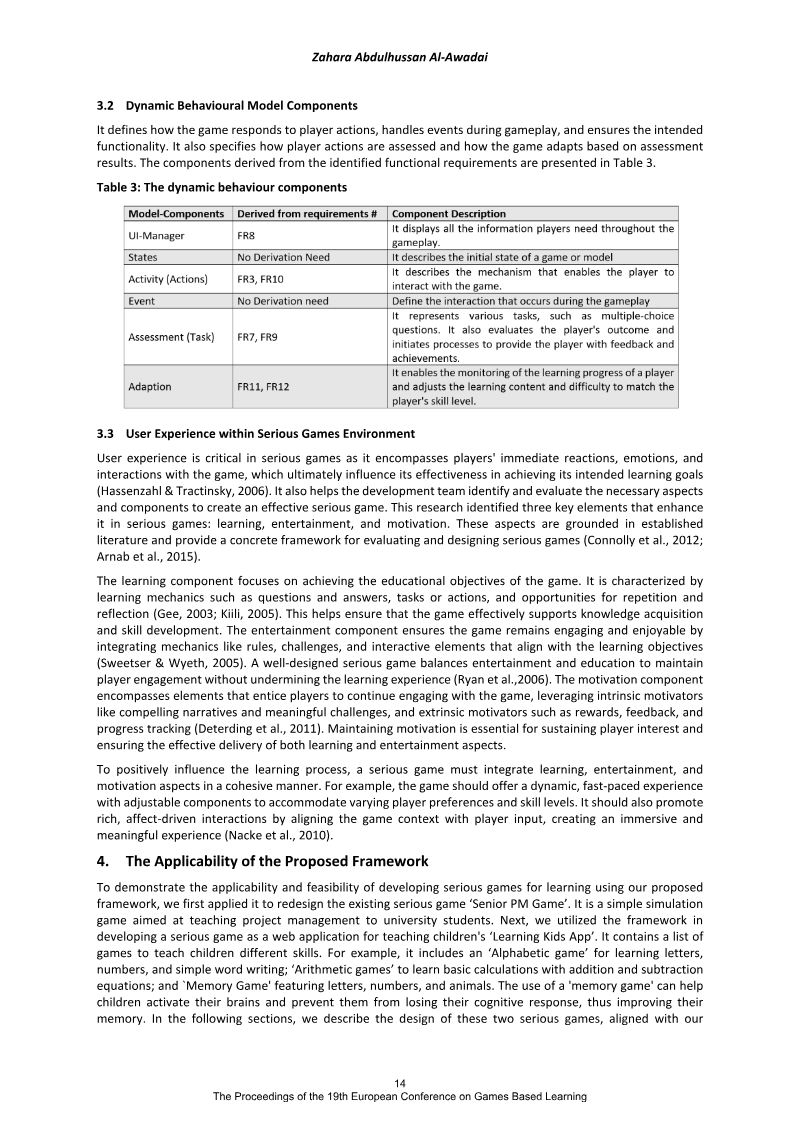
Players navigate a Unity first-person shooter maze, solving block-based programming puzzles that unlock protein keys. The game targets elementary students aged 10 to 12.
This paper presents NanoDoc, a serious game for teaching the programming concepts of sequence and iteration to elementary school students, with a focus on an adaptive support mechanism built around editable and executable working examples. The central argument is that worked examples, which show an expert solution to a similar problem that students can study and modify, reduce cognitive load and improve learning outcomes compared with hints, text, or video. The game is built in Unity as a first-person shooter in which players navigate a maze to solve block-based programming puzzles that unlock protein keys, and the adaptive system uses Fuzzy Logic to model each student's knowledge level from the efficiency of submitted solutions and to decide when worked examples should be offered.
The adaptation method computes a learning efficiency score by comparing the block count of an optimal solution with the student's submission, then maps this score onto four fuzzy knowledge sets (Unknown, Unsatisfactorily Known, Known, and Learned) and defuzzifies the result using a maximum-membership approach. Support is triggered according to a ruleset that considers the knowledge level and the number of failed attempts, with an additional automatic trigger after 120 seconds of inactivity. The authors situate this work within a limited body of research on adaptive serious games for programming, contrasting it with systems that rely on Bayesian networks, deep learning, or other fuzzy approaches.
The evaluation was a pilot questionnaire administered in January 2021 to 85 elementary students aged 10 to 12 who played for 45 minutes in a school computer lab. Results were broadly positive: nearly 90 percent of respondents expressed favorable attitudes toward learning programming through games, and graphics and world design were rated highly, while sound, difficulty of enemies and obstacles, and the need for greater challenge were identified as areas for refinement. The authors conclude that the adaptive algorithm functions as intended, although the small, single-school sample and the lack of controlled comparison limit the strength of these claims, and they plan a future empirical study comparing adaptive and non-adaptive worked example versions.
Each row is a game or company this document names, each column a document, oldest first. A mark means that document names it. Select a row to see those documents.

European Conference on Games Based Learning (ECGBL) · 2025
European Conference on Games Based Learning (ECGBL) · 2025
European Conference on Games Based Learning (ECGBL) · 2025

European Conference on Games Based Learning (ECGBL) · 2025
European Conference on Games Based Learning (ECGBL) · 2025
European Conference on Games Based Learning (ECGBL) · 2025
European Conference on Games Based Learning (ECGBL) · 2025
European Conference on Games Based Learning (ECGBL) · 2025
European Conference on Games Based Learning (ECGBL) · 2025

European Conference on Games Based Learning (ECGBL) · 2025


European Conference on Games Based Learning (ECGBL) · 2025

European Conference on Games Based Learning (ECGBL) · 2025



Breda University of Applied Sciences · 2026
European Conference on Games Based Learning (ECGBL) · 2025

European Conference on Games Based Learning (ECGBL) · 2025