1 free read left. Create a free account for unlimited reading + AI research.
Create free accountWhitepaper European Conference on Games Based Learning (ECGBL)
1 free read left. Create a free account for unlimited reading + AI research.
Create free accountWhitepaperEuropean Conference on Games Based Learning (ECGBL)
Players take the role of a tutor with 20 minutes to prepare a chaotic seminar room. The prototype was built in Unity and Spatial.io.
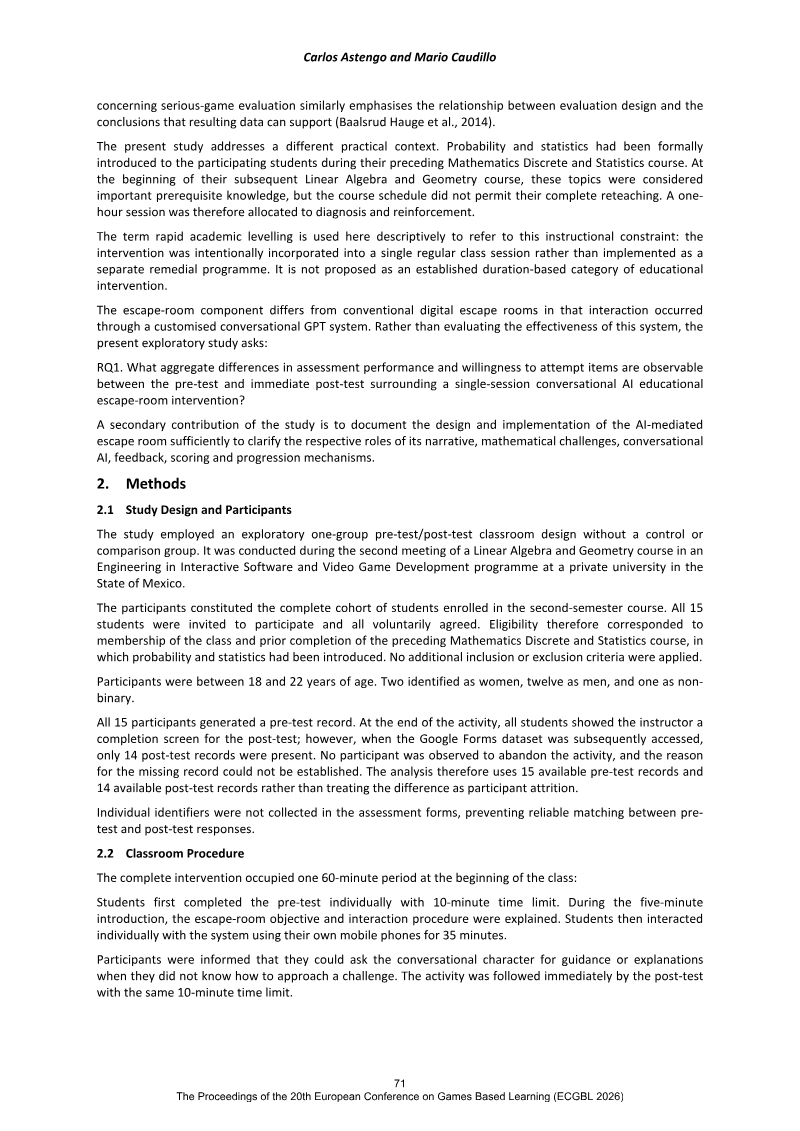
This paper presents the development and formative evaluation of an early-stage prototype of a digital escape room designed to train student tutors at TUD Dresden University of Technology. The escape room places players in the role of a tutor who has 20 minutes to prepare a seminar room that is chaotic, with technical defects, misplaced furniture and missing materials. Tasks address common tutoring challenges such as organisation, technical proficiency, problem-solving, time management and communication. The design draws on flow theory, problem-based learning, deindividuation theory and cognitive apprenticeship, and the web-based environment was built with Unity and Spatial.io. The stated focus is on usability and motivation rather than measurable learning gains.
The evaluation combined two stages. Four think-aloud usability sessions with qualitative interviews identified an abrupt game start and a lack of introduction to controls and task logic as major problems, while the graphic design, realism of tasks and motivational appeal were rated positively. A subsequent survey of 24 participants across two workshops gave the highest ratings to enjoyment (mean 3.3), motivation (mean 3.2) and ease of orientation (mean 3.2), and a moderate rating for usefulness in training (mean 3.0). The lowest scores concerned technical problems (mean 2.2), comprehension of the game's purpose and task clarity (both mean 2.3), and intuitiveness of controls (mean 2.5). The sample skewed toward female and younger participants, and the authors note that the sample size and descriptive-only analysis limit the strength of conclusions.
Based on these findings, the authors are revising task instructions, adding a guided onboarding tutorial, progress indicators, situation-specific hints, and a final reflection component, along with accessibility features such as keyboard control and contrast modes. Future work includes a summative evaluation of learning outcomes and possible adaptation to other audiences such as new teachers, mentors and crisis-management training. The authors conclude that digital escape rooms show promise as a scalable and transferable format for competence development in higher education, though this promise remains preliminary given the formative, early-stage nature of the study.
Each row is a game or company this document names, each column a document, oldest first. A mark means that document names it. Select a row to see those documents.



European Conference on Games Based Learning (ECGBL) · 2026



European Conference on Games Based Learning (ECGBL) · 2026



European Conference on Games Based Learning (ECGBL) · 2026



European Conference on Games Based Learning (ECGBL) · 2026



European Conference on Games Based Learning (ECGBL) · 2026



European Conference on Games Based Learning (ECGBL) · 2026



European Conference on Games Based Learning (ECGBL) · 2026



European Conference on Games Based Learning (ECGBL) · 2026



European Conference on Games Based Learning (ECGBL) · 2026



European Conference on Games Based Learning (ECGBL) · 2026



European Conference on Games Based Learning (ECGBL) · 2026



European Conference on Games Based Learning (ECGBL) · 2026



European Conference on Games Based Learning (ECGBL) · 2026
European Conference on Games Based Learning (ECGBL) · 2023



European Conference on Games Based Learning (ECGBL) · 2026