ArticleMobile Dev Memo
Introducing DeCANT: A Context-Conditioned, Attention-Based Multimodal Architecture for Creative Pre-testing
25 May 20261 pages~14 min full read
The article introduces DeCANT, a deep attention‑based multimodal architecture designed to pre‑test advertising creatives before deployment. The core thesis is that context—country, language, channel, and other situational factors—interacts with creative attributes in ways that can be learned through cross‑attention, enabling advertisers to predict 30‑day ROAS and filter out low‑potential creatives. The empirical study uses a proprietary dataset from Fabulous SAS, comprising nearly 100 000 ad‑level observations across more than 10 000 unique creatives on Meta’s platforms. Each creative is represented by image embeddings from a vision transformer, OCR text and semantic summaries via sentence transformers, and structured descriptors generated by an LLM. Contextual features are encoded as dense embeddings, with a learned aggregation token prepended to each sequence.
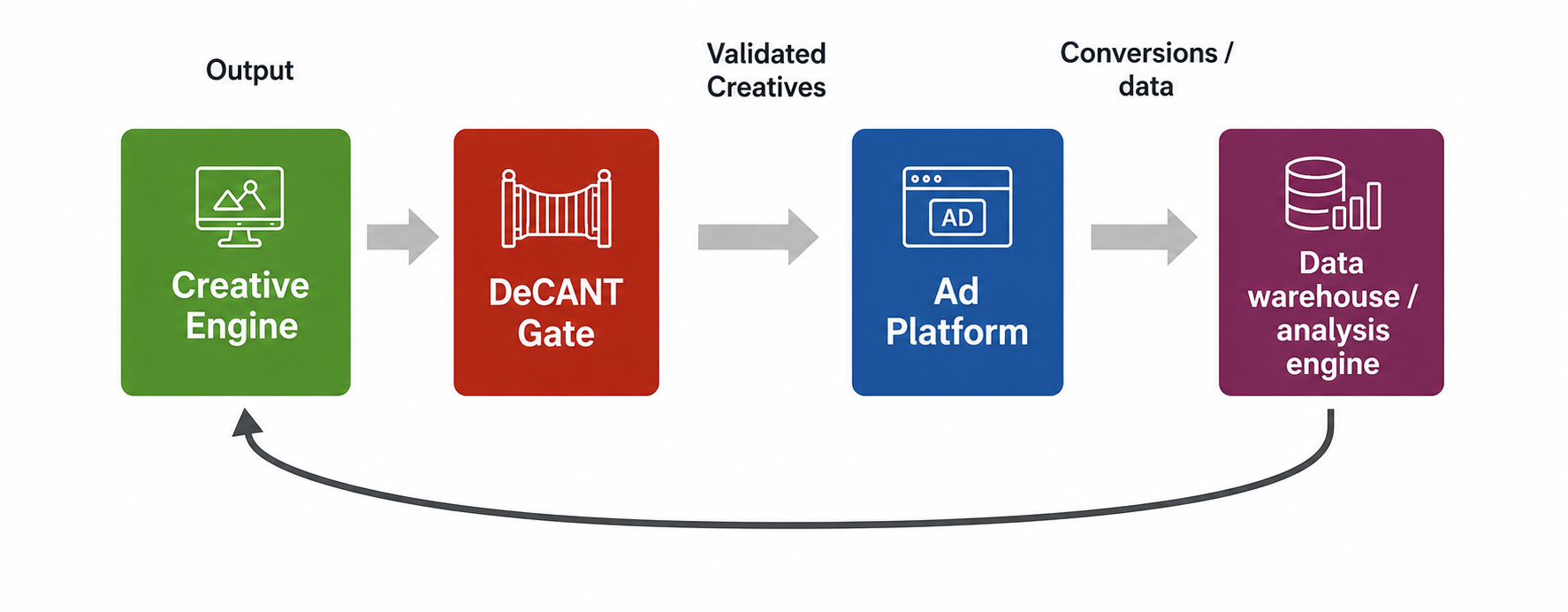
Model comparison shows that DeCANT outperforms an XGBoost baseline on both MAE and MSE, with the advantage driven by its ability to capture higher‑order interactions between context and media. A behavioral stress test perturbing weekday, season, and country variables demonstrates that DeCANT’s predictions shift more substantially across multiple contextual dimensions than XGBoost, which mainly reacts to country alone. The article outlines a practical workflow: generative creative production feeds into DeCANT, which predicts ROAS; creatives exceeding a threshold are uploaded for live testing, thereby reducing wasted spend. Training costs are modest (~$1 000 per cycle), suggesting weekly or daily retraining is feasible for scale advertisers.

Mobile Dev Memo · 2026

Mobile Dev Memo · 2026

Mobile Dev Memo · 2026

Mobile Dev Memo · 2026

Mobile Dev Memo · 2026

Mobile Dev Memo · 2026

Mobile Dev Memo · 2026

Mobile Dev Memo · 2026

Mobile Dev Memo · 2026

Mobile Dev Memo · 2026

Mobile Dev Memo · 2026

Mobile Dev Memo · 2026

SocialPeta · 2026

SocialPeta · 2025

SocialPeta · 2026
SocialPeta · 2026

Moloco · 2026

SocialPeta & Reforged Labs · 2025

SocialPeta · 2024

SocialPeta · 2021

SocialPeta · 2026

Raptive · 2026
InvestGame · 2026
SocialPeta · 2025