1 free read left. Create a free account for unlimited reading + AI research.
Create free account
Hunting for the Next Supercell
Key insights
6 takeaways- 01Game studios often achieve profitability within their first few years of operation, offering higher cash efficiency and lower capital dilution compared to typical tech startups.
- 02Strategic acquirers favor a decentralized operational model that keeps decision-making close to creative teams while providing the infrastructure to optimize retention and monetization metrics.
- 03The global gaming industry is a $140 billion market driven by 2.2 billion active gamers accessing content through major distribution platforms like the iOS App Store and Google Play.
- 04The industry is increasingly data-driven, utilizing rigorous analysis of player engagement and retention metrics to assess the viability of studios and intellectual property.
- 05Investment strategies prioritize the development of 'evergreen' titles capable of generating stable, long-term revenue, with successful breakout hits frequently yielding returns exceeding 10x.
- 06Successful studios create a virtuous growth cycle where established brands lower customer acquisition costs and attract top-tier talent, resulting in high gross margins.
Ask AI about this video
Transcript
you hi everybody my name is Alexis and I'm gonna talk about hunting for the next supercell so basically my background is I'm a game studio founder I founded a company called the Republic labs the night and sold to a store front where I'm the group chief operating officer and we're basically in the lines of 12 studios were quoted on the Stockholm stock market we make about 200 million in revenues 50 million profit so we're a mid-sized studio European studio and what we do is we basically acquire several studios yes you want me to I'm also a venture partner at a firm called atomic Oh which basically invests in
many internet startups and also game studios and some of the investments that were famous for our supercell which is done games like clash of clans or clash royale that maybe some of you have played also Rovio which is done Angry Birds and more recently we've also invested in bursa studios t-time and OBB and I'm also an angel investors I've invested in about half a dozen companies per year personally and of and quite a few studios as well so have a nice 360 view of what people look for when they're investing at seed because I invest in angel what people are looking when they invested scale because it's a venture partner Tomiko I do like the bigger 5 to 15 million checks and then what people want to buy because we're still front were buying two or three Studios every year the last studio that we acquired is the studio called kick side that maybe some of you might have heard of so how we think
about games investing and why we think this is still Europe seed and gem so first of all it's a huge market it's a super interesting market actually I read on like being behind this this thing so let me see if I can just does that work does this work now okay much okay that's this is better since I could feel stuck behind there you did very well so I mean huge huge market actually the numbers have evolved since then depending on on different resources you're talking about about 140 million so one hundred forty billion dollars market we see 2019 estimate you've got huge companies they've got a reach incredible scale you know you've got a copy like like King will have something
like 300 million monthly active unique users so super interesting market and obviously the thing that's really killing it in this market is mobile so Mobile's re doing extremely well and is definitely the fastest growing part of the market the second thing is platforms you know platforms really continue to develop so obviously the mobile platform is amazing for accelerating you've got also the messaging apps which in particularly in China are really interesting instant games is still in its infancy with other apps in the Western world but there's some really interesting skill you can achieve that the problem is volatilization clouds in the cloud games are coming with Google stadia so that's really really some interesting things happening with with platforms it's also an amazing time to get exclusive deals with some of the best platforms and get some of your games funded without even meeting your publisher so a lot of stuff happening in the market is interesting the second thing the another thing that is really interesting in this market
when you look at it from an investor point of view it is a lot of liquidity liquidity means you know start a company you saw that you make money right the average time that you need to achieve some decent liquidity with a startup first of all you know you need to be one of the one in ten companies that doesn't go past that's the first rule this is pretty hard and then one one one year one of those really exclusive clubs on average it takes you about ten years to achieve some sort of liquidity for your investors and sometimes it's even a lot longer in the games market there's a lot of exits a lot of exits and usually and usually they happen faster you know it can be from four five six seven years much faster and you have all sizes of exits it can go from you know twenty million dollars to ten billion dollars so there's no we're not talking about a unicorn in this case we're talking about a Decker corn so supercell was actually had two exits that first exited five billion two Softbank and then either the
second exit at ten billion dollars to ten cents so ten billion dollars is a lot of money so you know investors look at that and obviously King you know the Nyepi o at about five billion space a sold to supercell for a few hundred million my own company a Republic labs we sold it so front for tens of millions so you know you have different types of acquisitions that happen there and they're still front you know we were not only considering guys doing a lot of acquisitions wargaming's is on the hunt for acquisition but in our case you know we making two to three acquisitions per year and the size of the acquisitions we make range from ten million dollars up to two hundred eighteen million dollars so quite a fair big range and i talked about kicks i already so lots of liquidity fast returns so basically for atomic owe the investment in super cell gave us more than a 10x return so we
made the more than ten times our money in less than five years so that's a pretty interesting investment we don't get too many like those but that's a pretty good one and here you can see kind of a comparison between game companies and then basically tech companies and basically how fast it goes dark thing that we really like about that as an investor with games is that it's extremely cash efficient so normally when you invest in normal startup so my first startup was actually an online travel company was that was a part of the founding team this would company called last medCom it was actually one of the first unicorns in europe when there were not many unicorns at the time so I think we're only two in the course of time I think was last medCom in Skype and that's the company that we sold for 1.1 million 1.1 billion dollars after six years but for the we basically never made the profit so we kept raising money
and raising money and raising money and I think as the founders you know we got diluted like crazy I think the biggest shareholder of the founders which was not me had 3% of the company by the time we sold the company because we kept raising money in games that doesn't happen normally that doesn't happen normally you do you know you do your friends and family around you do your angel round then you do a series a maybe you'll do a series be very rare that you do a series see so you do less rounds of funding which is good for the founders and good for the investors why because quite honestly if you're doing games and within the first two or three years you haven't figured out a way to make your company profitable then you should probably be doing something else sorry to break the hard news because it's not that difficult actually to make money doing games if you've got you've got the right quality because you can generate revenue pink about a technical problem with this one
it's quite a few more signs or what okay so we just jump some slides yeah never mind so what's really interesting and here I'm kind of going to focus on Europe but obviously you know you need to remember that games in Europe were not seen as the big as a big deal until you know the super cells and Rovio came up everybody saw that you know that the really big you know game companies came either from the US and then mostly from China and this is just something to show you that actually there's some huge major major talent in Europe for games and because
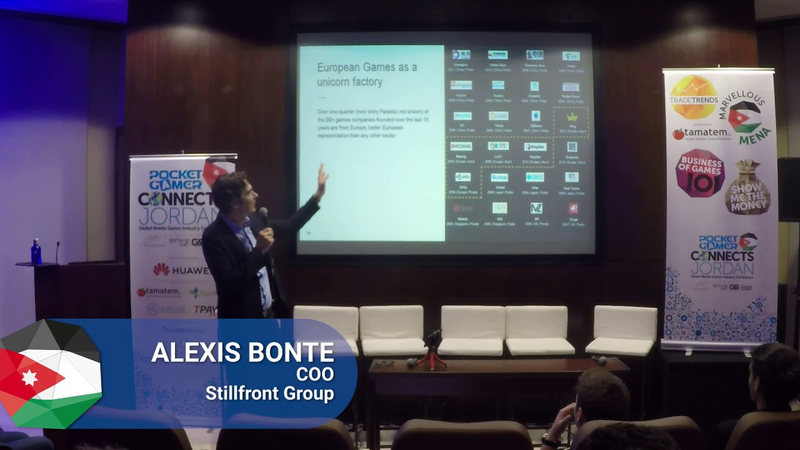
you have a history you know and that's and that's kind of a sort of thing that you need to create here you need to have those first successes and all that the reason some there's some major companies that came out of Europe in this kind of new generation new wave of games is you obviously had the ignition successes of companies like Ubisoft Jagex Gameloft and then King and then supercell and and out of these companies you have all they're kind of founders that they've started their own companies so obviously hopefully you know you'll have the same thing here in the region as well quite soon and one of the things a few people know is that games is the game sector is actually a unicorn Factory I would say that it's probably the highest in tech the highest proportion of unicorns actually came to come from the games industry and all of these companies and this is now probably I think a year and a half old all of these companies aren't game companies and they're all unicorns and some of some of these you know some of these companies you've probably never heard of and there's quite a few missing here so
if you just fix up I think paradox is done in here I think the the Polish company that got that does The Witcher is also unicorn is done in here and every I'd say every year this there's probably a few companies that that get that that basically get added to this list so here's a quick just just a quick information about Tomiko so we're I'm a venture partner so what we do as well which is quite important is we work with the founders that we funded so this is silica is the founder of super and then we work with these guys to basically help us with the new portfolio companies that we bring on board because we really are strong believers that you kind of need to basically help each other and the people who have experience helped the help the old guys in terms of self front which is my main job so front is really quite unique in terms of what we're doing so games are a creative
industry creative industries work if you give people freedom you need to have the decision-making as close to the product as possible if you look at a lot of the previous ways of the classical game companies why they do as they're very very successful at the beginning and then as they grow and they become bigger they become stuck and then they kind of stock in that franchise system or they keep releasing the same game over and over and over and over with with updates because they lose that kind of unique creativity that made them special at the beginning and that allowed them to create those really special special games right so we're trying to think how can we create like a huge huge huge games company but still keep that entrepreneurial side that kind of that that uniqueness so what we did is we decided okay what we're gonna do is we're gonna do an alliance of studios now we're not going to integrate those
studios we're not gonna tell to those studios this is how you have to do things we're going to keep all of the decision-making at the level of the game teams within the studios and within the studios and actually I remember when I was speaking about this to Chilika from supercell it was saying oh you're doing the same thing we're doing with ourselves where we know we're saying you know the cells decide you know the game teams decide everything they get down with the with the games and then we just help them out except you're doing that a bigger scale with several studios so this is basically what we're doing it's very hard to do but we really think that this is a model for the future and this is kind of and one of the and we actually have a studio here in the MENA region which is called Babel games I'm sure some of you know and the proof that this is a very successful model is for example in babble games that's a studio that basically has grown by almost 10 X in terms of revenues since they've joined the still DC tech join still front so what why why again
is gaming so so so incredible first of all there's 2.2 billion active gamers so whenever you're pitching or were you thinking about why am i doing games why am I in this industry and why is this industry interesting for investors is right now it doesn't matter where you are whether you're you know in Paris in Amman in Dubai in London you're building products that can be played by 2.2 billion people you have access to that amount of people and that is pretty unique and that is pretty special of course you need to have the skill sets you need to have the talent you need to have the experience but how many businesses are there that you know 5 or 6 people can start and then you have this kind of reach so this is really interesting is that I'll just reach the second thing is the scalability it's just how fast you can scale a product so
it's one thing to be able to reach you know billions of people but the other kind of challenge is how can you make sure that you get a product that that your product you know will still work when it's played by you know by by so many people on the ground the great news is in the games industries like many people you know you can use engines like unity you can use engines like unreal you have lots of back-end solutions to basically scale you can use if you do using you know yield multiplayer you can use photon or engine so there's a lot of tools out there that you don't need to develop yourselves to basically scale and I remember when we were doing last-minute comm one of the reasons we're losing so much money for so much time is we had to have our own server farm you know you needed so many more things to own yourself to scale that you don't need anymore so that's a big difference another thing is the rollout speed I mean you put your game on Google Play you put your game
iOS and other in Asia you pretty have you've got pretty much the world covered so it's two releases and you've got the distribution worldwide maybe except China so that's you know that's pretty unique and you know and you don't need the you don't need the local presence you know again you can do everything with a you know five people six people team in a man or in London or somewhere else that's quite unique second thing is the engagement potential as you know games are incredibly engaging people spend a lot of time on games and it's just it's just beginning and it's growing and growing and growing although it starts started kind of plateauing right now with the release of other forms and instruments a particularly popularity of things like Netflix and prime video and I think it's gonna continue to basically I think the growth in the number of hours spent in games
actually gonna start being challenging by these other forms of entertainment that you now have in your mobile devices so we'll see Natas Asians there's we cannot you know basically underestimate the potential of in-app purchases and what that's done to the industry and that that's been transformative of course it's lots of people you know there are premium lovers and they say you know games that Davina purchases are not real games real games are only premium games and all that I respect that thought but the customers don't care and they're voting with their wallets and their money is definitely going to free-to-play so very very powerful models there and then of course advertising you know we've all seen the wave of our casual games which by the way is going down and which and that's made possible by basically the advertising revenues there so there's lots of lots of ways to basically monetize now beyond just selling your game for 50 or 60 bucks or ten bucks the margins are amazing I mean if you
think about it okay we have to give if you're using if using Google and Apple you have to give them 30 percent of what you make but still you know you know your hosting costs if you've done your deals walk really low you've got incredibly high margins tell me how many businesses have gross margins of 70% or 65% on their products and then just eat and then and then basically you know if you're if you're selling in-app purchases you know that sword that one of your you know one of your graphic artists you know develops in you know in two hours you can sell it millions and millions of times for you know if you're for a few cents a pop you know that's incredible margins so I think one of the one of the people at Babel was saying you know when you have a game that that works he's dying having a money printing machine and it is it's true of course you've got to get there but it's true then our thing that we love as investors
and I love as an investor in games is they're highly data-driven yes it's a creative industry yes you have to know what you're doing in terms of in terms of you know the experience of creating really fun games and interesting games and all that but also you have so much data that allows you to know how it's working what are your KPIs what's the retention so it's pretty I would say easy to assess the potential of the game and how it's doing so that's another thing that we were like but yes there's a lot of competition but as an investor actually we actually like the fact that it's a very competitive market because then that means that you can see who's emerging who's coming up on top and that's the people you invest in and if they manage to come out on top in a very very competitive market then that means that they must be really good I'm gonna skip through the metrics because you guys know this and and and it changes but obviously as an investor key things that we look at these metrics of course they're different whether you were
casual game or a mid core game or hardcore game core gamer but we look at that but most important and it's always true these teams and teams are the critical elements that we look at when we're doing a game investment we look obviously a technical talent as well very carefully and then it's very important also to make sure that we have people who are creative risk takers I'll just stop this so in conclusion because I'm out of time another big advantage that investors like investors like to invest in things that are defensible and the thing in games is once you once you're winning once you have that huge IP once you've got that ton that's got those two or three games that are long worldwide one you have a clash royale or a game like that then that means that you have access to the best talent because everybody wants to work for your studio that means that your CPI's are lower because everybody knows your brand that
means that that also impacts in your on your KPIs then impacts on everything so one you kind of emerge to the top it's a very very defensible position and that as an investor that means that your investment becomes more and more valuable so that's another reason why games are super interesting and that's all I have time for so thank you very much I don't know if you have time for questions I think we don't okay any questions yeah thank you for the presentation what kind of characteristics you are looking for the development studios if you want to acquire a studio for example what are you looking for a storefront or as an investor only okay so it's still France very simple so still front we are looking for studios that have teams the years of experience that ideally have a few games that are really launched and
out there and generating what we call what we call with our particular we call evergreen games so games that people will play for years and years and years and years and generating basic stable revenue because the reason we're an interesting investment for the stock market is we're twelve studios were 36 games so we are very predictable returns and for us to have a hit game is just a cherry on the cake we don't need the hit game and that's what markets and investors have traditionally hated about the games industries they keep telling you oh it's just a hit driven industry so we can't really predict so what we do differently is we gather together a lot of a lot of studios that already had medium or big hits that there basically are still continuing to run and then by basically making them part of the wider combination of studios we increase our chances of their next games to be more and more successful and you also give them the ability to scale the existing games that they have that are successful to being even more successful so that's so far still front we look for medium to
large sized studios that basically to have ever existing games an ideal our profitable and we are particularly interested in drawing expansion so right now we have a lot of strategy games and we're very interested in casual games and that are evergreen as well to kind of expand the portfolio as an investor great teams with a good track record and people I like working with thank you very much thank you [Applause]
Summary
The gaming industry represents a massive, high-growth global market, currently valued at approximately $140 billion. Driven primarily by the rapid expansion of mobile gaming, the sector offers unique advantages for investors, including high liquidity, rapid exit timelines, and significant scalability. Unlike many other tech startups that require constant capital injections and suffer from heavy dilution, game studios are often highly cash-efficient, frequently achieving profitability within their first few years of operation. This financial stability, combined with the ability to reach a global audience of 2.2 billion active gamers through streamlined distribution platforms like Google Play and the iOS App Store, makes the industry a compelling target for venture capital and strategic acquisition.
Investment strategies in this space generally prioritize strong, experienced teams capable of creating "evergreen" titles—games that generate stable, long-term revenue. For venture firms, the goal is to identify studios that can navigate a competitive landscape to produce breakout hits, which often yield returns exceeding 10x. For strategic acquirers, the focus shifts toward building portfolios of profitable, mid-to-large-sized studios. By maintaining a decentralized model where decision-making remains close to the creative teams, parent companies can foster innovation while providing the infrastructure necessary to scale existing titles and improve key performance indicators like retention and monetization.
The industry is increasingly data-driven, allowing investors to assess the potential of a studio or a specific title through rigorous analysis of retention metrics and player engagement. Once a studio establishes a successful brand or intellectual property, it gains a defensible market position, attracting top-tier talent and lowering customer acquisition costs. This creates a virtuous cycle of growth, transforming successful studios into "money-printing machines" with high gross margins. Ultimately, the combination of creative talent, technical scalability, and data-backed decision-making positions the gaming sector as a premier "unicorn factory" within the broader technology landscape.























Comments