Video game economies function as complex systems for managing the flow of resources, such as currency, experience points, and crafting materials. The primary purpose of economic design is to shape player behavior, dictate the pace of progression, and introduce meaningful decision-making. By balancing the generation and consumption of resources, developers can create engaging gameplay loops while mitigating the risk of exploits or tedious grinding.
The framework for these systems consists of five core entities. Taps generate resources, incentivizing specific player actions like combat or exploration. Inventories provide storage, with capacity limits often forcing players to prioritize essential items. Converters facilitate the exchange of resources, such as spending currency on gear or trading materials for upgrades. Drains permanently remove resources from the system, which serves to balance power accumulation and introduce risk. Finally, traders act as independent entities that buy and sell goods, often creating complex puzzles related to supply, demand, and market fluctuations.
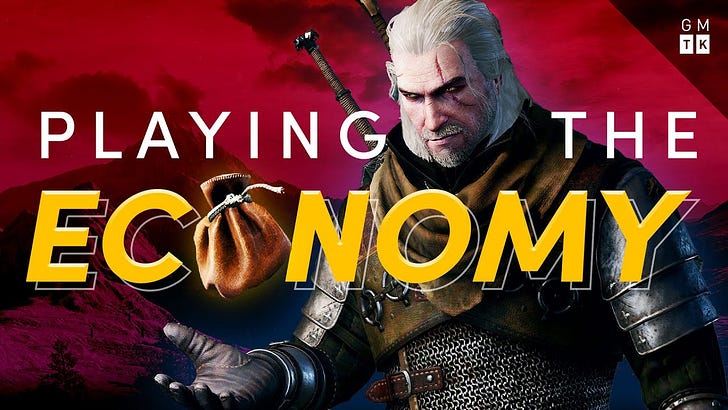
Effective design requires careful calibration to avoid negative feedback loops or unintended exploits. For instance, developers may implement negative feedback loops, such as increasing the cost of leveling up, to discourage repetitive grinding. Conversely, they may use drains to force strategic variety, as seen in games with breakable weapons. When these systems are mismanaged, players may discover exploits, such as the infamous cow-killing incident in The Witcher 3, which necessitated developer intervention. Ultimately, a well-designed economy transforms resource management from a simple administrative task into a core gameplay mechanic that challenges players to optimize their efficiency and adapt to changing circumstances.