1 free read left. Create a free account for unlimited reading + AI research.
Create free account
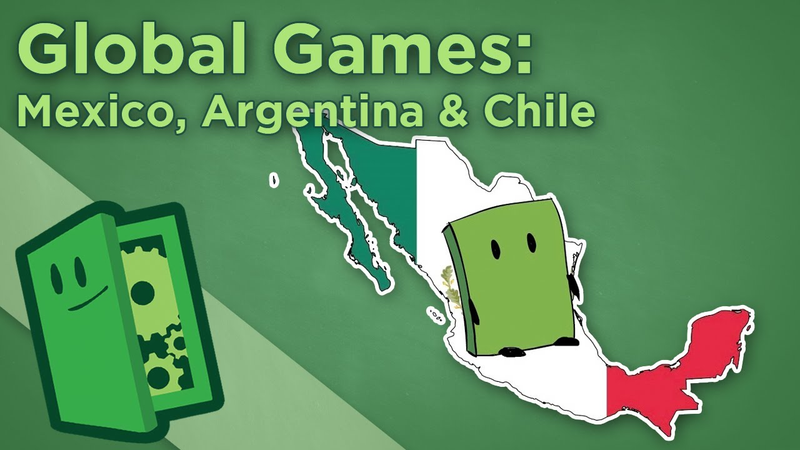
Global Games: Mexico, Argentina & Chile - The Future of Game Design in Latin America - Extra Credits
Key insights
6 takeaways- 01Mexico possesses a massive internal market of 116 million people, but its growth is currently limited by uneven wealth distribution and a failure to integrate gaming into existing entertainment business models.
- 02Mexico could potentially unlock its gaming industry potential by shifting its strategic focus toward the broader, more affluent Mexican-American demographic.
- 03Mexico’s potential as a development hub is constrained by semi-monopolistic cartels that stifle competition and a lack of concentrated middle-class consumers for the console market.
- 04Brazil is currently positioned as the most likely leader for the Latin American game industry, despite significant structural and economic hurdles across the region.
- 05Argentina and Chile are successfully bypassing the need for large-scale AAA production by fostering vibrant, independent development communities that produce high-quality, culturally distinct titles.
- 06The future of the Latin American gaming sector is currently trending toward organic, indie-led growth rather than the emergence of a single, large-scale industrial powerhouse.
Ask AI about this video
Transcript
[Music] [Music] hey everybody welcome to another episode of global games we really wanted to talk about the Norwegian game scene next cuz they have some exciting things happening but since we already started talking about Latin America we should probably talk about some of the other big contenders for the Latin American Market let's start with Mexico we're going to try to be a little more efficient with how we structure these episodes so let's boil it down to the essential questions first does Mexico have a big enough market yes absolutely the internal Market in Mexico is almost big enough in and of itself with 116 million people living there but once you consider the number of people of Mexican descent living abroad especially in the very game Centric United States not to mention the Spanish speaking population in the World At Large the answer is certainly yes the market is clearly there second is the economy developed enough and is the wealth spread around enough to support a game industry this one is not as clearcut as it is in Brazil in Brazil at least we have the test case of the pirate Market which demonstrates that if we get the software
price point low enough people are at least willing to pay for Hardware James didn't spend quite as much time examining the local markets in Mexico but from what he has seen he's less certain it's clear that there is a very vibrant market for mobile games as mobile is a place where people are willing to invest in the hardware and since they have the hardware anyway they're interested in picking up games but I'm not sure that the wealth is distributed well enough in Mexico or that as a whole the populace sees consoles as a valuable place to spend a significant portion of their income while in Mexico's City this may not be quite as much of a problem Mexico as a whole doesn't have as much of its population concentrated in metropolitan areas as Brazil does meaning that you have less of the urbanized middle class willing to spend money on games granted this is anecdotal and from a criminally small data set but from James's time there for a lot of the population games just didn't seem like that much of a priority however there is another factor to consider I apologize to people in both the US and Mexico as I understand that the Mexican-American community in the US and the native populace in Mexico are two culturally distinct entities but as this is a business examination I feel this needs mentioning if you do consider the Mexican-American Community Living in
the US as part of the larger Pan national Mexican Community then this equation flips if you make the assumption that games made in Mexico for a culturally Mexican audience will have a great deal of appeal to the Mexican-American Community then the economic equation kind of makes sense from what a somewhat more rigorous data the average income of the Mexican-American community in the US is above $20,000 and if we're willing to take this as representative demographic studies show there's not an enormous Gulf between the average amount of time the average child in the US spends playing games and how much time children labeled as Hispanic do which I know covers more than just Mexican Americans but I'm working with the data I've got here so third question what about education while the Mexican education system isn't really competitive with the major game producing nations of today it's certainly robust enough to start an industry or at least it would be if this was the largest stumbling block which leads us to the National quirks and Mexico has one big one cartels now when most people talk about cartels here in the US they're thinking about drugs but the idea of cartels or semi- monopolistic Enterprises extends well past drugs in the Mexican economy in the entertainment industry in Mexico many of
the methods of distribution are locked down and competitions actively discouraged this coupled with the fact that many of the entities currently controlling entertainment in Mexico want to experiment with games but either fundamentally don't understand the business or have been turned off of games by previous unsuccessful ventures in the field makes this a very tough environment to start an industry in it's a good Market to sell into but it may be a difficult Market to develop in or as an outside publisher to reach into overall I'm willing to say that of the two possible entities to emerge as Front Runners in the Latin American Market I would guess that Brazil is substantially more likely but no conversation about Latin American games would be complete without bringing up Argentina and Chile while I don't believe that either will be the Principal Juggernaut in the Latin American Market both have very vibrant independent development scenes and will certainly have or are already having a significant impact on the cultural landscape of games Reflections about life like today I die or I wish I were the moon or the wild slapstick of Rock of Ages provide us with a unique vision of the potential of the medium we'd certainly be poor without the contributions of these countries both countries have incredibly vibrant if sometimes financially struggling Indie
communities while they may never turn out AAA titles in the way that the US or Japan do I think in the coming years we'll see more small titles out of both of these countries that show us a perspective distinctly flavored by the local culture I think both Argentina and Chile will both end up supporting a small but important development community that will provide us products that people the world over can be engaged by but are still uniquely products of those countries and those cultural environments all right I think that wraps up our look at Latin America for a little while James doesn't have much experience with the game culture in any of the other Latin American countries but if he gets to any of them we May revisit this important Emerging Market later for right now though my money's on Brazil if we're going to see games become a major industry in Latin America in the next decade it's going to come from Brazil and this may change if something shifts radically within the media cartels in Mexico but if not I expect you're going to see some development in Mexico but probably not a full-blown industry in the way we think of in the US Japanese or Korean industries of course there's also the very real possibility that no major industry will emerge from Latin America in the near future there's still a lot of stuff that needs to happen first but even in that scenario at least we'll still have the work of some of the REM ably dedicated independent groups
scattered around Central and South America see you next week [Music] [Applause] [Music] [Applause] [Music] [Applause]
Summary
The Latin American game industry presents a complex landscape of potential and structural challenges, with Brazil currently positioned as the most likely regional leader. Mexico possesses a massive internal market of 116 million people and a significant cultural reach into the United States, yet it faces substantial barriers to becoming a major development hub. While the mobile gaming sector shows promise due to hardware accessibility, the broader console market is hindered by uneven wealth distribution and a lack of concentrated urban middle-class consumers. Furthermore, the Mexican entertainment industry is constrained by semi-monopolistic cartels that discourage competition and have historically struggled to integrate gaming into their business models effectively.
In contrast, Argentina and Chile represent a different model of industry growth. Rather than aiming for the large-scale, AAA production cycles seen in the United States, Japan, or South Korea, these nations foster vibrant, independent development communities. These regions are already producing unique, culturally distinct titles that contribute significantly to the global gaming landscape. While these countries may not emerge as the primary economic juggernauts of the region, they are expected to maintain a steady output of small, high-quality projects that offer diverse perspectives and creative innovation.
Ultimately, the development of a robust, full-scale game industry in Latin America remains contingent on overcoming systemic economic and structural hurdles. While Mexico’s potential could be unlocked by shifting its focus toward the broader, affluent Mexican-American demographic, the current environment favors the organic, indie-led growth observed in the southern cone. Regardless of whether a major industrial powerhouse emerges in the next decade, the region is already establishing a meaningful footprint through the dedicated efforts of its independent creators.






















Comments