ArticleGamesBeat
Global Gaming Workforce Growth Analysis: North America Trends
1 pages~11 min full read
Key insights
5 slides
The headline number
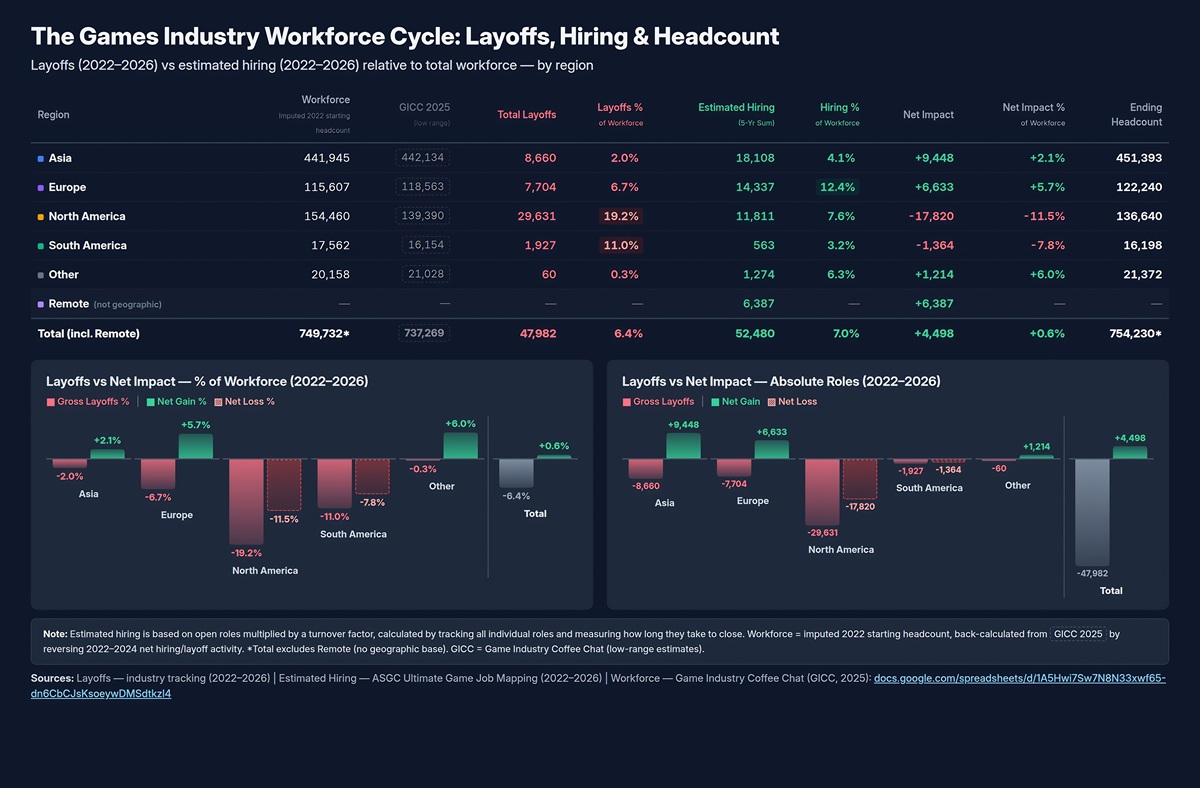
Global gaming workforce grew 0.6% from 2022 to 2026.
The total workforce increased from approximately 750,000 to 754,000 employees.
North America decline
North America's gaming workforce shrank 11.5% from 2022 to 2026.
The region lost 19.2% of its regional staff during this four-year window. Jobs redistributed toward Europe and Asia.
11.5%
North America gaming workforce contraction from 2022 to 2026
- Regional staff lost
- 19.2%
- Europe loss
- 6.7%
U.S. role migration
U.S. open gaming roles migrated toward the Northeast.
Open roles moved from the West, South, and Southwest toward the Northeast. The Middle Atlantic and New England regions showed the biggest gains in job share.
+14.1pp
Middle Atlantic gain in U.S. gaming job share
- New England gain
- +11.3pp
Hires versus eliminations
Roughly 52,500 new hires offset 48,000 eliminated roles.
The industry experienced roughly 52,500 new hires from 2022 through 2026. Approximately 48,000 roles were eliminated globally in the same period.
Slower expansion
Growth of 0.6% over five years is far below prior rates.
The industry previously saw 25% to 50% growth every five years. The current 0.6% growth creates a bottleneck for new entrants.
Slower pace. The industry's growth rate of 0.6% over five years is significantly lower than the 25% to 50% growth seen every five years previously.
1 / 5
Ask AI about this report