1 free read left. Create a free account for unlimited reading + AI research.
Create free accountArticle Breda University of Applied Sciences
1 free read left. Create a free account for unlimited reading + AI research.
Create free accountArticleBreda University of Applied Sciences
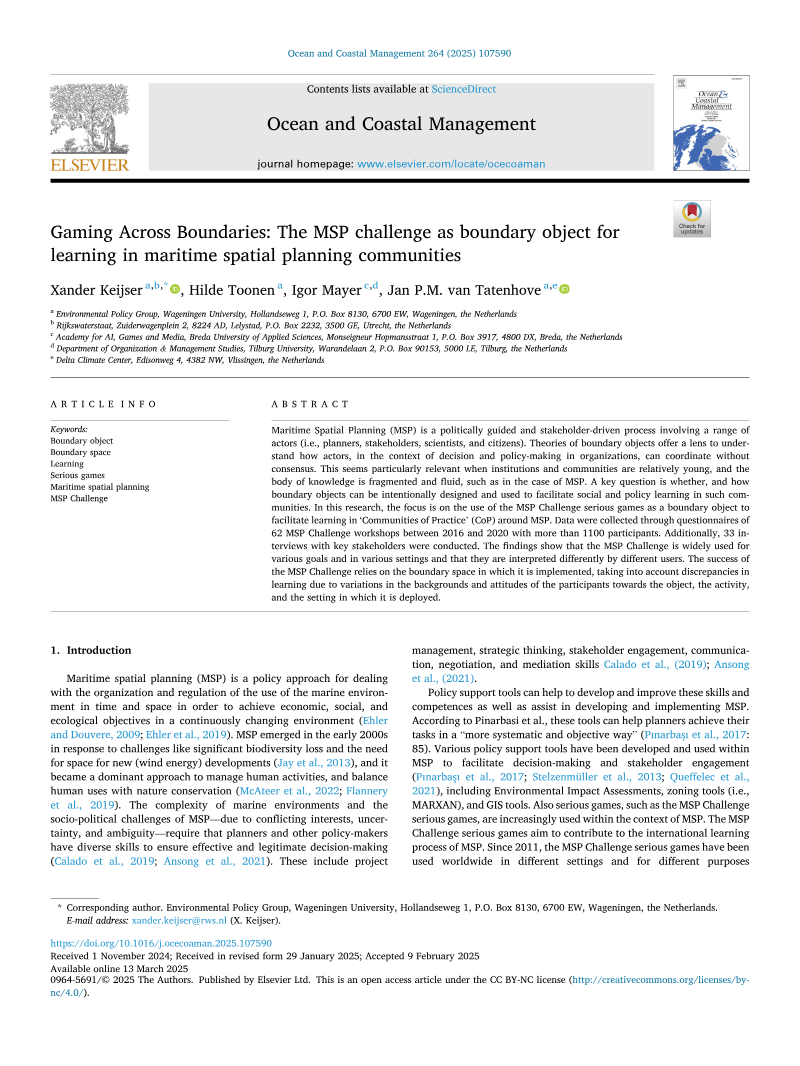
The study examines the MSP Challenge games as boundary objects that support learning in maritime spatial planning.
The MSP Challenge serious games are examined as boundary objects that support learning in maritime spatial planning (MSP), with the central argument that their effectiveness depends on the interplay between the game object, the activity design, and the boundary space in which participants interact. The study is a mixed-methods qualitative case study of two variants, the physical board game and the digital Simulation Platform, which replaced the original 2011 role-playing version that ended in 2015. It draws on 62 workshops conducted between 2016 and 2020 involving over 1,100 participants, including 935 questionnaire responses and 33 stakeholder interviews, with workshop observations supplementing the data.
Across the board game workshops, participants generally reported high enjoyment and improved understanding of MSP, with MSP Global 2030 sessions scoring highest. Outcomes, however, varied with group size, workshop duration, facilitation quality, and participant background. Organizers reported tangible effects, including workshop insights feeding into policy reports and stakeholders gaining a clearer sense of their roles in planning processes. The most common participant criticism concerned the omission of social issues and the lack of detailed data. Simulation Platform workshops, held mainly in educational settings, scored higher on understanding and enjoyment, though the authors caution that comparisons are constrained by the platform's ongoing development and differing contexts.
The findings indicate that the board game fosters intuitive interaction, while the computer-based platform can hinder communication for some participants, and that longer, well-facilitated workshops with preparatory content produce the strongest learning. Roughly 75% of post-game survey respondents reported sharing their experiences with colleagues, yet the study cannot establish whether this translated into organizational or policy-level learning. The authors thus conclude that the games advance individual and social learning effectively, while evidence for broader institutional change remains limited.
Breda University of Applied Sciences · 2026
Breda University of Applied Sciences · 2026
Breda University of Applied Sciences · 2026



Breda University of Applied Sciences · 2026
Breda University of Applied Sciences · 2026
Breda University of Applied Sciences · 2026



Breda University of Applied Sciences · 2026
Breda University of Applied Sciences · 2026
Breda University of Applied Sciences · 2026
Breda University of Applied Sciences · 2026
Breda University of Applied Sciences · 2026
Breda University of Applied Sciences · 2026
European Conference on Games Based Learning (ECGBL) · 2026



European Conference on Games Based Learning (ECGBL) · 2026
European Conference on Games Based Learning (ECGBL) · 2026