1 free read left. Create a free account for unlimited reading + AI research.
Create free account
Games industry consolidation and acquisition strategies
Key insights
7 takeaways- 01Acquirers prioritize studios that demonstrate strong performance metrics, specifically targeting those currently in or nearing the soft-launch phase.
- 02Investors favor studios with hyper-focused subject matter expertise and mature management structures over those chasing fleeting market trends.
- 03Studios must maintain a clear command of their performance data and strategic narrative to effectively communicate their value proposition during formal acquisition discussions.
- 04Successful integration depends on cultural alignment and the retention of founding teams, as buyers increasingly aim to preserve creative environments rather than simply absorbing assets.
- 05Developers should initiate long-term relationships with potential partners well before seeking capital to establish the trust and transparency required to streamline the acquisition process.
- 06In an environment of frequent platform disruptions, studios should prioritize partnerships that offer long-term strategic value over those providing only immediate capital.
- 07Acquisition valuations in the gaming industry typically hover around 10x EBITDA, though final figures fluctuate based on growth trajectory, IP uniqueness, and strategic synergies.
Ask AI about this video
Transcript
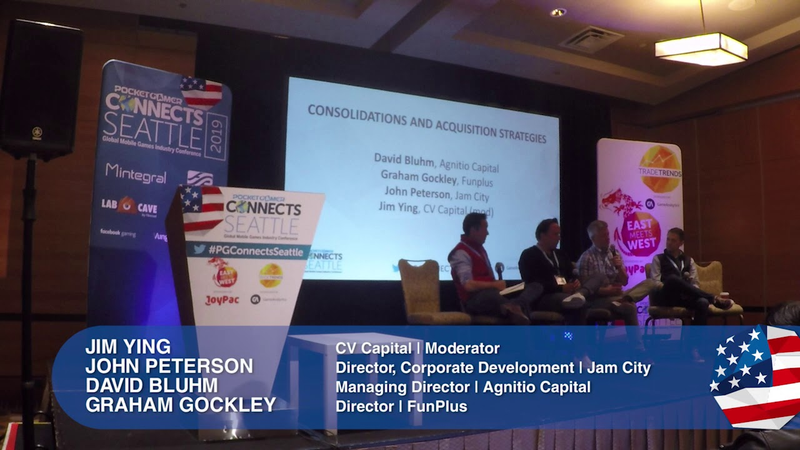
thanks everyone for making it so I think we want to have a pretty free flow conversation we'll have some Q&A time at the but I've got a couple of questions prepared you can start out with a round of intros yeah hi I'm John Peterson with Jam City based in Culver City California we started in 2010 and I grew from a super small company now we're over 700 boys and yeah looking for great opportunities here and if you guys see our coffee cups that's us so not saying the coffee is gonna be good but the cups Rock free
product placement here alright my name is David bloom I come from Seattle I was born in Seattle so that makes me kind of unique around here I guess but also came from game production game studio several of them starting in 1999 and most recently with wargaming company called WD sales her locally before that company called z2 which was acquired by King so have a little bit of a background in building and prosecuting and publishing games but working now in the investment banking area helping Studios find good solid strategic and financial exits and I work with a partner in London named Shum Singh and so we both have a kind of an extensive background working with game companies sounds good my name is Graham gawky I work with a company called fun Plus for those that
don't know we're actually a pretty interesting company that was started down in California but that has the majority of our development team over in Beijing but we build games for the West so we're kind of a very hybrid institution I'm actually representing the investments and acquisition side of the company while we make mobile games we actually have a lot of investments in other game studios eSports teams and a couple of investments in digital media as well I got started in games doing consulting for companies down in San Francisco and I spent a lot of time up here with Microsoft and some large gaming deals as well and yeah excited to talk about consolidations and acquisition stuff all right perfect my name is Jim being I'm with CB Capital we're also a Shanghai we're investment bank based in Shanghai we work on later stage investment in M&A deals the transactions that you guys might be familiar with we did a raise for behavior interactive and then we also worked on the Apple event transactions but let's jump into the Q&A so
appreciate the intros can you tell the audience a little bit about what your company is looking for and why that is what are the market trends that are driving that prioritization of targets yeah so our company is looking for anything it can make us bigger we're really good at puzzle and we have that down pretty well so if we can take a company that's that's working with puzzle that might have might not have the kpi's that it needs we can we can help them out with that and you know getting deep into level tuning and whatnot if we have to but it's something that adds to our core which is you know the puzzle or cookie jams are number one game and panda Popat publish shooting so we're really really good at that we have you know close to 40 million Mau so but
then also we need to diversify so we're looking for other great opportunities something that we can't do ourselves so we acquired two years three years ago TinyCo because they were doing builder games and you know we don't want we don't want to do that ourselves and so we look for great opportunities like that and then they also had the Harry are Harry Potter ID which was which was great for us so diverse diversification for us is is key you know we acquired a bingo pop from You c'n last year we acquired Disney emoji blitz last year we acquired studio called brains out of Columbia and all of these studio we're doing things that we couldn't do but it added to you know the portfolio of our company for diversification and that's that's we grow a lot through acquisitions but it's super strategic on how we look at things a lovely tone is
not a quick quick follow-up question so in terms of that versification it sounds like you know it is some story based games match three but why not into mid core or focus on geography in terms of diversification yeah so mid core is is something well that we will certainly look at I mean we've looked at you know mid core puzzle if you will the small giant we looked at them you know very early on we have a game from brains out of Colombia that's more of a clash Royale type of games gonna be it's super funny it's got great humor so yeah we we would certainly look at that but uh and this is why I always talk to you know my buddy David and and other ignition capitals around the world it's just it's a small ecosystem and and there's always just incredible companies out there and it's just a function of will they fit does a culture fit you ask
one other question regarding diversification as far as geography we just acquired two three one play studio out of Berlin and they're doing mahjong and ready to come out with a solitaire game too so it's again that's something that adds super super well to our core player group those those games are fantastic for cross promo Dave all right so we're we work with John and Graham and Rob and the companies are trying to expand their build as a business and what we look for is business builders ourselves entrepreneurs that have a passion for building a business and my partner and I are a two-person company where not looking to scale or become bigger we enjoy working with small independent
studios entrepreneurs and I describe my role most accurately as life coach as really sitting down and figuring out what they want from their business what their management team wants how they want to prosecute the rest their lives and put their talents and professional skills to work and find that match and find the right kind of a fit going forward for them whether it's keep building their company and just help them move it that along or whether it's find an acquisition partner that can scale them faster and so that's actually most of the work is figure out what you really want and how you want to structure it and then we go out and try and find which company out there might makes a best and and most positive fit for fun plus the outcomes that we're looking for are just large commercial success I think the team for private company and the founding team has been lucky enough to build two kind of
billion dollar businesses back-to-back basically they built a casual game studio in California and then moved to Beijing and then they sold that to a large Chinese game company for a billion dollars back in 2016 and now they're running the Kings Group which is a large kind of strategy game studio that has two of the top 50 grossing games in the strategy genre on mobile that are doing very well and that those are at a run rate of about a billion dollars they're really looking for teams that can kind of drive those really large commercial successes that's mostly around mobile we just think that's a very kind of easy market and there are a lot of geographies that themselves can drive million-dollar outcomes North America Europe Korea by itself China by itself Japan by itself but then we also look at things outside of mobile gaming so we also our investors in eSports we just think that's going to be an emerging market that's going to be very successful once it scales once we figure out how to monetize that audience and then just other parts of digital media
so there's streaming and game streaming and live streaming and other kind of ways to build an audience around Digital Entertainment that could be very successful all right thanks so for developers that either are in these areas that you guys looking for or maybe for other folks that would like to get on your radar how do developers or companies that are looking for strategic partners either investment or a question how do they get on your radar yeah I'll kick it off conferences like this are just a great way to meet people I think overall building your network as soon as possible and starting to think about that even if you're not directly out looking to fundraise or looking to sell the company meeting people like like David or some as early as possible is just great and those vacant investments will build dividends over time once you've know somebody and then a couple years down
the road when you are contemplating a transaction or some other type of transformative event for your company your team then you're already kind of well plugged into the overall environment so just encourage you to talk to as many people as possible and network as much as possible I mean it's our job to find you where we're supposed to be knowledgeable what's going on we ask a lot of questions we look at a lot of metrics and screens and you know for work we're not gonna on your door and ask and you know what you want to do with your company and how we might be able to help so we're certainly visible at most these events and conferences we host client dinners to get you kind of comfortable with the major publishers and strategic investors out there and help you through the entire process including getting you ready so our job
is to find you the more visible you can make yourselves I guess the easier it is than us but that's kind of our our responsibility find you yeah and I agree with both you guys industry events are super key it's a small small small you know group of group of companies that are here and and we always go to you know the games come as a world that GD sees of the world but these small ones these intimate ones are really important if you want to get in touch with us and talk to us because we have a lot of time GD sees crazy so that's that's more difficult but I'd say if you have something you know LinkedIn's easy I mean linkedin's we all look at LinkedIn and if you don't you should but I get pinged um LinkedIn quite a bit and there's amazing amazing opportunities that come from that and that's that starts the process so just being at the
events LinkedIn and just knowing who the key players are and getting known Thanks so in terms of timing for the companies what's a good time to start reaching out and start having these conversations yeah I would say for us in order to gain our interest at least have something that is in soft-launched are about ready to go to soft lunch so we can have some KPIs to look at i mean it's if if the gameplay is great and we can get a build perfect but then we want to keep the momentum going so if you're six months from a soft launch or getting some KPIs that are really meaningful it's probably a little bit too early good to get on our radar but if you want to get the momentum going it's just hit us hit us when we're ready cuz we get pinged by
you know hundred thousand plus companies a year honestly and it's it's important to have something that's that's tangible too if you have kpi's do you have his monetization gonna kick in if monetization is not gonna kick in for another three months then we got away and so it's just be ready and know your KPIs when you when you're coming out what your gameplay is and you know what you need to aspire to and if you have you know DS thirty that's supposed to be 15% in Europe one or depending on a different type of game it's supposed to be 6% and you're at one you got you need to work on it and so you just need to know your game know your KPIs no one to talk to us you know this is one of those areas where there's a lot of great device and
counsel and it's not usable a lot of people find themselves looking for either money or exits at the worst possible times because they got their businesses into a bit of a pickle or a challenge you've often probably all heard the the notion you want to raise money when you don't need it well that's the last thing from your mind when you don't need it so you do have to get a little ahead in terms of planning your business and I come from tech beyond gaming and the notion is you're always raising money you're always spending a certain portion of your time making sure your company has the right partners the right financial supporters to grow your business not knowing exactly when you might need to use them but it's an important part of the job of any company leader in terms of vision and capital
and talent that's the job of a company leader so that capital has to take up a certain percentage of time whether you need it or not you don't know sometimes when you're gonna need her or when a growth opportunity is going to cause your needs to change so you just need to have relationships with people that can help you that are good fits and and synergistic with your business so so the answer of timing if it's raising money you should be a portion a certain amount of your time always to making those relationships and helping them understand your business and when they need to help it you sometimes don't exactly control that timing we've all had games that didn't meet our expectations and that's the wrong time to have to go and raise capital after you're going to John or Graham with your metrics and they meet your expectations in terms of exit you know again back to the life coach comment that's you and your management team the senior people your co-founders
your friends and family that probably helped fund the company all have to have a consensus of when needs to happen with the company and whether it's got the right resources to grow on its own or it could benefit from being within a larger organization with more global or bigger machinery to grow the company faster and so that's a constant evaluation needed to go through with your team and yourself to decide when it's time to seek a partner to grow the company faster or bigger yeah I think the only thing I'd have to add is the the process does take between three to six months I would that's what you should be preparing for but if you're doing it well it can take as little as two to three weeks kind of to give an account or give a recorder on there to give a counter optimistic example if you're a studio that talks to John or myself you've been talking to us for a while the games on out yet the games only in soft-launched let's say you get that great first cohort and the game looks
exceptional you you've already had that conversation with us we already have a good background on the team and the management that's behind it and if you're beating your KPIs you're doubling the monetization goals all that stuff then that conversation has basically already started so you've kind of shortcutted that whole three-month cycle now you know who you want to be talking to you already have the partners lined up and you can kind of start talking terms as soon as possible whereas kind of going out and and and talking to as many people as possible that's the process that could take two to four months if you have all that kind of homework already done and then you are in a position to either sell or look for investment then you're then you were already there yeah - that is definitely it is a conversation between the seller or the company looking to raise and the buyer investor and the entrepreneurs out there building the companies they can you know build a great product they can drive the revenue but just as important
is for the investor our buyers out there like John and Graham what is it that they're looking for understanding the the ups and downs of the buyer market and who you need be who you need to be talking to at any given time alright so then can you talk through for the transactions that you guys have done what were the one or two things that caught your eye for these teams and I can we'll get to some of the surprises later on but what are those are things that initially caught your eye or you thought hey this is a team that we should dig into yeah for us I think it's always it's super exciting when you talk to two companies or teams that are so focused and so excited about their one game they might have multiple games that they've done but now they're just like hyper focused they're gonna put these other ones on the side for now and just focus on this one game if we get super excited about that game we want them to be really excited about that game so I think especially with how
how expensive you know CPI's are now and and in you a and if they have four different titles going and they have one great one but they want to make sure all these other ones stay it's just like that's gonna be you know how are they going to get the funding to keep all those going if we don't step in so if they're gonna if they have one game that's absolutely knocking a park and say soft-launched that's where it would be really exciting for us to get involved and that's that's what we've done we've our last couple ones they're like no we just want to do this two three one play out of Berlin they were just their team of eight super hyper focused on mahjong and solitaire and that's all they want to do they're very successful in their in their past businesses past games that they've developed but that's all they want to do and just be super super tight and good at that one in that one vertical if you
will and so that's what's really you know gets us excited immediately and obviously the kpi's show and and they're hitting their numbers it's um it's pretty easy for us to say yes yeah I think specialization definitely in terms of the competitive market of gaming right now is something that you should be be focused on I think what John's trying to say is like the the best bingo game or the best mahjong game out there is probably going to be built by somebody who's been building mahjong and bingo games for last ten years that's just part of though the way the markets going and the way that the audience is really understanding the quality of those games I think the only other two points I'd add to that is experience so again if you are somebody that has been building mahjong games for the last ten years you probably shouldn't go try to build a Forex battle game and just right off the bat and then the last one I would have is just
understanding where your innovation is I'm think I'm seeing a lot of decks that are trying to kind of point towards different market trends and trying to kind of hop on them without understanding what really the customer motivations are but behind different innovations in the market so if you look at successful titles like a small giant that have kind of come to market and you just think that it's a mash-up of a puzzle and an RPG it's a little bit more complicated than that so kind of better understand what the innovation that team has driven and what you are planning to drive in that market as opposed to just kind of following the trends kind of really deeply study the market and understand what you want to do and how the how the customer is gonna react to it I will add that this industry's matured and it's no longer as attentive to component acquisitions where they're
just buying you know ability to build a strong core game loop or a particular high efficiency LiveOps team that there's we have buyers that will buy based on pure metrics financial metrics so they want adult leadership if they have a studio that they feel is well led by mature management and it consistently produces profit they're not as concerned about how profitable it is as they are as how stable it is because the history of the game business is that a lot of what chaat wonders and people that built a great game then had trouble expanding into multiple games or multiple platforms or prosecuting their business globally what-have-you teams that can build those and manage them efficiently have buyers out there because they are building on financial metrics and they're making offers to buy companies strictly based on kind of programmatic
financial multiples and they value stability more so than some single competency that they they might be weak on so for these deals at half happen you know people see the the coverage in the news and it's very exciting for those founders and those employees but I think what they don't see is they all the transactions and all the conversations out there that happen in the background where an end result doesn't happen can you guys talk to some of the deals that you guys have seen or have moved further along in and what is it that might have derailed those discussions well we built an app and you just swipe right to accept the deal and then it appears on your oh yeah I think the the biggest thing is transparency and your partners so I'll be ready to have kind of the mature conversations about how the
business is going as soon as possible in the process if you're managing a more complicated mid core game economy and you can see its weaknesses don't assume that the diligence is gonna miss it and get to the end and get in a process where the game economy is faltering mitad acquisition that's just not a place where anybody wants to be that the same thing could be said about your tech weaknesses if you've built the tech stack and you're realizing that there are some things that aren't aren't aren't doing well as far as your technical debt just be open and transparent about all that as soon as possible and I'm obviously saying this in the buyer perspective but the better the more trust you gain in that process by being transparent the more kind of respect will be given back to you and more likely the higher the economic outcome for everybody involved maybe so okay so on the flip side from the developer standpoint or the acquire II standpoint what are some things that
they should look out for and the conversations with the investors of their buyers in terms of their prioritization of who they want to go in there's an 80% subject matter here I think and that's the the intentions of the leaders of the company and whether they are going to fully commit themselves to a deal I mean this is the age-old challenge that choirs have as they buy teams games plans to launch games plans to live I games strategies they're all replaceable and they're all created by teams and teams are the ones that execute on those plans so if an acquire is buying a team they want to know they've bought not just the back but the heart of the team they want to know that that team is committed to the new goal and of course studios are famously probably more independent than a lot of other businesses and they have
breathed a certain amount of culture and preference on the types of games and how they prosecute them and how they communicate I think acquires have become hypersensitive to this and they are now very amenable to keeping cultures intact and letting teams drive their businesses the way they see fit and that's been a very positive change over the last few years after seeing a lot of acquires kill studios and kill their energy and kill their mojo so I think there's a win-win here but they want to know that the the entrepreneur the senior teams the people driving that business are going to be fully on board and they're willing to make the compromises to keep that culture intact but they need to know that there's a win-win there and there's a mutual commitment going forward because after all that's where the basis of their their investment ultimately is made yeah I think for us when we what David
said was you know right on the head is culture for us is so so important we want to find teams that are so hungry so passionate and they have the leaders they're gonna take them there for the next you know three to four years so when we look at opportunities finding that finding finding teams that are that hungry and that excited and that passionate about what they're doing is fantastic but the big thing for us is don't mess it up and we don't want to and we won't and if we do then we're screwing up as a team I think and that comes from the leaders in our company mainly the the two founders crystal wolf coming from MySpace he had he had when News Corp bought myspace all they wanted was revenue revenue revenue and myspace at the time was way above
Facebook way more many users and when you want revenue revenue revenue that just absolutely you know changes the culture of the company it's always like where's the money coming where's money coming from what we got at putting up more ads in more ads more ads more ads and it just you can see where it where it ended up and in the cleanliness of Facebook versus MySpace and how that that acquisition through a company that didn't appreciate culture and where they were going and only wanted one thing we've learned a lot from that and I think when you look at opportunities that are out there it's just for us culture is starts a number one and you want to make sure that the that the founders are going to be there the founders just don't want their money and they're gonna run within the first year that's a red flag for us so yeah we're basically what David said we're really really key on finding teams
that want to stay and don't want to be interfered with with by the major company coming in okay let's talk about the process a little bit so I think grandma'd mentioned down there was it two to four months three to six and let's see you it said can you talk a little bit about how long does this process take what are some of the steps that happen along the way for you guys yeah let's split it into two and let's start with a acquisition I think the first thing you should do unless you're fully experienced and might have sold a company yourself before is contact kind of professional help either agents or bankers that have experience like like David over here to help that process they just know the network of buyers out there very well they know how to package the company and they know how to kind of professionalize aspects of the pitch that you might not be experienced in so
that's what I would most advocate if you're one one to get in that path is look for people that could back and help either in a very professional capacity or in a more informal capacity to talk to other founders who have sold their companies about what they've done in the process and ask for their guidance and help and then kind of going down the full diligence process just get ready for multiple stages of questions with teams and have your financials ready have your have your kind of data and stats around the game in good working condition to be kind of audited and be ready to ask to answer questions about all of that and then as far as sitting down and negotiating terms just be very clear about what you want at the beginning of the process are you looking to again join a company and and try to build something with them over the next two four six years in more of a long
term relationship or or you can be more honest and you're really just looking for a for a quicker exit you definitely want to structure the deal terms that kind of mirror your own incentives and how you're feeling about both the partner and the economic outcome that that you want so that overall kind of process takes multiple stages but that's what I would suggest for an acquisition for an investment kind of very similar you're just going and looking out for for partners that that want to be a part of your vision and the company going forward kind of better understand what partners could bring to the table in terms of strategic synergies or strategic support on in terms of publishing or monetization and things like that and then go out and seek partners that have invested and brought those strengths the table and other deals that's what I would recommend so most Studios just aren't ready but that's good that's okay because that's our job to help you get ready so we come
in and review and assess where you're at with your financials with your metrics with your roadmap and we help you with timing but coming from operating studios we can pull out things that are strategically valuable things you're doing well help emphasize those but we will literally just help you prepare and prepare external facing material will give you absolute guidance on what has to be in a due diligence file and will literally organize everything you need to do and help you do it and we're very hands-on it's it's we're not a organization we're not trying to scale its shum and I do every bit of our work we represent you at every meeting so we're very hands-on and we like doing that and it's part of our I guess bedside manner but we will walk you through that process and sometimes you're just not ready to go out and it'll take months to prepare that we have several clients right now that are just getting prepared to start talking
to people getting their financials in order getting their metrics in guard or getting all their documentation or in order so that's a big part of our of our work or that we do to get you ready to go out so we'll help you whether you're ready or not and do kind of a gap analysis and and address it yeah I think having David's the David's of the world you know makes make our jobs a lot easier but honestly we we talked to companies if ever they don't have a clue on on how the process is started at all it doesn't matter as long as they have the passion in a great game it's a good start and so can I go from could be a six month could be a year process could be 16 18 months but you start early and just you know we help them along the way you know and then the David's will come in or maybe not and in either way it's fine so I wouldn't stress out about the
the timing the timing it all depends on where you're at all right so there have been a couple of big recent announcements and developments in terms of Apple's gaming initiative Google stadia epics pushing on their game store to compete with steam how have you guys seen and what kind of expectations do you guys have around how these initiatives will impact either the investment or the M&A ecosystem moving port I'll start from the investing side just because we're starting to feel it a little bit more in terms of the teams we're talking to it's great I think for the people in this room and for the gaming community overall there's a lot of teams that are willing to put a lot of capital into great talented game studios that's that that's a bonus for everybody in the room as far as more people seeking returns on gaming investments I think it's becoming a little more competitive if you're talking to a team and you want to be in their cap table for the foreseeable
future and Epix just going to come in and give them ten million dollar platform deal instead therefore we're not going to be able to compete on on those same terms they obviously have unfair distribution advantages as well so it's a little bit different from our perspective but for the overall ecosystem I think it's a large plus I would say just be understanding of how these trends are happening Google Apple epic and I think steam and Xbox they're all going to have their own initiatives out there Sony the make sure I don't miss any they're gonna have their own initiatives out there just be be cognizant of kind of which markets you want to play in and how you're going to do it I think all those teams are really qualified they are just very competitive and you want to make sure you're not kind of limiting your opportunities set either based upon time or the number of platforms that you want to build on so been through this many many times and made the right and wrong
decisions about you know adopting and bracing new platforms I can remember doubting Verizon was gonna ship anything with brew on it any reasonable time and walking away and having to go back on my knees and beg to get back in after the fact that was a long time ago long before we had this iPhone or smartphone I should say ecosystem so being early on a platform can really pay off or it can be too early and distract you and siphon off valuable capital and opportunity costs so these decisions have to be made carefully but it is going to disrupt and we're going to have new opportunities and so I would tell you to stay agile aware and and be able to react fast as you possibly can and these will create new opportunities I've always been some combination of a believer and hopeful in the subscription model the idea that you
can build such a great brand that people will say look I'll I'll pay some fixed amount of a month every every month and you're gonna entertain me in this case with bundles of games and so I think that the free-to-play overhang a building a game is a some massive endeavor and it can really obviously get in the way of just making a fun experience I would welcome the idea that we find a different way to monetize games than free-to-play for our communities that can now allow us to just focus on fun and engagement without figuring out how to emotionally get them to pay us more money that would be a welcome thing if we had a subscription model that stabilized the ecosystem sets that we can just focus on building fun games I'm not sure that's how it's going to turn out or not we'll have to see but I would just
these agile as you possibly can because I think there are some disruptions coming just just a quick guide I think any type of strategic money from the industry makes a lot of sense compared to just going out and getting any money you can take because they get your business I understand it and it'll probably lead to other avenues of opportunity all right so I think we've got around four or five minutes left I want to leave some time for folks in the audience to ask any questions open it up yeah yeah it's a small room well you know a lot of markets the multiples have been declining so buyers are under a little more scrutiny as to what they can
do in terms of offering multiples to you right now it's not serious but it is you know been a softening environment in most environments obviously North America has been pretty flat declining in terms of valuing game companies but Europe where it's been a lot healthier as softened as well most recently we're still advising clients that you know the the the the general area is ten times EBIT uh and [Music] getting above that you're talking about strategic values and finding things you do really well that has a great value to a potential acquire and then that again goes back to that fit finding somebody who can take full advantage of what your companies really are and can value it yeah so generally what we'll see is when folks talk about multiples it's either multiple of the top-line revenue or the multiple of epithet or net income for some of the recent Western deals you do
see in the ten times a bit dot range from a net income perspective you might see somewhere from eight to twelve eight to fourteen on the top-line revenue side maybe you're looking at two to four times now those those are pretty big ranges and we all typically ask is that you know how do I get to one side of the range versus the other I think that's where the strategic value comes into play the strategic value what is your forward-looking story generally companies are looking to acquire they're excited about the team they're excited about the track record they're excited about that past historical financials and it needs to be some forward-looking story right most companies don't want to buy into a flat or declining business and so assuming you have all of those pieces in place that's when you can start pushing into the higher range of the even multiples yeah just say it depends on where you are in the lifecycle if you're a company that's basically just starting out that's more you're looking to seek investment and that's more like an
option on the future outcome of the companies that's again more more captured by venture capital models if you're a more stable business that's been operating for a while that's more in the multiple range if you're somewhere in between those two which is you have a game that's at scale you also have a lot of tech that can be used for other games that game engine that can be used for other types of kind of risky ins other things like that that's where you kind of get in the higher multiple range but depends on where you are yeah most frustrating answer is it depends but it does it's definitely an interesting dance because these are extensive deep conversations and they always start out with you know the team and you know what are the upcoming products and the personalities but ultimately you know for both sides it does come down to a lot of times the price and you have to do that dance you have to get their materials prep to do so yeah yeah I think it just it it
really depends on you know the company and where it's at Mike Grimes said it if they've been around for a long time and they're looking for an exit and the games have been around and there's it's kind of on its downward trend it's gonna be super hard to get the 10x e but uh multiple on that but you know if they're obviously if there's a great story to tell them that more on the pipeline and something super exciting then you might get it you might even get a little more but obviously stability is important for us when we're looking for opportunities predictability but yeah we'd gladly pay more if if the opportunity presented itself John told me backstage he throws in a case of Yeti cups with the gem city logo [Music]
Summary
Strategic acquisitions in the global games industry are primarily driven by the necessity for portfolio diversification, the acquisition of high-value intellectual property, and the requirement to scale commercial success effectively. Industry leaders prioritize studios that demonstrate strong, tangible performance metrics, particularly those nearing or currently in the soft-launch phase. Beyond quantitative data, successful integration relies heavily on cultural alignment and the long-term commitment of founding teams, as buyers increasingly seek to preserve the creative environments that foster innovation rather than merely absorbing assets.
Investors and acquirers favor studios that exhibit hyper-focus, deep subject matter expertise, and stable, mature management structures. Rather than chasing fleeting market trends, developers are encouraged to build long-term relationships with potential partners well before capital is required. Establishing trust and transparency through consistent networking and industry visibility significantly streamlines the acquisition process. Developers must maintain a clear understanding of their game’s performance data and strategic narrative to effectively communicate their value proposition during formal discussions.
The acquisition process is a complex, multi-stage endeavor that often necessitates professional guidance to ensure financial readiness and strategic alignment. While valuations typically hover around 10x EBITDA, these figures remain fluid, fluctuating based on a studio’s growth trajectory, the uniqueness of its intellectual property, and the specific strategic synergies offered to the buyer. In an era of frequent platform disruptions, studios are advised to remain agile and prioritize partnerships that provide long-term strategic value over those offering only immediate capital. By focusing on operational maturity and proactive relationship management, studios can better position themselves for successful integration within the broader gaming ecosystem.