1 free read left. Create a free account for unlimited reading + AI research.
Create free account
Fireside Chat: #PlayApartTogether, not just a Campaign. It's a Lifestyle
Key insights
6 takeaways- 01The industry focus has shifted toward creating persistent, immersive virtual environments that replicate and enhance real-world social interactions before, during, and after gameplay.
- 02During the 2020 pandemic peak, some gaming platforms experienced a 50-fold increase in monthly active users, establishing a new baseline for engagement that has persisted post-stabilization.
- 03Integrated real-time engagement (RTE) tools, such as voice and video chat, are now considered standard features rather than optional additions, as users prefer them over standalone video conferencing.
- 04The #PlayApartTogether initiative catalyzed a permanent shift in gaming, moving it from competitive entertainment to a primary social platform for broader demographics, including millennials and female players.
- 05Developers are increasingly prioritizing a hybrid social strategy that utilizes embedded SDKs to maintain a consistent social graph across both in-game and out-of-game environments.
- 06To ensure user safety and comfort in persistent virtual spaces, the industry is heavily investing in moderation technologies, including 3D avatars, face filters, and real-time content monitoring.
Ask AI about this video
Transcript
uh actually we're having another fireside chat which is a play a part together not just a campaign it's a lifestyle with a since sharma from agora and celtruck alti from bunge so please welcome them first the other fireside chat is after this one so thank you great yep hey souljack how are you good how are you doing good good uh thanks for joining me on this fireside chat i'm excited to have you and and speak a little bit about you know the global trends that we're seeing um in terms of you know in the gaming industry you know during this pandemic and then post pandemic and exploring you know are these trends here to stay this you know whole play together apart
campaign is it really just a campaign or is it a future trend that we see in the industry uh staying staying longer term so again thank you for joining me and uh let's get started sounds good cool can you see my screen cool yep so uh again we're here to talk to you guys today about you know the future trends um in the gaming industry uh really around real time engagement uh we're seeing you know several different gaming studios game developers looking to add real-time engagement to you know their games for their communities to engage online um so so chuck before we dive in um you know you want to explain a little bit about yourself and uh what bunch is doing really great great stuff that you guys are pulling off there so um so hey everyone uh i'm salty uh co-founder and ceo of bunch
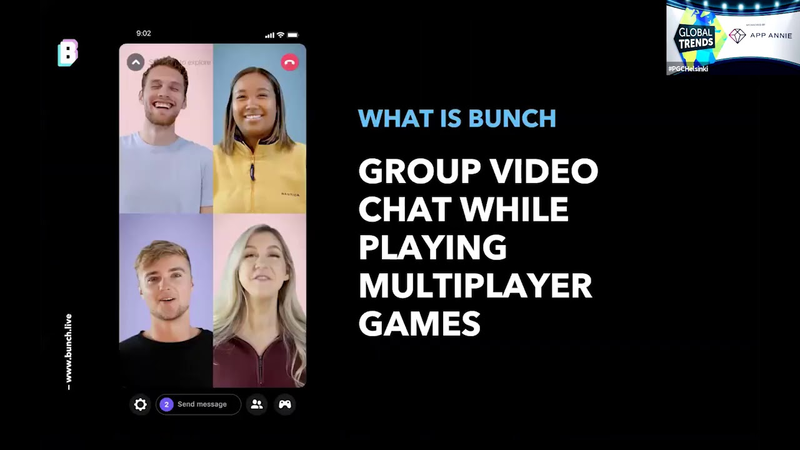
so bunch is a party app for multiplayer games it lets you group video chat with your friends and push a button to jump into any of your favorite multiplayer games it's a way to play your favorite games as if you're sitting next to each other when you're physically apart um so that's what we do cool well yeah thank you i mean i'm a i'm a huge uh personal user of bunch i play with it uh play with my friends all the time on bunch so you know if you haven't checked it out already go ahead and download it on the app store and and get playing with your friends um so as many of you may have heard right uh play together apart was you know really one of the um biggest campaigns put together by the world health organizations uh as well as several large gaming studios really to encourage people during this pandemic to stay socially connected while socially distancing um from each other right they wanted to make sure that everyone is still being able to have
that social interaction because that's one of the most important things and behaviors that you see and uh do as a human um but really you know i think what it promoted is kind of future growth in the industry whereas voice chat was you know the primary driver for multiplayer strategic games uh but now you're seeing many many social games and hyper casual games looking to add voice and video chat to allow their gaming community to you know play around and talk to each other um so at agora we saw a large increase of game titles game studios uh joined together and you know add real time voice and video chat as well as live streaming to their applications um and this trend was already really kicking off from the starting uh from even before the pandemic uh but i think really what happened was the pandemic was like the key catalyst that really changed how you know people
were viewing uh real-time engagement as actually a tool set or something that's ubiquitous across several game titles and uh necessary to provide their game studios so um we're curious to hear from you soulcik what are the trends that you're seeing with your audience in uh you know during covid um so one thing that we saw that was interesting is that our audience grew quite significantly so since the beginning of march our monthly active users grew by about 50 times like 5-0 and not only that but our audience i would say expanded from a more hardcore gen z gamer audience to more mainstream millennial and more female audience that was i think more interesting that is so with the kind of significant audience expansion uh our user base needs to be i would say
slightly more male uh now it's actually 60 female which is i think interesting as well awesome awesome and do you think um really the the growth of bunch during this pandemic phase was um attributed to that video component and you know that real social layer that you guys provide on top of the gaming experience how big of a part did that have to play i think video is definitely one uh but i basically look at it as a larger like how can you kind of simulate the experience of being together anytime anywhere and like i think video is a significant aspect of it but another aspect of it is basically can you create a way that makes it very very easy to get together like can you enable more spontaneous interactions totally so that i think is like another aspect of it as well totally totally and really even you know even though some of the pandemic uh restrictions are slowing down in some of the countries um at least at agora we're seeing still
many game studios and developers are really trying to you know continue adding rte services the interest is still very high is this a trend that you're seeing with your you know end users is is you know growth slowing down or you're still seeing many you know users jumping on and still being able to converse with each other even though the restrictions are easing up i mean we're still growing and um engagement is not that different uh so the thing that we notice is basically engagement patterns have been kind of similar uh before in you're included 19. uh so it's more like a top of the funnel thing where like i think what happens is when people unfortunately have to isolate from their friends um they first start seeking like oh how can i connect with my friends and they search for video chat solutions like zoom and others and when they realize just like video chatting with your friends just by itself it's kind of boring and repetitive uh in nashville's case we started seeing them looking for is the ability to play
games together uh while your video chatting and um i think with the initial the initial period of uh the restrictions the top of the funnel was much larger right because you basically it because all of a sudden it becomes like a painkiller a lot of people but i think with that we've also had a behavioral change where a lot of people didn't realize that this kind of thing was not really possible to do on their phones and they were never looking for it i think they come to your realization like oh this is a great way to spend my friday night with my friends because i didn't drive to my friend's house all the way to do xyz we could play a game of monopoly every friday just on our phones so that's i think behavioral change that's happening uh that's causing like so i think what we're gonna really see is basically not as rapid growth as march or may uh but basically somewhere in between totally yeah i know it makes sense right i can i can stay in my pajamas uh on a friday night but still be able to
you know converse with my friends and play play video games with them so um but that's a good that's a good point right really talking about the social behavior shift right we're seeing kind of shifts in every single aspect of our life right from companies that offering fully remote uh for life to virtual fitness solutions thriving uh i think this pandemic really shifted the the human mindset and uh you see that in in every aspect of our life so i think that trend will you know kind of resonate longer term and and people will kind of have a shifted mindset uh even post pandemic and obviously i don't think it will be fully online or or a new normal as they call it but really it will be a semi new normal where you know online zoom calls or online you know video chat during gaming for example with bunch right like those type of trends i think will continue to stay because you invest so much time and effort into
it um and and it's it's just something that is part of human nature at this point so what are your thoughts like is this played together apart is this a campaign is this uh a fad or is this the future what are your thoughts on that i mean i don't think it's completely new right so like we're not really like this behavior didn't start but it catalyzed we put it right so the way i look at it is like there's a reason why games like roblox and minecraft and uh others have persisted for a very long time right it used to be that we would go to uh the store buy a game play it for a week throw it away buy another game play for a resort away and like we started having these games that like have really stayed for a long time and i think the reason for that is you played with other people you play with the community and you play with your friends so i think the aspect of playing the game with your friends making it more fun and routine for a longer time had existed but i think it existed in a more mid to
hardcore gamer community um i think what we've really done is like we're extending um the gamer community to non-gamers uh who are looking at games as a way to spend social quality social time with their friends um i think that's kind of causing uh the growth in this behavior but it's not really a new behavior it's just basically happening at a much larger scale and it's causing new habits formed no totally right i mean i remember being in middle school playing lan parties and and it puts me back to the good old days right so i think it's uh definitely something that's been around but you know it's just much much more accessible at this point compared to you know going to somebody's house bringing your controllers and and uh you can have all those interactions online so it's it's great to see that i mean the audience is already doing that right yeah basically your kids or nephews or anything just know that they're on like roblox and minecraft and
fortnite on their phones all the time yeah and that they need a way to communicate with their friends we're just seeing that behavior expanding to a more mainstream audience yeah i know totally so in in that aspect right there's several different routes to kind of enable that communication whether you embed or have a standalone app something like discord right so how do you see that trend like do you see since you guys are it seems like you know it's an embedding overlay uh on top of uh on top of the game itself so how do you see standalone apps um versus embedding the solution for real-time engagement directly into your game what are the trade-offs on either right and like our position is that we're basically trying to be best of both worlds right because ultimately the user shouldn't have to choose right because the way i think to set it into context uh we believe there's like three types of gamer connections one that's like you're
connecting with your real world friends to play a game together the second is you're basically building an ephemeral connection with the person that you're playing with but you don't really care about that person but maybe you care about their skill level so call that like an ephemeral connection and a third one would be basically building deeper connections with the people that you game with a good example would be like the roblox friends that people make while they're playing together right probably a lot of them are some of them are from school and some other are people that you're meeting online um i think for the essential connections um the communication is more for coordination right you're playing pubg with a person and you you want to communicate or react and kind of play the game better in that situation i think an embedded voice chat solution works a lot better i doubt that people really want to video chat in that instance because like it's like a random stranger i just want to play pubg with you right um the other case is i think video chat becomes more interesting for use cases where you're basically playing
with your real world friends or game friends uh where these people are your friends and you care about these people when you want to play with them over and over again um i think the challenge with an only embedded solution with those two scenarios is that um it's not persistent right so when before the game session begins and after the game session ends you can't really communicate with those people and that's why uh solutions like bunch and discord work uh where like you get to communicate with people before and after the game as well but again uh having a standalone application that's that's not part of the game isn't very efficient it's more it's more resource constraining it doesn't it's like a black box to the game right so it doesn't really work with the game so i think our approach with that is like can you embed this thing as well such that it shouldn't matter to the player if they're starting the party from inside the game or from inside um so we're basically trying to create a situation where it's a single social layer
where it works exactly the same way if it's embedded or exactly the same way if it's a standalone application yep no exactly so like you said the best of both worlds right you see it's got kind of a halfway route for both both solutions so what is your uh offering for developers if you have one um curious to know yeah for sure so we have a developer platform so basically bunch app supports third party multiplayer games enables people to party up and jump into those games to play together so developers can use our platform to optimize their game such that for example if you and i want to play together you push a button on bunch and immediately transport it into the same game session together and then we also have a developer platform uh that game developers can integrate such that their players can start a bunch party without even leaving their game and that works embedded inside the game and it runs on the exact same social graph so they get to leverage their audience cross game um so if developers are interested in um
leaning on this technology they can reach out to us on our website bunch up live and the nice thing is a lot of that is powered by the agora technology so they get to use the uh awesome network that you guys are building uh working with us well i appreciate that yes i think um you know if any developers are interested feel free to find myself soulcik on the discord channel uh reach out if you have any questions um and you know i think that that's it for our fire chat fireside chat so if you have any questions uh please feel free to post them in the zoom and we'd be happy to you know give our thoughts on on where the industry is heading post coven cool i think we got some questions oops hey guys um yes we actually do how do you monetize bunch that's first question right uh we currently do not monetize our focus on
more on uh delivering more gaming content to our users and basically growing the network as fast as possible uh however uh we will be basically exploring different avenues for monetization similar to other platforms like discord and twitch and others do which is um enabling player player side monetization through micro expressions and programs like that uh and one of the things that's interesting about bunch is that it's a great way to discover new games right you see what your friends are playing you can discover games in real time wearing a party with them one of the really interesting things is if sid and i are playing a bunch party and he wants to play monopoly uh the bunch application assists with an automated download of that game while we're directly video chatting so it's like a killer weighted drive app downloads um so a lot of that stuff we can basically enable the games to run native advertising to boost their exposure but a lot of those things we're not exporting yet as our goal is driving more and more network growth in the short term
this looks like it's more of a comment than a question uh they're saying agora pricing is higher than uh arp dao in tier three to four geos yes uh so i i can't speak to uh the arc down numbers but uh you know we we tend to work with um several tier three tier four um countries and and really emerging emerging companies or countries as we call them and try to find a price point that works right we understand that monetization in some areas is harder than others so if you have any pricing related questions please don't hesitate to contact us through the contact sales tool at www agora and we'll be happy to work with you we understand uh there's complexities when it comes to monetizing games and and it gets harder and harder each day um so yeah i'm more than happy to work with you on the pricing side of things and and work with you
on a model that that is efficient and best for your company great well next question is do you have data on how the play together initiative is influencing um mental health disability during covid that's a good question i don't have much data around it i just have been reading around around it because you know many of the companies that are coming to agora um to to enable this video and voice chat have mentioned that this is really one of the key drivers right as you see um in the game store in the app store uh within the gaming space you're seeing a lot more downloads from the games that are coming fro with voice or video chat right so just in those general trends aspect you'll see a lot of them heavier download sets uh are coming from these voice and video enabled applications um more than happy to to speak about that when i have more data around that but um it's definitely this
campaign was a success in terms of driving those downloads for those type of games don't take any comments on that i mean i don't have any data to offer but like one qualitative piece of uh data is um like for example when we're doing user interviews in in an instance we saw that like a psychologist that was counseling teenagers was using bunch and uh noticed that it basically is making the counseling sessions a lot more effective because they not only kind of do the counseling session or video chat but they get to play games while video chatting which basically allows the teenagers up there counselling to focus a lot more and was recommending the solution to a whole bunch of other uh counselors that was like a point that we saw in some of the user interviews great well next next question doesn't video chat deviate players from uh during the game session i i think it if i may take this one um i think it
really depends on the context that the user is trying to play right so if i want to just hang out by myself and play pubg or fortnite by myself probably right because i just want to basically play a few rounds but if the goal is to party up with my real world friends or like the social graph that i really care a lot about we find that video chat basically extends the session time uh because you get to connect more meaningfully with the friends and i think it also is a question of user experience like the way we basically handle that is like you can just flick the video chat off the screen and bring it back anytime you want so you can basically design it or implement it in a way it really doesn't kind of obstruct the game view all right next question do you believe it is possible to fully recreate the live experience in a digital environment and will this be the new norm yeah i can start in seoul chick if you have any other comments you can add as well but um i think recreating um really the
you know real world life is is is the next step right uh i like to reference ready player one as as my ideal um ideal kind of future of technology right replicating something that um that allows you to experience real world experiences in the virtual world but even better right so you see this across not just with gaming but you see this across several different areas with you know let's say education the teacher can monitor how uh you know how how interested the students are with sentiment analysis for example or going to your virtual office in a in a metaverse space right and and being able to jump from office to office so i think recreating the real world experiences is the easy part um and i think with technologies like rte um real time engagement allows you to make the virtual world even better and and even more kind of in tune for
your proper experience i think you have much more control over that rather than when you're in the real world and we then we also have a comment it's there somebody wrote playing scrabble from bunch was confusing it did not start the video chat right i'm assuming the audience member was trying this on an iphone not on an android device uh so it's basically a limitation of ios operating system where uh when you're running an application on the background it actually doesn't allow us to project video chat if you use it on an android device you basically see that we have like a cool bunch overlay um so it's a limitation on the operating system with ios 14. apple is moving in that direction where they're enabling picture-in-picture and i'm hoping on ios 15 they're going to enable uh camera access while our app is running in the background but developers can also implement the bunch of sdk to enable video chat as well so if there's anyone at scopely uh hi hi guys
if you implement our sdk it will not be confusing uh and and then they did they did confirm that they were using it on their iphone right exactly so if the developer uses their sdk it works so much better and on an android device it's a more permissible environment so it works better and another question what do you think are the key factors to build the emotional connection when it comes to the digital environment um i'll basically take a crack at it and i'd love to hear such thoughts on this as well i think there's a few things one i think safety is really important right so privacy and safety because really kind of the type of communication and the mode of communication really depends on the context of communication right how many people are we with are our people do people know each other is it a private party or is just like strangers playing together so a lot of that really defines i think the user experience and another thing is i think uh the key to recreating a great uh experience is just beyond video chat as well right like can
we do things like taking clips of the most favorite moments of gameplay can we send reactions and guess like what are the things that kind of create excitement in an environment oh i think those are the things that expand beyond just video chat and requires like a social layer uh that enables this kind of experience yeah yeah i agree and i think um really one of the key points you touched on is you know safety and really i look at that as you know how comfortable are you right can you be yourself in the video chat and i think um really add-ons extensions on top of that video chat really help right like when you don't know anyone or when you don't know someone that's why the metaverse space is really taking off right like games like roblox and um you know i'm vu they're they're really taking off and especially in this pandemic and it's really because you can be yourself without having to show yourself if that makes sense right you can put up a 3d avatar that renders your face you know
your facial features in some games um and and allows you to really be yourself without any hesitation so i think technologies like face filters or voice changers that help mask your true identity but allow you to be yourself is really one of the key drivers of success for video chat as well great um somebody just posted a message saying the links are not working um that's a we'll deal with the techie i will check those out and get back to you or probably i won't get back people will fix them yeah um so last question um as we wrap up here how do you balance uh quote being yourself and the possibility of a user to create a full new character is there a way to avoid harassment yeah so going back to my previous point right i think um if game developers allow uh technologies like face filters 3d virtual avatar renderings
uh those type of technologies right voice changers you're still allowed to be yourself and you know converse in the way actually you may maybe yourself more than ever in in some aspects right because you're behind uh kind of a wall uh so i think that that is really the driver regarding harassment right agora also has several different partner solutions alongside the engagement aspect of the face filters 3d avatars we also have a lot of you know pre-pre-integrated partner solutions that offer content moderation right so if you say anything that you're not supposed to say or you do anything or show anything that you're not supposed to say we we can catch that on the fly so uh i think that's really important especially thinking about all the coca restrictions in the gaming space uh so if you're interested in learning more please do reach out to me at and more than happy to explain further how those technologies work in real time excellent so with that we are going to
wrap up the session so thank you again sid and celtra so much thank you agora for being a diamond sponsor of pocket gamer connects helsinki this year and um again for a reminder to the attendees if you want to carry on the conversation please head over to the discord for the event where you can ask anything you want for the entire rest of the day into the night so thank you again you
Summary
The gaming industry experienced a significant shift in 2020 as the #PlayApartTogether campaign evolved from a temporary public health initiative into a long-term lifestyle. During the COVID-19 pandemic, real-time engagement (RTE) tools—specifically integrated voice and video chat—became essential for maintaining social connections while physically distancing. This transition moved beyond traditional hardcore gaming circles, attracting a broader demographic of millennial and female players who utilized games as virtual spaces for social interaction rather than just competitive entertainment.
Data from this period indicates a massive surge in user engagement, with some platforms reporting a 50-fold increase in monthly active users. This growth was driven by the realization that video chat, when paired with interactive gameplay, provides a more compelling social experience than standalone video conferencing tools. While the initial rapid growth seen during the height of the pandemic has stabilized, the behavioral shift remains permanent. Players now view integrated social layers as a standard feature, leading developers to prioritize embedding communication tools directly into game titles to facilitate spontaneous, persistent interaction before, during, and after gaming sessions.
The industry is currently navigating the trade-offs between standalone social apps and embedded SDKs. The most effective solutions offer a hybrid approach, allowing users to maintain a consistent social graph regardless of whether they are interacting inside or outside a specific game. Furthermore, the industry is increasingly focused on safety and moderation, utilizing technologies like 3D avatars, face filters, and real-time content moderation to mitigate harassment and allow users to express themselves comfortably. As the industry moves toward a "new normal," the focus remains on creating immersive, persistent virtual environments that replicate and enhance real-world social experiences.




















Comments