1 free read left. Create a free account for unlimited reading + AI research.
Create free accountWhitepaper European Conference on Games Based Learning (ECGBL)
1 free read left. Create a free account for unlimited reading + AI research.
Create free accountWhitepaperEuropean Conference on Games Based Learning (ECGBL)
The paper argues that designers therefore bear a responsibility to handle gender representation with care, especially in character design.
This interdisciplinary paper examines how divergent design choices in video games can prompt player reflection on, and potentially challenge, patriarchal social systems. Grounded in systems thinking, Baudrillard's theories of simulation, and Creative Game Studies, the work adopts an intersectional feminist lens and positions games as immersive cultural texts with pedagogical potential. Its central argument is that because game design mirrors dominant social norms while also holding the capacity to subvert them, designers bear a responsibility to wield their influence with care, particularly regarding gender representation in character design.
The study presents two case studies: Satisfactory, whose player character is a woman engineer with no customization of her gendered presentation, and Outer Wilds, whose protagonist is genderless and uses they/them pronouns. Preliminary observations of online discourse, drawn from the Reddit community r/SatisfactoryGame, suggest that the female protagonist provoked some hostile reactions, while Outer Wilds discussions showed less misogynistic rhetoric and more introspection about why players notice gender at all. The paper cites a figure that women represent only 16.7% of architecture and engineering careers, framing the Satisfactory design as a counter to STEM gender norms. These observations are explicitly exploratory and are not presented as generalizable findings.
The methodology is primarily critical ludological analysis, with planned extensions into digital ethnography, social listening, and thematic analysis of Reddit and Steam forum data. The proposed approach would compare the sentiment of posts and comments against their upvote and downvote patterns to assess which views gain traction. The author notes that the research involved no human subjects and relied on publicly available content, and that AI tools assisted with organization and editing. The paper concludes by calling for further study across additional games and divergent mechanics to better understand how players interpret and internalize the messages embedded in game design.
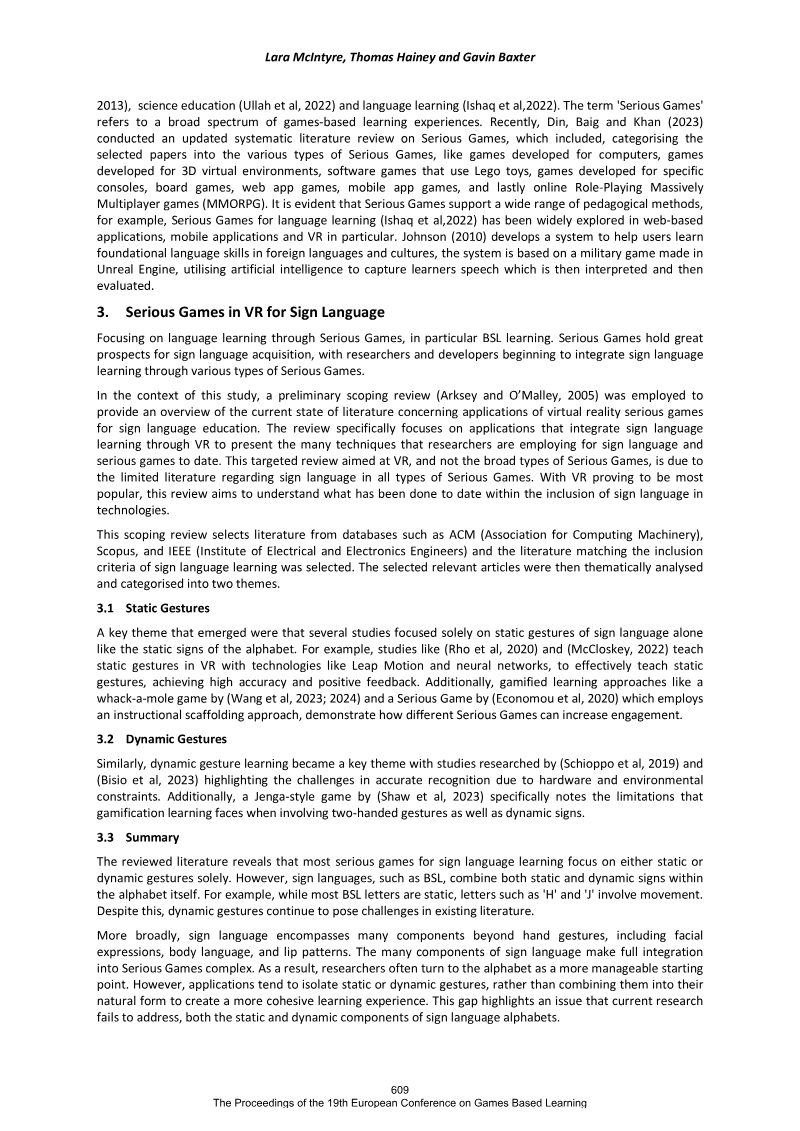
Each row is a game or company this document names, each column a document, oldest first. A mark means that document names it. Select a row to see those documents.
European Conference on Games Based Learning (ECGBL) · 2025
European Conference on Games Based Learning (ECGBL) · 2025
European Conference on Games Based Learning (ECGBL) · 2025
European Conference on Games Based Learning (ECGBL) · 2025
European Conference on Games Based Learning (ECGBL) · 2025
European Conference on Games Based Learning (ECGBL) · 2025
European Conference on Games Based Learning (ECGBL) · 2025
European Conference on Games Based Learning (ECGBL) · 2025
European Conference on Games Based Learning (ECGBL) · 2025
European Conference on Games Based Learning (ECGBL) · 2025
European Conference on Games Based Learning (ECGBL) · 2025
European Conference on Games Based Learning (ECGBL) · 2025
DiGRA · 2025