1 free read left. Create a free account for unlimited reading + AI research.
Create free account
Design Within Constraints PG Connects Digital #2
Key insights
6 takeaways- 01Cross-disciplinary alignment between programmers, artists, and designers must be maintained through transparent communication and collaborative tools to ensure project cohesion.
- 02Professional design maturity is defined by the ability to balance the needs of broad market audiences and dedicated superfans while operating within practical industry limitations.
- 03Creative excellence is best achieved by applying well-defined constraints early in production to prevent scope creep and maintain focus on a singular core vision.
- 04Development teams should prioritize low-fidelity prototyping to validate core mechanics before committing resources to high-polish assets.
- 05Rigorous pre-production planning, including the identification of specific target personas and project parameters, is essential for successful project execution.
- 06Iterative testing based on empirical feedback rather than assumptions allows teams to identify and resolve design bottlenecks early in the development lifecycle.
Ask AI about this video
Transcript
a friend of the show and a friend of mine it's Tyra from glow-up games how you doing Tara hello I'm good how are you I'm fine thank you yeah good to have you with this it's be here I would have spent it I know I would ask what the weather was like like I've been doing with everyone but I imagine it's much the same as it is with me which is starting to pick up actually yes the BBQ ready for the moment the Sun peeks out you know yeah we had one of the I would say coldest barbecues ever last week with there me and my brother socially distance garden BBQ last weekend and it was just the worst let you get on with your talk
which is all about designing with constraints and I know you've got some interactive parts and everything else like that you can warranty so everyone look forward to a really exciting talk and yeah if you've got any questions throw them into the Q&A and all right everybody so let's let's hope this goes well hey cuz I don't know what's going on anymore it's Friday kidding a game design designing within constraints so that was my most professor like into the introduction into this and basically I am going to be asking for your participation so you are all going to be my test subjects in this wonderful little experiment so please be prepared to participate as you all are familiar with the Q&A button I'd also
like you to get familiar with the chat button which I'm going to try and do right now so can you all see that actually how do i I should have checked this with Pocket Gamer people but you're going to have to back me up on this okay so I would like everybody to go ahead and say hello in chat and while you guys get familiar with that I get familiar with that I would like to introduce myself so look at that flashing button hello everyone I'm the CEO and founder of code covered which is the very first remote bootcamp video game school focusing on marginalized developers we've got some exciting programs going on at the moment where we've recently opened up fame scholarships for our intro to game making course as well as an incubator for developers early-stage developers who are affected by cohn fit and also an
incubator in august with wings fund to be able to help those who are affected by the cancellation of events like this I'm also the chief design officer and co-founder of glow-up games where we are mobile free-to-play studio founded by women of color and working on HBO's title insecure which is in its fourth season right now I'm on the board of multiple game studio initiatives and I speak a lot on design remote work and diversity and inclusion and I've yeah I've been in this industry for a very long time so shipped over ten titles in 15 years with the likes of EA Microsoft and backbone entertainment as well as smaller indie Studios such as deep fried entertainment and playable and I have also not shipped about seven titles but who's counting I'm kidding those seven titles are just as important as the ten titles because as you all probably know
you learn a lot more from failing and failing in some ways than you do from success so on that note let's see all of you wonderful people in chat thank you for saying hello hello to all of you I would like to say that the fifth person who said hello when surprised so one two three four five Charlie Charlie you are a winner congratulations design within constraints so this is part of them a bigger master class that I like to teach so I'm going to try and jam it as much as I can in the short space of time and to follow on with our audience participation I would love for you to be able to just jump in there and tell me what your discipline is so when we think about design and the sort of master classes I offer I'm not just doing this for designers I think it's really important to figure out when you're coming from different disciplines what designers are looking for and how to effectively communicate and expressing sort of the angles that you're coming
coming from you know as somebody who's worn the designer hat and the production hat I've often been at odds with that person in that role and particularly I know that in working with engineers the caveat is I did it done exactly what was designed and you're sitting there as a designer going well what about all of this other stuff that was obviously in my head and it's just logical artists getting fed up with designers constantly changing the design you know from the be eyes especially in the mobile free-to-play space you're you know reeling off your LTE art now are people who and all the other different combinations of the alphabet that you can imagine localization of course you're always worried about your leg strings tables and being able to translate that on a cultural level but also in the linguistic level and and that's a very expensive endeavor and something for designers to consider one thing that we joke about when we first heard localization pricing for example
in some of the studios I worked with is we can't even afford the E and E fix so that's something to consider for QA is understanding that when designers tend to say as designed it might be a catch-all for I just really don't want to deal with this right now and for audio well everybody leaves audio so last so you know why why break with tradition I'm not kidding so yeah I want to get a sense from the audience what your disciplines are and my headset is now losing battery so as you can understand it's probably been a busy day for all of you as well as me the second person who answered that question wins an achievement unlocked an achievement Patti you are an achievement unlock congratulations so in continuing with our participation what do you think that designers want or need to thrive I'll
give you all a second thank you Charlie I'm just writing this down you see okay so yeah when when I usually ask this question a lot of the feedback that I get especially from people of course not in the industry they just say well you get to make games and have fun all day and you know that isn't the case you know we hear a lot about once in freedom and yes creative Liberty is a great way to start that and having unlimited sort of not having any boundaries being able to explore all the different avenues and sort of refine vision off of that but what I've actually found is we thrive really well when we have boundaries in place and
what I'd like to draw attention to is and I don't know if you all have been seeing sort of some really popular series right now lost ants on um on Netflix about Michael Jordan Bulls and the Chicago Bulls basketball team and Phil Jackson who was the coach of the Chicago Bulls as well as the LA Lakers and he took that both teams to a lot of great success and one of the things that he is known for is his amazing management structure and getting the most out of each person on his team and one of the things that he was talking about his book level rings which I highly recommend is a system that he designed for the triangle system or he encouraged where he said it empowers the players offering each on a vital role to play as well as a high level of creativity within a clear well-defined structure the system that he was talking about was setting these parameters for the players within this triangle to understand what their roles are and how they can immediately respond to the action that's happening on the court to
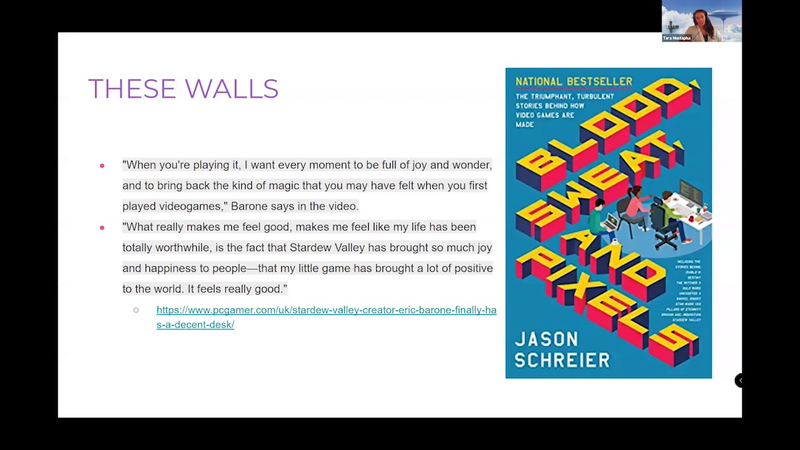
be able to respond quickly and have that creative freedom because they would know clearly what they were there to do and so in thinking of that you know what do you think that designers want or need to be successful and I think a couple of people have touched on it in in in chat already so we've got a clear view of the game we've got I think that said a well communicated vision having some of those persistence exactly but it's having some of those structures in place so what I'd like to talk about is sort of like the walls and I don't know if you've all had a chance but there's a really excellent book I've got it right beside me I will refer to it called blood sweat and pixels and in it one moment they talk about for one of the stories start you
Valley and that's an interesting sort of paradigm that I want to pick up on because I don't know if any of you familiar with the story of stardew valley but eric barone basically started it after he came out of university and was had trouble finding jobs and he had a vision that he wants to express now he was sort of in this idealistic situation or quote-unquote ideal situation where he didn't have sort of these constraints that we're talking about that we often find in when we're working for other Studios but what he did do initially was talk about what he wanted to create and as you can see in this quote he says when you're playing it I want every moment to be full of joy and Wonder and to bring back the kind of magic that you may have felt we first played video games so this harkens sort of to that idea of your ex statement no stardew valley it was to create some a new type of farming simulator that was built off of sort of the ideas of harvest moon and
rune factory but he wanted to encapsulate this feeling of joy and Wonder and magic and when the follow-up to that is him saying what what makes me feel good and makes me feel like my life has been totally worthwhile is the fact that star G valley has brought so much joy and happiness to people and has done the you know has brought a lot of positive to the world it feels really good so he was able as a solo developer which he you know spent four years developing the project established an ex established the course owner of the game that he wanted to make and stuck to that in order to come to complete his vision and this is exactly why one of the things as parameters is really good to have at the outset and to keep on coming back to you throughout your development cycle and one of those things that I want to talk about is back to my point earlier about not all designers are the same is you know the the inherent understanding that you have
different designers who have UX designers UI designers weapons designers systems economy currency I'm sure you can you know name off a couple but you also have to understand what kind of designer you're working with in terms of phases when I first started at Microsoft one of the questions that they asked me and my interview was what is your favorite phase of design or design phase of production and at first you know you could could be pre-production it could be that conceptualized phased could be in production or finally you know your alpha and beta phase and for me personally finally it's my favorite I thrive off of deadlines and for me that's when a game really comes together because you've got the goal posts set you know that every variable you're tuning every platform you're moving if
you're making a platform game for example is in pursuit of that end goal of creating the most fun a brilliant experience that adheres to the X statement and that those goal posts are in sight for me pre-production absolute hell like the hills are not alive with the sound of music I absolutely hate having that much freedom I need those constraints but a lot of designers will find that that's the place that they excel so whether you're working in a team with designers I think take into consideration what kind of designers you are working with and for those just this little for those who do you have a designer like me and pre-production one of the most valuable things that I can do to be able to get the most out of this phase is to be able to set like two-week deadlines two-week sprints and say I have got this much time to prototype something whether it's gray box whether it's a paper prototype to validate this
idea and then take it on to the next level so I still have to provide myself with some sort of constraint or structure in order to get the most out of it thank you for the additional happy and hippie fridays so yeah let's let's constrain away so in terms of our game so this is me being meta with my experiment of game design here and trying to commit as much into this as possible we've been playing a game this entire time right so I asked the fifth person Charlie who won a prize to say hi on that first slide I asked for a sense of disciplines in the in the audience and Patti want that Charlie again was the first person to say happy Friday and I didn't tell you all but there was also an achievement for social participation which I think Charlie probably won as well creek of the mark indeed so that
probably was kind of a shitty game to be absolutely honest and that's because I never told any of you what the parameters were off the mark you know you didn't know you were participating you didn't know that there would be a prize for a total achievement and that is unfair so this is one of those examples of sort of getting to test early and getting to test rapidly because you get feedback really quickly so if we were to go through this whole process again we'd start with like the first constraint which would be either your ex statement or if you're particularly business-focused who your target audience are and I'd uh yeah I'd really recommend doing at least four or five personas to identify who your talking mark it is and I don't know if you can can you see my screen if I again audience-participation drag over my mirror board here so mirror is a great
tool I am not sponsored by them but they have really great templates that you can use to sort of build out your your your games and it's great great visibility and it's a really great collaborative tool so when you're thinking of your personas of your target market I think this is a really great board to start with and it's very sort of not games driven but you know you can imagine if you were let's take our audience for example it's Friday at 4:30 in the afternoon and we're an audience of probably b2b execs and indie game developers who are really tired and probably have sore throats and I want to sit back and kick back with a beer and do something fun so knowing that the reasons to use this game that we've developed now is that we probably want to keep high engagement for the people who are just tired tired when we're really busy but great great
conference and the reason to get involved is because we get social validation we get the competitive streak and we want to talk about sort of like Bartlett I think it's Bartles MMO criteria he said there's like four different aspects to how people play games and that's you've got your socializers you put your Cheevers and you've got your explorers and you've got your killers and they're the ones who like pvp and things like that so we've managed to hit a couple of those targets in this we've created something that social we've created something with a sense of achievement Potti our achievement unlock our there we've managed to get some competition in first person to say happy Friday and people to participate in the social level so we've ticked all of those boxes you know get makes what is what our personalities and I think we can see
them coming through in chat over there and our vests lie with our different disciplines that we've established and skills predominately in the games industry and then you kind of get your idea of tech savviness which can apply to different aspects and in game development like are you a you know trying to appeal to people who are not necessarily tech savvy and won a one-to-one experience of Scrabble on their phone you know I know there's been some controversy for example around scoping of how they enter they took EA's version of Scrabble and translated that into mobile and theoretically you know and some of the controversy that that's made sort of local papers is that didn't translate well for that audience it's it changed how they perceived it and how they were able to enjoy it so from that I would say the next step into designing with constraints is your flowchart right so from our experience in our game we know
from the user standpoint there was a problem in that probably 60% of you didn't understand we were participating in a game or let's say a hundred percent because I didn't explain those rules at the beginning so if you know if this is the first this is like your first-time user experience if the player understands that they've they've done this before then they can go skip straight to the heads of the game if not then we have I should have said something up front which explained the whole process and and then I want you to take this and apply it to also your team your business so as a designer have I expressed what the designs or documents are for example to a programmer has the programmer expressed what our constraints are in terms of the device in terms of how big this game has to be as our production or project management team expressed how what the deadline is who our audience are have we got that
information and you know the list goes on art do we have enough capacity to create lots of assets how overburdened is our art team yeah even localization you know have we provided localization team with our screens how much text are we using how much of it is embedded into our graphics you know like what's worked on a project where everything was hard-coded or you know into the instantly hard-baked made sense of the art so changing a string was a really really horrible experience but the thing is I would what I'm trying to say is take these flows and apply them to the decision-making process of your team to understand where these blocks are going to come up and you do that fundamentally by establishing what your constraints are off of the bat so first things first is probably taking into consideration your
your X in the case of stardew valley you know I want to make a farming game that is joyful and magical and harkens back to sort of old-school games and its improvement on harvest moon and on Factory I want to understand your audience who are your personas who are you trying to target and provide those frameworks for your team to understand for your design to come through and figure out if it's measuring against those benchmarks are your team positioned in a way to so that you can get the most out of them so that they can thrive have you provided your team your designers your engineers everybody actually with the parameters that they need to be able to maximize the work that they need to achieve you know in in the case of our game for example yeah we should I tested you guys are they I've tested this framework for master classes I've gotten a lot of feedback just from this experience and
then itself and you know have we communicated one of the great things about working remotely and I've worked remotely for over two and a half years now is using slack using things like mirror to expose to to be transparent and not to be too prideful of you know or precious about your designs earlier you get them out there you can see where things are going wrong validation back and and you can see if you are actually thriving within those constraints so I try to make sure that we are on time and jam through that as effectively as possible but I hope from a high level it was informative and enables you guys to be able to see where that's where to put in basic constraints and why it's also a great idea to you know sort of like test early and test often and really appreciate you all jumping in there and I'm participating
so yeah that's me thank you yes thank you that was great so big interaction get everyone going get the well get everyone's creativity flowing in sense get everyone thinking and moving because we can be a bit static at the moment can we thank you no no not at all and we've got a couple of minutes and as I am finding at least with everyone I it seems to be doing the questions seem to come after rather than during so in the meantime I will do what I often do and ask one of my own questions which I think might be relevant some of the people in the audience which is obviously it would say you know test a lot and a test early and test often but I suppose a little bit of that is like how Early's a lot I get a lot of Indies asking like how early should they test or how early should they pitch for feedback like Germany thoughts on that if you're wondering if it's too early you're probably too late okay yeah I
mean it's hard it's really hard because I always know that I want something to be perfect or polish and you know I always hate it when I put something out there personally and somebody's like oh well this is wrong and this looks horrible and this looks that and I'm like I know I know I know we haven't done that yet because this is just a prototype and I know I know but it you know the truth is is that it's you you're always going to get some gems out there and yes it's okay you know and and just at that point as well when you are putting things out there if it is a prototype lean into making it ugly make it as ugly as you possibly can you know sure go the gray box route but sometimes like it's so ugly so everybody knows is absolutely not a finished product yeah but just be really clear also what you're trying to validate make those little like sort of just like little breadcrumbs of what you're trying to test and validate and there's there's even great ways to I think it's called you you a you I don't know what I
thought something like tester or something and you you get a five minutes of somebody's time on the iOS device to valid a something and you can't guide them at all but it's really great to be able to see just that little slice is working how I wanted to but yeah the earlier the better well and that's fantastic and and as I thought here come the questions so we'll start with gowron's question who came in first I wish I had a prize to give you Goren but Goran has said you mentioned a person but what about superfans hmm what does that mean I think I mean I'm obviously speaking for core on here but I suppose if we think about testing and audience not or not audience but yeah the audience of your game in the interaction you know it's I suppose there's a there's one thing to test it on maybe people who are sort of let's say gamers or maybe non-gamers but with a superfan it might be someone who like let's say it's a hyper casual game someone who exclusively you know is
involved in hyper casual or say you're adding something to your game it might be one of your sort of longest term players do you think it's better or worse I suppose to test on someone who's like has an understanding of what you're doing in terms of genre or the makeup of the game or anything like that or do you think that there's value in testing it on someone who maybe is a bit more broad in their experiences yeah okay I know I definitely see what you're saying and I think that's an interesting point of view because some I think when you when we identified the personas first I think it's really good to have a wide range so for example with you know blow up with the insecure title I know that their show on average gets about four million viewers per episode and they have a really dedicated fan base so I know that's a of people that we want to test the game early against to make sure that we're hitting the right tonal marks because the game is sort of like a has RPG
elements with rapping I also know that to validate that those mechanics are working I want somebody who has a persona of somebody who is somebody who enjoys RPGs there's a big thing like that but then I also want a persona of somebody who maybe isn't of either of those levels you know to see where their engagement is and I think a great way to engage will so if you do have a super super fan base is because they know your IP or they know your mechanics is so well they're probably able to give you the most sort of core feedback of whether you're hitting those marks in line with their targets and kind of validates um yeah validate all of those findings but also it's a great way to also keep them engaged as a community and keep them involved which you know super fans / whales are kind of in that sort of say little bubble there you know so you do want to bring them in yeah
definitely and it would be remiss of me not to say to the audience that if you want to learn more about what you're doing at globe and the development of the game then there's a talk from the game mechanics digital one that's available on our YouTube channels so I thought shameless plug I should throw that in I'll try and fit in one quick question as well before we bring Kate on and and Jackie's asked what was the most memorable moment of working on one of those final deadlines you described oh there are so many memorable one I don't know there's something you know one of my phone just one fight early in my career at background entertainment when we were working on the game called monster lab and and this is a thing like when you look at my career as many titles as I've shipped over that sort of time frame I've had a sort of career as being a firefighter of coming in sort of towards the last minute or whatever and
refining and taking things to two to final but you know what that initial project of muscle was a bit of a tricky one and we managed as a team of you know four teams of different skills to try and make these experiments come to life in a really short amount of time against little odds and you know everybody who I worked with on that team I'm still in touch with now and consider like family like you know I guess this going to war and blood is blood being spilled but seeing the validation when it comes to you know it being received publicly and seeing that all that hard work did pay off and then yeah knowing that you know when you are so passionate about something and you see that that little change of one little variable or something and it's so hard to sort of itemize but that is received well and was you know it's just completely validated I think um team
camaraderie as well isn't it exactly yeah well thank you so much thank you for joining us here and and yeah thank you for getting that audience there I pop well I'd say up off the feet but maybe looked in their arms and yes you too as well of course thank you
Summary
Creative excellence in game development is best achieved not through limitless freedom, but through the strategic application of well-defined constraints. By establishing clear boundaries and a singular core vision early in the production cycle, teams can avoid the pitfalls of scope creep and maintain focus on essential project goals. This structured approach mirrors successful methodologies in other high-performance fields, such as the triangle system in professional basketball, where defined roles and tactical limitations allow individual talents to coalesce into a more effective unit.
Successful implementation of these constraints requires rigorous pre-production planning, including the identification of specific target personas and project parameters. Developers should prioritize the creation of functional, low-fidelity prototypes to validate core mechanics before investing in high-polish assets. This iterative process of testing early and often allows teams to identify design bottlenecks and adjust mechanics based on empirical feedback rather than assumptions. Such transparency is vital for cross-disciplinary alignment, ensuring that programmers, artists, and designers remain synchronized throughout the development lifecycle.
Ultimately, the ability to navigate inherent limitations is a hallmark of professional design maturity. By fostering open communication and utilizing collaborative tools, studios can manage expectations effectively while balancing the needs of broad market audiences and dedicated superfans. Embracing these structural boundaries serves as a catalyst for innovation, enabling teams to deliver cohesive, high-quality experiences that remain true to their original creative intent while operating within the practical realities of the industry.
























Comments