1 free read left. Create a free account for unlimited reading + AI research.
Create free accountArticle G|A|M|E – The Italian Journal of Game Studies
1 free read left. Create a free account for unlimited reading + AI research.
Create free accountArticleG|A|M|E – The Italian Journal of Game Studies
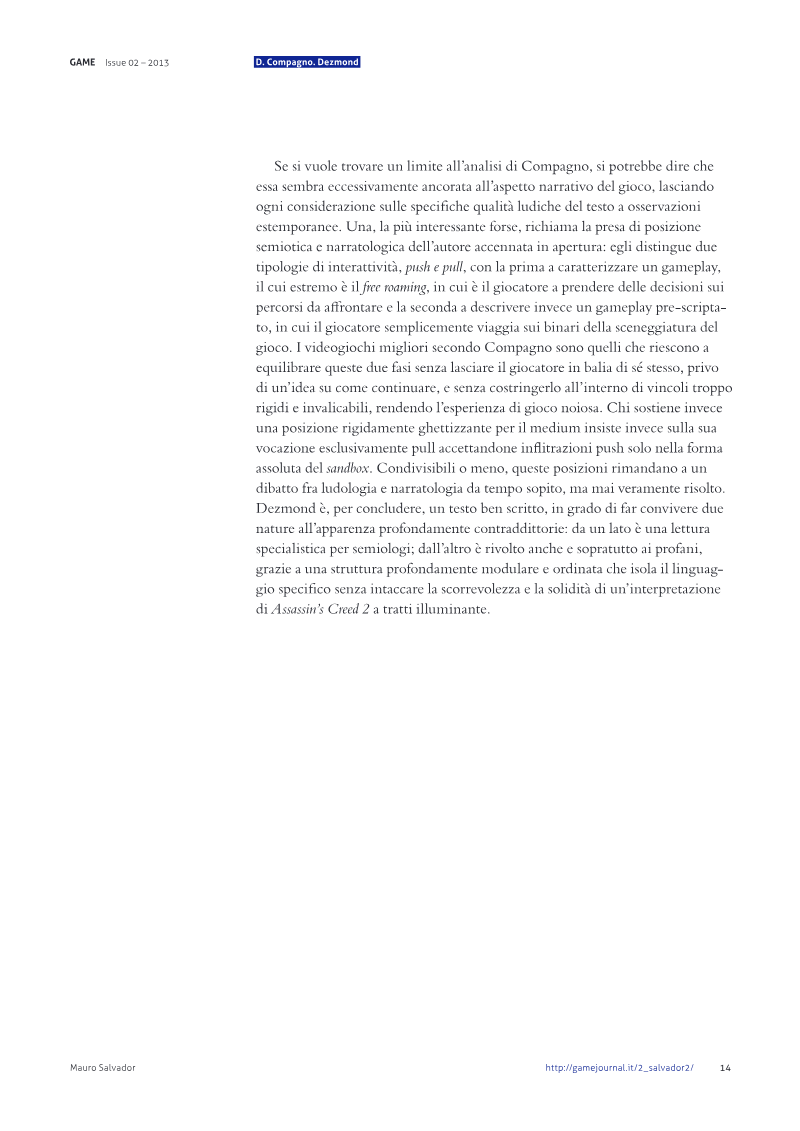
D. Compagno's book analyses Assassin's Creed 2 and is the eighteenth volume in the "Ludologica. Videogames d'autore" series. It appeared with Unicopli, edited by Matteo Bittanti and Gianni Canova.
This book review, published in the 2013 issue of Critical Notes, assesses D. Compagno's semiotic analysis of Assassin's Creed 2, the eighteenth volume in the "Ludologica. Videogames d'autore" series edited by Matteo Bittanti and Gianni Canova for the publisher Unicopli. The work's central method is Roland Barthes's S/Z, which Compagno applies to treat the game as a language in its own right and to examine why its narrative carries the meanings it does. The reviewer considers this approach demanding but productive, since it allows videogames to be studied with theoretical tools developed for other media.
The analysis divides the game's text into roughly two hundred lexias and examines each in detail, with particular attention to narrative structure and to cultural references ranging from classical literature to videogame culture. Its principal interpretive claim is that Assassin's Creed 2 functions as a metaphor for psychoanalysis: the Animus becomes a therapist's couch, and the protagonist Desmond's journey through his ancestors' memories parallels a search through his own past that leads him to confront conflicts with his parents and to discover the mission his birthright imposes on him.
The reviewer identifies a limitation in the work's concentration on narrative, which leaves the specifically ludic qualities of the game to occasional remarks. A notable exception is Compagno's distinction between push and pull forms of interactivity, which he uses to argue that the best games balance player agency against scripted progression. The review situates this within the longstanding and unresolved debate between ludology and narratology. Overall, the book is judged well written and modular, accessible to general readers while remaining rigorous for specialists, and its interpretation of the game is described as occasionally illuminating.
Each row is a game or company this document names, each column a document, oldest first. A mark means that document names it. Select a row to see those documents.
G|A|M|E – The Italian Journal of Game Studies · 2026
G|A|M|E – The Italian Journal of Game Studies · 2026
G|A|M|E – The Italian Journal of Game Studies · 2026
G|A|M|E – The Italian Journal of Game Studies · 2026
G|A|M|E – The Italian Journal of Game Studies · 2026
G|A|M|E – The Italian Journal of Game Studies · 2026
G|A|M|E – The Italian Journal of Game Studies · 2026
G|A|M|E – The Italian Journal of Game Studies · 2026
G|A|M|E – The Italian Journal of Game Studies · 2026
G|A|M|E – The Italian Journal of Game Studies · 2026
G|A|M|E – The Italian Journal of Game Studies · 2026
G|A|M|E – The Italian Journal of Game Studies · 2026
DiGRA · 2026