1 free read left. Create a free account for unlimited reading + AI research.
Create free accountWhitepaper European Conference on Games Based Learning (ECGBL)
1 free read left. Create a free account for unlimited reading + AI research.
Create free accountWhitepaperEuropean Conference on Games Based Learning (ECGBL)
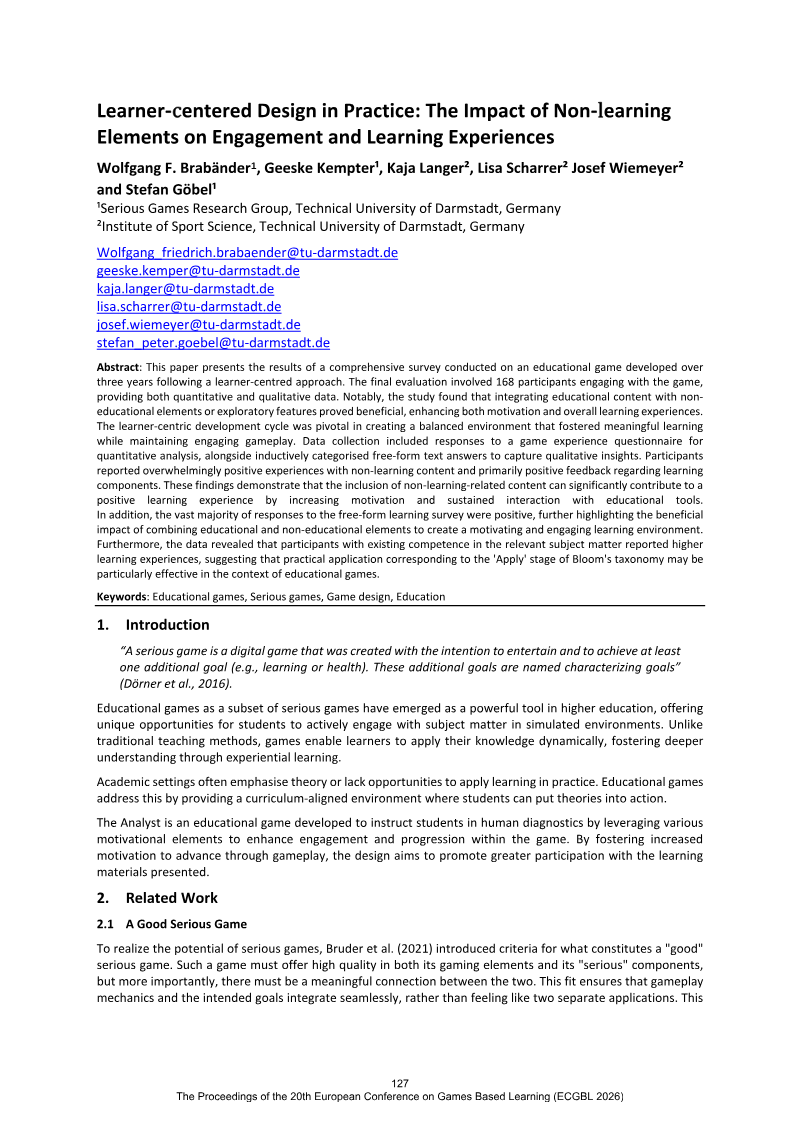
Pairs stepped through animal-themed portals to choose colours and patterns for a virtual Parasaurolophus. The real dinosaur fossil served as the physical anchor.
A study of 90 museum visitors who played a two-person augmented reality (AR) game at a natural history museum examines how players divide their attention among a real dinosaur fossil, virtual overlays, and their co-player. The game, built for Meta Quest 3 headsets, asks pairs to choose colours and patterns for a virtual Parasaurolophus by stepping through animal-themed portals, with the fossil serving as the physical anchor for the experience. The authors combined observation, pre- and post-game questionnaires, post-game attention-triangle mapping, and interviews, with interview data coded through an inter-rater content analysis.
The central finding is that participants focused mainly on the virtual elements, a pattern the authors attribute largely to novelty, since most had little prior AR or VR experience. The fossil received comparatively little sustained visual attention, and co-player attention varied with the game's active and passive phases. Despite this, the game produced statistically significant gains in interest in the Parasaurolophus (medium effect, d = .54), in dinosaurs generally, in scientific hypothesis-making, and in the intention to inspect the fossil more closely and seek further information afterward (medium effect, d = .41). Attention patterns did not vary meaningfully by age, gender, prior AR experience, or relationship to the co-player.
The authors frame the fossil as a contextual anchor rather than a constant visual target, arguing that meaningful learning engagement in heritage AR does not require continuous gaze at the authentic artifact. Limitations noted include passthrough clarity issues on the headset, occasional difficulty distinguishing real from virtual content, and the likelihood that novelty effects will diminish as users become accustomed to the medium.
Each row is a game or company this document names, each column a document, oldest first. A mark means that document names it. Select a row to see those documents.



European Conference on Games Based Learning (ECGBL) · 2026



European Conference on Games Based Learning (ECGBL) · 2026



European Conference on Games Based Learning (ECGBL) · 2026



European Conference on Games Based Learning (ECGBL) · 2026



European Conference on Games Based Learning (ECGBL) · 2026



European Conference on Games Based Learning (ECGBL) · 2026



European Conference on Games Based Learning (ECGBL) · 2026



European Conference on Games Based Learning (ECGBL) · 2026



European Conference on Games Based Learning (ECGBL) · 2026



European Conference on Games Based Learning (ECGBL) · 2026



European Conference on Games Based Learning (ECGBL) · 2026



European Conference on Games Based Learning (ECGBL) · 2026
DiGRA · 2023