The Czech Games Industry Study serves as a comprehensive assessment of the economic impact, structural composition, and developmental challenges facing the Czech game development sector. By monitoring industry performance, the study aims to advocate for systemic improvements in government support, education, and international labor mobility. The analysis highlights that while the industry is a significant cultural and economic force—generating revenue that exceeds the domestic film industry—it requires targeted policy interventions to sustain long-term growth and global competitiveness.
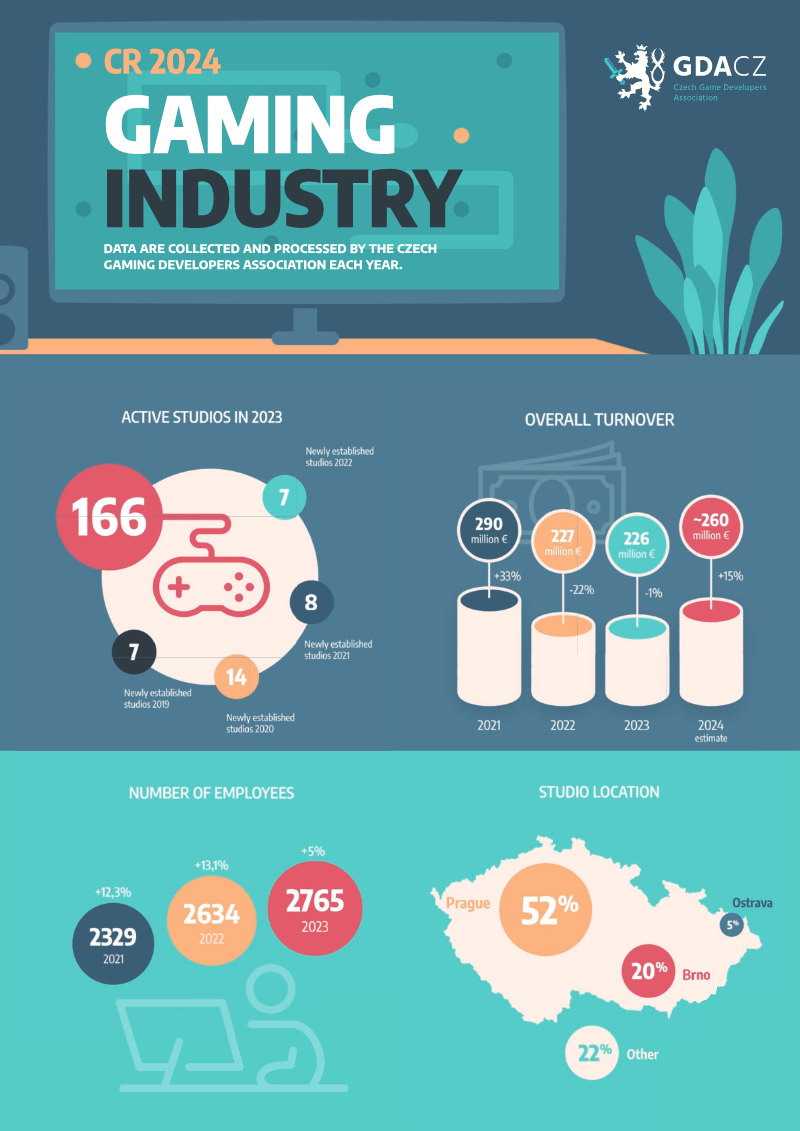
Key findings indicate a resilient but fluctuating market. After a record-breaking 2021, industry turnover declined by 22% in 2022 to CZK 5.57 billion, remaining stagnant through 2023. However, projections for 2024 suggest a recovery with anticipated growth of approximately 17%, targeting a turnover of CZK 6.5 billion. The sector is highly export-oriented, with 98% of total revenue derived from international markets. The industry comprises roughly 170 studios, primarily concentrated in Prague (52%) and Brno (20%), and is characterized by strong domestic ownership, with foreign-owned branches representing only 7% of the market.
Employment remains a critical bottleneck, with the industry employing approximately 2,765 people as of 2023. Despite creating over 400 jobs annually, more than 60% of companies report a shortage of qualified labor. The current educational landscape is insufficient to meet this demand, forcing studios to rely on international recruitment, with foreign nationals accounting for 36% of the workforce. To address these gaps, the industry calls for enhanced government support regarding visa accessibility, specialized academic programs, and direct investment initiatives to ensure the sector remains a viable and growing pillar of the national digital economy.
8Bit · 2026

Ukie · 2025

Direcció General d’Innovació i Cultura Digital · 2025
InGameJob · 2025
Polish Agency for Enterprise Development · 2025
PGDA – Pioneers of Game Development Austria · 2024
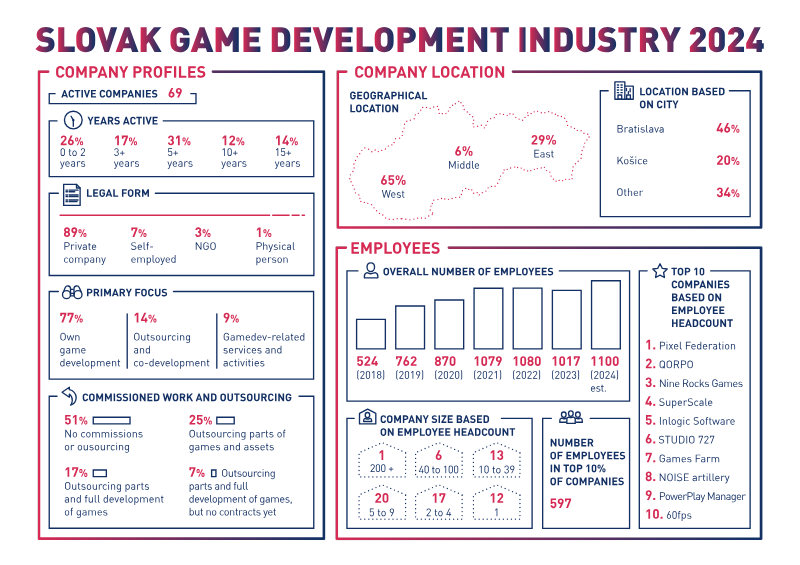
Swiss Game Developers Association · 2024
Austrian Professional Association of Management Consultancy · 2024
Slovak Arts Council · 2020
Slovak Game Developers Association · 2019

European Games Developer Federation · 2016
Values Value · 2026