1 free read left. Create a free account for unlimited reading + AI research.
Create free accountWhitepaper DiGRA
1 free read left. Create a free account for unlimited reading + AI research.
Create free accountWhitepaperDiGRA
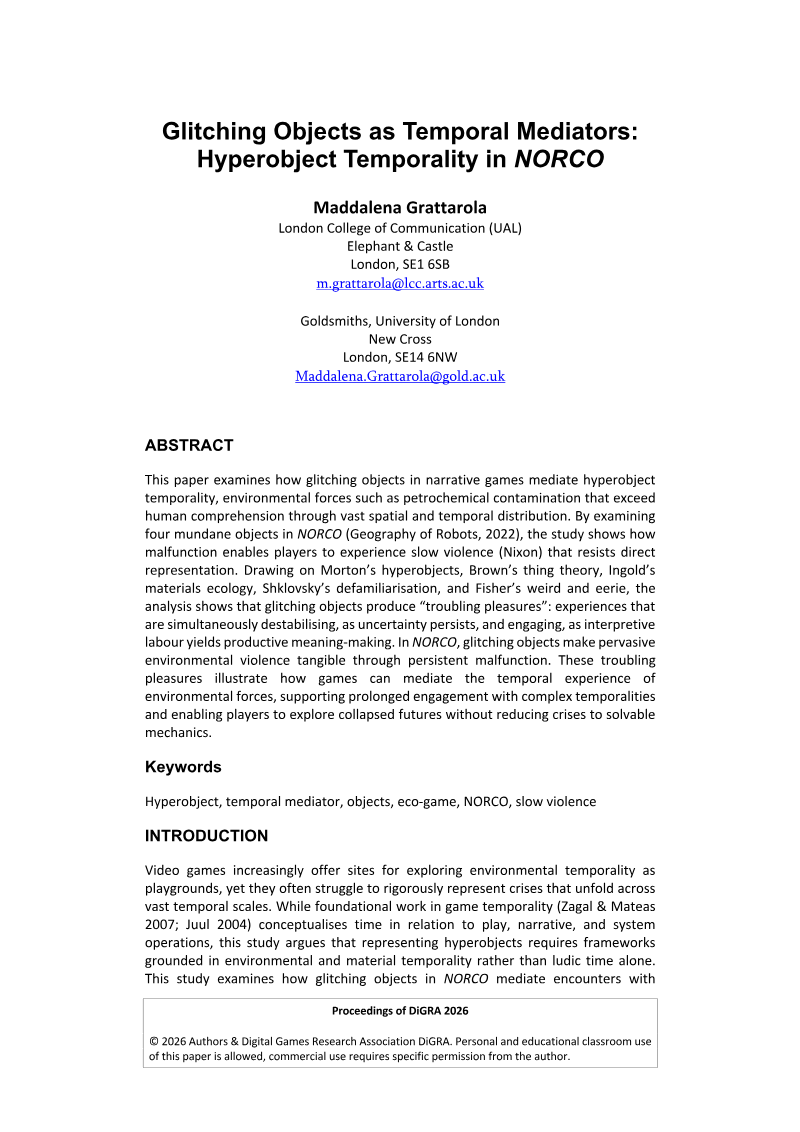
The paper argues that Botany Manor and The Abbess Garden use gentle, nurturing design to frame Victorian England and Grand Siècle France.
This paper examines how two recent cozy botanical games, Botany Manor and The Abbess Garden, represent historical realities when their emphasis on safety, softness, and nurturing renders the past comfortable. Through textual analysis of these titles, set in Victorian England and Grand Siècle France and centered on female protagonists tending plants, the authors investigate how videogames mediate the pleasures of cultivating nature in the past while engaging with themes of gender, science, colonial classification, and harm. The study positions itself within game studies, game design, environmental humanities, and history.
The authors argue that these games carry the affective conventions of cozy design, including attentive care, observation, and discovery of plants, into historically specific settings that otherwise feature violence, annexation, progress narratives, and gendered constraints. Rather than dramatizing danger through gameplay, the titles displace historical inequality into letters, books, and dialogue. In Botany Manor, the protagonist's career is constrained by institutional sexism conveyed through correspondence, while The Abbess Garden hints at threats to the abbey through conversation. The paper contends that this indirect design allows players to inhabit historically informed worlds without firsthand peril, positioning cozy games as a potential "new mode of doing history in games."
The analysis further contends that botany's historical status as a liminal space between science and domesticity shapes the games' mechanics and representations. Women's botanical work was often dismissed as hobby or domestic labor, a dynamic the games reproduce by framing care as feminine labor and by featuring dismissive or threatening male non-player characters. Catalogues and classification systems in both games are read as mechanisms of colonial taxonomy that generate a sense of order and control, reinforcing the cozy atmosphere while remaining entangled with the gendered and colonial histories that shaped botanical knowledge.
DiGRA · 2026
DiGRA · 2026