Updated Mar 21, 2026 by Take-Two Interactive
Legal · June 1, 2022
Published by Take-Two Interactive
The Conflict of Interest Guidelines for Directors, adopted by Take-Two Interactive Software, Inc. in June 2022, establish a formal framework for ethical conduct and accountability among the members of the Board of Directors. The primary purpose of these guidelines is to help directors recognize and navigate ethical risks, particularly situations where personal interests might interfere—or appear to interfere—with the interests of the company and its subsidiaries. The scope of the policy covers all directors, including those who also serve as officers, and extends to their immediate family members as defined by NASDAQ regulations. Key provisions prohibit directors from exploiting corporate opportunities for personal gain, competing with the company, or using company property and information for non-business purposes. The guidelines set specific thresholds for gifts, generally limiting acceptable items to those with a de minimis value of $150 or less, provided they are customary and related to unique life events. Furthermore, directors are required to maintain strict confidentiality regarding non-public information and must provide annual disclosures of all material outside business interests, including positions held in other public or private companies. The policy emphasizes transparency and reporting, mandating that potential conflicts be disclosed immediately to the Chairman of the Board or the Corporate Governance Committee. While the Board may waive certain conflicts through a majority vote of disinterested directors, such waivers must be publicly disclosed in compliance with SEC and NASDAQ rules. To foster a culture of honesty, the guidelines include non-retaliation protections for those reporting questionable behavior in good faith and empower the Board to take disciplinary actions to deter wrongdoing and ensure adherence to these standards.
PAGE 1 / 4 CONFLICT OF INTEREST GUIDELINES FOR DIRECTORS JUNE 2022 CONFLICT OF INTEREST GUIDELINES FOR DIRECTORS 1. Introduction The Board of Directors (the “Board”) of Take-Two Interactive Software, Inc. (the “Company”) has adopted the following Conflict of Interest Guidelines (“Guidelines”) for directors of the Company. These Guidelines are intended to focus the Board and each director on areas of ethical risk, provide guidance to directors to help them recognize and deal with ethical issues, provide mechanisms to report unethical conduct, and help foster a culture of honesty and accountability. Each director must comply with the letter and spirit of these Guidelines. No guidelines or policy can anticipate every situation that may arise. Accordingly, these Guidelines are intended to serve as a source of guiding principles for directors. Directors are encouraged to bring questions about particular circumstances that may implicate one or more of the provisions of these Guidelines to the attention of the Chairman of the Corporate Governance Committee or the Chairman of the Board, who may consult with inside or outside legal counsel as appropriate. Directors who also serve as officers of the Company should read these Guidelines in conjunction with the Company’s Global Code of Business Conduct and Ethics. All references to the “Company” in these Guidelines shall be deemed to include all subsidiaries of the Company. 2. Conflict of Interest
ectors who also serve as officers of the Company should read these Guidelines in conjunction with the Company’s Global Code of Business Conduct and Ethics. All references to the “Company” in these Guidelines shall be deemed to include all subsidiaries of the Company. 2. Conflict of Interest A “conflict of interest” occurs when a director’s direct or indirect personal interest interferes in any way, or appears to interfere, with the interests of the Company as a whole. A conflict situation can arise when a director takes actions or has interests that may make it difficult to perform his or her work for the Company objectively and effectively. Moreover, even the appearance of impropriety can call one’s integrity into question. Therefore, as a director of the Company, you must address the appearance of a conflict of interest as well as actual conflicts of interest. Remember, conflicts of interest may also arise when a director, or a member of his or her immediate family<sup>(1)</sup> receives improper personal benefits as a result of his or her position as a director of the Company. Managing conflicts of interest effectively is essential to good corporate governance. Personal conflicts of interest with the Company are prohibited as a matter of Company policy unless otherwise disclosed to the Board and waived or approved by the Board. However, certain conflicts of interest may not be waived by the Board.
fectively is essential to good corporate governance. Personal conflicts of interest with the Company are prohibited as a matter of Company policy unless otherwise disclosed to the Board and waived or approved by the Board. However, certain conflicts of interest may not be waived by the Board. In particular, a director must never use or attempt to use his or her position as a director of the Company to obtain for himself or herself, for his or her family members, or for any other person, any improper personal benefit (including loans to, or guarantees of obligations of, such persons) from any person or entity, including any other director, officer, employee, customer or supplier of the Company. Any situation that involves, or may reasonably be expected to involve, a conflict of interest between any director and the Company must be disclosed immediately to the Chairman of the Corporate Governance Committee and/or the Chairman of the Board. Persons who become aware of potential conflicts between any director and the Company may also contact the Company’s Chief Legal Officer. The Chief Legal Officer can be contacted anonymously, if desired. All discussions with the Chief Legal Officer will be treated
PAGE 2 / 4 CONFLICT OF INTEREST GUIDELINES FOR DIRECTORS JUNE 2022 confidentially and the Company will pursue the matter and take action, as the circumstances warrant. No retaliation or adverse action may be taken by the Company or any of its employees or directors against anyone for good-faith reports of questionable behavior.<sup>(2)</sup> Guidelines applicable to the most common conflict of interest situations involving directors are described below. If any director is uncertain whether his or her actions or business relationships could create a conflict, or if he or she has doubts about an existing situation, he or she should discuss the matter with internal or external counsel. 3. Corporate Opportunities Directors owe a duty to the Company to advance its legitimate interests when the opportunity to do so arises. Directors are prohibited from: (a) taking for themselves personally opportunities that are discovered through the use of corporate property, information or the director’s position; (b) using the Company’s property, information, or position for personal gain; or (c) competing with the Company, directly or indirectly, for business opportunities; provided, however, if the Company’s disinterested directors determine (after full disclosure of the opportunity to such disinterested directors) by majority vote that the Company will not pursue an opportunity that relates to the Company’s business, then a director may do so.
usiness opportunities; provided, however, if the Company’s disinterested directors determine (after full disclosure of the opportunity to such disinterested directors) by majority vote that the Company will not pursue an opportunity that relates to the Company’s business, then a director may do so. A director shall recuse himself or herself from any Board decision involving any company with which such director is affiliated or in which he or she holds, directly or indirectly, any interest (other than a non-material interest in any company traded on a national securities exchange). 4. Gifts Generally, Directors and members of their immediate family shall not accept gifts from any officer, employee, customer or supplier of the Company, or other person or entity that does business with the Company; however, gifts received in recognition of a unique life event, such as a birth of a child, a marriage or a significant anniversary or birthday may be accepted if such gift is reasonable and appropriate for the occasion or has de minimus economic value. The economic value of multiple gifts received from a specific source should be considered as a whole over the previous twelve months. Generally, any single reasonable and appropriate gift is considered to have de minimus economic value if it has a readily ascertainable retail value of $150 or less. A gift received from a business counterparty should be considered reasonable and appropriate if it can be viewed as normal and customary. An example of such a normal and customary gift would include a package of golf balls marked with the logo of the counterparty. 5. Confidentiality
$150 or less. A gift received from a business counterparty should be considered reasonable and appropriate if it can be viewed as normal and customary. An example of such a normal and customary gift would include a package of golf balls marked with the logo of the counterparty. 5. Confidentiality Directors serve in a fiduciary capacity. They must maintain the confidentiality of information entrusted to them by the Company, except to the extent disclosure is authorized or legally mandated. Confidential information includes all non- public information that might be of use to competitors, or harmful to the Company, if disclosed.
These corporate governance guidelines, adopted in June 2022, establish the structural and operational framework for a company’s Board of Directors. The primary purpose of the document is to define the responsibilities, qualifications, and ethical standards required of directors to ensure effective oversight and alignment with shareholder interests. The scope covers board composition, committee structures, and specific policies regarding executive compensation and strategic planning, adhering to regulatory standards such as the NASDAQ Marketplace Rules and the Securities Exchange Act of 1934. Key findings and mandates include a board size limited to between one and ten members, with a requirement that at least two-thirds of directors be independent. The governance structure relies on four standing committees—Executive, Audit, Compensation, and Corporate Governance—each governed by written charters. The guidelines emphasize rigorous independence standards, requiring that the Corporate Governance Committee affirmatively determine the absence of material relationships between independent directors and the company. Furthermore, the board must conduct annual self-evaluations and dedicate specific sessions each year to strategic planning and senior management succession. The document also outlines strict financial and ethical accountability measures. A clawback policy allows the board to recover improperly awarded incentive compensation from executives if payments were based on erroneously reported financial results due to fraudulent or illegal conduct. Additionally, director qualifications are explicitly defined in an annex, prioritizing integrity, diversity, and financial literacy. To align interests with stockholders, the guidelines mandate that a portion of director compensation be provided in company equity. The board maintains the authority to limit outside directorships held by its members to prevent conflicts of interest or time commitment issues.
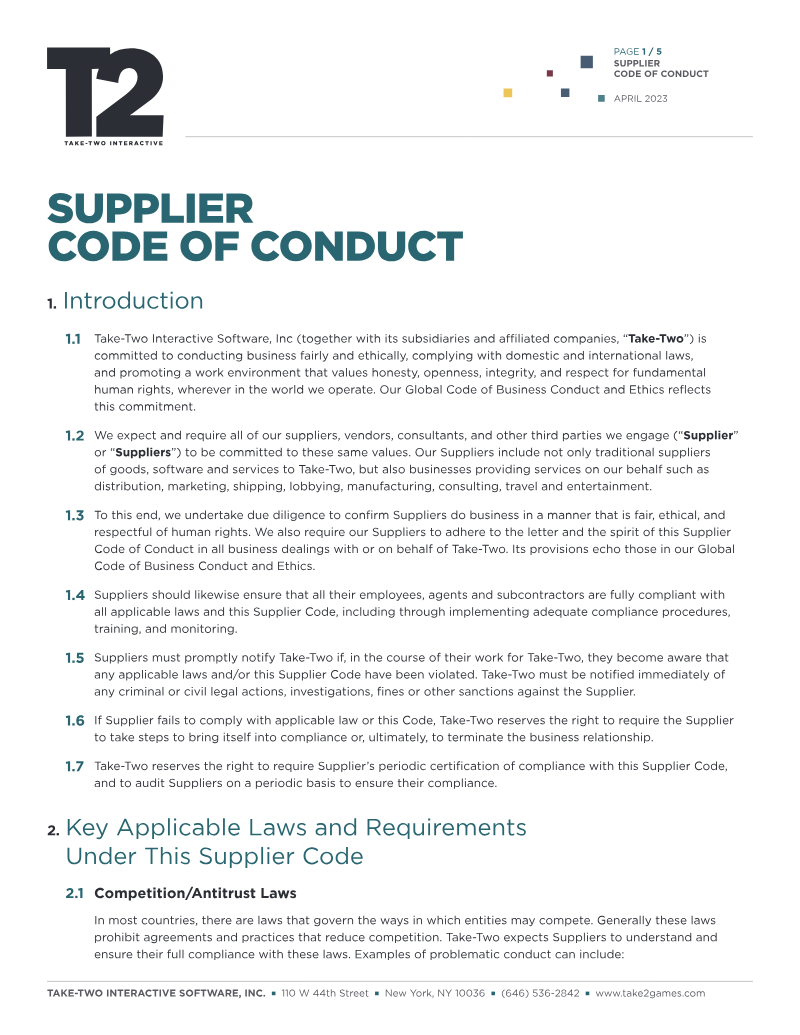
Take-Two Interactive maintains a comprehensive framework of mandatory ethical standards designed to ensure integrity, legal compliance, and the protection of human rights across its global operations. These standards apply to all employees, directors, and third-party partners, covering a broad geographic scope that includes specific restrictions regarding sanctioned territories such as Iran and North Korea. By establishing strict protocols for non-discrimination, the protection of corporate assets, and the disclosure of potential conflicts of interest—including outside employment and romantic relationships—the organization fosters a culture of accountability. Compliance is reinforced through biennial training and a rigorous enforcement mechanism where violations may lead to termination. Corporate integrity is further supported by mandates for financial transparency and fair competition. All financial records must accurately reflect transactions, and the unauthorized disclosure of sensitive information to shareholders or the media is strictly prohibited. To prevent market manipulation, the framework forbids insider trading and establishes clear antitrust guidelines that prevent the exchange of commercial data with competitors or interference with the pricing rights of distributors. Furthermore, the organization enforces a zero-tolerance policy toward bribery, corruption, money laundering, and tax evasion. This extends to third-party agents, who must undergo due diligence to ensure all business dealings, particularly those involving public officials, remain ethical and legal. To facilitate the reporting of misconduct, a 24/7 anonymous hotline is provided, allowing for the confidential disclosure of grievances to the Chief Legal Officer or Audit Committee. Strong anti-retaliation protections ensure that individuals reporting concerns in good faith are shielded from adverse actions, though disciplinary measures apply to those who provide knowingly false information. Waivers of these ethical requirements are exceptionally rare, requiring formal approval from the Board of Directors or the Chief Legal Officer, with any executive-level exceptions disclosed publicly to shareholders to maintain institutional transparency.
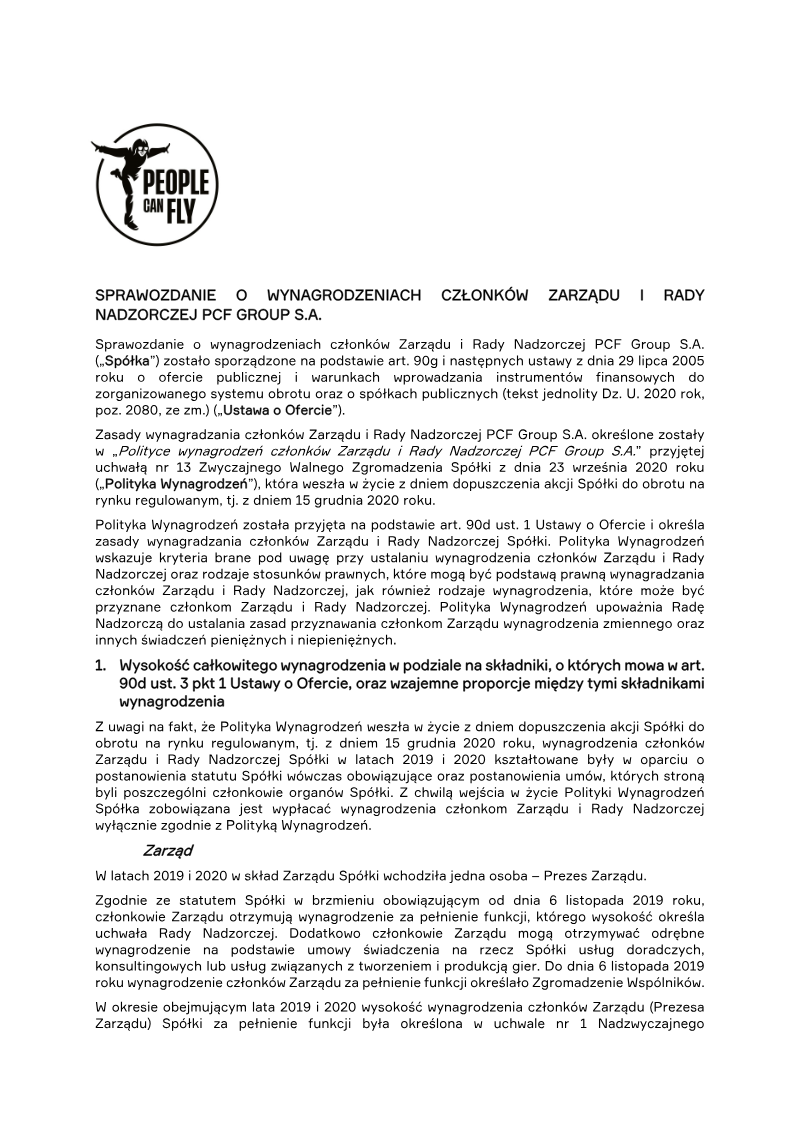
PCF Group S.A. maintains a framework of corporate governance that aligns with the majority of the Best Practice of GPW Listed Companies 2016, though it maintains several strategic deviations rooted in its organizational structure and recent transition to public markets. As of late 2020, the company’s governance model is characterized by a single-member Management Board, which precludes a formal division of responsibilities and centralizes risk management, compliance, and internal audit functions. Rather than establishing dedicated internal units for these oversight roles, the company relies on the direct supervision of the Management Board and the Audit Committee to ensure operational integrity. A significant area of non-compliance involves the absence of a formalized diversity policy. The company prioritizes merit-based recruitment and professional qualifications over specific gender or age targets for its governing bodies. Furthermore, technical and historical limitations impact transparency; the company does not provide real-time public broadcasts of General Meetings or a five-year historical financial data set in a processable format, citing its recent adoption of International Financial Reporting Standards as the primary cause for the latter. Regarding shareholder rights and executive compensation, the company adheres to statutory guidelines but bypasses certain optional recommendations. Notable exceptions include a share nominal value of 0.02 PLN, which is significantly lower than the recommended 0.50 PLN, and the lack of a dedicated compensation committee. While a formal remuneration policy is in place, stock-based incentives currently lack a minimum two-year vesting period. Despite these omissions, the company maintains standard protocols for managing conflicts of interest and ensures that significant related-party transactions follow established legal requirements, even in the absence of specific internal bylaws requiring additional Supervisory Board approval.
11 bit studios S.A. demonstrates a high level of alignment with the corporate governance standards established for the Polish capital market, though it maintains specific, intentional deviations based on cost-benefit analyses and strategic priorities. The company’s governance framework emphasizes a clear division of responsibilities between the Management and Supervisory Boards, prioritizing transparency in investor relations and strict adherence to internal audit and risk management protocols. While the company supports diversity and independence within its leadership structures, it currently opts out of several technical and linguistic recommendations, such as providing video transmissions of general meetings or maintaining a comprehensive English-language website, citing high implementation costs and a lack of significant shareholder demand. Shareholder relations are characterized by a focus on long-term growth over immediate capital distribution, as evidenced by a five-year suspension of dividend payments to fund strategic investments. Although the company facilitates shareholder participation through traditional means, it rejects the implementation of real-time electronic voting or bilateral communication during general meetings. Furthermore, while conflict-of-interest procedures and oversight of related-party transactions remain robust, the company does not fully comply with formal remuneration reporting standards. It has declined to establish a dedicated remuneration committee or a comprehensive remuneration policy report, choosing instead to provide only partial disclosures within its periodic activity reports. The scope of these governance practices reflects the company’s status as a listed entity on the Warsaw Stock Exchange during the 2016 fiscal period. The overall strategy balances the necessity of regulatory compliance with the practicalities of a growth-oriented business model. By maintaining rigorous internal controls and supervisory oversight while bypassing certain non-mandatory technical recommendations, the company aims to protect corporate interests and ensure operational efficiency without incurring what it deems unnecessary administrative expenses.