Updated Mar 17, 2026 by PCF Group
Legal · December 17, 2020
Published by PCF Group
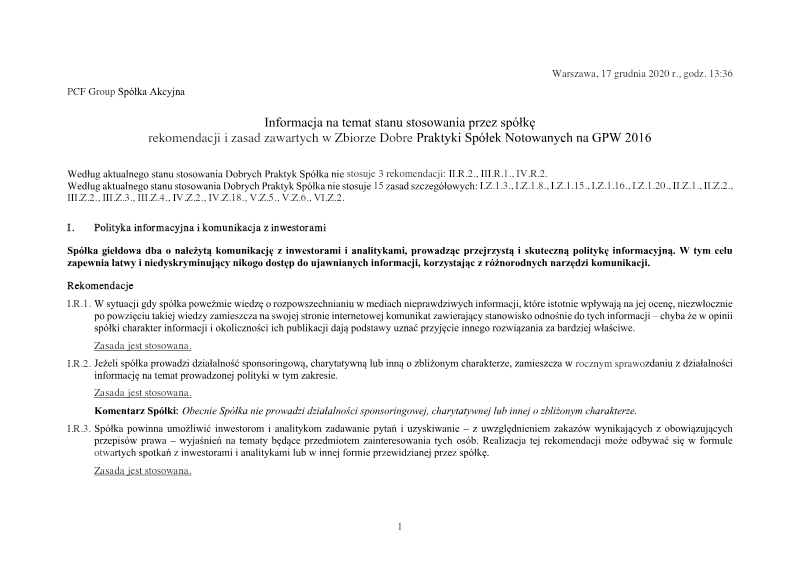
PCF Group S.A. maintains a framework of corporate governance that aligns with the majority of the Best Practice of GPW Listed Companies 2016, though it maintains several strategic deviations rooted in its organizational structure and recent transition to public markets. As of late 2020, the company’s governance model is characterized by a single-member Management Board, which precludes a formal division of responsibilities and centralizes risk management, compliance, and internal audit functions. Rather than establishing dedicated internal units for these oversight roles, the company relies on the direct supervision of the Management Board and the Audit Committee to ensure operational integrity. A significant area of non-compliance involves the absence of a formalized diversity policy. The company prioritizes merit-based recruitment and professional qualifications over specific gender or age targets for its governing bodies. Furthermore, technical and historical limitations impact transparency; the company does not provide real-time public broadcasts of General Meetings or a five-year historical financial data set in a processable format, citing its recent adoption of International Financial Reporting Standards as the primary cause for the latter. Regarding shareholder rights and executive compensation, the company adheres to statutory guidelines but bypasses certain optional recommendations. Notable exceptions include a share nominal value of 0.02 PLN, which is significantly lower than the recommended 0.50 PLN, and the lack of a dedicated compensation committee. While a formal remuneration policy is in place, stock-based incentives currently lack a minimum two-year vesting period. Despite these omissions, the company maintains standard protocols for managing conflicts of interest and ensures that significant related-party transactions follow established legal requirements, even in the absence of specific internal bylaws requiring additional Supervisory Board approval.
Warszawa, 17 grudnia 2020 r., godz. 13: 36 PCF Group Spółka Akcyjna Informacja na temat stanu stosowania przez spółkę rekomendacji i zasad zawartych w Zbiorze Dobre Praktyki Spółek Notowanych na GPW 2016 Według aktualnego stanu stosowania Dobrych Praktyk Spółka nie stosuje 3 rekomendacji: II.R.2., III.R.1., IV.R.2. Według aktualnego stanu stosowania Dobrych Praktyk Spółka nie stosuje 15 zasad szczegółowych: I.Z.1.3., I.Z.1.8., I.Z.1.15., I.Z.1.16., I.Z.1.20., II.Z.1., II.Z.2., III.Z.2., III.Z.3., III.Z.4., IV.Z.2., IV.Z.18., V.Z.5., V.Z.6., VI.Z.2. I. Polityka informacyjna i komunikacja z inwestorami Spółka giełdowa dba o należytą komunikację z inwestorami i analitykami, prowadząc przejrzystą i skuteczną politykę informacyjną. W tym celu zapewnia łatwy i niedyskryminujący nikogo dostęp do ujawnianych informacji, korzystając z różnorodnych narzędzi komunikacji. Rekomendacje I.R.1. W sytuacji gdy spółka poweźmie wiedzę o rozpowszechnianiu w mediach nieprawdziwych informacji, które istotnie wpływają na jej ocenę, niezwłocznie po powzięciu takiej wiedzy zamieszcza na swojej stronie internetowej komunikat zawierający stanowisko odnośnie do tych informacji – chyba że w opinii spółki charakter informacji i okoliczności ich publikacji dają podstawy uznać przyjęcie innego rozwiązania za bardziej właściwe. Zasada jest stosowana. I.R.2.
dzy zamieszcza na swojej stronie internetowej komunikat zawierający stanowisko odnośnie do tych informacji – chyba że w opinii spółki charakter informacji i okoliczności ich publikacji dają podstawy uznać przyjęcie innego rozwiązania za bardziej właściwe. Zasada jest stosowana. I.R.2. Jeżeli spółka prowadzi działalność sponsoringową, charytatywną lub inną o zbliżonym charakterze, zamieszcza w rocznym sprawozdaniu z działalności informację na temat prowadzonej polityki w tym zakresie. Zasada jest stosowana. Komentarz Spółki: Obecnie Spółka nie prowadzi działalności sponsoringowej, charytatywnej lub innej o zbliżonym charakterze. I.R.3. Spółka powinna umożliwić inwestorom i analitykom zadawanie pytań i uzyskiwanie – z uwzględnieniem zakazów wynikających z obowiązujących przepisów prawa – wyjaśnień na tematy będące przedmiotem zainteresowania tych osób. Realizacja tej rekomendacji może odbywać się w formule otwartych spotkań z inwestorami i analitykami lub w innej formie przewidzianej przez spółkę. Zasada jest stosowana.
I.R.4. Spółka powinna dokładać starań, w tym z odpowiednim wyprzedzeniem podejmować wszelkie czynności niezbędne dla sporządzenia raportu okresowego, by umożliwiać inwestorom zapoznanie się z osiągniętymi przez nią wynikami finansowymi w możliwie najkrótszym czasie po zakończeniu okresu sprawozdawczego. Zasada jest stosowana. Zasady szczegółowe I.Z.1. Spółka prowadzi korporacyjną stronę internetową i zamieszcza na niej, w czytelnej formie i wyodrębnionym miejscu, oprócz informacji wymaganych przepisami prawa: I.Z.1.1. podstawowe dokumenty korporacyjne, w szczególności statut spółki, Zasada jest stosowana. I.Z.1.2. skład zarządu i rady nadzorczej spółki oraz życiorysy zawodowe członków tych organów wraz z informacją na temat spełniania przez członków rady nadzorczej kryteriów niezależności, Zasada jest stosowana. I.Z.1.3. schemat podziału zadań i odpowiedzialności pomiędzy członków zarządu, sporządzony zgodnie z zasadą II.Z.1, Zasada nie jest stosowana. Komentarz Spółki: Zasada ta nie jest w pełni stosowana.
i, Zasada jest stosowana. I.Z.1.3. schemat podziału zadań i odpowiedzialności pomiędzy członków zarządu, sporządzony zgodnie z zasadą II.Z.1, Zasada nie jest stosowana. Komentarz Spółki: Zasada ta nie jest w pełni stosowana. Zarząd składa się z jednej osoby a zatem z powodów obiektywnych Spółka nie ma możliwości zamieszczenia na swojej stronie internetowej wewnętrznego podziału odpowiedzialności za poszczególne obszary działalności Spółki pomiędzy członków Zarządu; jednak Spółka zamierza stosować przedmiotową zasadę w pełni w przypadku rozszerzenia składu Zarządu, a do tego czasu zamieszcza na swojej stronie internetowej wewnętrzny podział odpowiedzialności za poszczególne obszary działalności Spółki z uwzględnieniem jednoosobowego składu Zarządu. I.Z.1.4. aktualną strukturę akcjonariatu, ze wskazaniem akcjonariuszy posiadających co najmniej 5% ogólnej liczby głosów w spółce – na podstawie informacji przekazanych spółce przez akcjonariuszy zgodnie z obowiązującymi przepisami, Zasada jest stosowana. I.Z.1.5. raporty bieżące i okresowe oraz prospekty emisyjne i memoranda informacyjne wraz z aneksami, opublikowane przez spółkę w okresie co najmniej ostatnich 5 lat, Zasada jest stosowana. I.Z.1.6.
Zasada jest stosowana. I.Z.1.5. raporty bieżące i okresowe oraz prospekty emisyjne i memoranda informacyjne wraz z aneksami, opublikowane przez spółkę w okresie co najmniej ostatnich 5 lat, Zasada jest stosowana. I.Z.1.6. kalendarz zdarzeń korporacyjnych skutkujących nabyciem lub ograniczeniem praw po stronie akcjonariusza, kalendarz publikacji raportów finansowych oraz innych wydarzeń istotnych z punktu widzenia inwestorów – w terminie umożliwiającym podjęcie przez inwestorów decyzji inwestycyjnych,
Zasada jest stosowana. I.Z.1.7. opublikowane przez spółkę materiały informacyjne na temat strategii spółki oraz jej wyników finansowych, Zasada jest stosowana. I.Z.1.8. zestawienia wybranych danych finansowych spółki za ostatnie 5 lat działalności, w formacie umożliwiającym przetwarzanie tych danych przez ich odbiorców, Zasada nie jest stosowana. Komentarz Spółki: Zasada ta nie jest w pełni stosowana. Zamiarem Spółki jest zamieszczanie na stronie internetowej zestawienia wybranych danych finansowych za ostatnie 5 lat działalności, w formacie umożliwiającym przetwarzanie tych danych przez ich odbiorców. Spółka wskazuje jednak, że do 2018 r. sprawozdania finansowe Spółki sporządzane były zgodnie z ustawą z dnia 29 września 1994 r. o rachunkowości („Ustawa o Rachunkowości”), a po tym czasie sprawozdania są sporządzane zgodnie z międzynarodowymi standardami sprawozdawczości finansowej zatwierdzonymi do stosowania w Unii Europejskiej („MSSF”). Na potrzeby sporządzenia prospektu zatwierdzonego przez Komisję Nadzoru Finansowego w dniu 25 listopada 2020 r., Spółka sporządziła skonsolidowane zbadane historyczne informacje finansowe Grupy za okres od 1 stycznia 2019 r. do 31 grudnia 2019 r., od 1 stycznia 2018 r. do 31 grudnia 2018 r. oraz od 1 stycznia 2017 r. do 31 grudnia 2017 r. sporządzone na potrzeby oferty akcji Spółki zgodnie z międzynarodowymi standardami rachunkowości („MSR”), MSSF i ich interpretacjami, zatwierdzonymi do stosowania w Unii Europejskiej.
PCF Group S.A., operating as People Can Fly, maintains a high level of transparency and shareholder engagement while navigating the transition toward full compliance with the Best Practice for GPW Listed Companies 2021. As of early 2023, the AAA game developer adheres to the majority of governance standards regarding board independence, internal systems, and shareholder relations. The company facilitates electronic participation in general meetings and provides bilingual broadcasts to ensure accessibility for its investor base. While it recently established an internal audit function and committed to a five-year external audit cycle, certain gaps remain in formalized risk and compliance departments, which the company intends to address in future reporting cycles. The primary areas of non-compliance center on formalized ESG strategies and diversity policies. The company currently excludes environmental and social issues from its formal business strategy, arguing that its operations as a software developer have a relatively low environmental impact. Furthermore, the company has opted not to implement a structured diversity policy for its Management or Supervisory Boards, preferring to maintain flexibility in recruitment by prioritizing specialized professional qualifications over specific gender or age metrics. Despite the absence of a formal policy, the company emphasizes a commitment to gender pay equality and merit-based advancement. Regarding executive compensation and related-party transactions, the company follows established standards for transparency and oversight. Remuneration for the Supervisory Board remains independent of short-term financial results, and procedures are in place for external valuations of significant transactions. Although the company’s statutes do not currently require General Meeting approval for all related-party transactions, it maintains rigorous internal oversight through the Supervisory Board. These governance practices reflect a balance between meeting the regulatory expectations of the Warsaw Stock Exchange and maintaining the operational agility required in the competitive global gaming industry.
PCF Group S.A. demonstrates a governance strategy that balances standard public company transparency with the specific operational realities of a high-end AAA game development studio. While the firm adheres to the majority of the 2021 Best Practices for GPW Listed Companies, it intentionally diverges from several key recommendations regarding environmental, social, and governance (ESG) integration and board composition. Specifically, the company rejects formalized gender diversity quotas, such as the recommended thirty percent threshold for management and supervisory boards, opting instead for a merit-based recruitment model. Furthermore, it does not currently publish detailed ESG performance metrics, citing the relatively low environmental impact inherent to the digital entertainment industry. Operational governance reveals a reliance on lean internal structures, which results in certain compliance gaps. The company lacks dedicated departments for internal audit and risk management, preventing the Supervisory Board from providing formalized assessments of internal controls. While the firm maintains robust investor communication and independent oversight, it does not yet offer electronic participation in general meetings or provide preliminary financial estimates. These omissions are attributed to perceived technical and legal risks, though there is a stated intent to evaluate electronic meeting capabilities in the future. Recent adjustments indicate a move toward closer alignment with regulatory expectations. The company committed to implementing live broadcasts of general meetings and has updated its internal regulations to require supervisory review of all management board resolutions. Future incentive programs are expected to incorporate both financial and non-financial objectives, ensuring that executive compensation remains tied to long-term sustainability. Overall, the governance profile reflects a transition period for the developer as it matures within the public market while maintaining its focus on technical excellence and meritocracy over rigid administrative frameworks.
Following its debut on the Warsaw Stock Exchange in December 2020, PCF Group S.A. established a corporate governance framework aligned with the Best Practice for GPW Listed Companies 2016, while identifying specific deviations necessitated by its organizational structure. The company’s governance model is characterized by a high degree of centralization, featuring a one-person Management Board led by CEO Sebastian Wojciechowski. This structure resulted in several non-compliance areas during the 2020 fiscal year, including the absence of a formalized diversity policy and the lack of a management responsibility map. Furthermore, the company opted not to maintain separate internal units for risk management or internal audit, instead consolidating these oversight responsibilities within the Management Board and a newly established internal finance department. Control of the company remains concentrated among a core group of founding shareholders who held 76.60% of voting rights at the end of 2020. This concentration is reinforced by specific personal rights granted through company statutes, which allow the founding group to appoint the majority of the Supervisory Board and the Chairman, provided they maintain a 40% voting threshold. Sebastian Wojciechowski retains the personal right to appoint the CEO as long as his individual voting share remains at least 25%. While share transfers are not statutorily restricted, significant lock-up agreements were in place for key shareholders and employees following the initial public offering, extending up to four years for certain share series. Financial oversight is managed through a Supervisory Board and a dedicated Audit Committee, which monitors financial reporting and auditor independence. In 2020, Grant Thornton served as the company’s auditor, providing no non-audit services to ensure objective reporting. To address potential conflicts of interest arising from the dual roles of certain Supervisory Board members who also served as directors within the gaming studio, the company implemented composition changes in early 2021. As the organization matures, there is an expressed intent to adopt more formalized governance practices, including expanded financial data history and more sophisticated internal control schemes.
PCF Group S.A. navigated its first full year as a listed entity in 2021 by balancing the "Best Practice for GPW Listed Companies 2021" with the operational demands of a rapidly expanding AAA video game developer. While the organization committed to these governance standards, it formally opted out of twenty specific principles, primarily regarding ESG integration, formalized diversity policies, and internal audit structures. Management justifies these deviations by prioritizing professional qualifications over demographic quotas and citing the specialized nature of the gaming industry, though it maintains high workplace standards through LEED-certified facilities and informal risk management systems. The governance framework is characterized by significant concentrated control held by a "Group of Authorized Shareholders" led by Sebastian Wojciechowski. This group retains 70.65% of voting rights and possesses personal rights to appoint a majority of the Supervisory Board, provided they maintain a 40% ownership threshold. Furthermore, Wojciechowski holds the personal right to appoint the President of the Management Board, a body he led as a single-person entity throughout 2021. While no formal restrictions on voting rights exist, a substantial portion of Series A shares remains subject to four-year lock-up agreements following the 2020 initial public offering. Financial oversight and transparency are managed through a five-member Supervisory Board and an Audit Committee featuring independent experts in finance and gaming. Although the company lacked a dedicated internal audit department in 2021, the Management Board maintained financial reporting risk systems that received no negative feedback from external auditor Grant Thornton. The organization is currently transitioning toward higher transparency standards, with plans to implement real-time streaming of general meetings and more formalized internal reporting to align with evolving regulatory expectations for public companies in Poland.