1 free read left. Create a free account for unlimited reading + AI research.
Create free accountWhitepaper European Conference on Games Based Learning (ECGBL)
1 free read left. Create a free account for unlimited reading + AI research.
Create free accountWhitepaperEuropean Conference on Games Based Learning (ECGBL)
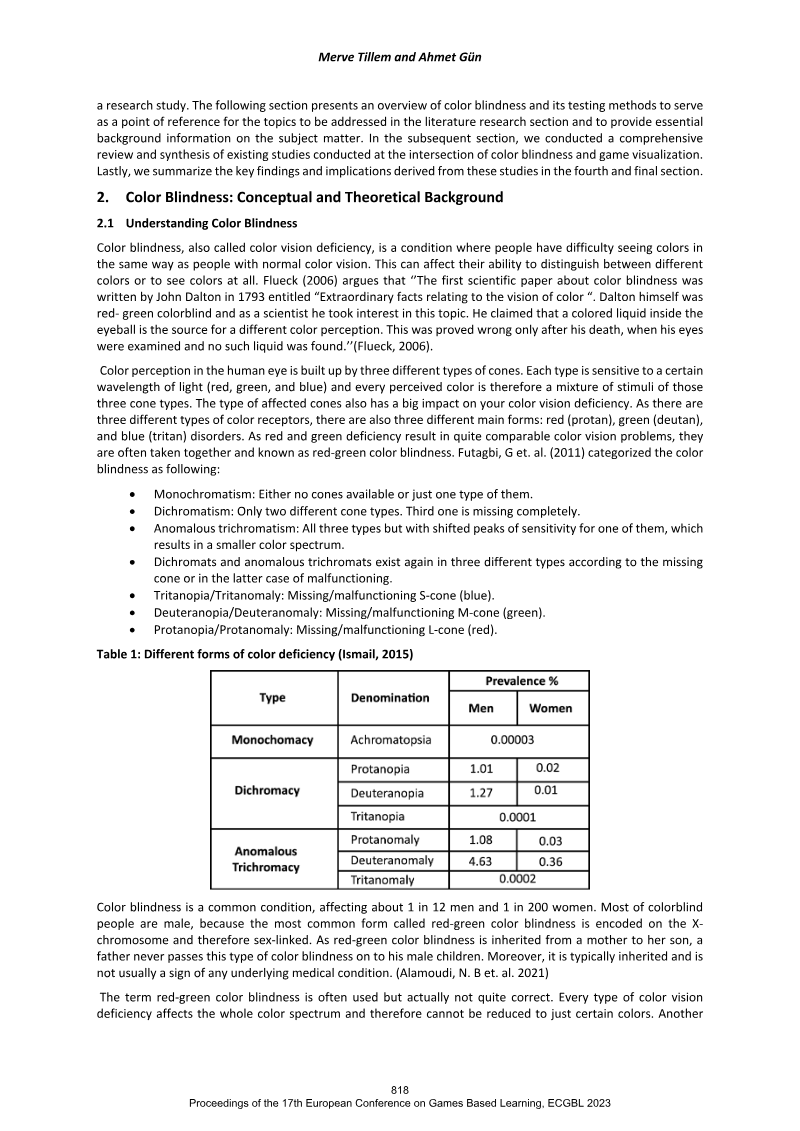
Roughly one in twelve men and one in two hundred women have color vision deficiency. Its implications for digital gaming have received limited systematic attention.
Color blindness, or color vision deficiency, affects roughly one in twelve men and one in two hundred women, yet its implications for digital gaming have received limited systematic attention. This review examines how color vision deficiency intersects with game design, accessibility technology, and player experience. The authors searched Scopus, Web of Science, and ACM, identifying around 100 papers, of which 11 were analyzed after excluding off-topic and engineering-focused work, providing a focused view of the current research landscape.
The reviewed literature spans several areas. Studies on design patterns and screen-based simulations show that tailored design and accessibility features can meaningfully improve the experience for color-blind players. Work on wearable augmented reality glasses, such as the Chroma system, and on operating system tools like Windows 10's color filter illustrates how assistive technology can compensate for chromatic deficits. Educational and awareness games, including those that teach players about color blindness, also appear in the literature and may help with early detection.
A central finding is that color blindness may shape emotional perception more than objective gameplay performance. Research on the performance impact of color blindness in games suggests that its effects are not always captured by conventional measures, pointing to the importance of subjective and affective outcomes in future evaluation.
The review also identifies a significant gap: no study to date has examined whether color-blind players experience differences in physical, sensory, or emotional responses during gameplay. Addressing this question would clarify whether current accessibility approaches adequately serve color-blind players and where design interventions should focus next.

European Conference on Games Based Learning (ECGBL) · 2026



European Conference on Games Based Learning (ECGBL) · 2026

European Conference on Games Based Learning (ECGBL) · 2026



European Conference on Games Based Learning (ECGBL) · 2026



European Conference on Games Based Learning (ECGBL) · 2026



European Conference on Games Based Learning (ECGBL) · 2026



European Conference on Games Based Learning (ECGBL) · 2026



European Conference on Games Based Learning (ECGBL) · 2026



European Conference on Games Based Learning (ECGBL) · 2026



European Conference on Games Based Learning (ECGBL) · 2026



European Conference on Games Based Learning (ECGBL) · 2026



European Conference on Games Based Learning (ECGBL) · 2026
European Conference on Games Based Learning (ECGBL) · 2026