1 free read left. Create a free account for unlimited reading + AI research.
Create free accountArticle DiGRA
1 free read left. Create a free account for unlimited reading + AI research.
Create free accountArticleDiGRA
Distilling the key insights…
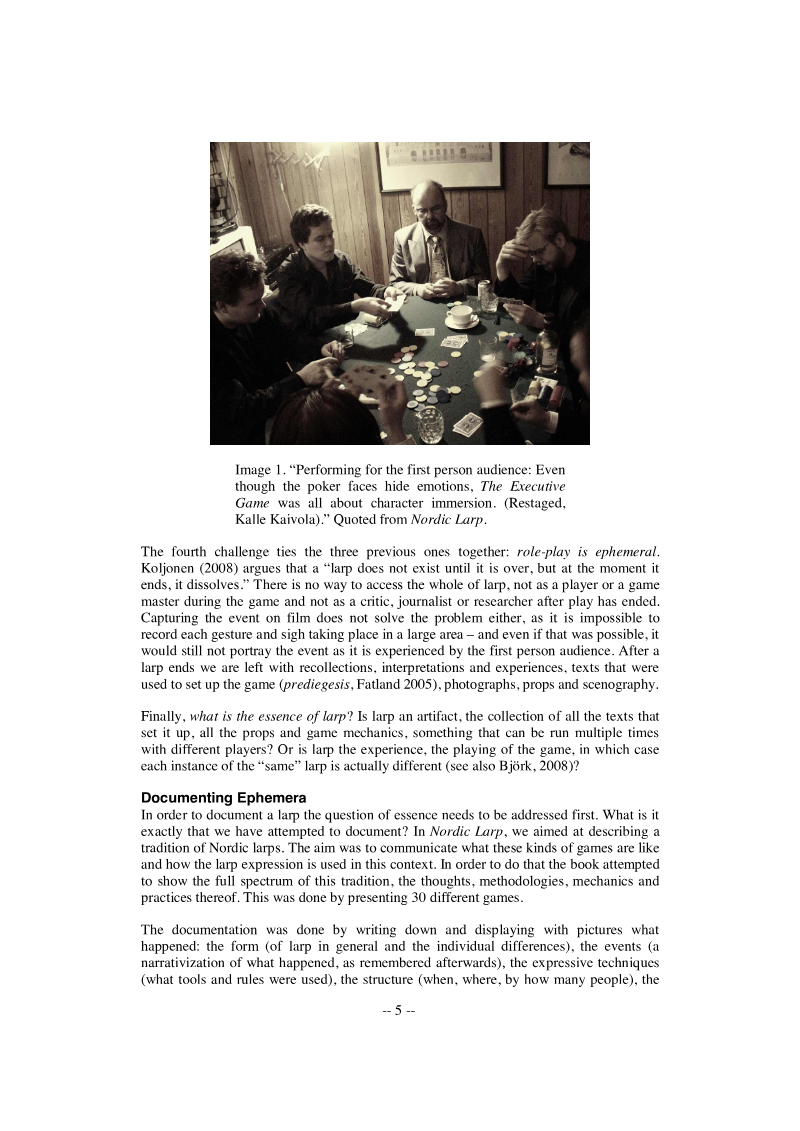
Nicolle Lamerichs's analysis examines a Dutch fan-initiated live-action role-playing game (LARP) set in the universe of the cancelled television series Firefly, organized by the Knights of the Kitchen Table. The paper argues that the game embodies a co-creative design perspective in which the roles of designer, player, and fan overlap rather than remain separate. Drawing on participatory ethnography and an interview with the designers, it positions fan-made play within participatory culture, alongside fan fiction, fan art, cosplay, and modding, while critiquing game studies for its relative neglect of player-initiated games. Design is understood through Salen and Zimmerman's framework of four interacting elements: designer, context, participants, and meaningful play.
The game places players on the outer rim of the Firefly universe, where six ships converge at the colonial vessel New Carolina. Four staff members, who were both fans and experienced game masters, selected the series for its casual, non-heroic characters, small ships, and morally ambiguous settings, all of which favor collaborative roleplay. Using physical props and a lightly structured skill system adapted from existing Firefly and Star Wars LARP rules, the designers encouraged cooperation and sandbox-style exploration. Their stated aim was to facilitate rather than dictate play, allowing meaningful outcomes to arise from player choices, such as an Alliance takeover or a triggered execution. This approach required frequent improvisation whenever participants departed from scripted events.
The study finds that the game's co-creative structure gave players substantial agency. Game masters adapted continually to participant behavior and deliberately introduced moral dilemmas, including executions and a suicide mission. They anticipated protests or a coup that never occurred, and the resulting story diverged considerably from the designers' intentions. The author concludes that the boundaries between fans, gamers, and designers were blurred, as participants co-authored the narrative while staff supported play through hands-on mechanics and withdrew when necessary. Ultimately, the paper presents the Dutch Firefly LARP as evidence that role-playing games, in contrast to many digital games, place player agency at the center of a participatory and derivative story world.
Each row is a game or company this document names, each column a document, oldest first. A mark means that document names it. Select a row to see those documents.
DiGRA · 2012
DiGRA · 2012
DiGRA · 2012
DiGRA · 2012
DiGRA · 2012
DiGRA · 2011
DiGRA · 2011
DiGRA · 2011
DiGRA · 2011
DiGRA · 2011
DiGRA · 2011
DiGRA · 2011
Game Developers Conference · 2019