Interactive Institute
Organization2 reports
Interactive Institute is a Swedish research institute for art, design and technology. It publishes research reports on game design topics such as electronically augmented board games and socially adaptable games.
Documents
Whitepaper7 pages
Augmented Board Games: Enhancing Board Games with Electronics
This paper, presented at DiGRA 2005, examines augmented board games: traditional board games extended with electronics, sensors, and computational power to enhance gameplay.
- The paper, presented at DiGRA 2005, maps the design space of augmented board games (traditional board games extended with electronics, sensors, and computing), with the goal of mapping subspaces rather than producing a complete taxonomy.
- The authors set three research priorities: minimize unempowering or tedious player activities, provide mechanics impossible or impractical without technology, and preserve the social environment of non-augmented board games.
- Purely aesthetic augmentation was deliberately excluded unless it arose as a side effect of gameplay improvements.
Interactive InstituteJan 2005
Whitepaper8 pages
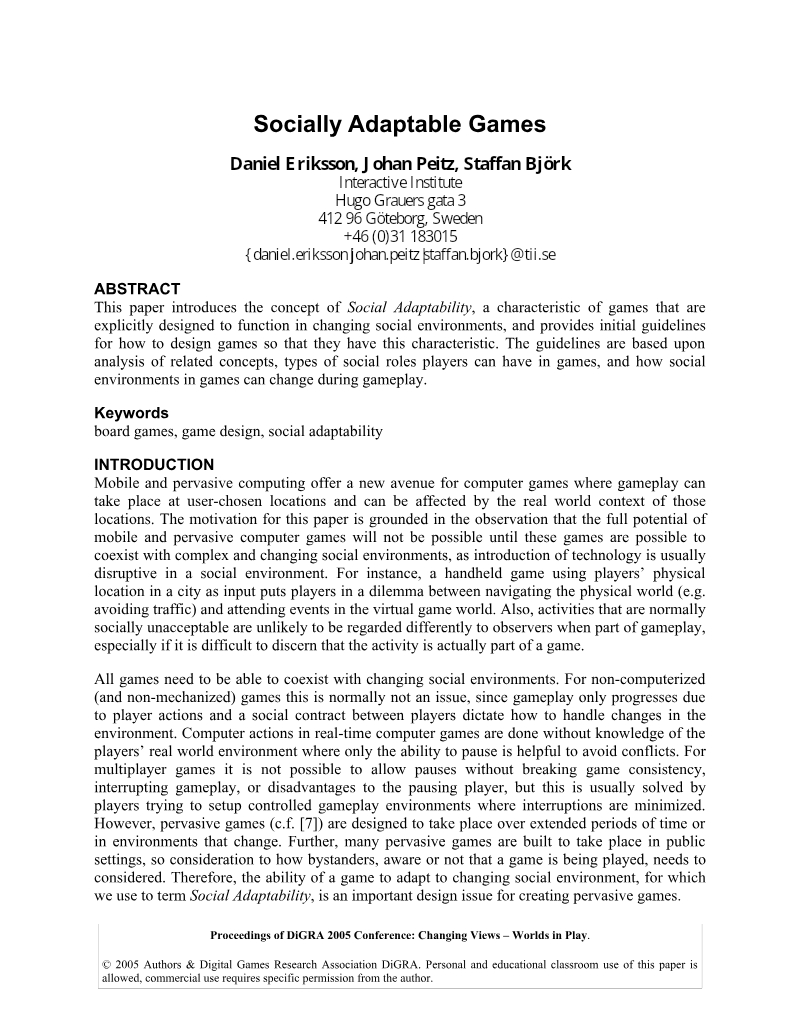
Socially Adaptable Games
This paper introduces "Social Adaptability," defined as a game's ability to adjust, either actively through sensing or passively through design, to changes in its social environment so that negative effects on gameplay and on bystanders are minimized.
- Social Adaptability is defined as a game's ability to adjust, actively through sensing or passively through design, to changes in its social environment so that negative effects on gameplay and bystanders are minimized.
- The authors argue that pervasive and mobile games, which are played over long periods, in changing locations, and often in public, cannot reach their potential unless they can coexist with complex social contexts.
- Traditional board and card games achieve only partial social adaptability, because their pause-based solutions force all players to adapt to one player's interruption.
Interactive InstituteJan 2005