1 free read left. Create a free account for unlimited reading + AI research.
Create free accountWhitepaper DiGRA
1 free read left. Create a free account for unlimited reading + AI research.
Create free accountWhitepaperDiGRA
Cross-sectional correlations dominate the gaming literature.
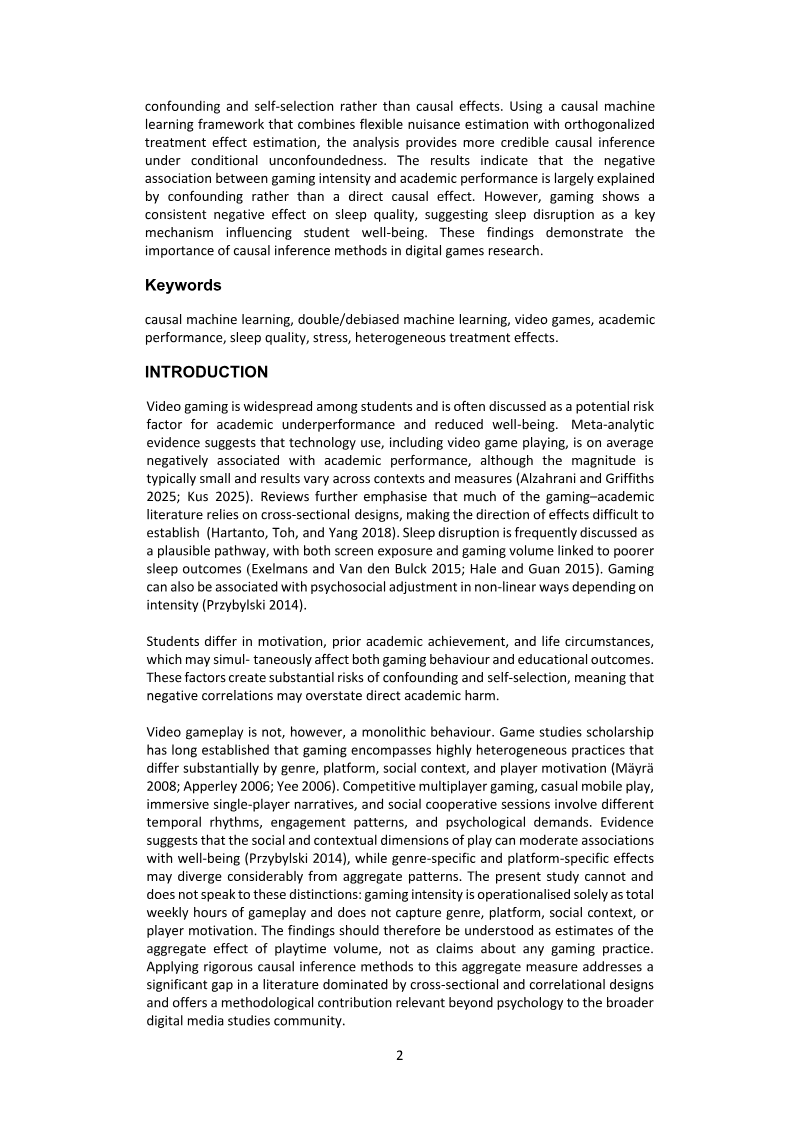
This study investigates the causal effects of video game intensity on university students' academic performance and psychosocial well-being, specifically sleep quality and stress. The research focuses on students in Kazakhstan, Kyrgyzstan, and Uzbekistan, utilizing a cross-sectional survey dataset of 2,267 observations. The primary methodology involves Double/Debiased Machine Learning (DML) and Causal Forest techniques to provide robust causal inference, addressing limitations of prior correlational studies that often overstate negative associations due to confounding. Gaming intensity is defined as total weekly hours of gameplay.
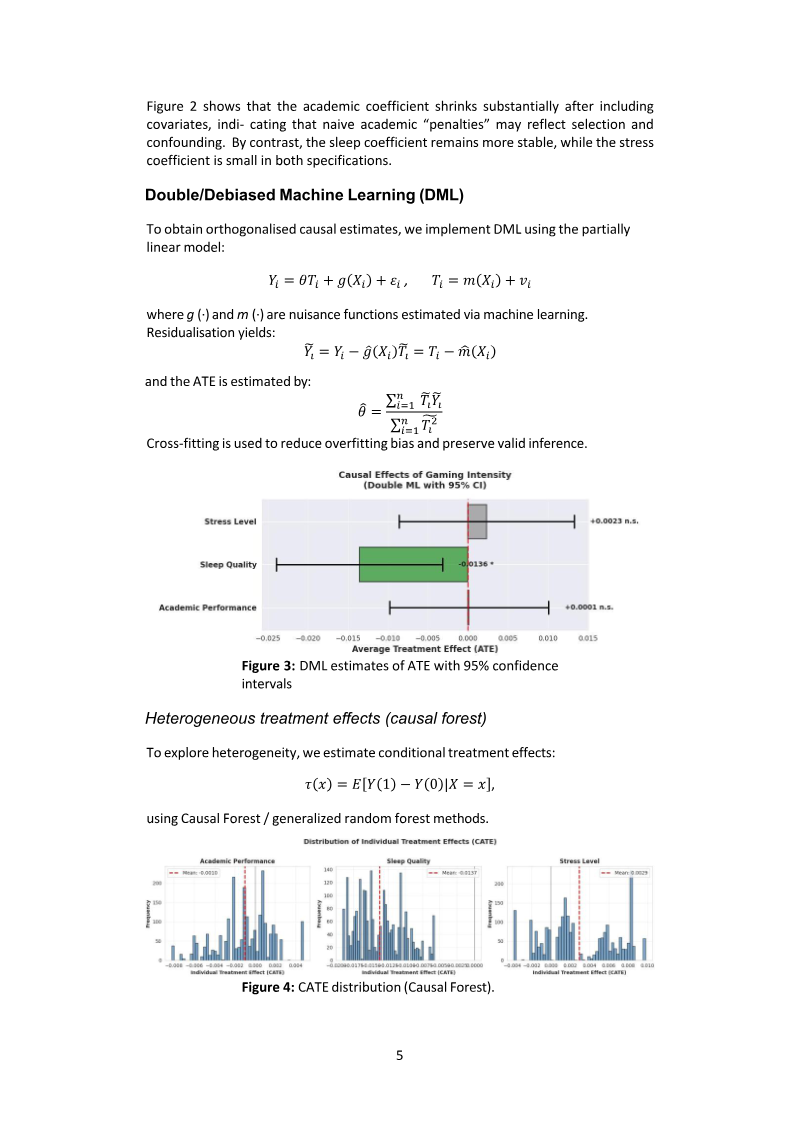
Key findings indicate that the negative correlation between gaming intensity and academic performance, commonly observed in conventional analyses, is largely attributable to confounding factors and self-selection rather than a direct causal effect. After controlling for covariates using DML, the estimated causal effect on academic performance becomes statistically indistinguishable from zero. In contrast, gaming intensity demonstrates a consistent and statistically significant negative causal impact on sleep quality. This effect remains robust across average and heterogeneous treatment effect estimates, identifying sleep disruption as the most reliable mechanism through which intensive gaming affects student well-being. No systematic average causal effect on stress was observed.
The study concludes that concerns regarding gaming and student welfare should primarily focus on sleep disruption rather than academic performance. It suggests that interventions, such as in-game session timers, platform-level bedtime notifications, and playtime transparency tools, could mitigate sleep displacement without broadly pathologizing play. Methodologically, the research underscores the importance of causal machine learning in digital media studies to achieve more policy-relevant conclusions by accurately disentangling causal relationships from mere correlations. Future research should explore genre- and context-specific play patterns and integrate behavioral playtime logs with self-reported data.

DiGRA · 2026

DiGRA · 2026



DiGRA · 2026



DiGRA · 2026



DiGRA · 2026



DiGRA · 2026



DiGRA · 2026



DiGRA · 2026



DiGRA · 2026

DiGRA · 2026



DiGRA · 2026



DiGRA · 2026
The Game Business · 2026
















Comments