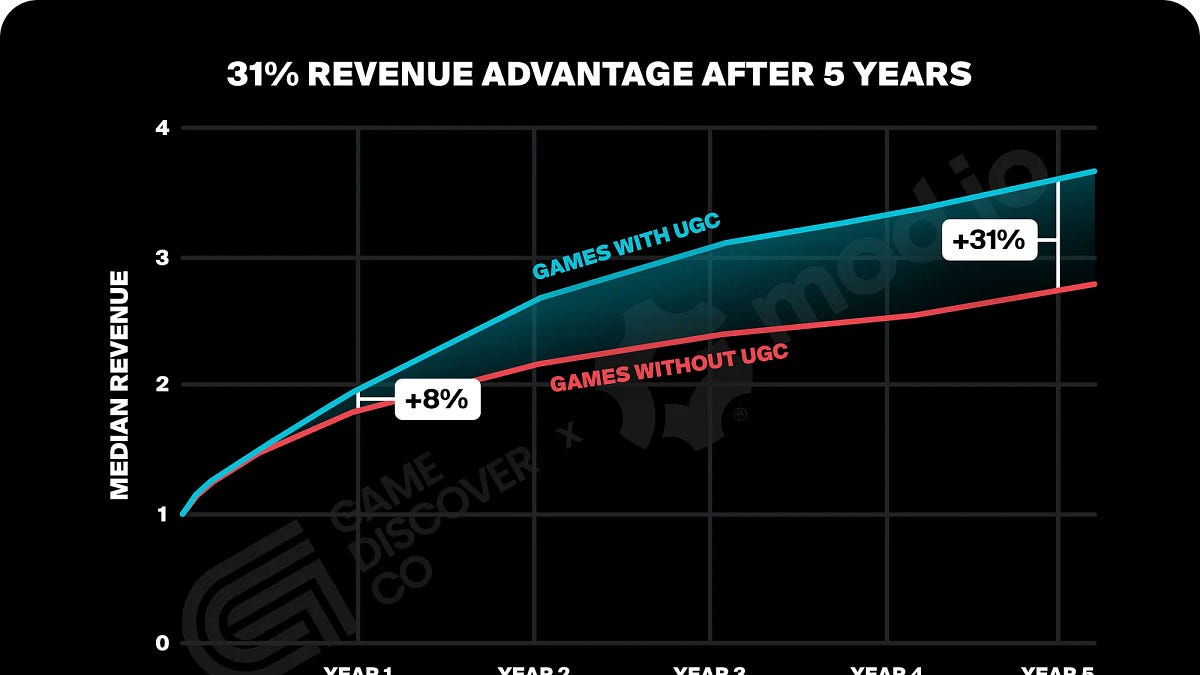
User-generated content (UGC) serves as a significant driver for both sales and long-term player retention across the video game industry. By analyzing approximately 1,200 games that generated over $1 million in initial monthly revenue on Steam, findings indicate that titles incorporating official UGC or modding solutions realize an 8% revenue advantage in their first year, which expands to a 31% advantage after five years. This performance gap is mirrored in player engagement, with UGC-enabled games demonstrating 75% higher concurrent user counts after two years and 115% higher counts after five years compared to titles without such support.
The research, conducted in partnership with Mod.io, also addresses common developer concerns regarding the potential cannibalization of paid downloadable content (DLC). Data suggests that games with UGC support actually see 105% higher total revenue per DLC, suggesting that modding ecosystems foster a virtuous cycle of engagement rather than diminishing the value of official expansions. Furthermore, the study expanded its scope to include console and virtual reality platforms. On consoles, games with mod support showed a 16% player advantage on PlayStation and a 24% advantage on Xbox after one year. In the VR sector, specifically among titles with over 1,000 player ratings on the Meta Quest Store, those with UGC support experienced 30% more growth over the past year than their counterparts.
While acknowledging potential correlation-causation factors—such as the possibility that certain genres naturally attract both modders and long-term players—the evidence consistently points to UGC as a powerful tool for extending a game's lifecycle. By empowering players to contribute content, developers can maintain higher engagement levels and drive sustained commercial performance across diverse platforms and hardware ecosystems.