Loading the document

1 free read left. Create a free account for unlimited reading + AI research.
Create free accountArticleGame Production Alchemist
This approach identifies both negative threats and positive risks, which are opportunities that can drive project innovation and performance.
Key shift. Agile risk management treats both negative threats and positive opportunities as actionable inputs for project trajectory.
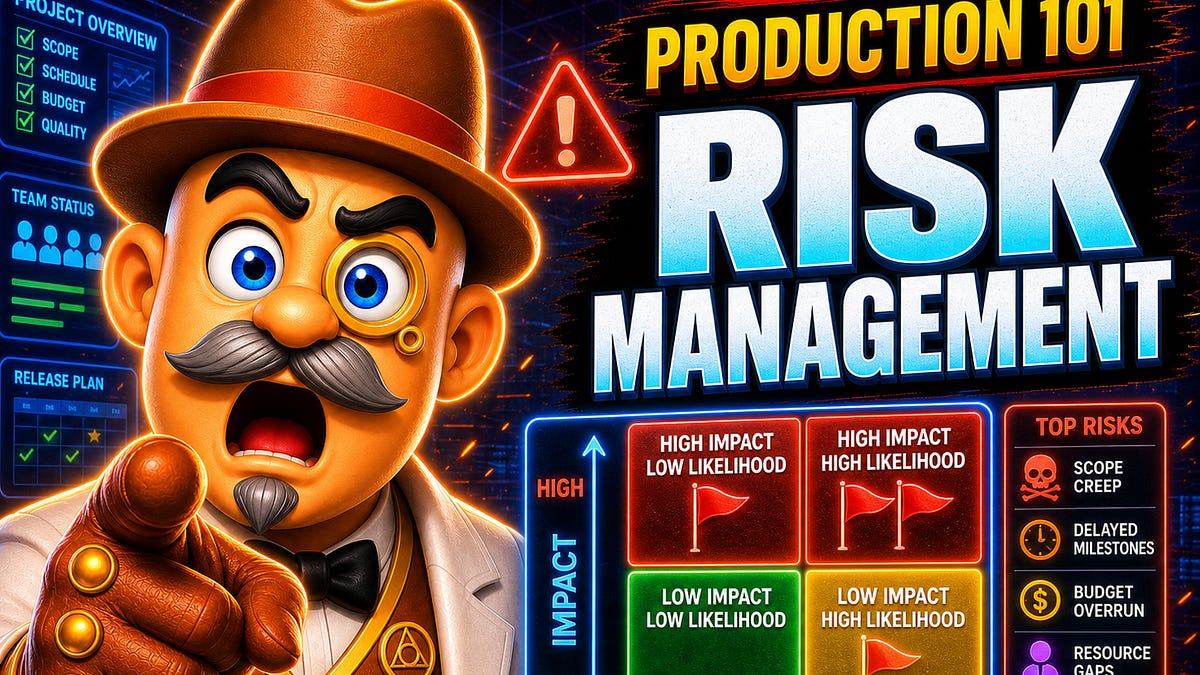
The document "Agile Risk Management in the Game Studio" outlines a comprehensive framework for integrating adaptive risk management practices into game development, contrasting it with traditional, more rigid approaches. Its main purpose is to advocate for a proactive, continuous, and collaborative risk management strategy that is deeply embedded within agile methodologies, applicable to projects of varying scales. The core thesis is that while agile processes inherently address some team-level risks through iterative cycles, larger or more complex projects necessitate a structured yet flexible system for identifying, analyzing, and responding to both potential threats and opportunities.
Key findings emphasize a dynamic approach to risk, redefining it to encompass both negative impacts and positive opportunities, and clearly differentiating future uncertainties (risks) from current problems (issues). The framework highlights the importance of continuous monitoring through tools like risk registers and issue logs, alongside a flexible scoring system for impact and likelihood that combines objective analysis with expert intuition. Response strategies include mitigation, avoidance, acceptance, monitoring, and transference.
Effective implementation, as detailed, relies heavily on clearly defined roles such as Risk Managers and Risk Owners, and a studio culture that promotes open communication, psychological safety, and acknowledges the subjective nature of risk perception. While the primary focus is on the operational aspects of risk management within game development, a supplementary section, seemingly promotional, underscores the critical and evolving role of producers in ensuring project success, even within smaller teams, suggesting that effective leadership and role definition are integral to managing project complexities and risks. The document's scope is focused on game development studios, without specific geographic or time period limitations, and addresses various project scales within the industry.

Game Production Alchemist · 2026

Game Production Alchemist · 2026
Game Production Alchemist · 2026

Game Production Alchemist · 2026
Game Production Alchemist · 2026
Game Production Alchemist · 2026

Game Production Alchemist · 2026

Game Production Alchemist · 2026
Game Production Alchemist · 2026

Game Production Alchemist · 2026

Game Production Alchemist · 2026

Game Production Alchemist · 2026










Comments