Key insights
6 slides
The problem
Game storytelling is often hindered by the need for technical programming expertise.
This requirement creates bottlenecks and limits creative control for professional storytellers. The engine aims to address this disconnect between storytellers and game developers.
Key Issue. The engine decouples narrative creation from technical programming by using a standardized XML-based format.
1 / 6
- 01The engine decouples narrative creation from technical programming by using a standardized XML-based format, allowing storytellers to define dialogue and stage directions without writing game code.See it on page 2
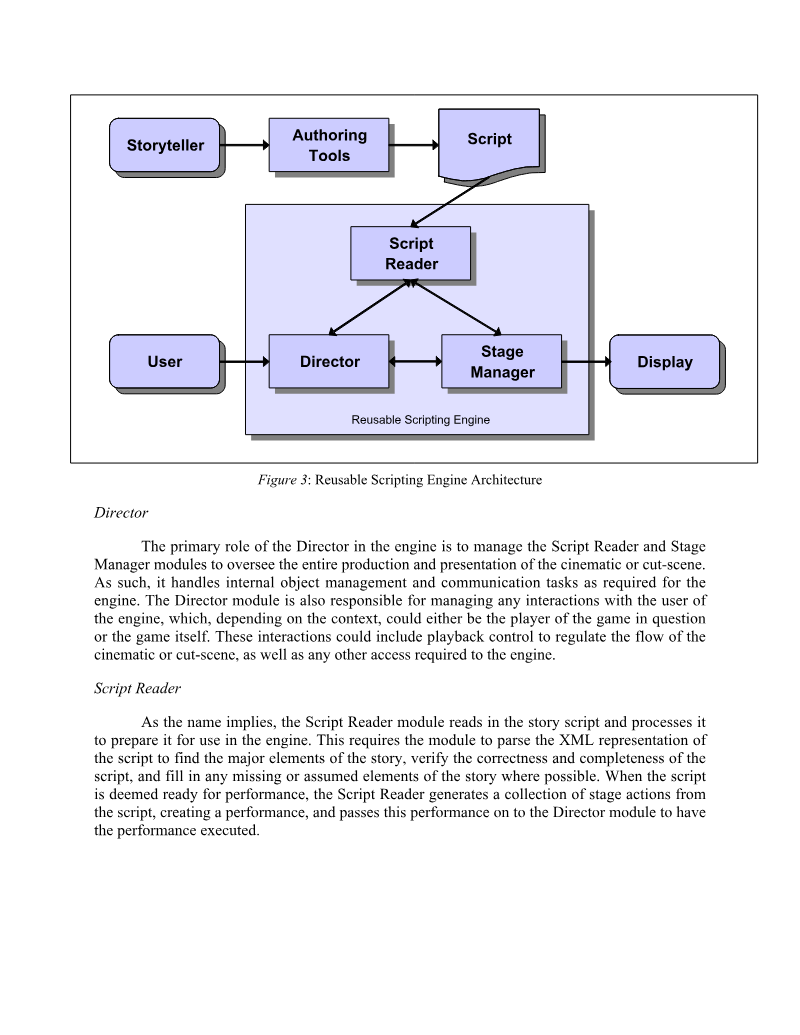
- 02The architecture consists of three core modules: a Director for production flow, a Script Reader for XML parsing and validation, and a Stage Manager for executing visual and audio performance.See it on page 6
- 03The system utilizes a customized implementation of Text Encoding Initiative (TEI) guidelines, incorporating specific hooks for game-ready assets like 3D models and audio files.See it on page 3
- 04The prototype was developed in C++ for Windows, integrating the OGRE 3D rendering engine and the FMOD sound system to facilitate compatibility with academic and independent projects.See it on page 8
- 05Initial testing demonstrated the engine's capability to manage character model swapping, tone-based dialogue formatting, and precise, timed stage directions.See it on page 11
- 06Future development is focused on expanding the engine to support complex 3D animations, dynamic story generation, and fully integrated in-game storytelling sequences.See it on page 11
Ask AI about this report
Summary
The Reusable Scripting Engine addresses the disconnect between professional storytellers and game developers by providing a tool that automates the generation of cinematics and cut-scenes. The primary thesis is that game storytelling is often hindered by the requirement for technical programming expertise, which creates bottlenecks and limits creative control. By utilizing a standardized, XML-based scripting format, the engine allows storytellers to define narrative elements—such as dialogue, character models, and stage directions—without needing to write underlying game code.
The engine architecture consists of three core modules: a Director that manages production flow, a Script Reader that parses and validates XML-encoded stories, and a Stage Manager that executes the visual and audio performance. The methodology relies on a customized implementation of the Text Encoding Initiative (TEI) guidelines, adapted to include specific hooks for game assets like 3D models and audio files. The prototype was developed in C++ for the Windows platform, utilizing the OGRE 3D rendering engine and the FMOD sound system to facilitate integration with existing academic and independent game projects.
Initial testing involved re-enacting scenes from television and film, demonstrating the engine's ability to handle character model swapping, tone-based dialogue formatting, and timed stage directions. Findings indicate that the system successfully decouples narrative creation from technical implementation, allowing developers to focus on story quality. While the prototype currently faces minor rendering glitches, the results confirm that a modular, script-driven approach is a viable solution for streamlining game production. Future development aims to expand support for complex 3D animations, dynamic story generation, and integrated in-game storytelling sequences.