1 free read left. Create a free account for unlimited reading + AI research.
Create free accountWhitepaper European Conference on Games Based Learning (ECGBL)
1 free read left. Create a free account for unlimited reading + AI research.
Create free accountWhitepaperEuropean Conference on Games Based Learning (ECGBL)
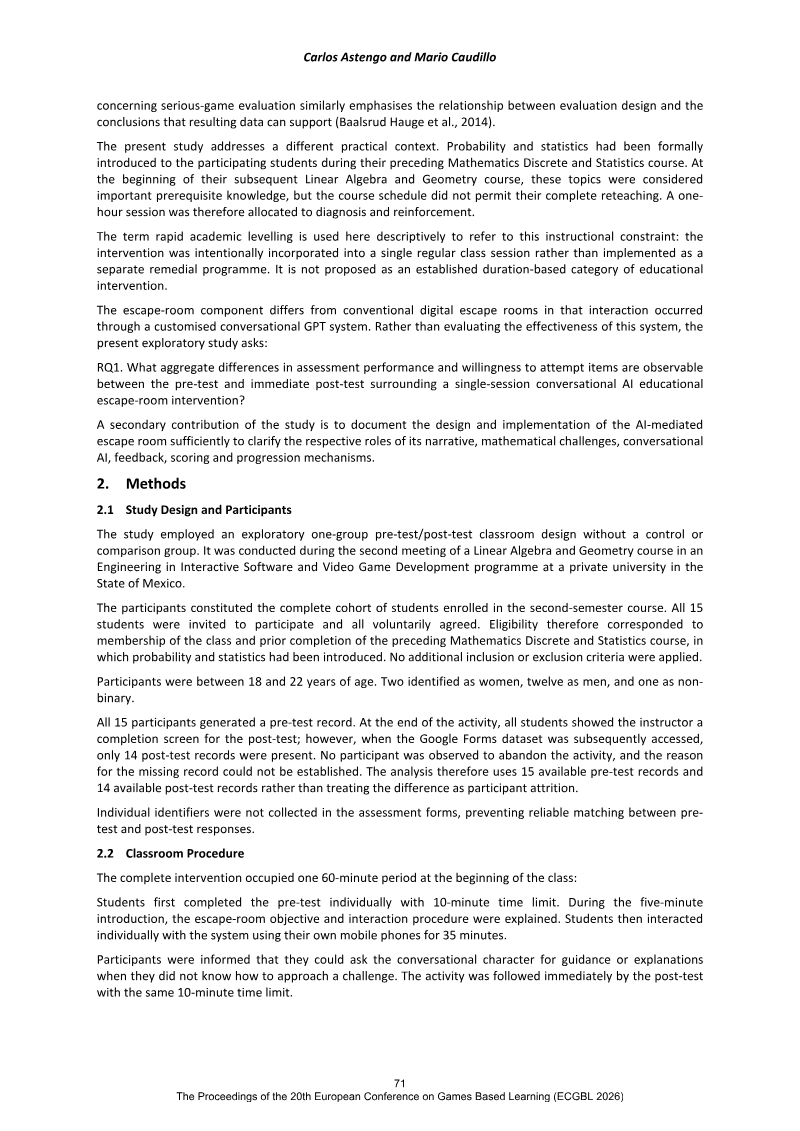
The review analysed 38 peer-reviewed articles published between 2019 and early 2023. Higher education dominates the sample.
Who was studied. North American institutions account for 47% and European institutions for 45% of the reviewed studies.
This paper examines how digital educational escape rooms (DEERs) can be designed to build social entrepreneurship competencies such as problem solving, interpersonal communication, creativity, confidence, and empathy. Drawing on a systematic review of 38 peer-reviewed English-language journal articles published between 2019 and early 2023, drawn from ERIC, Web of Science, and Scopus, the authors coded studies by subject area, region, study type, impact, theoretical grounding, and reported design elements. The sample is weighted toward higher education, with North American (47%) and European (45%) institutions dominating, and healthcare-related courses accounting for the largest share of content areas at 39%, followed by science and engineering at 24%.
The review finds that DEERs are overwhelmingly associated with positive outcomes for learning, motivation, engagement, and collaboration, and that nearly all reported successful online teamwork. Notably, no consistent evidence links specific design choices such as puzzle type, narrative style, team size, play length, or synchronous versus asynchronous format to particular skills. Instead, the gamified, team-based learning environment appears to drive impact more than individual design features. Theoretical grounding was inconsistent: roughly 39% of articles reported no game-design theory and a similar share no pedagogical theory, though constructivism, active learning, problem-based learning, flow theory, and cognitive load theory recur, with some evidence that instruction before gameplay improves knowledge retention.
The authors conclude that DEERs hold considerable promise for social entrepreneurship education, yet the field lacks a common reporting schema, standardized competency definitions, and robust pre- and post-testing, and many studies rely on small samples or observation. The authors identify more nuanced research on design elements and collaboration optimization as the priority for future work.



European Conference on Games Based Learning (ECGBL) · 2026



European Conference on Games Based Learning (ECGBL) · 2026



European Conference on Games Based Learning (ECGBL) · 2026



European Conference on Games Based Learning (ECGBL) · 2026



European Conference on Games Based Learning (ECGBL) · 2026



European Conference on Games Based Learning (ECGBL) · 2026



European Conference on Games Based Learning (ECGBL) · 2026



European Conference on Games Based Learning (ECGBL) · 2026



European Conference on Games Based Learning (ECGBL) · 2026



European Conference on Games Based Learning (ECGBL) · 2026



European Conference on Games Based Learning (ECGBL) · 2026



European Conference on Games Based Learning (ECGBL) · 2026
European Conference on Games Based Learning (ECGBL) · 2023
European Conference on Games Based Learning (ECGBL) · 2022
European Conference on Games Based Learning (ECGBL) · 2022