1 free read left. Create a free account for unlimited reading + AI research.
Create free account
A Framework for Valuing Mobile Gaming Studios
Key insights
6 takeaways- 01Valuation should shift from market-centric multiples to a bottom-up approach based on tangible financial drivers and actual cash-generating potential.
- 02Discounted cash flow (DCF) models are often unsuitable for early-stage startups, making data-driven financial hygiene a more reliable metric for studios at all lifecycle stages.
- 03The primary valuation pillar requires modeling the residual value of existing user cohorts by calculating long-tail revenue assuming all new user acquisition ceases immediately.
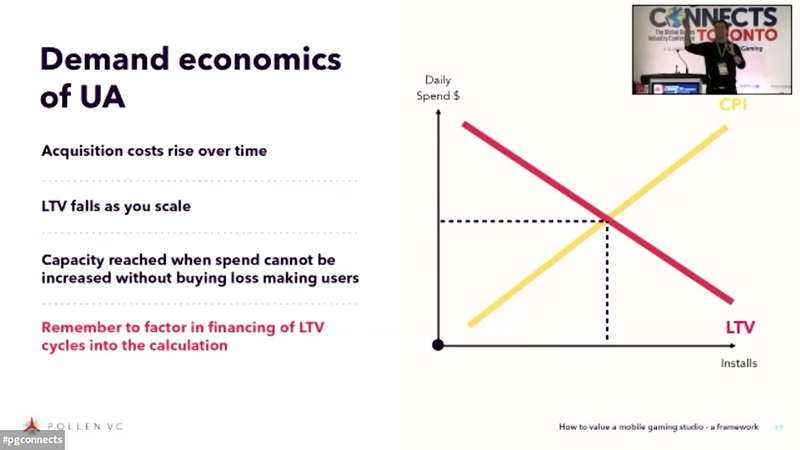
- 04Studios must evaluate the efficiency of their user acquisition machine by identifying the equilibrium point where acquisition costs intersect with lifetime value (LTV).
- 05Valuations must account for the financing costs required to bridge the gap between upfront user acquisition spend and the delayed realization of LTV.
- 06Intangible assets including first-party data, cross-promotion capabilities, and proprietary non-content intellectual property are essential components of a studio's defensible value.
Ask AI about this video
Transcript
foreign [Music] ask a familiar face to come back on up so we've got Martin coming back up he's going to talk to us about creating a framework for valuing a company because after all we put so much time sweat effort blood tears into making our games and making our games businesses how do we actually describe that to investors how do we make sure we get that value so Martin cool thank you very much Oscar so I'm Martin McMillan I'm the founder
and CEO of Poland VC um what we're trying to do is basically improve the overall financial literacy of game developers um that's a sort of higher purpose Mission our day job is providing revolving credit facilities to help them scale so rather than go and raise equity for to put into user acquisition we provide non-dilutive debt Capital which can be be used to scale up uh gaming studio uh in a very sort of capital efficient way so um we're going to talk about a framework for how to value a mobile gaming studio so obviously the last couple of years has had an insane amount of uh M A activity um and obviously the Market's changing now so what we thought we'd do is um is come up with some kind of framework components if you like that can help arrive a value now this may be you trying to Value yourself as a studio it may be uh VC investors trying to figure out what the next round price is it may be of course primary target
really is an acquirer saying how am I going to Value this as an asset so if we go back to my my very first uh day of being an economic student first principle of value is something is worth what someone's prepared to pay for it there's no point in saying oh well they sold for this therefore I'm worth that or whatever unless there's someone's actually prepared to part with cash then you know it's just theoretical so the price is what someone's prepared to pay for your studio now what typically always happens is in and we've been in a 15-year bull market so um there's two ways to look at this you can look at the market-centric methodologies for value and Company or you can look at the company-centric so if you look at Market Centric that's about you know it's about revenues it's about ebit does it's about multiples you know everyone will say well they sold for 20x or 15x whatever therefore I'm going to Value myself on the same basis it's like a it's it it it's always what happens um and there's some kind of comparables
about there as well so you can uh you know you can Benchmark it against different uh transactions that have happened the other way of doing it is the bottom up and typically in times when markets pull back um it's very very helpful to have a bottom-up case so this is looking at the company and this is looking at where the where the revenue drivers within the company are to actually come up with some sort of defensible uh base case valuation so this is things like uh you know cohorts cash the ability to generate cash as well as some of the other intangibles around it so next statement everything is a DCF so DCF has discounted cash flow it's how companies have been valued for the last 100 years um and it's basically the the DCF analysis is like taking us looking at all the expected future cash flows that that company is going to generate and then discounting them back to it in
value today so it might be of two three four five ten year and you basically say well if I had to borrow the money today to achieve all of this then you know what would this present value number be so it basically takes all of these future cash flows back to a value today now using discounted cash flow as a way an evaluation mechanic for a seed stage or series a Stage Company just doesn't work right um and the the factor it because you there's just too much uncertainty so you don't know if you're making a 500 000 seed investment uh of course you expect to make money back maybe 10 or 20x but you've got very very little certainty over that so I'm not suggesting using uh DCF mechanic for you know valuing a a venture caps around or anything at all at least not until later in a company's life but where you've got cash flows and particularly metrics around user acquisition it's a very very good starting point and again what we're trying to do is to create a framework where we've got some tangible value
drivers within a business to then argue a defensible value so number one um existing user cohorts so the the thing to do here is to assume let's say that you stop acquiring any users so organic users paid users whatever you just press stop on all new customer acquisition and what we're trying to do is to take you know those are Classics uh stats cohort diagram so we're saying let's assume the UA stops here what do we expect the residual value to be in all of those users so if you know if it's short ltvs then it's going to be very short if it's very long multi-year franchises there's going to be a lot of value trapped up there so what we're trying to do is effectively value the long tail and to say you know if we waited until all of this kind of played out and then discounted it back there is this much value trapped you know right to the end of the long tail so that's number one um now the key things that drive that
are number one historical UA spend so if you've been spending fifty thousand dollars a day for the last four years you've a ton of you know uh money that's gone in it can be very very Capital intensive game um a business rather invest in UA so the key driver is going to be how much you've already spent invested in those cohorts and on the other side of it is like how long will it play will it take for those cohorts to play out so this is LTV duration you know am I a hyper casual game with a 30-day LTV or am I some kind of mid-core with a 12 to 18 month or am I some like an amazing puzzle game that people are going to play for two or three or four years before they move on to something else so LTV duration is super important because that's how much is going to be trapped in the residuals but also how much you've spent is gonna it's effectively putting money into a flywheel and how long does it take that flywheel to run out of energy that's the way to think about um existing user cohorts so the next one is basically the
efficiency and the scalability of your UA machine so your UA machine um the way we always think about it is like first of all figure out have you got a machine can you put a dollar in and make more than the dollar back within a known time frame so unfortunately most people can't which is why they fall over but if you do and you're able to scale a business using page UA which is obviously you know one of the probably the primary Channel how are these games scale we want to understand the metrics behind your machine and how good your machine is because effectively what I'm buying as a as an acquirer a big part of it apart from the cash flows from your residuals is your ability to generate money through Page UA so if we look at a uh so I assume this is a um let's say some kind of puzzle game or something it's got a uh thinking about a two-year lifetime value so I've got some some predictability in this I've maybe I've got a Year's worth of cohorts already something like that um you've got a five dollar acquisition cost and an eight dollar LTV
and it takes you you're going to break even on that roast break even at about nine months and you'll go on to generate a 60 return so you're going to generate an extra two bucks uh return but it takes you two years to to to get that return so you're making a you're making a profit you turn five into eight you're making a you're making a three dollar profit which if you look at it uh is a sixty percent profit but it takes you two years so if you want to be you could you could take it back to a um let's say an annual metric and the the annualized return on Capital here going into this UI machine is 30 it's pretty good um now you could look at it on a monthly basis you could look at an annualized basis whatever but as a as a financial buyer this is really important to you because it's how efficient is your machine because what I'm really doing is I'm buying your machine um so what I want to understand is the
return on Capital that the machine gives so in this case it's giving me a you know uh like 2.8 per month return on Capital 30 annualized Capital so if I'm in acquirer I'm thinking Hmm I've got this machine I can make a 30 annualized return uh and that's going to factor majorly uh into my um into my decision my valuation decision the next thing of course though is scalability how much can I scale that machine until the economics just fall over so this is just demand economics um and if I'm spending five thousand dollars a day but I'm planning to spend fifty thousand dollars a day what's probably going to happen is my acquisition costs are just going to shoot up and the economics break and it falls over so we have this concept of the machine running at full capacity which is basically an equilibrium level that you can't continue to invest in um so if we look at the just the core demand economics of user acquisition right so this is just literally it's
economics 101 planted into uh planted into to mobile advertising so I look at the LTV as my demand curve right and so this is a typical economics 101 um so the the ltvs might demand um and the acquisition costs CAC CPI whatever you want to call it uh is my Supply codes my supply of users now what will happen is in any UA scenario the acquisition cost will slowly sometimes uh sometimes quickly um Spike very quickly so the the rule of thumb there is if you're in if you're in a massive addressable market like a hyper casual type of type of genre and you could add two cents to your bid and a you know and reach another 10 million users or something like that you could have a relatively flat LTV curve whereas if you're in something super Niche then as you start to go and look for more users for it for your game you just run
out of the people that are actually interested in the particular IP or or genre of game you're after so the the um the mechanics of these curves are very difficult and they're definitely not a straight line and the other thing is they move around every day so this is why you need to be super on top of the Matrix at all times but if you go back to the the valuation argument again if you want to be very theoretical about it a rational Studio should want to increase their acquisition spent until those curves intersect right so until your acquisition cost equals your uh equals your LTV um now the mistake that some people um may have what sorry an economic theory that would just be like you know that's the sort of the uh the equilibrium price right um the mistake that people sometimes make is that they don't factor in the financing costs to get to that so if you say well I'm you know I've got an LTV of two dollars and a Kaka back a cack of
two dollars well the two dollars goes out today but the two dollars of LTV doesn't come in for two years so you have to figure out how you're going to finance that LTV cycle in the meantime um because otherwise you're going to be buying by the time you fat in the financing cost you're going to be buying unprofitable traffic which no one is uh no one's particularly interested in um the other thing is uh apologies would be a bit technical in here but it's the convexity of your LTV curve right it's just the shape of the LTV curve the way to look at it is games that generate quite a lot of the LTV early on and then it flattens off are great because the cash generation of that game is happening a lot quicker if I get 70 of my LTV of my um you know LTV back within the first three months and then the other 30 takes a year and a half that's okay because the ability to generate cash quickly is good so anything that you can do within the games to increase the convexity and to increase the
revenue generating capabilities of a game in the in the short term are are are going to be super interesting so and then there's you know the before we get into the um the third part of the framework there's some other stuff to take into account um first of all in terms of Organics uh so you're not paying if you've just got a naturally high level of organic that's great that needs to be thought about separately to just the paid UA machine um the way to approach that is to create you know like estimates um of you know if you're acquiring 10 000 new users a day and you're not doing anything for it then okay let's figure out am I going to presume that goes on for one year or two years and I'm going to Discount the value of those users back um the second is consider your acquirer's cost of capital um how do they fund themselves in their business right so let's say I'm a super cash Rich gaming acquirer and I have my money in the bank making one percent
I've got a billion dollars in the bank making one percent per annum so if I can acquire your company and I can put money into this user acquisition machine and I'm getting a 30 annualized return from the cash that I've got sitting in the bank good deal unfortunately that's not not so in the normal way it plays out but thinking about the other side and what the costs are are uh is is definitely a you know definitely good sort of two-way thinking to have and then of course the UA is going to be chopping around no one's and you know when we talk about residual cohorts these are users you've already acquired you know what the shape of the curve is and each of those users is at a different stage in that cohort's Journey if you if you were basing an acquisition on like hey if if uh you know Facebook and Tick Tock ads don't you know just stay roughly where they are we could make a billion dollars from this over the next five years it's super super risky so you've got to factor in some volatility um and you know provide a haircut buffer zone where you know the economics will
still continue to work um typo that should be number three and then there's basically everything else right and I'm being you know like we could do it we could do a whole presentation on all of these on each one of those um different factors right but here because I'm thinking through a financial mindset not like a well if this happened then that could happen then you know it would be worth a billion dollars I'm trying to get really really tangible therefore Financial components in the framework so number three is basically lumpting lumping and everything else first of all first party data so if I've already got 10 million users that I can then cross promote that's going to save me user acquisition costs from an existing portfolio there's a tangible value in so that should absolutely go into the mix team and culture everyone goes on about teaming culture right everyone loves a great team great culture the reality is if you're a financial buyer what you need is that team and
great culture to deliver the rest of the LTV that you've just acquired a stream of cash flows right might be a little bit controversial but there are not that many teams out there who are just able to just knock out you know hit games time and time again you know some of the biggest guys have not had big pick games for years which is why they invest and they acquire other companies so past performance is not an indicator of future success right I'm not dissing the teams Everyone likes a good team but it's it's a part of it makes sense very hard to ascribe a value to Brian presence do you have a good brand reputation all of these things are like Halo effects um that are going to help um justify and talk up evaluation um one thing that's the that's definitely there is is if you've created intellectual property is there if you were part of a multi-billion dollar franchise is there then the expertise to take the IP that you've created and to you know go and make a film from it or uh you know just merchandising in in in other verticals or or leverage that IP
because you're you know you've got acquired um by someone who's got ability to help you monetize that um non-content IP this is kind of an interesting one so many companies build their own tools to fix a problem that they have themselves it may be automating bidding for user acquisition or something like that so look for identifiable nuggets of non-content intellectual property that could be potentially commercialized or sold or you know what we're looking for is just different ways to justify value so sometimes you know I mean look slack was a an internal tool um I think for a gaming company before they realize you know that the real value is in the messaging tool right um ongoing content creation costs right so this is like if I'm valuing my company based on this sort of stream of expected uh users the number one way to get URL TVs to fall off a cliff is to stop having enough content for them to um uh for them to play until those are all
required for you to think about you know what's what you need from a content and a live Ops to actually support the delivery of that um of that LTV and then last one you know player behavioral Trends what's going on the market is is your you know uh are you in a a market which you know everyone's loving or they're sort of leaving the genre and going to look for something else um so sorry to be a bit disingenuous and to lump all of these very important things into one slide but essentially when we're looking through this financial lens of trying to create our framework um these are much harder to Value from a uh from a a financial um point of view so go back to um that typos made into this slide too uh so number one is your existing users if you press stop and did nothing else today what are they worth by the time it pans out secondly what kind of machine am I buying what's what's your ability to generate money through pages or acquisition uh using
that machine and how much can you scale it and then three let's look for different pieces of tangible value within our business and try and figure out something that is defensible and ascribe some kind of monetary monetary value to um so that was that was it from me uh it's just a different way of looking at it but I think as the markets turn um and the free-flowing or free-flowing Venture Capital as well as just like you know very frothy uh valuations for for um uh for gaming Studios then hopefully there's something there's some sort of tangibility here into trying to ascribe value so we've got about a minute and a half left I don't know if anyone's got any um any any questions I forgot I left the mic at the back sorry did anyone have any questions for Martin our last one I mean um one of the issues I think a lot of companies have when they start out is they haven't got the
game live yet they're trying to find funding they're trying to get proof uh some people are trying to find equity for that rather than maybe a publisher for that funding um they don't have a lot of the information yet um is it okay for them to use for example The Limited quality like Perfection zapani whatever or mobile or steam spy on other platforms is it is it okay to use that kind of data to provide some level of evidence or do they actually need to get out and do for example CPC testing on Facebook I mean look here we're talking really about a way of value in establishing company that's looking to sell yeah so this is absolutely not for kind of seed stage or even series a state because there's so much uncertainty nothing to Value so really all of this conversation is about well-established probably you know most likely venture-backed companies that have done a seed in a series a and they've got these metrics and they've either scaled up or or you know they're operating at scale whatever so this is
really companies coming out the other end of the no no I totally understand that but I think you've got you've got a lot of companies who are starting in that Journey are there lessons you you think from where they need to get to to is all the stuff that you've been talking about that they can apply to that earlier stage I think they can you know tracking all the data and understanding why that data is super important so particularly and you know however well you can do attribution all these things really early on because these These are the these are the signals that you can then use in three or four or five years time to justify uh justify the value so I think you know the the principles that we're talking about you know it's useful for people to have them even if they're at a very early stage because what you're trying to do is rather than just sort of uh you know come out with something sort of you know super ethereal about what's going to happen in the future so okay that that might all well happen but these are things I'm working on now because these are the tangible value drivers within my business now and I think that's really nailed what I'm was
trying to angle at which is that as we're starting even if you don't think you're this company that Martin is talking about that's about to exit and is trying to scale and work out what their value is you've got to be thinking in this way you've got to be thinking about what Milestones do I need to hit in order to make my game successful and even if you're not necessarily thinking about um your valuation in your exit I think you still need that information you still need that for yourselves because how do you know you're actually being successful if you're not using the same metrics that some external party will value on later anyway I think it's just good Financial hygiene and and founder discipline to be to be trying to understand things the way that a potential acquirer is going to gonna look at it and I think that really Taps into the sort of type of financing that you're doing to support teams anyway because I think that this whole idea of I don't want to use the word factoring it's the right word but this whole idea of being unlocking Finance based on the performance of games is absolutely game changing in my
opinion yeah well what and what we're seeing right now is as the sort of the free flow venture capital is Switched Off yeah the founders are much more you know we preach this idea of capital efficiency using different forms of financing so we've seen a quite a big uptick in business recently from companies that said you know what I want to keep my VC money in the bank and I'm going to look for different ways of funding my funding my acquisition yeah and that and that's just a you know that's just an argument around Capital efficiency yeah and as a as a publisher we've taken that complete to heart and a whole business strategies based on stuff that Martin was talking about four years ago anyway and a question in the back sorry good thank you very much I was curious if you have a product where you're maybe running a subscription model or something where your LTV is linear and not you know potentially an exponential curve do you feel like you know aside from factoring in what your churn rate is to actually establish a real LTV for your your customer who theoretically
could pay forever but essentially we'll probably leave at some point are there any other tricks or tools that as someone you know if you're working with that kind of a business model you should be incorporating into that chart that you had of LTV versus UA cost the and the things that I mean look subscription and SAS business can be great because they literally can be multi-year what you'd want to do is to have you know how long are you going to call it for you look at your you look at your churn rates and so on you can't say hey I'm going to do this over the next 20 years because the entire Market but due to over three years or four years they're totally valuable if you can show that you've got multi-year if you've got enough data to support it if you haven't done one 12-month cycle it's very difficult to predict five years of behavior right but if you've been going for two or three years and show you know you know showing that people have been have been there I mean we are you know we're um working with the company who's got you know cohorts that are six or seven years old there's a lot of residual value traps in that and guess what there's a lot of value that they can that they can unlock so most of what we're looking at is like free to play like a single shot but yeah if you've got subscription uh then it just
basically just juices the LTV for for longer why we focus on living games because it's like compound interest in many ways if you are able and we have yet to prove that we're not a decision what we can do Martin's calculation but if we're able to prove that we can sustain audiences over the long term across multiple games and create cross promotion across that that's exciting I actually use the farming analogy yeah so you've got like let's say you've got um hyper casual 30-day that's basically like farming salad greens or something the worst that can go wrong is your Hydroponics switch off whatever and you lose the crop you get your crop to Market in 30 days if I'm building some you know merge game that's got like a one year or 15 month time and then I'm expecting people to to play it's like farming sugarcane or something there's a lot of things that can happen to that crop before the ultimate ltv's delivered yeah which is why we spend so long before we announce games anyway on that note I think we I think we're done for questions so I'm going to say thank you very much for Martin not only for great
talk and a great panel earlier but also because pollen were the sponsors of this section the CFO Insight section thank you very much Martin um [Applause]
Summary
This framework for valuing mobile gaming studios provides a structured, bottom-up approach designed for established companies, particularly those navigating a shift from high-growth venture capital environments to more capital-efficient operations. The primary thesis is that defensible valuations should move beyond market-centric multiples and instead rely on tangible financial drivers that reflect the actual cash-generating potential of a studio’s assets.
The methodology centers on three core pillars. First, studios must calculate the residual value of existing user cohorts by modeling the long-tail revenue generated if all new user acquisition were to cease immediately. This requires analyzing historical acquisition spend and the duration of lifetime value (LTV) across different game genres. Second, the framework evaluates the efficiency and scalability of the user acquisition (UA) machine. This involves analyzing the return on capital, the convexity of the LTV curve, and the equilibrium point where acquisition costs intersect with LTV. Third, the valuation incorporates intangible but essential business components, such as first-party data, cross-promotion capabilities, proprietary non-content intellectual property, and the operational necessity of ongoing live-ops content to sustain player retention.
The analysis emphasizes that while discounted cash flow (DCF) models are standard for mature businesses, they are often unsuitable for early-stage startups due to high uncertainty. Instead, the framework advocates for "financial hygiene" and data-driven discipline at all stages of a studio’s lifecycle. By treating user acquisition as a measurable, scalable machine and accounting for the financing costs required to bridge the gap between upfront acquisition spend and delayed LTV realization, founders can build a more defensible case for their company’s value, regardless of current market volatility.























Comments