Loading the document
1 free read left. Create a free account for unlimited reading + AI research.
Create free accountWhitepaper Georgia Institute of Technology
1 free read left. Create a free account for unlimited reading + AI research.
Create free accountWhitepaperGeorgia Institute of Technology
Human computation games combine game design with crowdsourced data processing.
Dual objective. The primary objective is to balance player engagement with the successful completion of complex computational tasks.
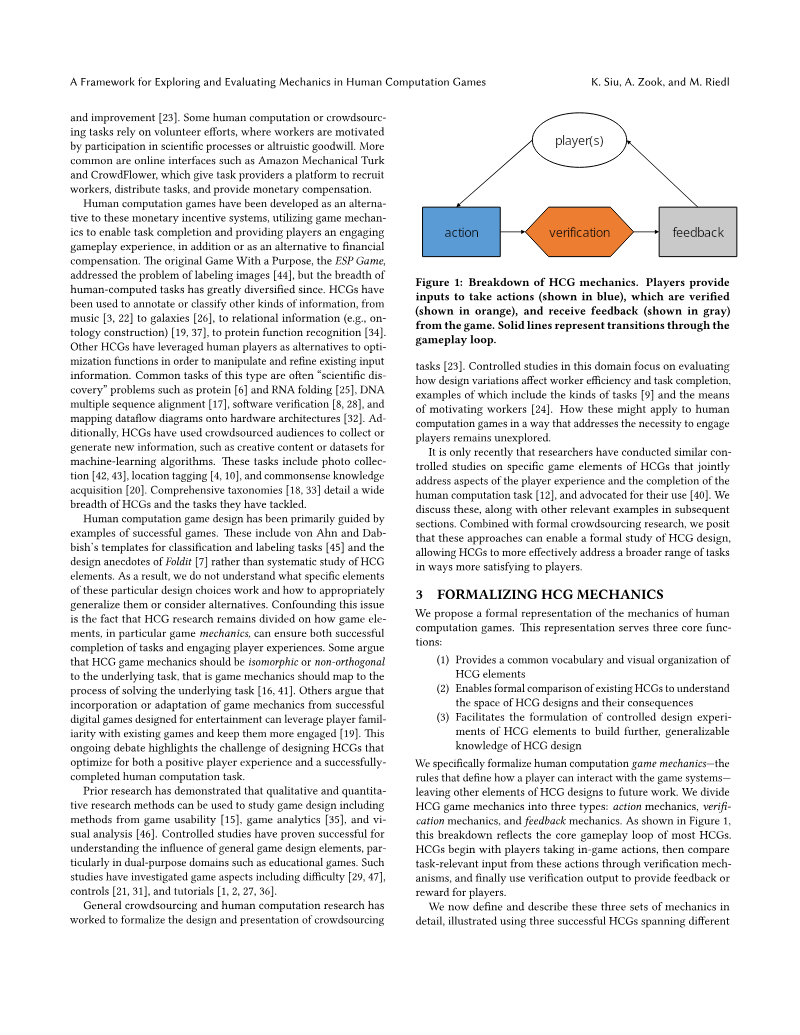
Human computation games represent a specialized intersection of game design and crowdsourced data processing, where the primary objective is to balance player engagement with the successful completion of complex computational tasks. To move beyond ad-hoc design templates, a formal framework categorizes these experiences into three core components: action, verification, and feedback. By standardizing these elements, developers can transition from intuitive design to a modular, evidence-based approach that treats game mechanics as variables in a controlled system. This methodology allows for the systematic isolation of specific features to determine their precise impact on both the user experience and the quality of the resulting data.
The effectiveness of this approach is validated through controlled A/B testing, utilizing tasks with known solutions to measure the dual axes of player retention and task performance. Case studies, including titles such as Cafe Flour Sack and Gwario, demonstrate that designers can successfully integrate mainstream gaming elements without compromising the integrity of the computational output. By analyzing how different mechanics influence engagement and volume, researchers can predict outcomes and optimize game loops to ensure that crowdsourced efforts remain both sustainable and accurate.
This analytical framework encompasses the broader landscape of games with a purpose, drawing on extensive research into reward systems, onboarding processes, and the comparative efficacy of competitive versus collaborative play. By providing a structured lens through which to evaluate these mechanics, the framework serves as a vital tool for developers aiming to bridge the gap between entertainment and utility. Ultimately, this evidence-based strategy ensures that human computation games can effectively scale to meet complex computational demands while maintaining the high levels of player motivation necessary for long-term project success.
German Research Centre for Artificial Intelligence · 2026

Serious Games Society · 2025
University of Luxembourg · 2025