Key insights
5 slides
Market Performance
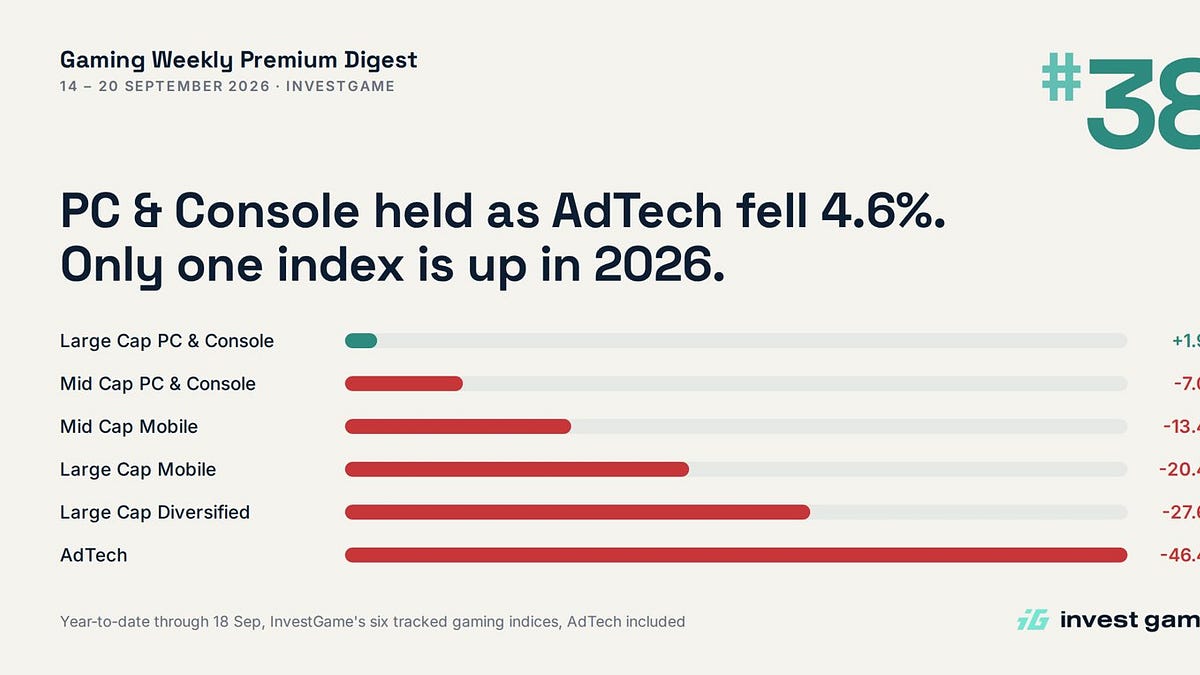
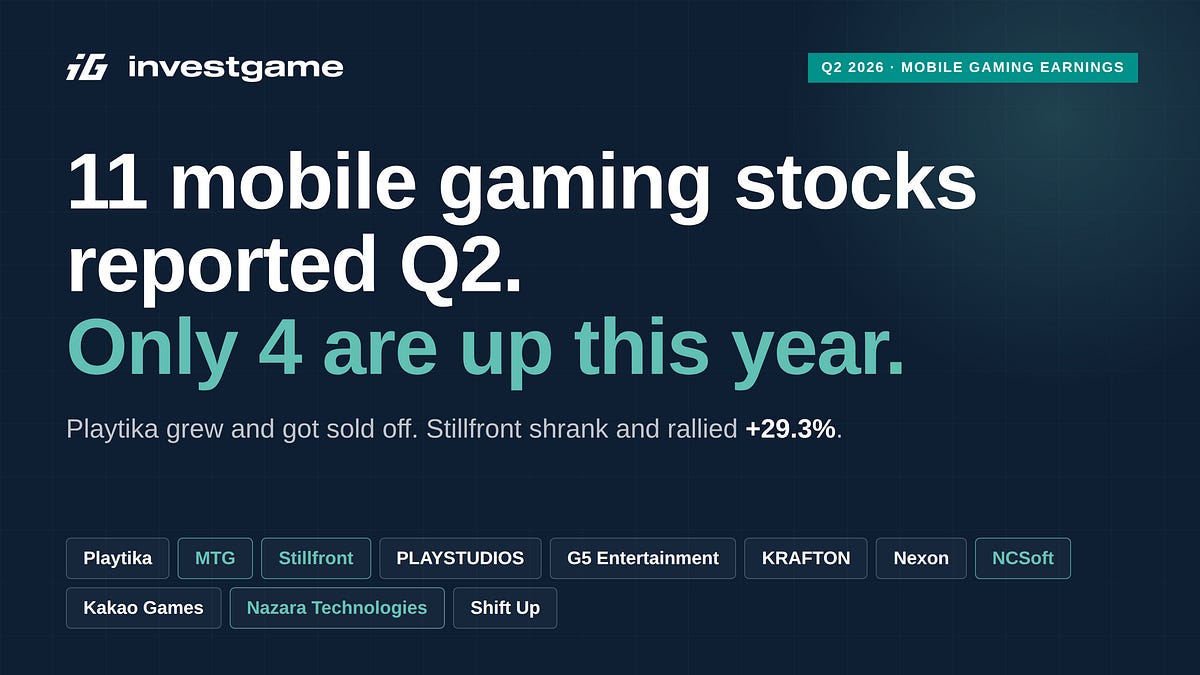
Most mobile gaming stocks experienced negative year-to-date performance.
As of August 28, 2026, only 4 of 11 tracked mobile gaming companies had positive stock price increases. Regional indices for the West and Asia were down 15.4% and 7.8% respectively.
Revenue Trends
Mobile gaming companies saw median revenue declines in Q2 2026.
Median revenue for Q2 2026 declined year-over-year by 7.3% in the West and 5.8% in Asia.
Growth Engines
Specific hit titles drove significant revenue growth for some companies.
KRAFTON's Subnautica 2, NCSoft's Lineage Classic, and Playtika's Disney Solitaire were key growth drivers.
Like a blockbuster movie for a film studio, a hit game can significantly boost a company's performance.
+288.6%
Revenue growth for Playtika's Disney Solitaire.
- KRAFTON’s Subnautica 2 revenue growth
- +94.9%
- NCSoft’s Lineage Classic revenue growth
- +101.5%
Investor Focus
Investors prioritized margin expansion and financial stability over top-line growth.
Stillfront's stock rallied despite a revenue decline due to margin improvements. Playtika's stock fell despite revenue growth due to cautious guidance.
Margin Focus. Market reactions favored margin expansion and financial stability over top-line growth.
+29.3%
Stillfront stock rally.
- Stillfront revenue decline
- -7.8%
- Playtika stock fall
- -15.4%
Capital Returns
Capital returns and strong title performance can boost stock prices.
Nexon's stock jumped due to a record quarter for MapleStory and a ~$2.0B special dividend.
Shareholder Value. Nexon’s 19.9% stock jump was fueled by a record quarter for MapleStory and the announcement of a ~$2.0B special dividend.
+19.9%
Nexon's stock jump.
- Nexon's special dividend
- ~$2.0B
1 / 5
Ask AI about this report