Monetization & Live Ops
Revenue models, in-game economies, retention and live operations.
282 documents
Sensor Tower · 2024
ReportLandscape Shifts in IP Gaming: An Analysis of How the Competitive Landscape of IP in Gaming Has Shifted in 2023
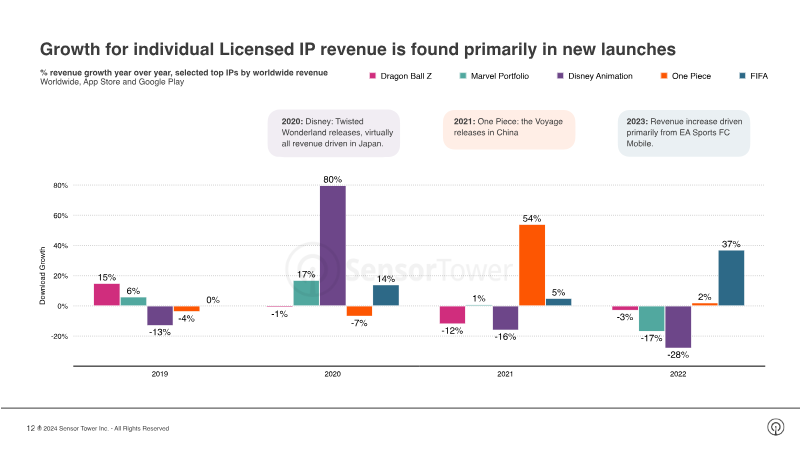
The global gaming landscape in 2023 was defined by the overwhelming commercial dominance of established intellectual properties, which accounted for every top launch on PC and console. Licensed mobile titles generated $16 billion in gross revenue, driven largely by the unprecedented success of Monopoly GO!, which reached $1 billion in revenue in under seven months. This performance propelled Hasbro and Scopely to the top of the corporate and publisher rankings, respectively. While video game and anime IPs continue to command the largest market share—particularly in Asia where they account for 70% of downloads—board game IPs experienced a significant revenue surge within the United States. Strategic integration of IP serves as a critical driver for both monetization and marketing efficiency. Role-playing games remain the most lucrative genre for licensed content due to the effectiveness of gacha-based monetization, while cross-platform collaborations and limited-time events continue to expand audience reach. Furthermore, established franchises demonstrate superior cost-efficiency compared to original titles, achieving high sales volumes with significantly lower marketing expenditures. This suggests that leveraging recognized brands provides a vital competitive advantage in an increasingly crowded marketplace. Despite the high visibility of major hits, the mobile IP market remains largely unsaturated, with licensed titles currently accounting for less than 20% of total revenue across most genres. While RPGs and social casino mechanics have proven successful, casual categories such as puzzle and simulation games represent significant untapped opportunities for future integration. Growth in the sector is increasingly dependent on high-profile new launches rather than the expansion of legacy titles, indicating that the strategic selection and execution of new IP partnerships will dictate the next phase of industry expansion.
SocialPeta · 2024
Report2023 Global Mobile Games Marketing Trends White Paper
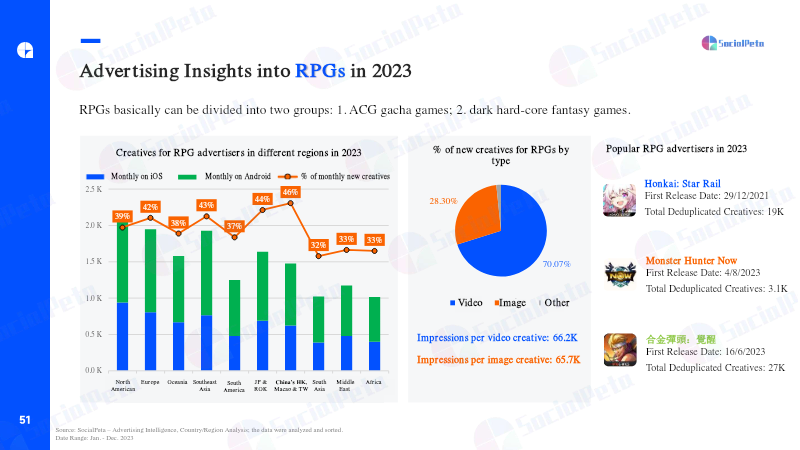
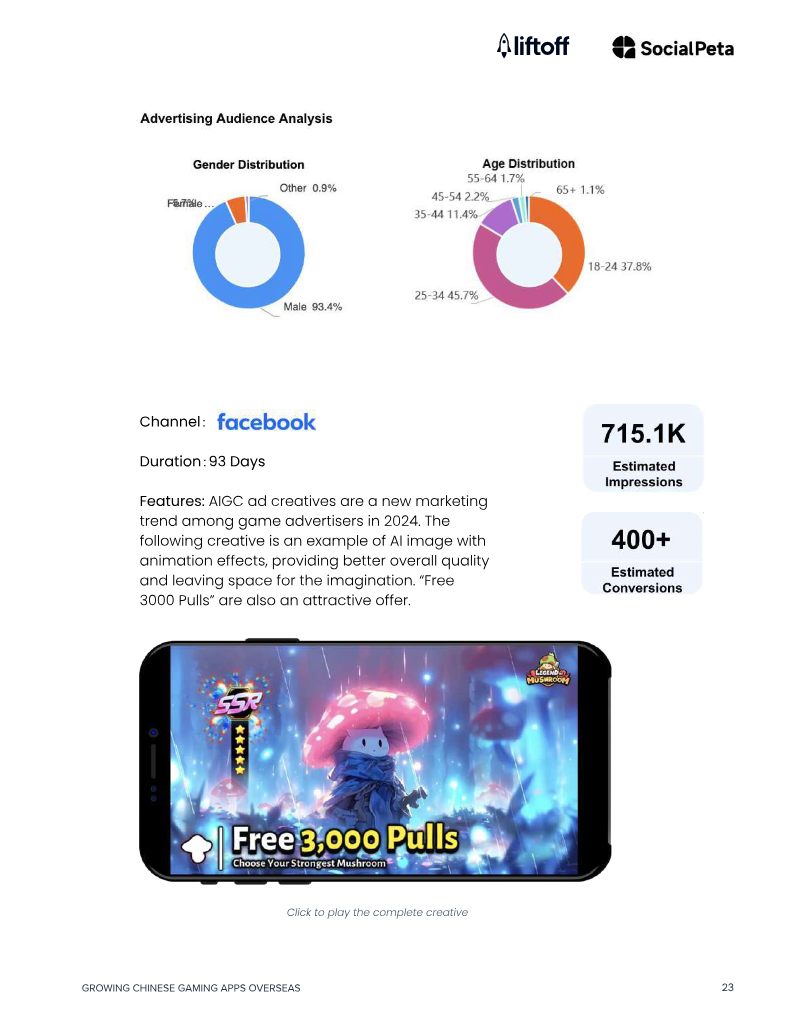
The global mobile gaming landscape underwent a significant transformation in 2023, characterized by a strategic shift toward the hybrid-casual model. This evolution combines the accessibility of hyper-casual mechanics with the monetization depth of mid-core titles, utilizing a mix of in-app advertising and in-app purchases to stabilize revenue. Marketing efforts were defined by a nearly 50% year-over-year surge in monthly active advertisers, exceeding 40,000 globally. While North America maintained its leadership in total advertiser volume, Southeast Asia emerged as the most competitive region for creative output. Concurrently, Android became the primary focus for volume-driven campaigns due to ongoing iOS privacy restrictions, though iOS remained the preferred platform for high-value mid-core and hard-core marketing. Creative strategies pivoted toward high-impact visual storytelling and the integration of generative AI to manage rising user acquisition costs. Although video remains the dominant format, accounting for over 76% of impressions, AI-generated image creatives gained significant traction, particularly in square formats. Developers increasingly utilized "mini-game" ad patterns—such as ASMR, dramatic narratives, and deliberate failure scenarios—to lower entry barriers for complex genres like Simulation and Strategy games. Meanwhile, RPG and Casino titles leaned heavily on influencer collaborations and live-action content to drive engagement in emerging markets across Southeast Asia and the Middle East. Sustainable growth in 2024 depends on a holistic integration of AI-driven production and programmatic transparency. The successful global expansion of Chinese-developed mini-games and the revitalization of legacy titles through trending ad mechanics illustrate a broader trend of creative agility. By analyzing over 1.4 billion ad creatives across 70 countries, it is evident that the industry is moving toward a data-driven future where high-engagement formats like rewarded ads and user-generated content are essential for navigating a fragmented and privacy-conscious global market.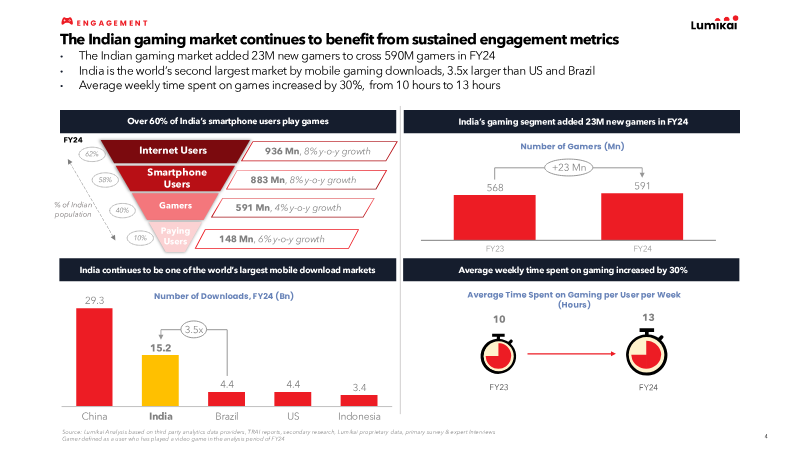
Lumikai · 2024
ReportLevelling Up: State of India Interactive Media and Gaming Research FY24
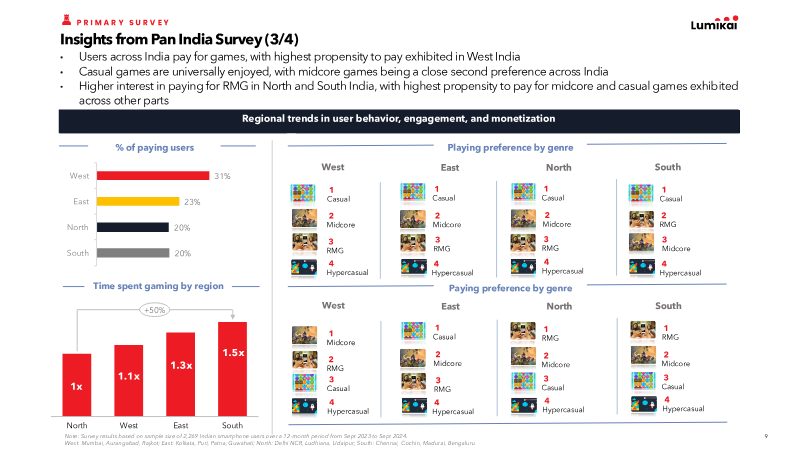
The Indian interactive media and gaming sector has emerged as a significant economic force, reaching a market valuation of $12.5 billion in fiscal year 2024. Within this landscape, gaming stands out as the fastest-growing segment, contributing $3.8 billion to the total market. Driven by a 20% compound annual growth rate, the gaming industry is projected to reach $9.2 billion by fiscal year 2029. This growth is underpinned by a massive user base of 590 million gamers, which expanded by 23 million individuals over the past year, and a 30% increase in average weekly engagement time, now reaching 13 hours per user. Monetization trends reveal a shift toward midcore gaming, which experienced a 53% year-on-year revenue increase. In-app purchases remain the primary growth driver, with the average revenue per paying user rising 15% to $22. While real-money gaming continues to be a major contributor, it faces margin compression due to recent regulatory and taxation adjustments. Despite these challenges, the sector benefits from high user sophistication, with significant overlap between real-money and midcore gaming audiences. The findings are based on a comprehensive mixed-methods study conducted between May and October 2024, incorporating primary survey data from 2,269 smartphone users across 16 Indian cities alongside secondary market analysis and industry expert interviews. The research highlights a maturing ecosystem supported by government recognition of gaming as a "sunrise sector." Policy developments, including the establishment of Centers of Excellence for Animation, Visual Effects, Gaming, and Comics, and the formal classification of esports as a sport, signal a transition toward a more structured and mainstream industry environment.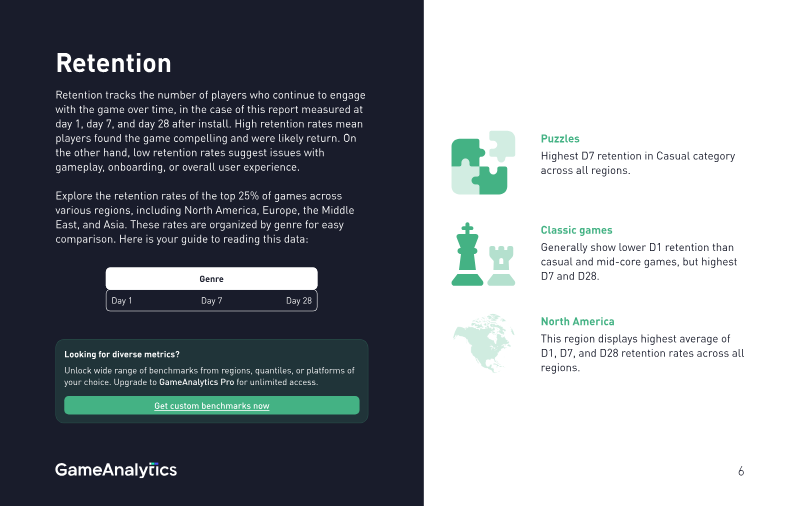
GameAnalytics · 2024
ReportMobile Gaming Benchmarks: Q1 2024
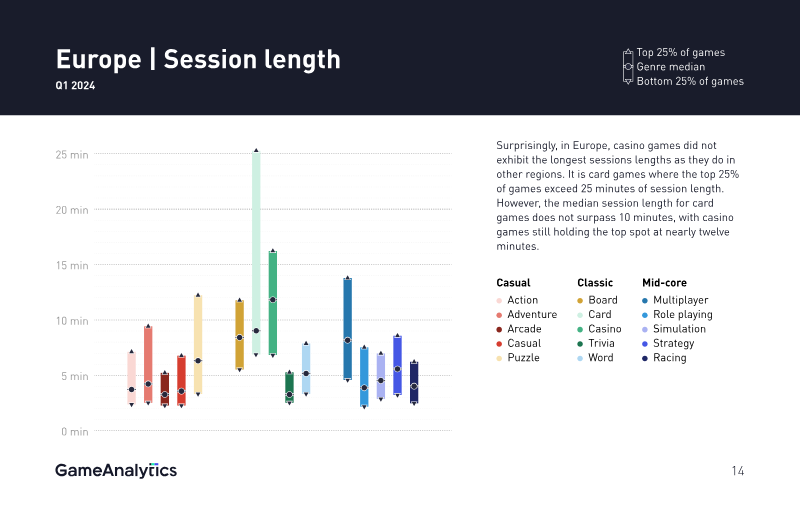
The Q1 2024 mobile gaming benchmarks provide a comprehensive analysis of player engagement metrics, specifically retention rates, session lengths, and session counts across 15 game genres. The analysis is based on data from over 10,000 games utilizing the GameAnalytics platform, representing 1.67 billion monthly active users across North America, Europe, the Middle East, and Asia. The primary objective is to offer developers a standardized framework to evaluate game performance, identify areas for optimization, and refine mechanics to improve long-term player retention and engagement. Key findings indicate that global median retention rates for the first quarter of 2024 were 22.91% for Day 1, 4.20% for Day 7, and 0.85% for Day 28. Classic games—encompassing board, card, casino, and trivia titles—consistently outperformed other genres across most regions and metrics. While North America and Europe generally exhibit higher retention averages, the Middle East shows a distinct preference for classic games, which achieve their highest regional performance there. Puzzle games also demonstrate notable stability, maintaining consistent engagement metrics across all monitored territories. Regarding session behavior, the global median session length is 4.45 minutes, with most genres averaging 4 to 5 sessions per day. Europe leads in session duration, while the Middle East records the highest frequency of daily sessions, particularly within the puzzle and word genres. The analysis suggests that session length and frequency are highly correlated with game pacing and social features. To optimize these metrics, the findings recommend a data-driven approach involving A/B testing, funnel analysis, and the implementation of LiveOps to adapt to player behavior in real-time.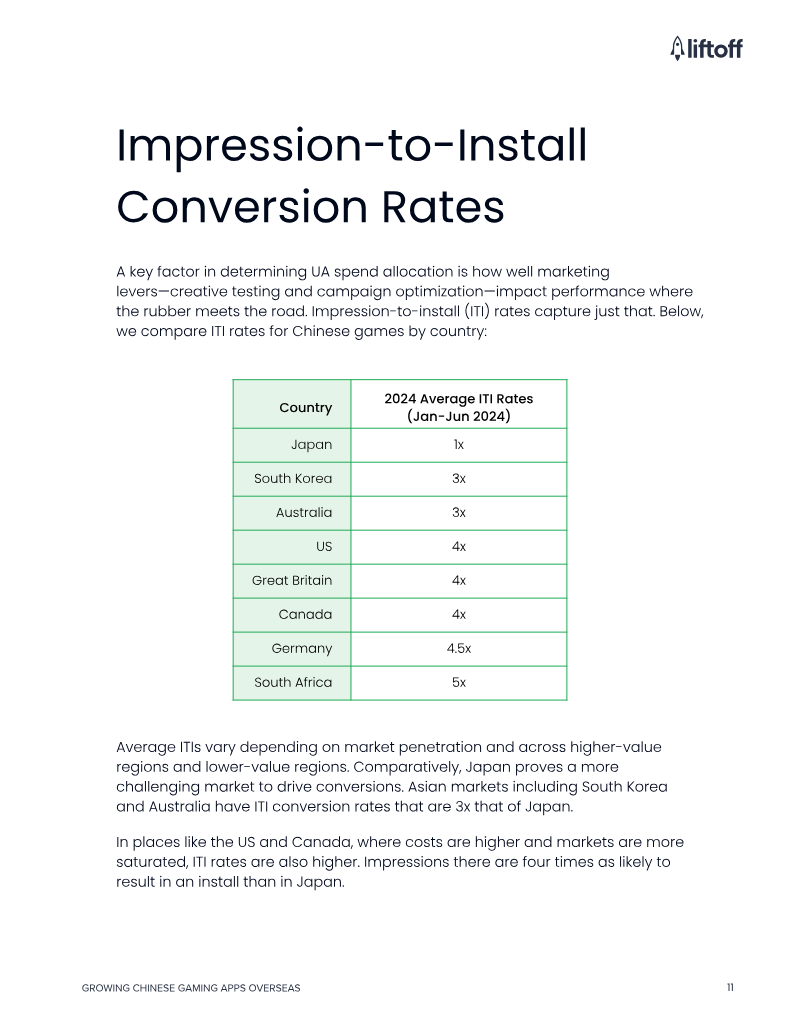

Liftoff · 2024
ReportGuide to Growing Chinese Gaming Apps Overseas: 2024
Chinese gaming applications continue to exert a dominant influence on the global stage, particularly within the strategy and role-playing game segments in mature markets such as the United States, Japan, and South Korea. While these regions offer substantial revenue potential, they are characterized by intense competition and elevated costs per install. To navigate these challenges, successful publishers are shifting toward hyper-localized strategies that tailor art styles to regional aesthetic preferences—favoring manga-inspired visuals in Japan and realistic or cartoon aesthetics in Western markets—while utilizing local influencers to establish brand credibility. Technological innovation serves as a primary driver for operational efficiency and user acquisition. The integration of generative AI has become essential for the rapid localization of ad creative, voice-overs, and marketing copy, ensuring both speed and brand compliance. High-performing titles currently leverage high-volume, innovative campaigns that incorporate minigames and AI-enhanced visuals to capture player attention. Beyond acquisition, long-term retention is increasingly supported by the implementation of social hangout spaces, home-building systems, and character trial models that balance accessibility with monetization. Monetization strategies have evolved to prioritize engagement through sophisticated, time-limited mechanics. Publishers are frequently employing box gachas, pull-milestone rewards, and gamified event structures such as diceboards and bingo to incentivize spending. Furthermore, the consistent deployment of diverse live events remains a critical requirement for maintaining player interest and competitive viability. By combining these aggressive monetization tactics with a commitment to continuous content updates, Chinese developers are effectively sustaining growth and deepening their footprint across the global gaming landscape throughout 2024.


Sensor Tower · 2024
ReportQ4 2024 Digital Market Index
In Q4 2024 global in‑app purchase revenue reached a record $39.4 billion, up 13.5% year‑over‑year, with non‑game apps now nearly matching game revenue at $19.2 billion versus $20.2 billion. iOS dominates the market, generating roughly 70% of IAP revenue ($30 billion) and outpacing Google Play’s growth (15.4% versus 9.7%). Overall app downloads remained flat at about 34 billion, while non‑game downloads increased and game downloads stabilized after a pandemic peak. Strategy titles emerged as the most lucrative segment, generating over $4.8 billion in IAP revenue—a 80% quarter‑over‑quarter lift that offset an 11% year‑over‑year decline in RPGs. Strategy games also accounted for six of the top ten download growth drivers, with a 26% year‑over‑quarter increase. In contrast, RPG revenue fell 29% globally, though regional pivots in Korea—where strategy and puzzle games grew 55% and 14%, respectively—helped mitigate the loss. Puzzle titles also contributed to overall download growth. TikTok (including Douyin) led non‑game app monetization, delivering $6 billion in IAP revenue for the year—more than double any other app or game. Advertising spending in the United States reached $34 billion in Q4, with social media platforms capturing 77% of the spend; TikTok experienced the fastest year‑over‑year growth at 22%. Amazon drove U.S. digital ad spend growth, supporting campaigns for Audible, Prime Video and Amazon Music, while other major advertisers such as Verizon, Liberty Mutual, Coca‑Cola, Microsoft, Epic Games, Target and Walmart increased spend—particularly on gaming and social platforms. Retail‑media impressions hit a record 80 billion, up 4% year‑over‑year, with Walmart and Target dominating the top ten categories and Best Buy‑Samsung and Chewy‑Nestlé emerging as the most viewed co‑branded pairs. Collectively, these findings illustrate a strategic shift toward strategy titles, the continued dominance of TikTok in app monetization, and an outsized role for social media advertising and retail‑media partnerships during the holiday peak. The data cover global markets with a focus on U.S., Korean, and broader digital advertising trends for the fourth quarter of 2024.


Newzoo · 2024
ReportGlobal Games Market Report 2024
The Global Games Market Report 2024 projects a modest 2.1 % year‑over‑year growth, bringing worldwide revenues to $187.7 billion in 2024 and reaching $213.3 billion by 2027 at a 3.1 % compound annual growth rate. PC gaming remains the largest segment, generating $43.2 billion in 2024 and accounting for roughly 22 % of total revenue by 2027, while consoles are expected to rise to a 30 % share as cross‑platform releases become more common. Mobile revenue growth has slowed after the pandemic, and its market share is projected to decline further, underscoring a shift toward PC‑centric titles. Player numbers are set to climb to 3.42 billion, a 4.5 % increase driven largely by PC adoption; mobile and console growth are more modest at 3.5 % and 2.3 %, respectively. The report’s methodology blends primary consumer research, macro‑economic data, app‑store feeds, and public company financials to estimate players, payers, and revenue streams. It also highlights the rising influence of user‑generated content (UGC) and cross‑generational appeal, noting that Gen Alpha and Gen Z together represent 94 % and 86 % of online gamers, respectively. UGC is emerging as a significant revenue source for both studios and creators, demanding strategies that balance older and younger player habits. Key insights emphasize the growing importance of IP‑driven franchises, licensing, and transmedia ventures for revenue generation. Detailed breakdowns cover game delivery models, monetization tactics, genre performance, and regional revenues—including VR and cloud gaming metrics. The report promotes tailored consulting services such as TAM sizing, genre teardowns, audience analysis, campaign measurement, and live‑service strategy to help studios optimize development, marketing, and monetization in an increasingly competitive landscape.


Xsolla · 2024
ReportState of Play: Xsolla Report
The report argues that the indie game sector has become a dominant force in the global market, driven by lowered entry barriers, widespread use of accessible engines, and a shift toward influencer‑led discovery. Data show that 2024 indie sales surpassed AAA titles, generating over $15 million in lifetime revenue across PC, Xbox, and Steam, with action, adventure, and RPG genres leading. Indie titles now account for 18 % of U.S. PC/console players and achieve higher average Steam ratings (≈72 %) than AAA games, reflecting a 12‑month YoY growth spike in early 2024 that continues to push positive momentum. Key enablers include Unity’s 38 % market share, Unreal’s steady growth, and Godot’s sharp rise, which together support the release of 8 000–10 000 titles annually. Free or low‑cost asset stores and backend services such as Xsolla Backend reduce development time and cost, with studios reporting average backend build costs of $21 million versus in‑house development. Cross‑platform publishing and a 29 % share of Steam revenue in 2023 further accelerate market penetration. The U.S. remains the largest gaming market, but regional hubs like Wisconsin are emerging through local publisher support and flexible work models. QA professionals increasingly influence inclusive design, while systemic barriers to gender and LGBTQ+ representation persist. Average U.S. developer salaries rose from $88,010 in 2023 to $91,009 in 2024, and the edutainment sector is projected to grow from $9.1 B in 2020 to $30.7 B by 2025, driven by online learning platforms. Online education and influencer marketing are rapidly expanding; MOOCs are expected to reach $279 billion by 2029, and the global influencer market is projected at $36 billion in 2024. These trends underscore continuous skill development and targeted influencer partnerships as cost‑effective channels for monetization, marketing, and distribution. The synthesis highlights the need for strategic adaptability among publishers, developers, and investors to capitalize on the evolving indie landscape.


Sensor Tower · 2024
ReportSouth East Asian Mobile Game Market Insights 2024
Mobile game downloads across Southeast Asia grew by 3.4 % in the first half of 2024, reaching 4.2 billion installs, with Google Play accounting for 91 % of the volume. In‑app purchase revenue rose by 3.4 % to $1.16 billion, a slight decline of 3 % from the previous half‑year; Google Play contributed 57 % of total revenue. From January to August, mid‑core genres such as simulation, arcade, puzzle and lifestyle led download growth (11 %–14 %), while sports titles experienced a 39 % revenue surge, representing 9 % of total IAP income. Strategy and RPG games dominated downloads (47 %) but saw modest revenue declines of 3 %–9 %. Indonesia remains the largest market, with a 10 % download increase and 41 % of regional downloads; Thailand follows as the highest‑earning country, adding $400 million in revenue. The top ten download leaders are dominated by Garena Free Fire, Mobile Legends: Bang Bang and Roblox, with Garena Free Fire maintaining a 54 % growth rate. In revenue terms, Mobile Legends: Bang Bang leads with $1.16 billion, followed by eFootball™ 2024 and Garena Free Fire; Roblox and Coin Master also show strong growth, with Roblox’s revenue rising 90 %. The case study of Honor of Kings illustrates rapid penetration after its Southeast Asian launch in June 2024, achieving a 175 % month‑over‑month spike in Indonesia and capturing the top download spot in July. By August, Honor of Kings generated $1.7 billion in IAP revenue for the period and accounted for 51 % of its global downloads from Indonesia alone. The report relies on Sensor Tower’s estimated download and IAP data from the App Store and Google Play, excluding pre‑installs, duplicate downloads, ad revenue, third‑party sales, and direct developer payments.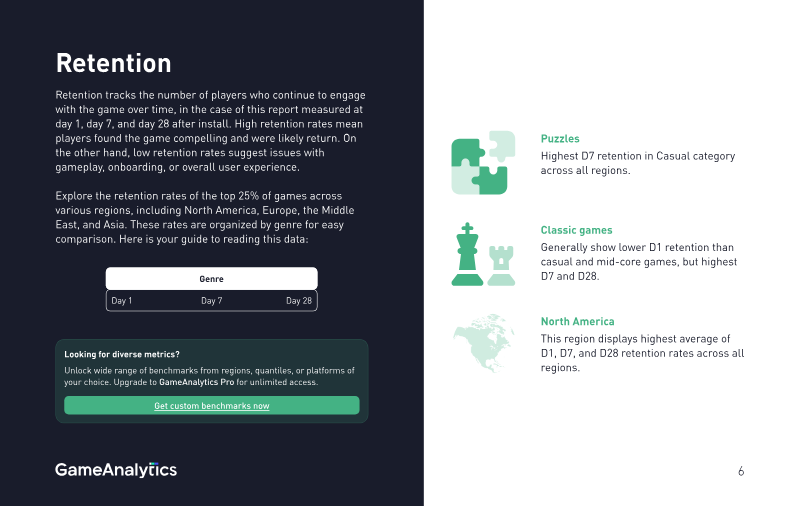
GameAnalytics · 2024
ReportMobile Gaming Benchmarks for Q1 2024
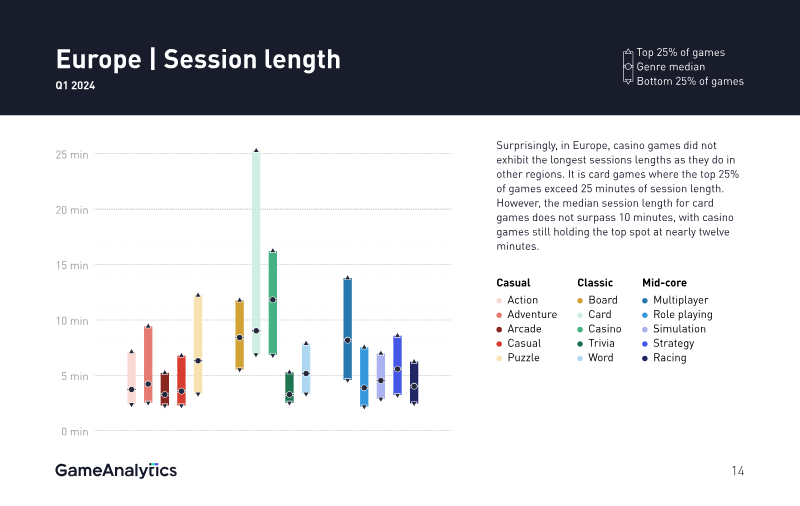
The benchmark study presents a comprehensive snapshot of mobile gaming performance during Q1 2024, focusing on key engagement metrics—retention, session length, and session count—across North America, Europe, the Middle East, and Asia. Data derive from over 10 000 games tracked by GameAnalytics, with each title typically released in at least three regions, yielding a combined monthly active user base of approximately 1.67 billion. Retention figures reveal that the global median day‑1 retention stands at 22.91 %, day‑7 at 4.20 %, and day‑28 at 0.85 %. Classic games (board, card, casino, trivia, word) dominate retention performance, especially in the Middle East where they lead all regions. Casual and mid‑core titles lag behind, with puzzle games maintaining stable but lower retention across all markets. Session length analysis shows a global median of 4.45 minutes, with casino and card games achieving the longest sessions in North America (≈20 min) and Europe (card games exceeding 25 min). In the Middle East, casino titles surpass 15 minutes, while Asia’s top casino games reach nearly 23 minutes. Session count averages range from 3–5 daily sessions per game, with puzzle and word games in the Middle East achieving the highest counts (≈10 sessions/day). Methodologically, metrics are reported in quantiles—top 25 %, median, and bottom 25 %—to illustrate performance across the spectrum of developers. The report underscores that high retention, longer session lengths, and frequent session counts correlate with stronger player engagement, offering actionable insights for studios aiming to benchmark against industry leaders.


Bain & Company · 2024
ReportGaming Report 2024: Meet the Moment – How Gamers Are Changing the Game
The report demonstrates that the global video‑game market reached $196 billion in 2023 and is expected to grow at roughly 6 % per year through 2028. Growth is driven by a youthful demographic—80 % of players aged 2‑18—who devote nearly one third of their entertainment time to gaming. These gamers increasingly engage in immersive, cross‑platform ecosystems that combine social interaction, co‑creation and real‑world extensions of game IP. Their spending per hour can be up to five times higher when they participate in multiple activities, underscoring the commercial value of integrated experiences. Key findings reveal that 70 % of players use multiple devices and 90 % desire a single consolidated marketplace, with half willing to pay for it. Publishers are therefore urged to develop device‑agnostic platforms, strengthen direct relationships with players and employ data‑driven marketing. In the mobile sector, an 80 % failure rate after three years contrasts sharply with a 10–25 % failure rate in software and retail, highlighting the need for highly targeted paid performance marketing, rigorous A/B testing and tight alignment across development, finance and marketing teams. Long‑term acquisition and retention strategies, coupled with generative AI for ad creation and optimization, are identified as critical success factors. Operating models at leading studios are shifting toward standardised core tools, autonomous entrepreneurial teams with clear milestones and strategic embedding of generative AI. Talent attraction now demands a comprehensive package that includes purpose, competitive pay, work‑life balance, learning paths and ESG commitments to remain competitive with the broader tech industry. The report’s thesis is that understanding diverse gamer segments, delivering interoperable cross‑platform experiences and investing in data‑driven, AI‑enhanced operations are essential for capturing the rapidly expanding, monetarily active gaming audience.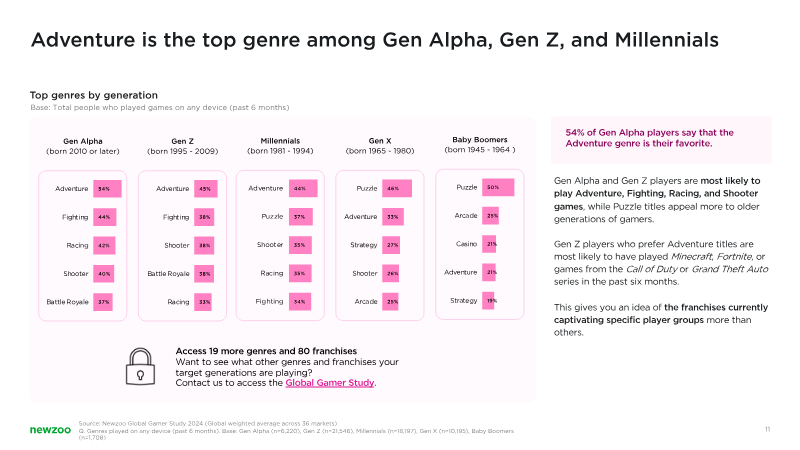


Newzoo · 2024
Report