SocialPeta
Research162 documents
Documents
Article
Short Drama Weekly Ranking: May 09, 2026
The weekly snapshot of short‑drama activity for the week of April 20–26, 2026 shows a modest 2.27 % rise in active titles to 22,500, driven by 4,900 new launches that now represent 21.78 % of the market. AI‑generated manga dramas maintain a growing presence, holding 1,500 titles or 6.67 % of the active catalog. The data source is SocialPeta’s analytics platform, which aggregates view counts and ad‑creative metrics across mobile drama apps.
Key narrative trends emerge from the top performers. “My Beggar Wife is a Billionaire” leverages an anti‑trope of a CEO masquerading as a beggar, generating 9.24 million impressions from 1,600 unique ad creatives. The show’s success is attributed to a high‑stakes identity reveal that flips traditional power dynamics, appealing to audiences craving cathartic payoff. “Back From the Brink: The Heiress Rises” captures 6.4 million impressions with 1,100 creatives, centering on a memory‑losing heiress reclaimed by her conglomerate mother; its dramatic climax hinges on a public humiliation interrupted by DNA evidence, maximizing viewer curiosity. “Found A Homeless Genius To Save My Company” ranks 14th, featuring an elderly wheelchair‑bound protagonist whose redemption arc is driven by a childhood pact with a now‑tycoon former cleaner, delivering emotional depth that translates into strong ad engagement.
Across these titles, archetype subversion—whether through resilient elders or lost heiresses—combined with destiny‑driven tension and aggressive cliffhangers, consistently boosts paid conversions. The analysis underscores a broader industry shift toward anti‑trope storytelling that delivers high‑stakes emotional payoff, aligning creative strategy with audience demand for catharsis and surprise.
- The short-drama market grew to 22,500 active titles for the week of April 20–26, 2026, a 2.27% increase driven by 4,900 new launches.
- New releases now account for 21.78% of the total active market, indicating a high volume of content turnover.
- AI-generated manga dramas have established a significant foothold, representing 1,500 titles or 6.67% of the active catalog.
- Top-performing titles like 'My Beggar Wife is a Billionaire' and 'Back From the Brink: The Heiress Rises' generated 9.24 million and 6.4 million impressions respectively through aggressive ad-creative strategies.
- Successful narrative strategies currently prioritize archetype subversion, such as flipping traditional power dynamics or using high-stakes identity reveals to drive viewer curiosity.
+2
SocialPetaMay 2026
Article
Micro Drama Weekly Ranking: April 13–19, 2026
The weekly ranking analysis focuses on short‑drama content released between April 13 and 19, 2026, with an emphasis on audience engagement metrics such as deduplicated creatives and impressions. The report identifies a 9.61 % week‑on‑week rise in active short dramas, totaling roughly 22,000 titles, and notes that about 4,800 new releases represent 21.77 % of the active catalog, indicating a steady influx of fresh material.
Key thematic trends emerge: two‑male‑lead dramas continue to gain traction, driven by “love‑hate” dynamics and high‑tension relationship storytelling; AI‑generated dramas dominate ad placements, leveraging hyper‑realistic characters and immersive narratives to deliver emotionally charged scenes while staying within platform guidelines. The analysis highlights three top titles—“You Rule My Body And Soul” (No. 11, ~38 million impressions), “Weeping Bones” (No. 12, ~23 million impressions), and “Whispers in the Dark Alpha’s Bed” (No. 39, ~23 million impressions)—and dissects their creative hooks, such as forced romance, character reversals, and supernatural family tragedy.
The methodology relies on SocialPeta’s data collection of creative counts and impression totals across major social platforms (Facebook, TikTok, Messenger). The scope is global micro‑drama markets with a focus on short‑form content released within the specified week. Conclusions underscore that forced romance, extreme character shifts, and AI‑enhanced visuals drive high engagement, while platform‑specific creative strategies are increasingly critical for maximizing reach.
- The active short-drama market grew by 9.61% week-on-week to approximately 22,000 titles, with 4,800 new releases accounting for 21.77% of the total catalog.
- AI-generated content is the dominant force in ad placements, utilizing hyper-realistic characters and immersive storytelling to maintain high engagement while adhering to platform guidelines.
- Top-performing titles for the week of April 13–19, 2026, included 'You Rule My Body And Soul' (38 million impressions), 'Weeping Bones' (23 million impressions), and 'Whispers in the Dark Alpha’s Bed' (23 million impressions).
- Audience engagement is currently driven by specific narrative tropes, including forced romance, high-tension 'love-hate' dynamics in two-male-lead dramas, and extreme character reversals.
- Data collected from Facebook, TikTok, and Messenger indicates that supernatural family tragedy and character-driven conflict remain effective creative hooks for short-form content.
+2
SocialPetaMay 2026
Article
Top Mobile Games with Maximum Downloads: March 2026
In March 2026, global mobile game download activity was dominated by a mix of casual puzzle titles and high‑budget shooters. The most downloaded single‑platform app on the App Store was Arrows – Puzzle Escape, achieving roughly 3 million downloads, with India contributing over 30 % of the total. Order Crazy: Sort Magic Match followed with about 2 million downloads, largely driven by the Japanese market. On Google Play, Free Fire led with 13 million downloads—a 11.9 % month‑on‑month increase—while Paper.io 2 surged 62.4 % to reach 11 million downloads, reflecting strong momentum in the casual‑action segment.
Revenue figures mirrored these download trends but highlighted different monetization strengths. MONOPOLY GO! generated $48.1 million on the App Store, up 3.7 % MoM, whereas PUBG MOBILE posted $30 million during its anniversary celebrations, rising 32.2 % MoM. On Google Play, Last War: Survival topped revenue charts with $50 million, despite a 13.6 % MoM decline, indicating sustained monetization from its large user base. Coin Master and Gossip Harbor delivered $46.2 million and $34.3 million respectively, with the latter showing a healthy 6.2 % MoM growth.
The data cover worldwide markets, focusing on the two major app ecosystems (Apple App Store and Google Play) for March 2026. Methodology is based on SocialPeta’s proprietary analytics of download counts and revenue estimates derived from in‑app purchase and advertising metrics. The findings underscore the continued importance of aggressive user acquisition, localized marketing, and diversified monetization strategies in maintaining competitive advantage within the mobile gaming sector.
- Google Play revenue was led by 'Last War: Survival' at $50 million, while 'MONOPOLY GO!' dominated the App Store with $48.1 million in revenue.
- 'Free Fire' reached 13 million downloads on Google Play, marking an 11.9% month-on-month increase, while 'Paper.io 2' saw a significant 62.4% surge to 11 million downloads.
- 'Arrows – Puzzle Escape' was the top App Store download with 3 million installs, with India accounting for over 30% of that volume.
- 'PUBG MOBILE' experienced a 32.2% month-on-month revenue increase to $30 million, bolstered by its anniversary celebrations.
- 'Gossip Harbor' demonstrated steady growth with $34.3 million in revenue, reflecting a 6.2% month-on-month increase on Google Play.
+2
SocialPetaMay 2026
Article
Top Mobile Apps with Maximum Downloads: March 2026
In March 2026, global mobile applications that achieved the highest download volumes displayed a blend of rapid user acquisition and strategic monetization. Claude, an AI‑powered chatbot, led the App Store with an 88 % jump in monthly active users and a 148 % rise in revenue, driven by its Claude 4.6 update, persistent memory features, and multi‑cloud support that attracted both consumers and businesses. On the Google Play side, short‑drama platforms such as FreeReels and ReelShort maintained strong download growth, while niche titles like onX Hunt leveraged a partnership with Ford Motor to offer free Elite memberships and integrated in‑vehicle access, boosting subscription conversions during the spring hunting season.
Revenue analysis revealed that download dominance does not automatically translate into top earnings. Apps with focused audiences—onX Hunt, Tinder, and niche short‑drama services—converted downloads into higher revenue through feature upgrades (e.g., Tinder’s AI Chemistry, Photo Insights, and new interactive modes) and seasonal content. The App Store favored monetization‑heavy titles, whereas Google Play rewarded broad appeal and accessibility.
Key insights highlighted the importance of product updates, strategic partnerships, and targeted campaigns in converting download momentum into revenue. The report covered worldwide markets for March 2026, drawing on data from the App Store and Google Play without specifying survey size but implying comprehensive platform analytics. The findings suggest that publishers should align user acquisition strategies with monetization pathways to maximize both visibility and profitability.
- In March 2026, Claude led the App Store with an 88% increase in monthly active users and a 148% revenue surge, fueled by the Claude 4.6 update, persistent memory, and multi-cloud support.
- High download volume does not guarantee top earnings, as niche apps like onX Hunt, Tinder, and short-drama platforms outperformed broader titles by focusing on high-conversion monetization strategies.
- Strategic partnerships, such as the collaboration between onX Hunt and Ford Motor, successfully drove subscription conversions by integrating in-vehicle access and offering free Elite memberships.
- Tinder effectively converted its user base into revenue by deploying feature-specific upgrades, including AI Chemistry, Photo Insights, and new interactive modes.
- Short-drama platforms like FreeReels and ReelShort maintained strong download growth on Google Play, demonstrating the continued market demand for niche, accessible content.
+3
SocialPetaMay 2026
Article
Top Mobile Game with Maximum Downloads: March 2026
The analysis focuses on global mobile games that achieved the highest download volumes in March 2026, drawing data from both Apple’s App Store and Google Play. The study covers the entire world market for that month, examining download counts, revenue figures, and regional contributions to identify trends in user acquisition and monetization.
Key findings reveal that tactical shooters dominate download growth, with Free Fire securing roughly 13 million single‑platform downloads—a 11.9 % month‑on‑month rise—while Paper.io 2 surged 62.4 % to exceed 11 million downloads. Puzzle titles also performed strongly; Arrows – Puzzle Escape captured about 3 million downloads, largely from India, and Order Crazy: Sort Magic Match reached 2 million downloads with a Japanese‑heavy audience. In revenue, the top performer on Google Play was Last War: Survival, generating about $50 million in a single month despite a 13.6 % decline MoM, whereas Coin Master and Gossip Harbor maintained stable or modest growth at $46.2 million and $34.3 million respectively. On the App Store, MONOPOLY GO! and PUBG MOBILE delivered $48.1 million and $30 million, reflecting 3.7 % and 32.2 % MoM increases.
The methodology relies on aggregated download and revenue data from the two major app distribution platforms, with no explicit sample size disclosed but implying comprehensive coverage of all available titles. The report underscores how high‑budget, IP‑driven games and localized marketing campaigns continue to shape the competitive landscape, while also highlighting the resilience of casual and social‑gaming segments in sustaining revenue streams.
- Tactical shooters led March 2026 download growth, with Free Fire reaching 13 million downloads (an 11.9% MoM increase) and Paper.io 2 surging 62.4% to over 11 million downloads.
- Last War: Survival remained the top revenue generator on Google Play at $50 million, despite a 13.6% MoM decline in earnings.
- MONOPOLY GO! and PUBG MOBILE showed strong App Store performance, generating $48.1 million and $30 million respectively, with the latter seeing a 32.2% MoM revenue increase.
- Casual and social gaming titles maintained stable revenue, with Coin Master earning $46.2 million and Gossip Harbor reaching $34.3 million.
- Puzzle games demonstrated successful regional targeting, as Arrows – Puzzle Escape secured 3 million downloads primarily from India, and Order Crazy: Sort Magic Match reached 2 million downloads with a strong Japanese audience.
+2
SocialPetaMay 2026
Article
Short Drama Weekly Ranking: Male-Oriented Dramas Gain Momentum with AI Live-Action
The short-form drama industry is currently experiencing a notable shift in content strategy, characterized by the rising prominence of male-oriented narratives. This trend is increasingly supported by the integration of artificial intelligence in live-action production, which serves as a catalyst for creative efficiency and audience engagement. By leveraging AI-driven tools, creators are able to produce high-volume, targeted content that resonates with specific demographic segments, effectively diversifying the traditional landscape of short-form storytelling.
The market evolution reflects a broader movement toward data-informed production cycles where AI-assisted live-action serves to lower barriers to entry and enhance visual output. This technological adoption allows for more rapid iteration of themes that appeal to male viewers, who have historically been an underserved segment in the short drama market. The integration of these tools facilitates a more agile response to shifting viewer preferences, enabling producers to optimize their creative strategies based on real-time performance metrics.
While the industry continues to expand across global digital platforms, the focus remains on maximizing visibility through sophisticated advertising and distribution models. The current trajectory suggests that the intersection of AI technology and male-centric content will remain a primary driver of growth within the short drama sector. As production techniques become more refined, the industry is poised to further capitalize on these trends to secure higher audience retention and increased monetization opportunities across competitive digital markets.
- The short-form drama market is shifting toward male-oriented narratives to capture a historically underserved demographic.
- AI-driven live-action production is being utilized to increase creative efficiency and enable high-volume content output.
- Technological integration allows for rapid iteration of content, enabling producers to respond to real-time performance metrics and viewer preferences.
- AI tools are lowering barriers to entry and enhancing visual quality, facilitating a more agile production cycle.
- The combination of AI technology and male-centric storytelling is identified as a primary driver for future growth and monetization in the short drama sector.
+3
SocialPeta
Article
Top Mobile App Ad Creatives and Advertising Trends: March 2026
In March 2026, SocialPeta’s analysis of global mobile‑app advertising revealed a pronounced shift toward high‑return verticals, with short dramas and web novels dominating the top 10 on iOS while e‑commerce brands maintained a strong presence on Android. The report quantified ad creative activity, noting that iDrama generated approximately 104 000 deduplicated creatives—88.2 % new—and reached 82 countries, with the United States, Germany and France accounting for the largest share. iDrama’s flagship short drama, “Idiot Boss Fired Me,” delivered 40 million impressions from 2 200 creatives, underscoring the effectiveness of free‑viewing models in attracting cost‑conscious users.
Health‑tech advertising also gained traction, as illustrated by Pill Reminder & Health Tracker’s 68 000 Android creatives (72.1 % new) spread across 84 regions, predominantly in high‑spending markets such as Europe and North America. Image‑based creatives dominated (52.9 %) and highlighted first‑aid scenarios to reinforce the app’s daily health guardian positioning. In India, FRND leveraged live‑action videos featuring local talent to capture Tier 2 and Tier 3 audiences, achieving 4.17 million estimated impressions on Facebook.
Key takeaways emphasize that short drama and web‑novel combinations drive volume acquisition, while e‑commerce scales on Android. AI and social apps receded from the top 20, leaving low‑monetization products at a disadvantage. The data suggest that advertisers should prioritize creative volume, platform‑specific channel strategies, and localized storytelling to maximize downloads and revenue in the evolving mobile‑app landscape.
- Short drama and web novel apps dominate iOS advertising, led by iDrama’s “Idiot Boss Fired Me,” which generated 40 million impressions from 2,200 unique creatives.
- High-volume creative production is a primary growth strategy, evidenced by iDrama launching 104,000 deduplicated creatives (88.2% new) across 82 countries.
- Health-tech advertising is scaling rapidly on Android, with Pill Reminder & Health Tracker deploying 68,000 creatives (72.1% new) across 84 regions, focusing on image-based first-aid scenarios.
- E-commerce brands maintain a dominant presence on Android, while AI and social apps have fallen out of the top 20 advertising categories.
- Localized storytelling is critical for market penetration, as seen by FRND’s use of local talent in live-action videos to capture 4.17 million impressions in India’s Tier 2 and Tier 3 markets.
+3
SocialPetaApr 2026
Article
Top Mobile Game Ad Creatives and Advertising Trends: March 2026
The analysis focuses on mobile game advertising activity in March 2026, drawing from SocialPeta’s global database of over 1.7 billion creatives across more than 80 countries. The study examines the most downloaded titles, their advertising spend and revenue performance on both the App Store and Google Play. Key findings show that publishers are leveraging high‑volume creative production, with Habby’s new roguelike “Dicero!” generating 9 k distinct creatives by March and reaching a peak of 2,396 daily ads on iOS. Video formats dominate at roughly 80 %, primarily in 1280×720 landscape, and the majority of campaigns target English and Traditional Chinese audiences, with Japanese and Korean markets close behind. The creative strategy emphasizes high‑level visual effects, gameplay tutorials, and user‑generated content to highlight progression gaps—such as “before vs. after X hours”—to tap into players’ power‑progression anxiety.
PUBG’s 8th anniversary event illustrates how event‑driven campaigns can lift revenue, with the App Store reporting a month‑over‑month increase of over 30 %. The report also notes that “Dicero!” employs memetic apologies, physical prize showcases, and milestone rewards (e.g., 2 million pre‑registration bonuses) to sustain engagement. Overall, the data suggest that successful publishers combine large creative libraries, localized targeting, and psychologically resonant messaging to maximize downloads and monetization. The findings provide actionable insights for marketers seeking to refine user acquisition strategies in the competitive mobile gaming landscape of 2026.
- Video ads dominate the mobile gaming landscape, accounting for approximately 80% of all creative formats, with a preference for 1280×720 landscape dimensions.
- High-volume creative production is a primary growth driver, exemplified by Habby’s 'Dicero!' which launched with 9,000 distinct creatives and reached a peak of 2,396 daily ads on iOS.
- Event-driven marketing remains highly effective for revenue growth, as demonstrated by PUBG’s 8th-anniversary campaign, which triggered a month-over-month revenue increase of over 30% on the App Store.
- Successful user acquisition strategies in 2026 prioritize psychological triggers, specifically using 'before vs. after' progression comparisons to exploit player anxiety regarding power gaps.
- Top-performing campaigns utilize a mix of memetic content, physical prize showcases, and milestone-based rewards, such as the 2 million pre-registration bonuses used by 'Dicero!'.
+3
SocialPetaApr 2026
Whitepaper10 pages
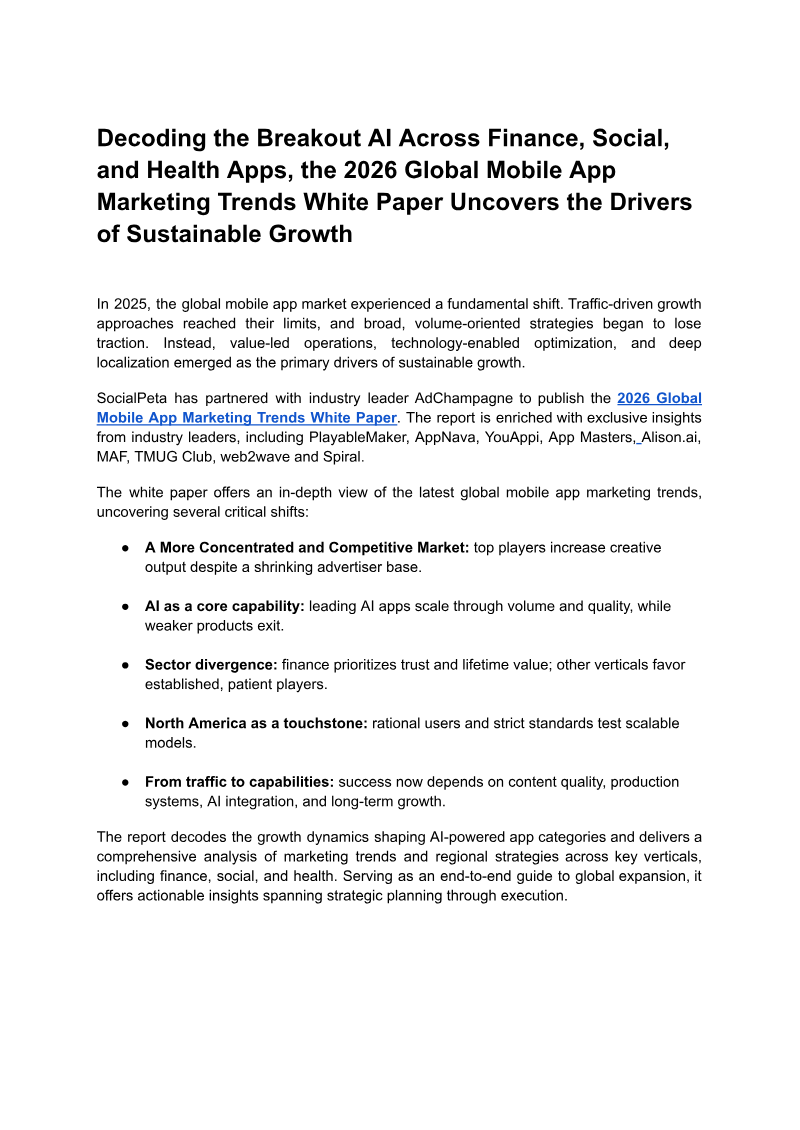
2026 Global Mobile App Marketing Trends White Paper
The white paper argues that the 2025 mobile app market has shifted from volume‑driven traffic growth to value‑centric, technology‑enabled optimization. It identifies a “scissor gap” where the number of active advertisers fell 16.7 % YoY while creatives per advertiser rose 73.3 %, indicating higher competitive thresholds and a focus on creative quality. Market share remains strongest in business & productivity, utilities, entertainment, and finance, but creative volume is dominated by short‑drama, reading, and AI apps. iOS and Android advertising ratios stabilized at 4:6, with iOS advertisers producing more creatives due to higher monetization expectations.
User acquisition spend reached $78 billion, a 13 % YoY increase driven almost entirely by iOS, with e‑commerce, fintech, and betting leading non‑gaming verticals. Video remains the dominant ad format (≈70 % of social inventory), while static and playable ads serve testing, Android traffic, and engagement signals. AI has moved from a marketing tool to a core capability; leading AI apps scale through volume and quality, while many smaller entrants exit due to weak monetization.
Finance apps maintain steady growth focused on user quality, lifetime value, and compliance, contrasting with AI’s rapid scaling. North America remains the most selective market, demanding high content quality and long‑term trust; success here signals scalability elsewhere. The paper concludes that sustainable growth now hinges on creative capability, system efficiency, AI integration, and long‑term value creation rather than sheer traffic volume.
- The mobile app market has shifted from volume-based growth to a quality-focused model, evidenced by a 16.7% YoY decline in active advertisers alongside a 73.3% surge in creatives per advertiser.
- Global user acquisition spend grew 13% YoY to $78 billion, with the increase driven almost exclusively by iOS advertising.
- Video remains the dominant advertising format, accounting for approximately 70% of social media inventory, while static and playable ads are relegated to testing and engagement signaling.
- The iOS-to-Android advertising ratio has stabilized at 4:6, though iOS advertisers maintain higher creative output due to expectations for superior monetization.
- AI has transitioned from a marketing tool to a core operational capability, where success is defined by the ability to scale volume and quality while maintaining sustainable monetization.
+3
SocialPetaApr 2026

Report43 pages
Insight into Global Micro Drama App Marketing for 2026
SocialPeta’s analytics platform aggregates data from more than 90,000 micro‑drama advertisers and 80 million ad creatives across over 55 countries, positioning itself as a key resource for launching and scaling micro‑drama apps worldwide. The platform projects the global micro‑drama market to reach $6 billion by 2026, emphasizing its capacity to deliver actionable insights into advertising strategies, creative formulas, and regional audience preferences.
In 2025 the ecosystem expanded sharply: active advertisers rose by 63.6 % to over 700, while each advertiser produced a 144.9 % increase in creatives, largely thanks to AI‑powered production tools. Southeast Asia dominated genre preferences for “reversal of fortune” and “rebirth” dramas, whereas North America’s high‑paying users gravitated toward premium romance content. Europe remained the largest source of creative volume, underscoring a sustained upward trend in both advertiser participation and output across the globe.
A case study of “Evil Bride vs. The CEO’s Secret Mom” illustrates high‑impact marketing: 44 K creatives generated an estimated 2.7 B impressions in key markets such as the USA, UK, Canada, Australia, and Germany. AI‑driven tools—DSV restructuring and automated cover/clip generation—reduced production time, enabling rapid localization. Short, cliffhanger‑style ads with intense conflict and strong visual hooks outperformed longer formats, driving downloads and engagement in North America, Southeast Asia, Latin America, and the Middle East.
By late 2024 vertical micro‑dramas had matured into a stable ecosystem, with regional preferences—“reversal of fortune” in Southeast Asia and conflict‑driven stories in Latin America—fueling audience engagement. Production scaled to 55 vertical dramas in 2025 through standardized pipelines and AI‑enhanced marketing, allowing faster creative validation, lower volatility, and continuous data‑driven optimization. The analysis stresses that audience‑first IP development—testing concepts in short form before scaling—and multi‑platform, AI‑supported workflows are essential for reducing creative risk and converting IP into long‑term company capital.
- The global micro-drama market is projected to reach $6 billion by 2026, supported by a 63.6% increase in active advertisers to over 700 in 2025.
- AI-powered production tools drove a 144.9% increase in creative output per advertiser in 2025, enabling rapid localization and standardized production pipelines.
- High-impact marketing campaigns, such as the 44,000 creatives for 'Evil Bride vs. The CEO’s Secret Mom,' demonstrate that short, cliffhanger-style ads with intense conflict are the most effective format for driving global engagement.
- Regional audience preferences are highly segmented, with Southeast Asia favoring 'reversal of fortune' and 'rebirth' themes, while North American users gravitate toward premium romance content.
- Europe currently leads the global market in total creative volume, while Latin America and the Middle East show strong engagement with conflict-driven storytelling.
+3
SocialPetaApr 2026
Report90 pages
2026 Global Mobile Gaming Marketing Trends White Paper
The white paper establishes that the mobile‑gaming advertising ecosystem expanded rapidly in 2025, with more than 90 000 active advertisers and an influx of roughly 8 000 new entrants each month, a 22 % year‑over‑year rise. Advertisers increasingly deploy fresh creatives, with video accounting for 74 % of all ads—up 14 % YoY—and Android remains the dominant acquisition platform, though iOS shares grow for mid‑core and hard‑core titles.
Top mobile games in 2025 show a clear split between volume‑driven casual installs and value‑focused premium titles. Casual hits such as Block Blast! and Subway Surfers dominate downloads, while mid‑core and premium games generate the bulk of revenue. Leading spenders—FunPlus, Yotta Games, Hungry Studio—continue to favor Android for lower cost‑per‑install acquisition, whereas iOS delivers higher monetization per install.
The industry is moving from a linear funnel to an “Infinity Loop” model that integrates acquisition, retargeting, and lifecycle actions. Aarki’s supervised‑AI engine demonstrates the potential to boost lifetime value by up to 30 % and reduce campaign volatility, underscoring the importance of a unified, data‑driven full‑funnel strategy that prioritizes LTV over instant installs.
Early‑stage mobile games must achieve rapid habit formation, with 60‑minute daily play by week 2 and high alliance join rates. Paid‑traffic validation is critical; a Day‑1 acquisition rate below 35 % signals readiness issues. Creative trends vary by genre: lightweight socializing and parkour mini‑games dominate SLG spend, RPGs favor narrative IP‑linked content, while simulation and casual titles rely on realistic or viral short‑video formats that capture 70–80 % of impressions.
Regional insights reveal puzzle and casino titles lead creative trends in 2026, with Japan/Korea driving new creative volume and Southeast Asia showing higher local IP acceptance. Mobile‑gaming ad spend rises modestly in Oceania and South America, with Android dominating creative output. A strategic pivot toward “authenticity‑utility‑impact” stacks—solving real problems and building defensible communities—drives higher retention, while AI‑powered creatives accelerate rapid testing. Finally, marketers increasingly adopt AI and programmatic DSPs beyond walled gardens; performance gaps and trust issues persist, yet data show significant install uplifts when CTV campaigns complement mobile ads, indicating a shift toward transparent, scalable programmatic solutions.
- The mobile gaming advertising ecosystem grew by 22% year-over-year in 2025, with over 90,000 active advertisers and 8,000 new entrants joining monthly.
- Video content now accounts for 74% of all mobile game ads, representing a 14% year-over-year increase in usage.
- A shift toward an 'Infinity Loop' marketing model, supported by supervised AI, can increase player lifetime value (LTV) by up to 30% by integrating acquisition, retargeting, and lifecycle management.
- Android remains the primary platform for volume-driven acquisition due to lower costs, while iOS is increasingly favored for mid-core and hard-core titles to maximize monetization per install.
- Early-stage games require a Day-1 acquisition rate of at least 35% and 60 minutes of daily play by week two to signal long-term viability.
+1
SocialPetaApr 2026
Article
Top Mobile Apps: January 2026
In January 2026, global mobile app performance was dominated by a mix of entertainment, social networking and subscription services. NetShort reclaimed the top iOS ad‑spending spot, while ChatGPT surged in South Korea with 3.4 billion minutes of usage time—an eight‑fold year‑over‑year increase that propelled it back to the App Store’s revenue leader. Threads eclipsed 400 million monthly active users, surpassing X and positioning itself for further expansion. Google One leveraged a 50 % discount on its 2 TB and AI Pro plans, integrating Gemini into family subscriptions to drive revenue growth.
The top 20 revenue‑generating apps on the App Store highlighted ChatGPT’s dominance in Korea and Paramount+’s price hike following its Q3 earnings, which boosted subscription income. On Google Play, Google One’s promotional strategy and NetShort’s promotion of over 2,200 dramas—up 10.1 % month‑over‑month—catapulted the latter into the top 20 download list.
Download leaders mirrored revenue trends but also revealed geographic nuances: Threads’ 141.5 million daily active users on iOS outpaced X, while Temu captured 20.34 million Polish users (+12.6 % YoY), overtaking Allegro as the country’s leading e‑commerce platform. NetShort’s Android download surge was driven by its drama promotion strategy.
The analysis underscores that while high download volumes do not guarantee top revenue, they signal strong user demand and market positioning. Publishers can align user acquisition tactics with monetization objectives by monitoring both download trajectories and revenue outcomes across App Store and Google Play.
- ChatGPT became the App Store’s revenue leader in South Korea, driven by 3.4 billion minutes of usage time, an eight-fold year-over-year increase.
- Threads reached 400 million monthly active users, officially surpassing X in user base and recording 141.5 million daily active users on iOS.
- Google One achieved revenue growth by integrating Gemini into family plans and offering a 50% discount on 2 TB and AI Pro subscriptions.
- NetShort reclaimed the top iOS ad-spending spot and entered the top 20 Google Play download list by expanding its library to over 2,200 dramas, a 10.1% month-over-month increase.
- Temu captured 20.34 million users in Poland with 12.6% year-over-year growth, successfully overtaking Allegro as the country's leading e-commerce platform.
+3
SocialPetaMar 2026