Sensor Tower
Research137 documents
Documents

Report53 pages
Mobile App Trends 2024: Japan Edition
The Japanese mobile app market maintains its status as a global powerhouse, generating $17.9 billion in consumer spending and 2.5 billion downloads in 2023. Despite a marginal decline in annual installs, the market demonstrated a strong recovery in the first quarter of 2024, characterized by a 3.5% rise in spending and a 3% increase in downloads. This growth is underpinned by high user engagement and a notable 30% ATT opt-in rate within the gaming sector, signaling a resilient ecosystem for data-driven marketing and monetization.
Mobile gaming remains the primary revenue driver, with RPGs accounting for nearly half of all consumer spend and achieving a high average revenue per monthly active user of $5.09. However, the landscape is evolving toward deeper immersion, as evidenced by simulation games reaching average session lengths of over 40 minutes. Simultaneously, the finance and e-commerce sectors are experiencing rapid expansion. Finance apps saw a 53.5% spending surge in early 2024, while e-commerce lifetime value in Japan reached $9.67 by the end of the first month, nearly doubling global medians.
Strategic shifts in user acquisition are evident across all segments, with a marked transition toward paid channels. The paid-to-organic install ratio for gaming reached 2.31 in early 2024, while finance and e-commerce also saw significant increases in paid acquisition efforts. This trend is complemented by the emergence of Connected TV as a critical performance channel. With ad spend projected to reach 170 billion yen by 2025, advertisers are increasingly reallocating budgets from social media to CTV to leverage its high viewership and its proven ability to assist in driving mobile app installs through sophisticated measurement and AI-driven creative optimization.
- The Japanese mobile market generated $17.9 billion in consumer spending in 2023, with Q1 2024 showing a 3.5% increase in spending and a 3% rise in downloads.
- Mobile gaming remains the primary revenue driver, with RPGs capturing nearly 50% of consumer spend and simulation games achieving session lengths exceeding 40 minutes.
- Finance apps experienced a 53.5% surge in spending in early 2024, while e-commerce apps reached a first-month lifetime value of $9.67, nearly double the global median.
- Connected TV is emerging as a critical performance channel, with ad spend projected to reach 170 billion yen by 2025 as advertisers shift budgets away from social media.
- User acquisition strategies have shifted heavily toward paid channels, evidenced by a 2.31 paid-to-organic install ratio in the gaming sector during early 2024.
+1
Sensor TowerMar 2024
Report38 pages
Landscape Shifts in IP Gaming: An Analysis of How the Competitive Landscape of IP in Gaming Has Shifted in 2023
The global gaming landscape in 2023 was defined by the overwhelming commercial dominance of established intellectual properties, which accounted for every top launch on PC and console. Licensed mobile titles generated $16 billion in gross revenue, driven largely by the unprecedented success of Monopoly GO!, which reached $1 billion in revenue in under seven months. This performance propelled Hasbro and Scopely to the top of the corporate and publisher rankings, respectively. While video game and anime IPs continue to command the largest market share—particularly in Asia where they account for 70% of downloads—board game IPs experienced a significant revenue surge within the United States.
Strategic integration of IP serves as a critical driver for both monetization and marketing efficiency. Role-playing games remain the most lucrative genre for licensed content due to the effectiveness of gacha-based monetization, while cross-platform collaborations and limited-time events continue to expand audience reach. Furthermore, established franchises demonstrate superior cost-efficiency compared to original titles, achieving high sales volumes with significantly lower marketing expenditures. This suggests that leveraging recognized brands provides a vital competitive advantage in an increasingly crowded marketplace.
Despite the high visibility of major hits, the mobile IP market remains largely unsaturated, with licensed titles currently accounting for less than 20% of total revenue across most genres. While RPGs and social casino mechanics have proven successful, casual categories such as puzzle and simulation games represent significant untapped opportunities for future integration. Growth in the sector is increasingly dependent on high-profile new launches rather than the expansion of legacy titles, indicating that the strategic selection and execution of new IP partnerships will dictate the next phase of industry expansion.
- Established intellectual properties dominated the 2023 market, accounting for every top-performing launch on both PC and console platforms.
- Licensed mobile titles generated $16 billion in gross revenue in 2023, with Monopoly GO! reaching $1 billion in under seven months to drive Hasbro and Scopely to the top of industry rankings.
- Video game and anime IPs dominate the Asian market with a 70% share of downloads, while board game IPs saw a notable revenue surge in the United States.
- Established franchises offer superior cost-efficiency over original titles, achieving higher sales volumes while requiring significantly lower marketing expenditures.
- The mobile IP market remains largely untapped, as licensed titles currently account for less than 20% of total revenue across most genres.
+1
Sensor TowerJan 2024
Report25 pages
Global Mobile Gaming Industry Outlook 2024
The global mobile gaming market experienced a period of stabilization in 2023, with total in-app purchase (IAP) revenue reaching $76.7 billion. While this figure represents a 2% year-on-year decline, it remains 22% higher than pre-pandemic levels recorded in 2019. The industry outlook is positive, with revenue projected to rebound to $78 billion in 2024 and surpass $100 billion by 2028, reflecting an anticipated average annual growth rate of approximately 6.8%.
Market performance in 2023 was characterized by a shift in consumer preference away from mid-core and hardcore genres toward casual and hybrid-casual titles. Casual gaming revenue grew by 8% to $28.6 billion, now accounting for 38% of the global market. Within this segment, puzzle and board games performed exceptionally well, with both genres reaching $10 billion in revenue. Notable titles such as Royal Match and MONOPOLY GO! were primary drivers of this growth, with the latter emerging as a significant revenue contributor in the board game category. Conversely, traditional powerhouses like RPG and strategy games saw revenue declines of 10% as the pandemic-driven stay-at-home demand subsided.
Geographically, the United States remains the largest mobile gaming market, generating $22.2 billion in 2023. While the U.S. market remained stable, other key regions experienced varied results; the Chinese iOS market held steady, whereas Japan and South Korea saw revenue contractions of 13% and 7%, respectively. Despite broader genre declines, high-quality new releases—particularly in the RPG sector—continued to secure top positions in growth rankings. The analysis relies on estimated IAP data from the Apple App Store and Google Play, excluding advertising revenue and third-party Android marketplace income.
- The global mobile gaming market generated $76.7 billion in IAP revenue in 2023, a 2% year-on-year decline, but is projected to rebound to $78 billion in 2024 and exceed $100 billion by 2028.
- Consumer preferences shifted toward casual and hybrid-casual titles, with casual gaming revenue growing 8% to $28.6 billion, now representing 38% of the total market.
- Puzzle and board games were primary growth drivers, each reaching $10 billion in revenue, bolstered by the success of titles like Royal Match and MONOPOLY GO!.
- Traditional mid-core and hardcore genres, specifically RPG and strategy games, experienced a 10% revenue decline as pandemic-era demand subsided.
- The United States remains the largest mobile gaming market with $22.2 billion in 2023 revenue, while Japan and South Korea saw significant contractions of 13% and 7%, respectively.
+2
Sensor TowerJan 2024

Report46 pages
Q4 2024 Digital Market Index
In Q4 2024 global in‑app purchase revenue reached a record $39.4 billion, up 13.5% year‑over‑year, with non‑game apps now nearly matching game revenue at $19.2 billion versus $20.2 billion. iOS dominates the market, generating roughly 70% of IAP revenue ($30 billion) and outpacing Google Play’s growth (15.4% versus 9.7%). Overall app downloads remained flat at about 34 billion, while non‑game downloads increased and game downloads stabilized after a pandemic peak.
Strategy titles emerged as the most lucrative segment, generating over $4.8 billion in IAP revenue—a 80% quarter‑over‑quarter lift that offset an 11% year‑over‑year decline in RPGs. Strategy games also accounted for six of the top ten download growth drivers, with a 26% year‑over‑quarter increase. In contrast, RPG revenue fell 29% globally, though regional pivots in Korea—where strategy and puzzle games grew 55% and 14%, respectively—helped mitigate the loss. Puzzle titles also contributed to overall download growth.
TikTok (including Douyin) led non‑game app monetization, delivering $6 billion in IAP revenue for the year—more than double any other app or game. Advertising spending in the United States reached $34 billion in Q4, with social media platforms capturing 77% of the spend; TikTok experienced the fastest year‑over‑year growth at 22%. Amazon drove U.S. digital ad spend growth, supporting campaigns for Audible, Prime Video and Amazon Music, while other major advertisers such as Verizon, Liberty Mutual, Coca‑Cola, Microsoft, Epic Games, Target and Walmart increased spend—particularly on gaming and social platforms. Retail‑media impressions hit a record 80 billion, up 4% year‑over‑year, with Walmart and Target dominating the top ten categories and Best Buy‑Samsung and Chewy‑Nestlé emerging as the most viewed co‑branded pairs.
Collectively, these findings illustrate a strategic shift toward strategy titles, the continued dominance of TikTok in app monetization, and an outsized role for social media advertising and retail‑media partnerships during the holiday peak. The data cover global markets with a focus on U.S., Korean, and broader digital advertising trends for the fourth quarter of 2024.
- Global in-app purchase (IAP) revenue hit a record $39.4 billion in Q4 2024, a 13.5% year-over-year increase, with non-game apps ($19.2 billion) nearly reaching parity with gaming ($20.2 billion).
- iOS remains the primary revenue driver, generating $30 billion (70% of total IAP revenue) and outpacing Google Play’s growth at 15.4% versus 9.7%.
- Strategy games became the most lucrative gaming segment with $4.8 billion in Q4 IAP revenue, marking an 80% quarter-over-quarter increase that helped offset an 11% year-over-year decline in RPG revenue.
- TikTok (including Douyin) is the dominant non-game monetization force, generating $6 billion in annual IAP revenue, more than double that of any other single app or game.
- U.S. advertising spend reached $34 billion in Q4, with social media platforms capturing 77% of the total and TikTok recording the fastest year-over-year growth at 22%.
+1
Sensor TowerJan 2024

Report65 pages
The State of AAA Game Advertising
The analysis demonstrates that 2023 marked a peak in AAA game advertising, with live‑service titles such as Fortnite commanding the highest spend (US$57 M) and blockbuster launches—Hogwarts Legacy, Diablo IV, and Call of Duty: Modern Warfare III—each exceeding US$25 M. YouTube remained the dominant channel (35 % of spend), yet Facebook, TikTok, and Instagram captured significant shares, indicating a broadened media mix compared to 2022. Activision Blizzard and Epic Games led the market, each allocating over US$70 M to U.S. campaigns that supported both new intellectual properties and established franchises.
Hogwarts Legacy’s strategy centered on PlayStation branding, with “PS5” references dominating pre‑launch and launch creatives across TikTok, Facebook, and other social platforms. The campaign’s largest spend outside social media was on OTT (US$1.8 M), supplemented by Twitch, Reddit, and niche sites such as fandom.com and Pluto TV. The title relied heavily on the PlayStation partnership and traditional OTT channels rather than extensive brand collaborations.
Diablo IV leveraged a “hellish” fantasy narrative, consistently using terms like devour, violence, and gore throughout its campaign. The title partnered with diverse brands—from Mountain Dew to SteelSeries, Secretlab, and First We Feast—to extend reach across gaming hardware, lifestyle, and food sectors. In contrast, Starfield capitalized on its Xbox Game Pass launch, offering a $70 full price or a $10/month subscription model that attracted new players. Its spend focused on YouTube and TikTok 15‑second video ads (94 % of creative), blending gameplay and live‑action content across Hulu, YouTube, and Twitch. Brand partnerships spanned retailers like Target, hardware makers such as Seagate, and food brands like yfood, underscoring a multi‑channel approach that blended platform promotion with cross‑industry collaborations.
Call of Duty: Modern Warfare III executed a highly integrated, multi‑phase advertising strategy that blended pre‑order, beta, launch, and holiday campaigns into a single continuous push. Forty percent of spend was allocated to post‑launch activities, with creative focus shifting from celebrity endorsements to esports influencers. Ad formats diversified—reducing YouTube 15‑second ads from 92 % to 69 % and increasing Instagram video posts—while high‑profile collaborations (e.g., with 21 Savage and Monster) positioned the title as a leading example of modern AAA advertising. The campaign’s aggressive, format‑diverse approach drove strong post‑launch engagement and brand visibility.
Fortnite remained the top‑spending game in U.S. PC/console advertising, supported by a broad brand partnership ecosystem that includes Nike, LEGO, and Disney. The year’s most significant launches—Hogwarts Legacy (highest sales and ad spend, capitalizing on the Harry Potter IP) and Diablo IV (the biggest 2Q launch with robust live‑service performance)—illustrate how new titles continue to drive high‑profile marketing campaigns. Major publishers such as Activision Blizzard and Epic Games dominate ad spend, while diversified media strategies and cross‑industry collaborations underpin the sector’s continued growth.
- AAA game advertising peaked in 2023, with top live-service titles like Fortnite spending US$57M and major launches including Hogwarts Legacy, Diablo IV, and Call of Duty: Modern Warfare III each exceeding US$25M.
- YouTube remains the primary advertising channel at 35% of total spend, though publishers are increasingly diversifying into Facebook, TikTok, and Instagram to reach broader audiences.
- Activision Blizzard and Epic Games led the market in 2023, each allocating over US$70M to U.S. campaigns for both new intellectual properties and established franchises.
- Marketing strategies are increasingly reliant on cross-industry brand partnerships, exemplified by Diablo IV’s collaborations with food and hardware brands and Fortnite’s ecosystem involving Nike, LEGO, and Disney.
- Call of Duty: Modern Warfare III successfully shifted its strategy toward a continuous, multi-phase push, allocating 40% of its budget to post-launch activities and pivoting from celebrity endorsements to esports influencers.
Sensor TowerJan 2024

Report25 pages
South East Asian Mobile Game Market Insights 2024
Mobile game downloads across Southeast Asia grew by 3.4 % in the first half of 2024, reaching 4.2 billion installs, with Google Play accounting for 91 % of the volume. In‑app purchase revenue rose by 3.4 % to $1.16 billion, a slight decline of 3 % from the previous half‑year; Google Play contributed 57 % of total revenue. From January to August, mid‑core genres such as simulation, arcade, puzzle and lifestyle led download growth (11 %–14 %), while sports titles experienced a 39 % revenue surge, representing 9 % of total IAP income. Strategy and RPG games dominated downloads (47 %) but saw modest revenue declines of 3 %–9 %.
Indonesia remains the largest market, with a 10 % download increase and 41 % of regional downloads; Thailand follows as the highest‑earning country, adding $400 million in revenue. The top ten download leaders are dominated by Garena Free Fire, Mobile Legends: Bang Bang and Roblox, with Garena Free Fire maintaining a 54 % growth rate. In revenue terms, Mobile Legends: Bang Bang leads with $1.16 billion, followed by eFootball™ 2024 and Garena Free Fire; Roblox and Coin Master also show strong growth, with Roblox’s revenue rising 90 %.
The case study of Honor of Kings illustrates rapid penetration after its Southeast Asian launch in June 2024, achieving a 175 % month‑over‑month spike in Indonesia and capturing the top download spot in July. By August, Honor of Kings generated $1.7 billion in IAP revenue for the period and accounted for 51 % of its global downloads from Indonesia alone. The report relies on Sensor Tower’s estimated download and IAP data from the App Store and Google Play, excluding pre‑installs, duplicate downloads, ad revenue, third‑party sales, and direct developer payments.
- Southeast Asia's mobile game market saw 4.2 billion installs in H1 2024, a 3.4% increase, while in-app purchase (IAP) revenue reached $1.16 billion, a 3.4% year-over-year rise but a 3% decline from the previous half-year.
- Indonesia is the region's largest market by volume, accounting for 41% of total downloads with 10% growth, while Thailand leads in profitability, contributing $400 million in IAP revenue.
- Google Play remains the dominant platform in the region, capturing 91% of total download volume and 57% of total IAP revenue.
- While strategy and RPG titles command 47% of downloads, they experienced revenue declines of 3%–9%, whereas sports titles saw a significant 39% revenue surge, now representing 9% of total IAP income.
- Honor of Kings demonstrated rapid market penetration following its June 2024 launch, capturing the top download spot in July and generating 51% of its global downloads from Indonesia by August.
+1
Sensor TowerJan 2024
Report44 pages
Digital Market Index: Q1 2024
Global consumer spending on mobile applications reached a record $45 billion in the first quarter of 2024, reflecting a 9.5% year‑over‑year increase that was largely driven by the iOS ecosystem, which grew 11.5% versus a 5.3% rise on Google Play. Despite this surge in spend, total app downloads fell 3.5%, marking the third consecutive quarterly decline since Q1 2021; nevertheless, iOS maintained its highest quarterly download volume since 2020. Entertainment and productivity categories led the spend growth, each expanding over 30% YoY, while gaming spending rebounded on iOS but remained flat on Google Play.
Hyper‑casual games continued to dominate the download landscape, with racing and action titles generating the largest volumes. Conversely, casual sub‑genres such as arcade and simulation experienced double‑digit declines. TikTok remained the top spender globally, generating more than $1.2 billion in revenue and outpacing YouTube by a wide margin, while emerging short‑form drama apps—ReelShort, DramaBox, and ShortMax—entered the top ten for both revenue and download growth. In mobile gaming, “Monopoly GO” set a new quarterly spend record of $770 million, surpassing the previous $765 million benchmark and standing alone as a title to exceed $600 million in a single quarter.
Retail‑media advertising in the United States was led by Walmart and Target, which together delivered over 18 billion impressions in Q1 2024. Specialized retailers such as Chewy and Home Depot captured significant niche shares, with personal care emerging as the top category overall—driven by Ulta and Sephora. Walmart dominated food, beverages, and consumer packaged goods, while Target excelled in shopping, household supplies, and baby & toddler segments. Co‑branded partnerships—including Chewy × Purina, Walmart × Unilever, and Target × Apple—generated hundreds of millions of impressions, underscoring the strategic value of retailer‑brand collaborations in expanding digital ad reach.
- Global mobile app spending reached a record $45 billion in Q1 2024, a 9.5% year-over-year increase driven primarily by an 11.5% growth in the iOS ecosystem.
- Total app downloads declined by 3.5%, marking the third consecutive quarterly drop, even as iOS achieved its highest download volume since 2020.
- Monopoly GO set a new mobile gaming record with $770 million in quarterly spend, becoming the only title to surpass $600 million in a single quarter.
- Entertainment and productivity apps led category growth with over 30% year-over-year increases, while TikTok maintained its position as the top-earning app with $1.2 billion in revenue.
- Short-form drama apps including ReelShort, DramaBox, and ShortMax emerged as top performers in both revenue and download growth during Q1 2024.
+1
Sensor TowerJan 2024
Report7 pages
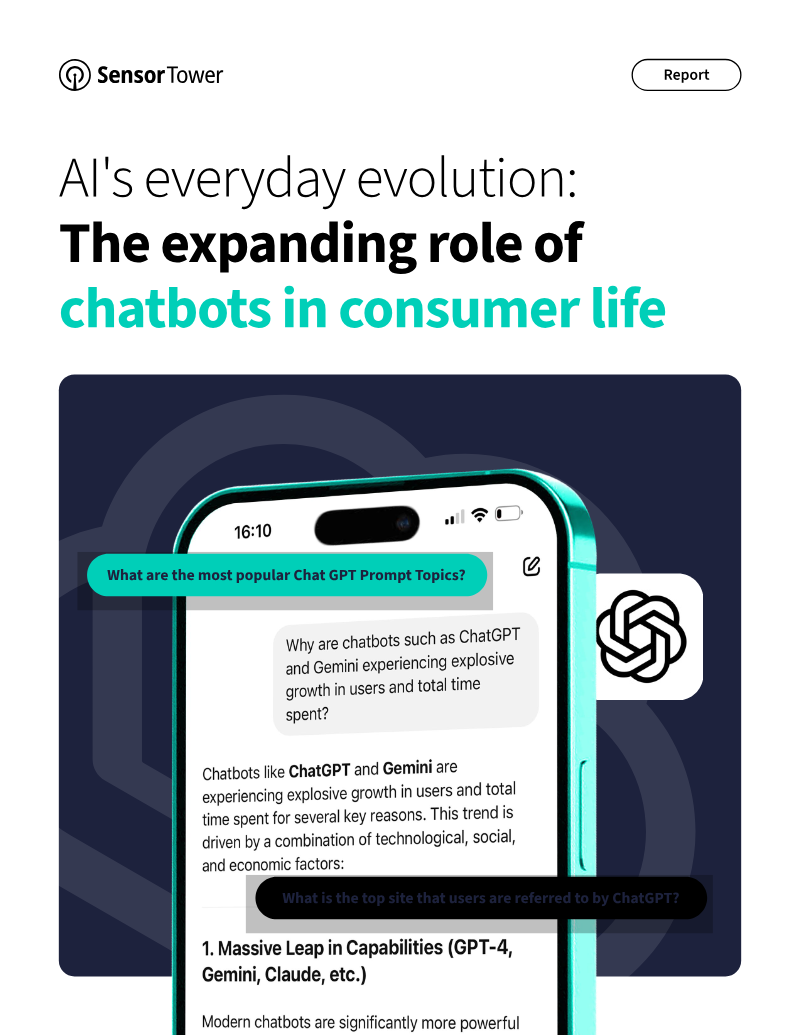
AI's Everyday Evolution: The Expanding Role of Chatbots in Consumer Life
The rapid expansion of artificial intelligence chatbots is fundamentally altering consumer behavior, signaling a shift away from the long-standing dominance of traditional search engines. By early 2025, OpenAI’s ChatGPT reached 500 million global monthly active users, achieving this milestone faster than any app in the last decade. This growth is accompanied by a significant increase in engagement; in April 2025, ChatGPT saw a 60% rise in session frequency and a 270% jump in web visits, while traditional search engines experienced a 3% decline in user engagement metrics.
The demographic profile of AI users is evolving from technical early adopters to mainstream consumers. This transition is reflected in the shifting nature of user prompts. While software development queries accounted for 44% of prompts in early 2024, they fell to 29% by 2025. Conversely, categories such as economics, finance, and taxes saw a substantial increase, rising 9 percentage points year-over-year. This suggests that consumers are increasingly relying on AI for complex personal tasks, including investment planning and tax preparation.
Data indicates that chatbots are becoming powerful engines for web traffic and commerce. The top referral destinations from ChatGPT include YouTube, Wikipedia, and the National Library of Medicine, with Amazon ranking fourth. This positioning highlights the growing role of AI in driving purchase intent and informational discovery. While early adopters of AI have already reduced their time spent on Google apps by approximately 6%, more recent converts have yet to show a material change in search habits, suggesting that the erosion of traditional search dominance may accelerate as user habits solidify over time.
- ChatGPT reached 500 million global monthly active users by early 2025, marking the fastest growth for any application in the last decade.
- In April 2025, ChatGPT experienced a 60% increase in session frequency and a 270% jump in web visits, while traditional search engine engagement declined by 3%.
- The utility of AI is shifting from technical tasks to complex personal management, with software development prompts dropping from 44% to 29% of the total share between early 2024 and 2025.
- Consumer reliance on AI for finance, economics, and tax preparation grew by 9 percentage points year-over-year, signaling a move toward mainstream adoption for high-stakes personal tasks.
- Chatbots are emerging as significant drivers of web traffic and commerce, with YouTube, Wikipedia, the National Library of Medicine, and Amazon serving as the top referral destinations.
+1
Sensor TowerJan 2024
Report25 pages
Sensor Tower Global Mobile Gaming Industry Outlook 2024
Global mobile gaming experienced a minor 2% year-on-year decline in in-app purchase revenue in 2023, totaling $76.7 billion. Despite this slight contraction, the market remains 22% larger than pre-pandemic levels in 2019. Projections indicate a recovery to $78 billion in 2024, with a long-term growth trajectory expected to surpass $100 billion by 2028 at an average annual growth rate of 6.8%. These findings are based on Sensor Tower App Performance Insights, covering the App Store and Google Play across major global markets including the United States, China, Japan, and South Korea.
The industry is currently defined by a shift in consumer spending from mid-core and hardcore titles toward casual and hybrid-casual models. Casual game revenue grew 8% to $28.6 billion in 2023, now accounting for 38% of the global market. Hybrid-casual games showed the most aggressive growth, increasing 30% to exceed $2.1 billion. In contrast, traditional high-revenue genres like RPGs and Strategy games both saw 10% revenue declines as the pandemic-era stay-at-home boost faded. Despite these drops, RPGs and Strategy remain the largest individual segments, generating $20 billion and $14.8 billion respectively.
Geographically, the United States remains the largest market at $22.2 billion, followed by the Chinese iOS market at $15.1 billion. While the Japanese and South Korean markets saw declines of 13% and 7% respectively, specific titles defied broader trends. MONOPOLY GO! and Royal Match emerged as major drivers in the casual sector, with the former generating $1.2 billion and the latter surpassing Candy Crush Saga in monthly revenue. In the mid-core space, new entrants like Honkai: Star Rail and Whiteout Survival achieved significant growth, particularly in APAC markets, by utilizing innovative themes and integrated gameplay mechanics.
- Global mobile gaming revenue reached $76.7 billion in 2023, a 2% year-on-year decline, but is projected to recover to $78 billion in 2024 and exceed $100 billion by 2028.
- Consumer spending is shifting toward casual and hybrid-casual models, with casual revenue growing 8% to $28.6 billion and hybrid-casual revenue surging 30% to over $2.1 billion.
- Traditional high-revenue segments, specifically RPGs and Strategy games, experienced a 10% decline in 2023, though they remain the largest categories at $20 billion and $14.8 billion respectively.
- The United States remains the top global market with $22.2 billion in revenue, followed by the Chinese iOS market at $15.1 billion.
- Casual titles like MONOPOLY GO!, which generated $1.2 billion, and Royal Match, which surpassed Candy Crush Saga in monthly revenue, are currently driving market growth.
+2
Sensor TowerJan 2024

Report46 pages
The State of Gaming 2024: An Analysis of the Current Mobile Gaming Market Trends
The global mobile gaming market underwent a significant correction in 2023, characterized by a 10% decline in worldwide downloads and a 2% drop in total revenue. This downturn was primarily fueled by escalating user acquisition costs and a post-pandemic stabilization of consumer habits. While the broader market contracted, a distinct shift toward casualization occurred, evidenced by an 8% increase in Casual game revenue and a 30% surge in the Hybridcasual segment. Conversely, Mid-core titles faced a 9% revenue decline, signaling a transition in player preferences toward more accessible experiences.
Geographic performance diverged sharply as publishers pivoted toward emerging markets to mitigate rising costs in established territories. While the Asian market saw a 6% revenue contraction, the Middle East, Europe, and Latin America experienced revenue growth of 8%, 7%, and 4% respectively, despite falling download numbers. This regional resilience was often driven by high-profile intellectual properties, such as the success of Monopoly GO! in Europe and the expansion of Netflix’s gaming portfolio, which saw a 194% increase in downloads through the integration of major franchises like Grand Theft Auto.
Strategic adaptations in 2023 focused on maximizing player lifetime value through Live Ops events and transmedia collaborations. Mobile gaming now commands 67% of global digital advertising spend, with marketing strategies increasingly segmented by platform; YouTube and TikTok serve as primary hubs for core gamers, while Facebook and Pinterest remain vital for reaching casual female audiences. To combat the challenges of the current landscape, the industry has embraced low-cost user-generated content and external subscription models, leveraging recognizable IP to bridge the gap between gaming and broader entertainment media.
- The global mobile gaming market contracted in 2023, with a 10% decline in downloads and a 2% drop in total revenue due to rising user acquisition costs and post-pandemic habit stabilization.
- Player preferences shifted toward accessibility, resulting in an 8% revenue increase for Casual games and a 30% surge in the Hybridcasual segment, while Mid-core titles saw a 9% revenue decline.
- Publishers are pivoting to emerging markets to offset costs, with the Middle East, Europe, and Latin America seeing revenue growth of 8%, 7%, and 4% respectively.
- High-profile intellectual property is a primary growth driver, evidenced by the success of Monopoly GO! in Europe and a 194% surge in Netflix gaming downloads following the integration of franchises like Grand Theft Auto.
- Mobile gaming now accounts for 67% of global digital advertising spend, with marketing strategies increasingly segmented by platform, such as using YouTube and TikTok for core gamers and Facebook and Pinterest for casual female audiences.
+1
Sensor TowerJan 2024

Report30 pages
State of Mobile Games in Japan
The analysis provides a comprehensive overview of Japan’s mobile‑gaming ecosystem in 2024, measuring the market’s size, growth dynamics, and competitive landscape. Total in‑app purchase (IAP) revenue reached roughly ¥2.5 trillion, marking a modest increase over 2023, while the combined share of the Apple App Store and Google Play stabilized at about 55 % and 45 % respectively. Advertising‑derived income expanded by 35 % year‑on‑year, now accounting for roughly 8 % of overall mobile‑gaming revenue, driven largely by user acquisition through YouTube, TikTok and Instagram.
Top‑grossing publishers dominate the market, with Mixi, Bandai Namco, CyberAgent, miHoYo, Square Enix and GungHo each securing multiple titles in the upper echelon of revenue. Flagship games such as Fate/Grand Order, eFootball, Pokémon GO, and the One Piece franchise collectively generated more than ¥1 trillion, underscoring the continued strength of established IPs. Genre analysis shows 3D titles now represent roughly half of the top‑performing apps, reflecting a shift toward richer visual experiences, while 2D and casual games retain a sizable user base.
The study covers the period January through July
- Japan’s mobile gaming market generated approximately ¥2.5 trillion in total in-app purchase (IAP) revenue during the first seven months of 2024.
- Established intellectual properties remain the primary revenue drivers, with titles like Fate/Grand Order, eFootball, Pokémon GO, and the One Piece franchise collectively accounting for over ¥1 trillion in earnings.
- Advertising-derived income grew by 35% year-on-year, now representing 8% of total mobile gaming revenue, fueled by user acquisition campaigns on YouTube, TikTok, and Instagram.
- The market is highly concentrated among top-tier publishers, including Mixi, Bandai Namco, CyberAgent, miHoYo, Square Enix, and GungHo.
- 3D titles have become the dominant visual format, now accounting for roughly 50% of the top-performing mobile applications.
Sensor TowerJan 2024
Report46 pages
The State of Gaming 2024
The global mobile gaming market underwent a significant correction in 2023, characterized by a 10% decline in downloads and a 2% dip in overall revenue. This downturn was primarily driven by escalating user acquisition costs and a post-pandemic stabilization of consumer habits. A distinct shift in player preference emerged as mid-core revenue fell by 9%, while casual and hybrid-casual segments grew by 8% and 30%, respectively. Despite these macro challenges, breakout successes like Monopoly Go! and Royal Match proved that innovative monetization and robust live operations can still yield massive returns in a tightening market.
Marketing strategies have evolved to prioritize high-impact collaborations and mobile advertising, which now commands 67% of global gaming ad spend. The industry is seeing a move toward gender parity in mid-core gaming, while platform-specific engagement has become more specialized, with TikTok attracting core gamers and Facebook remaining a stronghold for the female-skewing casual demographic. To mitigate rising costs, developers are increasingly leveraging intellectual property and transmedia expansions to drive organic discovery and long-term player retention.
Geographically, the industry focus is shifting toward emerging markets such as Latin America and the Middle East, where lower costs per install in countries like Brazil and Saudi Arabia offer new avenues for growth. While external subscription models, such as Netflix Games, experienced a 194% surge in downloads, they currently represent a small and largely unprofitable portion of the total ecosystem. Consequently, the prevailing industry strategy emphasizes the optimization of existing titles through aggressive live operations and brand partnerships rather than relying solely on new user acquisition in saturated Western markets.
- The global mobile gaming market contracted in 2023, with a 10% decline in downloads and a 2% dip in revenue due to rising user acquisition costs and post-pandemic habit stabilization.
- Market segment preferences shifted significantly in 2023, as mid-core revenue fell by 9% while casual and hybrid-casual segments grew by 8% and 30%, respectively.
- Mobile advertising now accounts for 67% of global gaming ad spend, with marketing strategies increasingly relying on high-impact collaborations and transmedia IP to drive organic discovery.
- Developers are pivoting toward emerging markets like Brazil and Saudi Arabia to capitalize on lower costs per install compared to saturated Western regions.
- While Netflix Games saw a 194% surge in downloads, subscription models remain a small and largely unprofitable segment of the overall gaming ecosystem.
+1
Sensor TowerJan 2024