
Press Start
Open-access student and early-career game studies journal hosted by the University of Glasgow.
Documents
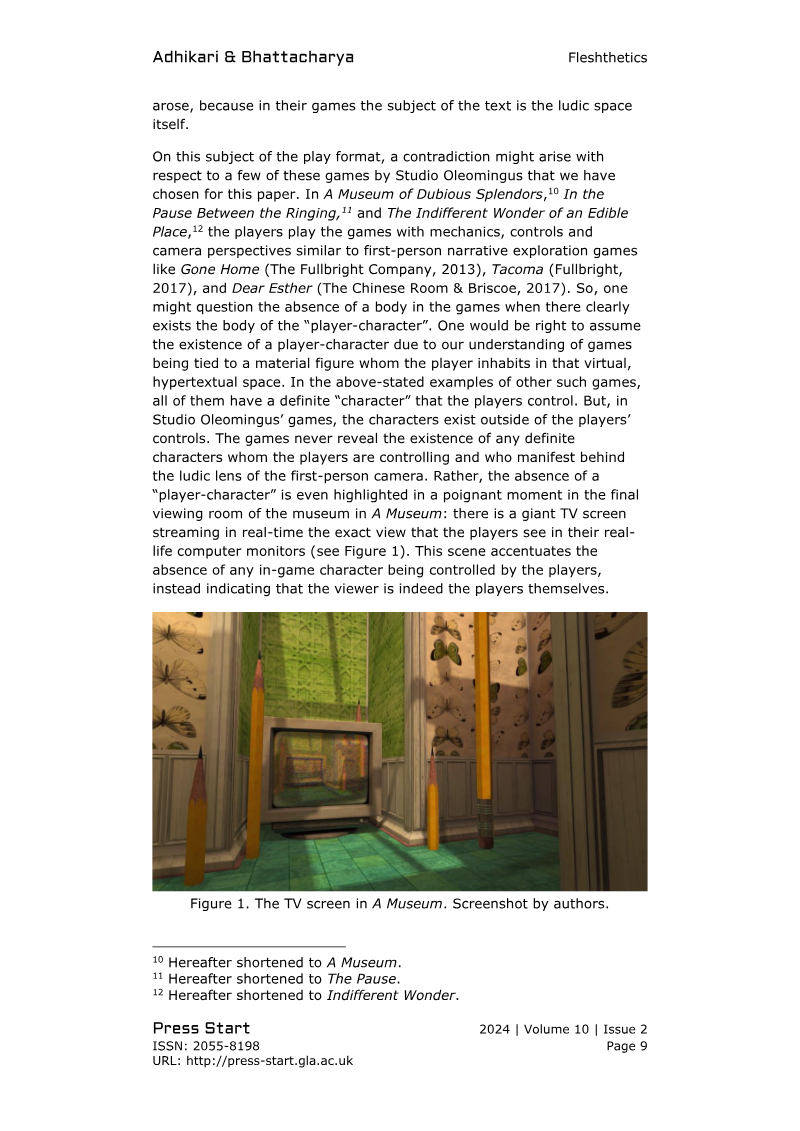
Fleshthetics of the Postcolonial Body: Examining Contested Identities in the Works of Studio Oleomingus
Fleshthetics of the Postcolonial Body: Examining Contested Identities in the Works Centre for Studies in Social Sciences, Calcutta, India Through a holistic analysis of the games by Studio Oleomingus, this paper will explore the concept of "Fleshthetics," examining how the postcolonial body/Flesh is a palimpsest and collage of…
- Studio Oleomingus games, including 'A Museum of Dubious Splendors' (2018), 'In the Pause Between the Ringing' (2019), 'The Indifferent Wonder of an Edible Place' (2020), 'The Uncertain Repetitions of Truth' (2020), and 'Folds of a Separation' (2022), serve as the primary case studies for analyzing the postcolonial body.
- The authors introduce 'Fleshthetics' as a theoretical framework to move beyond the rigid, monolithic academic definitions of the 'postcolonial body' by focusing on the 'Flesh' as a plastic, non-linear, and fragmented assemblage of identities.
- The 'Flesh' is defined as an absent-present entity capable of deformation and reformation, contrasting with the traditional 'Body,' which is often constrained by material, chrononormative, and colonial definitions of history.
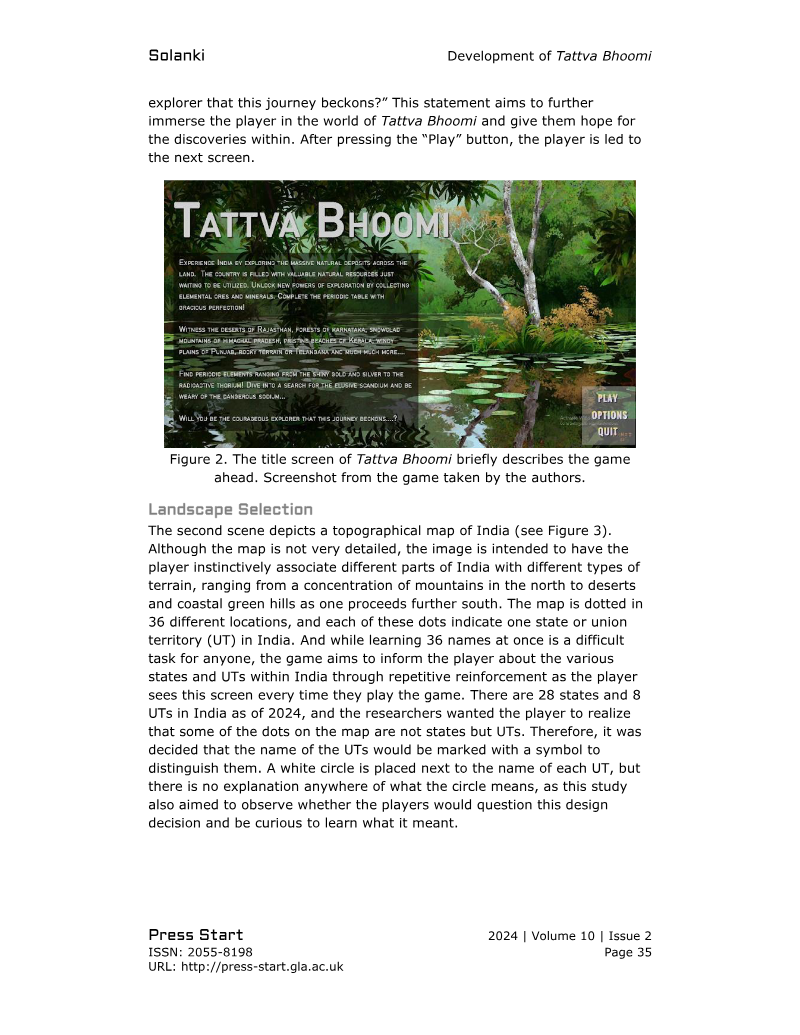
Enter the Backrooms of Tattva Bhoomi: An Educational Game for Middle School Students in India
Press Start Development of Tattva Bhoomi Enter the Backrooms of Tattva Bhoomi: An Educational Game for Middle School Students Indian Institute of Technology Hyderabad, India This paper outlines the development process of Tattva Bhoomi, a game- based learning application developed by the authors and designed to teach chemistry…
- Tattva Bhoomi is an educational game designed for Indian middle school students to teach chemistry and natural resource concepts through exploration and iterative learning.
- The game utilizes an 'approach-and-collect' mechanic for interaction, removing the need for complex mouse clicks to ensure accessibility for users with limited gaming experience.
- Development followed an iterative prototyping process, focusing on a single, high-detail landscape modeled after the topography of Rajasthan to overcome initial resource constraints.
A Place to Survive: OMORI Through Bronfenbrenner’s Ecological Systems Theory
Press Start A Place to Survive A Place to Survive: OMORI Through Bronfenbrenner's Ecological Systems Ateneo de Manila University, Philippines De La Salle University, Dasmariñas, Philippines Philippine Normal University, Philippines This research delves into the narrative of the role-playing game OMORI (OMOCAT, 2020).
- The role-playing game OMORI (2020) serves as a psychological narrative that can be analyzed as literature, using the Japanese kishōtenketsu four-act story structure to explore themes of trauma, guilt, and isolation.
- Urie Bronfenbrenner’s ecological systems theory provides a framework to demonstrate how characters' development is shaped by immediate family dynamics (microsystems) and broader societal influences (macrosystems).
- The game's narrative reveals how neoliberalism, capitalism, and religious values—which emphasize perfectionism and status—indirectly influence the characters' psychological well-being and life contentment.
If Only I Had Someone to Play With: Sociality in Single Player Board Games
Press Start Single Player Board Games If Only I Had Someone to Play With: Sociality in Single Player Board Games Canterbury Christ Church University, United Kingdom Since 2004, the tabletop board game market has seen a surge in solo compatibility.
- Solo board gaming has seen a significant market surge since 2004, accelerated by COVID-19 restrictions that necessitated alternative play methods.
- A survey of 220 solo board gamers revealed that 72% believe solo play improves their knowledge and skills for multiplayer variants, demonstrating a transfer of 'gaming capital'.
- Solo play offers a unique, immersive experience that avoids the 'chores' of multiplayer gaming—such as rule enforcement debates and social downtime—which can distract from game immersion.
Play My Resume: Exploring Resume and CV Differentiation Through Personalized Web-Based Games
Play My Resume: Exploring Resume and CV Differentiation Through Personalized Web- Central Michigan University, United States Since the 1980s, creative job seekers have turned to nontraditional and interactive resume formats to help set themselves apart from other candidates.
- Game resumes are almost exclusively created by individuals seeking employment within the games industry, serving as a specialized tool for showcasing technical and creative skills.
- The standard design for a game resume is a short, low-friction experience with an average runtime of less than five minutes and a focus on player immortality to ensure the recruiter sees the entire content.
- Nearly 50% of game resumes utilize the side-scroller platformer format, a trend popularized by Robby Leonardi’s 2013 interactive resume, while the remainder span genres like action RPGs, adventure games, and interactive fiction.
Defining Art Styles in Games: Their Influence on Creative Expression
Press Start Defining Art Styles in Games Defining Art Styles in Games and Their Influence on Creative Expression University College London, United Kingdom This article explores and highlights the differences between art styles in video games, and details how the use of them can allow for the expression of creative ideas and…
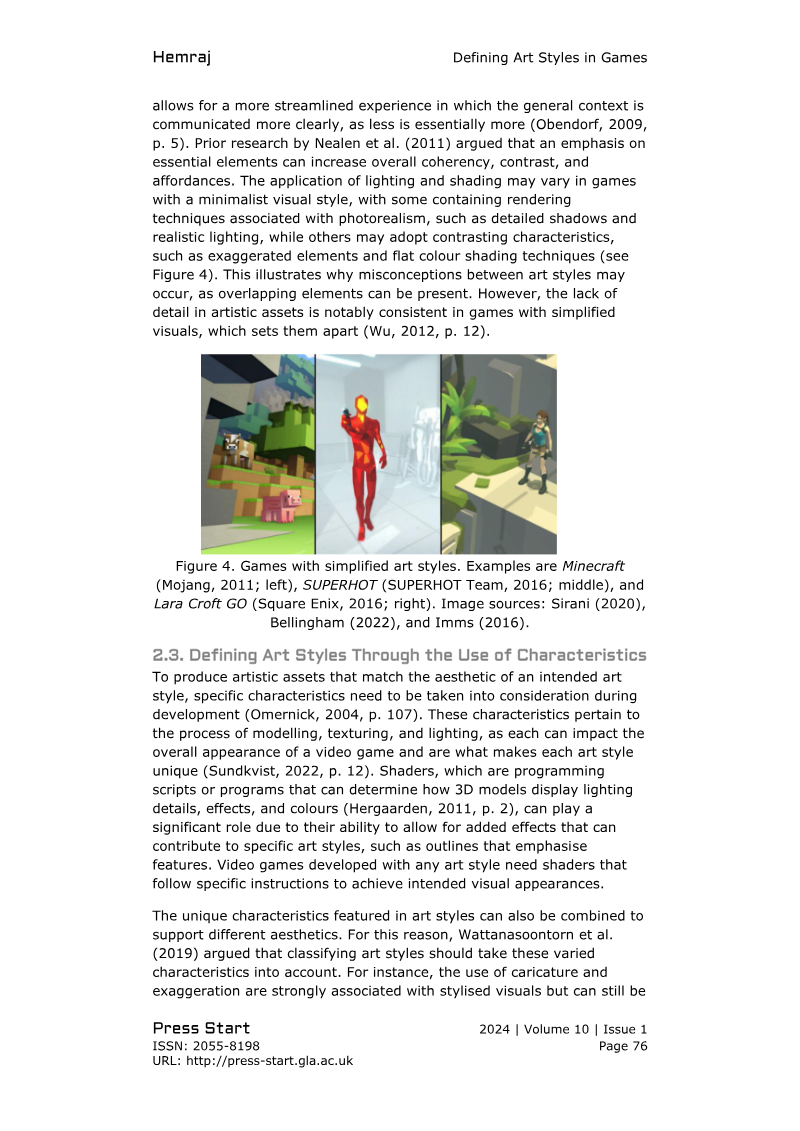
- Art styles in video games are defined by visual elements like proportions and shading, serving as essential tools for creative expression and communicating complex messages beyond mere entertainment.
- Existing academic frameworks for classifying art styles generally categorize them into photorealistic, stylised (caricature), and simplified (minimalism) models, though they differ in their levels of abstraction.
- The 'art game' genre, exemplified by titles like The Maze of Nightmares, utilizes gameplay mechanics, obstacles, and rules to explore social issues and personal experiences rather than focusing solely on traditional fun.
Lost Again: Refractive Nostalgia and Video Games
Lost Again: Refractive Nostalgia and Video In tackling chronophobia, which Svetlana Boym (2001) defines as the anxiety of deciding how to use our time meaningfully as it depletes, video games become purposeful spaces where we can revisit the things we have lost, or what we anticipate will be lost with time.
The Eruptive History of Death Mountain: A Geological Investigation of a Virtual Volcano
Press Start The Eruptive History of Death Mountain The Eruptive History of Death Mountain: A Geological Investigation of a Virtual Volcano Across The Legend of Zelda Series University of Leicester, United Kingdom Enrolment in geology-related courses has declined over the last few decades, in part due to a lack of understanding…
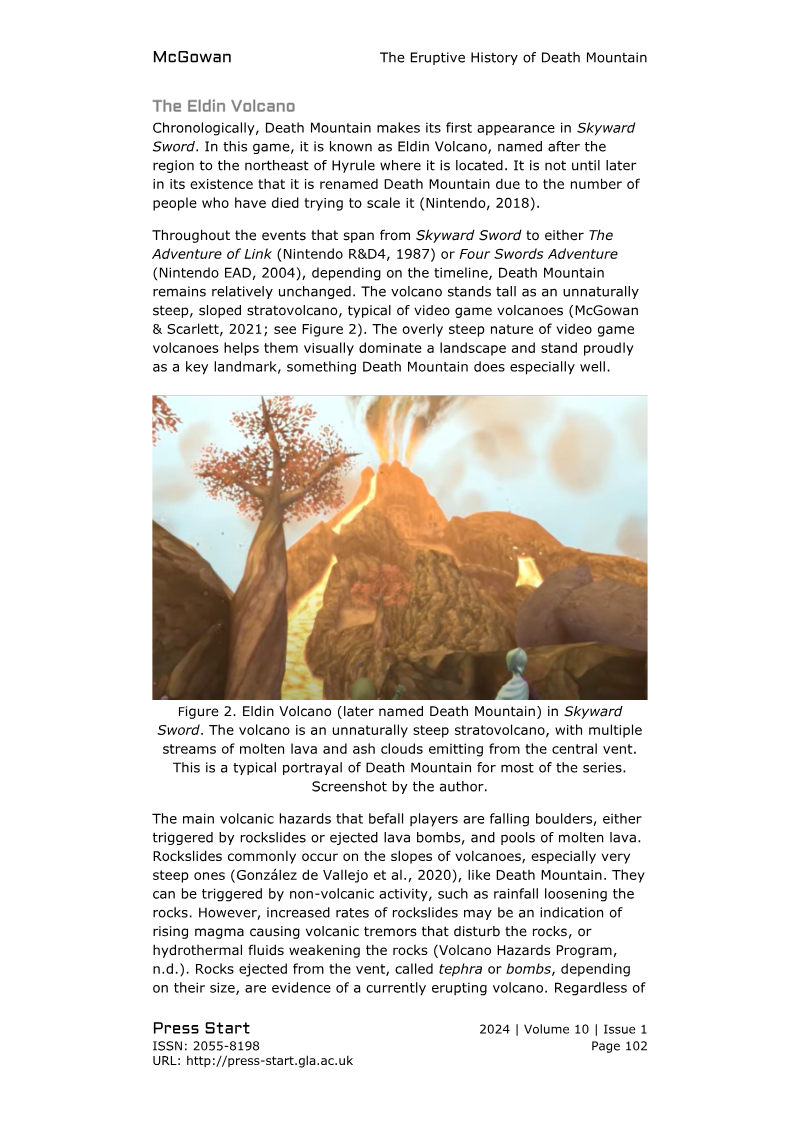
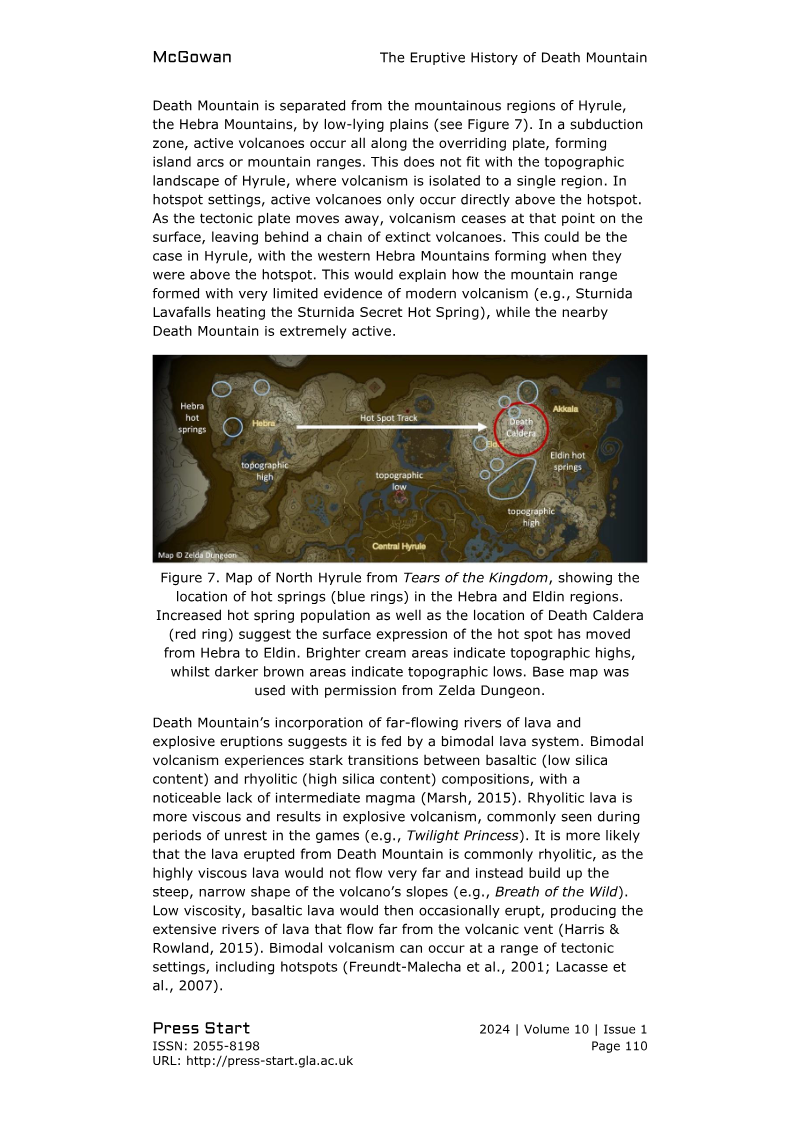
- The Legend of Zelda series demonstrates a coherent, realistic evolution of the volcanic peak 'Death Mountain' across 12 titles, progressing from a standard stratovolcano to a complex system featuring hydrothermal activity and caldera formation.
- The introduction of hot springs and ore mining in later titles like 'Twilight Princess' and 'Breath of the Wild' serves as geological evidence of a maturing magmatic plumbing system and increased shallow-depth magma presence.
- While the series employs common video game tropes—such as unrealistic lava lake sizes, which can reach up to 5,000 meters across in 'Breath of the Wild' compared to the 250-meter maximum of the real-world Mount Nyiragongo—the environmental progression remains geologically plausible.
Minecraft's Atom
Press Start Minecraft's Atom Given that the fundamental element of Minecraft (Mojang Studios, 2011) is appreciably large, what its players discover is a sandbox-style game in which the ubiquitous block, Minecraft's atom, stands for an unparalleled degree of immediacy.
Doki Doki Subversion Club!: Gothic Ghosts, Uncanny Glitches, and Abject Boundaries
Press Start Doki Doki Subversion Club! Doki Doki Subversion Club!
Becoming Halfling: Racial Permeability as Ludonarrative Architecture in Critical Role
Press Start Becoming Halfling Becoming Halfling: Racial Permeability as Ludonarrative Architecture in the Critical University of Kentucky, United States Livestreamed play of tabletop games affords a new medium for analysis of racialization for game studies.
- Tabletop roleplaying games like Dungeons & Dragons often perpetuate White supremacist racial logic through gameplay mechanics and lore that inherently guide players to treat 'monstrous' races as impulsive, violent, and lacking agency.
- In the Critical Role campaign, the character Nott the Brave—a Goblin who is secretly a Halfling named Veth Brenatto—serves as a case study for how players and the game system regress into racial stereotypes, treating the character as an 'Other' until she is transformed back into a human-coded form.
- The author argues that current efforts toward diversity in TTRPGs are insufficient because they focus on representation rather than restructuring the underlying mechanical and narrative architecture that enforces racialized hierarchies.
Lost in a Dream: Queering Time and Space in Yume Nikki
Press Start Lost in a Dream Lost in a Dream: Queering Time and Space in University of California, Los Angeles, United States This article investigates the opportunities for queer play in Yume Nikki (KIKIYAMA, 2004) by examining the spatial and temporal dimensions of the game's "Dream World" alongside its narrative.
Do you work at Press Start? Get a free report of how these documents are read and cited here.