
International Journal of Serious Games
Open-access peer-reviewed journal of the Serious Games Society on the design, use and assessment of serious games.
Documents
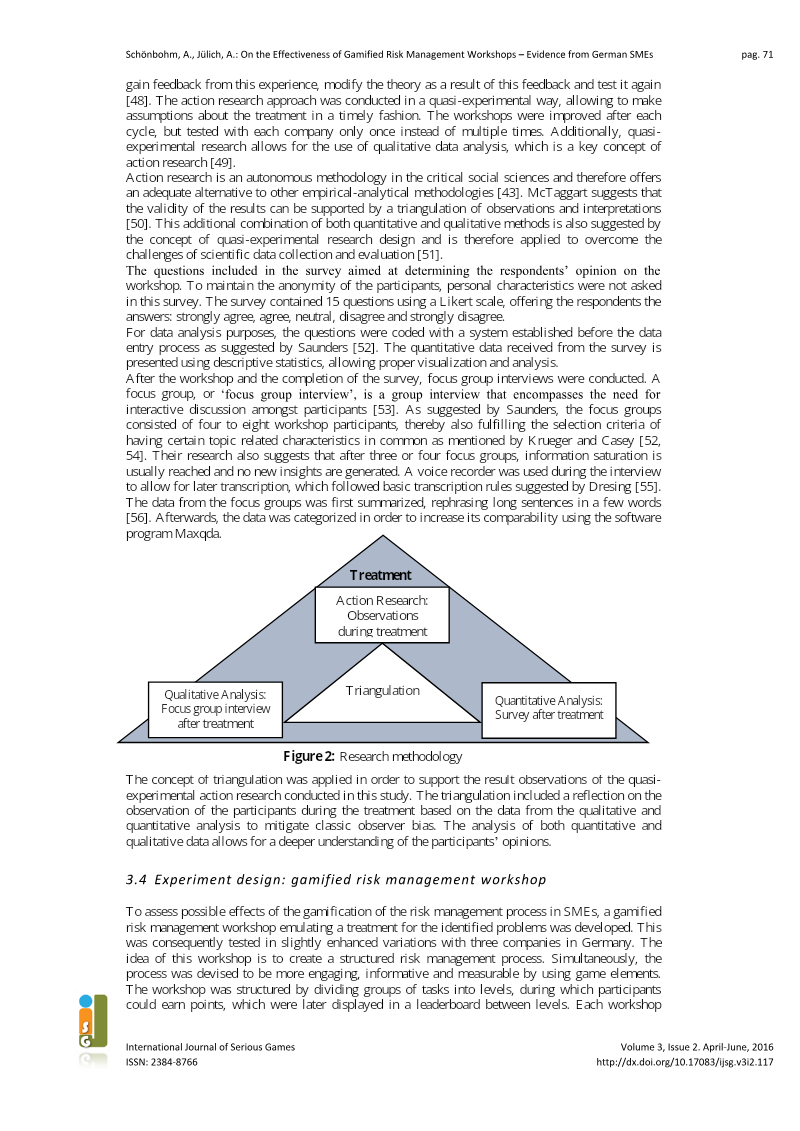

On the Effectiveness of Gamified Risk Management Workshops: Evidence from German SMEs
Gamified risk management workshops serve as a viable intervention to address systemic failures in small and medium-sized enterprises, specifically regarding employee motivation, knowledge gaps, and the prevalence of cognitive biases.
- Gamified risk management workshops significantly improve the quality of risk-related discussions and decision-making by replacing abstract processes with structured, interactive frameworks.
- The integration of game mechanics like points and leaderboards fosters employee autonomy and mastery, effectively addressing common issues of low motivation and knowledge gaps in SMEs.
- Collaborative gamified environments mitigate individual cognitive biases by forcing teams to consider a broader range of threats and strategic responses.


Using Digital Games to Learn Mathematics: What Students Think?
Digital games offer a potential, albeit nuanced, pedagogical tool for mathematics education at the university foundation level.
- A student’s pre-existing interest in mathematics is the primary determinant of success for game-based learning, rendering technology confidence and gaming habits insufficient drivers on their own.
- Digital games are not a universal solution for disengaged learners but function most effectively as a supplementary tool for students who already possess a positive attitude toward mathematics.
- While 78 percent of university foundation students identify as active gamers, their enthusiasm for integrating these games into formal mathematics curricula is only moderately positive.

Development of an HIV Prevention Videogame Intervention: Lessons Learned
The development of PlayForward: Elm City Stories establishes a rigorous framework for creating serious games aimed at adolescent HIV prevention.
- Successful health-focused digital interventions require an iterative, theory-driven development process that prioritizes depth of engagement over the breadth of educational content.
- The use of 'Game Playbooks' is essential for maintaining focus on specific behavioral targets and preventing superficial content delivery during the development cycle.
- Integrating behavioral science with interactive entertainment creates a scalable model for health behavior change that bridges the gap between clinical theory and game design.

Game Based Cyber Security Training: Are Serious Games Suitable for Cyber Security Training?
This analysis evaluates the efficacy of serious games as training tools for cyber security, a field increasingly vital due to the high economic and social costs of digital crime.
- Serious games for cyber security are currently in an immature state, with most existing tools limited to basic public awareness topics like phishing rather than advanced professional training.
- There is a critical lack of specialized training resources tailored for IT professionals and management decision-makers.
- Current interventions predominantly rely on short-term, single-session formats, which contradicts established behavioral science indicating that effective training requires long-term, sustained engagement.

Augmented Reality Cubes for Cognitive Gaming: Preliminary Usability and Game Experience Testing
The Cognitive Augmented Reality Cubes (CogARC) system serves as a novel serious gaming platform designed to facilitate cognitive screening and training for elderly populations.
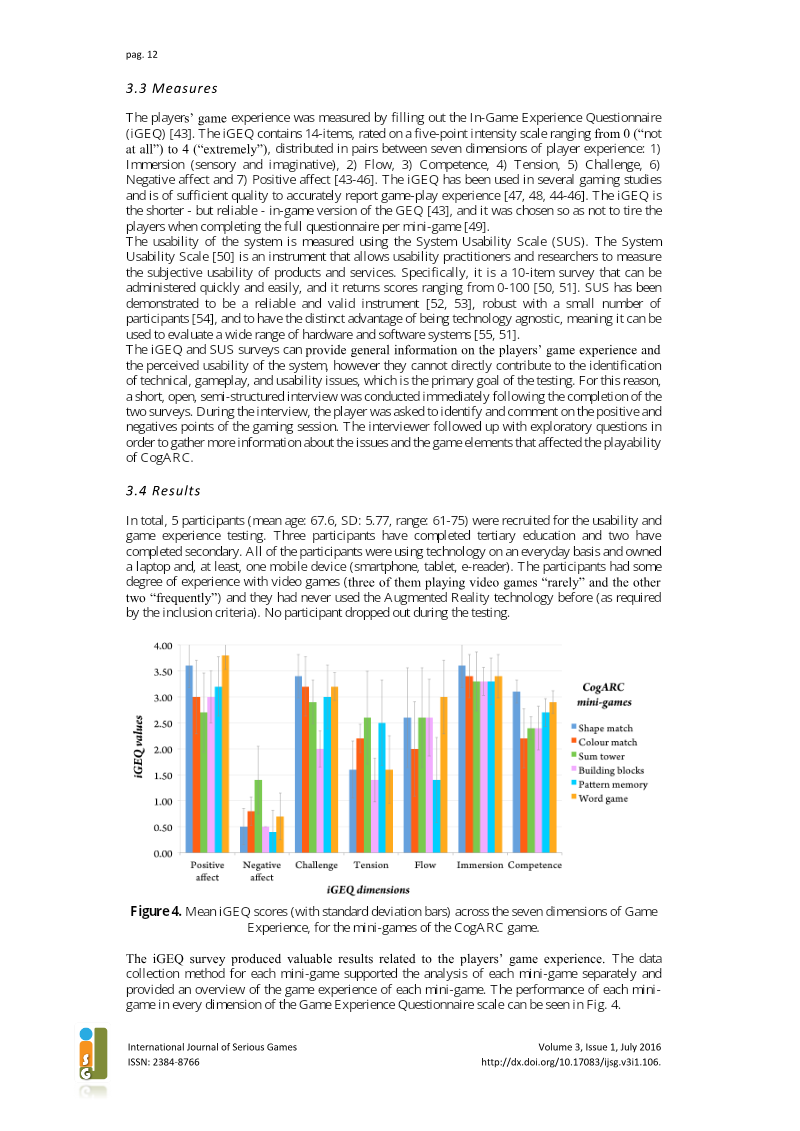
- The CogARC system uses physical cubes and tablet-based augmented reality to provide cognitive screening and training for elderly populations, focusing on memory, attention, and executive processing.
- Preliminary usability testing with elderly participants resulted in a System Usability Scale score of 70.5, indicating a generally positive reception.
- Technical development has migrated to the Unity platform and implemented multi-marker tracking to address persistent issues with latency and marker occlusion.
Accurate Complex Systems Design: Integrating Serious Games with Petri Nets
The integration of Petri Nets with serious game development provides a robust framework for the design and validation of complex systems.
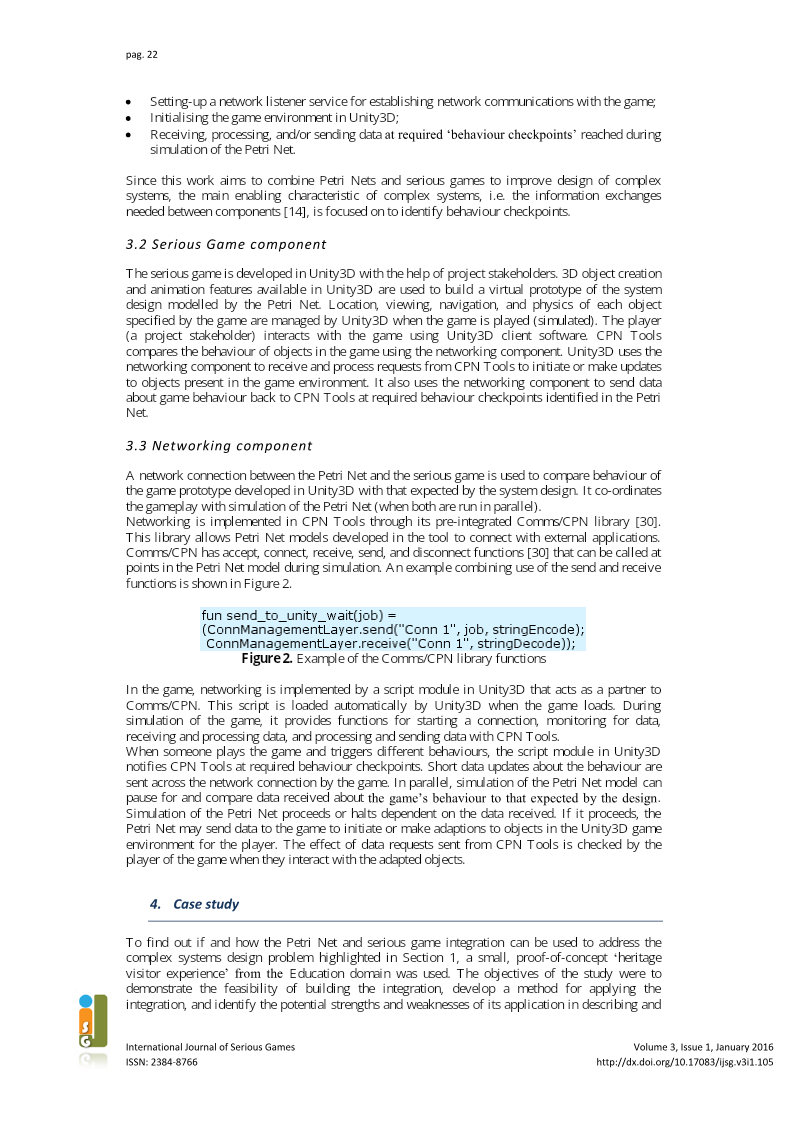
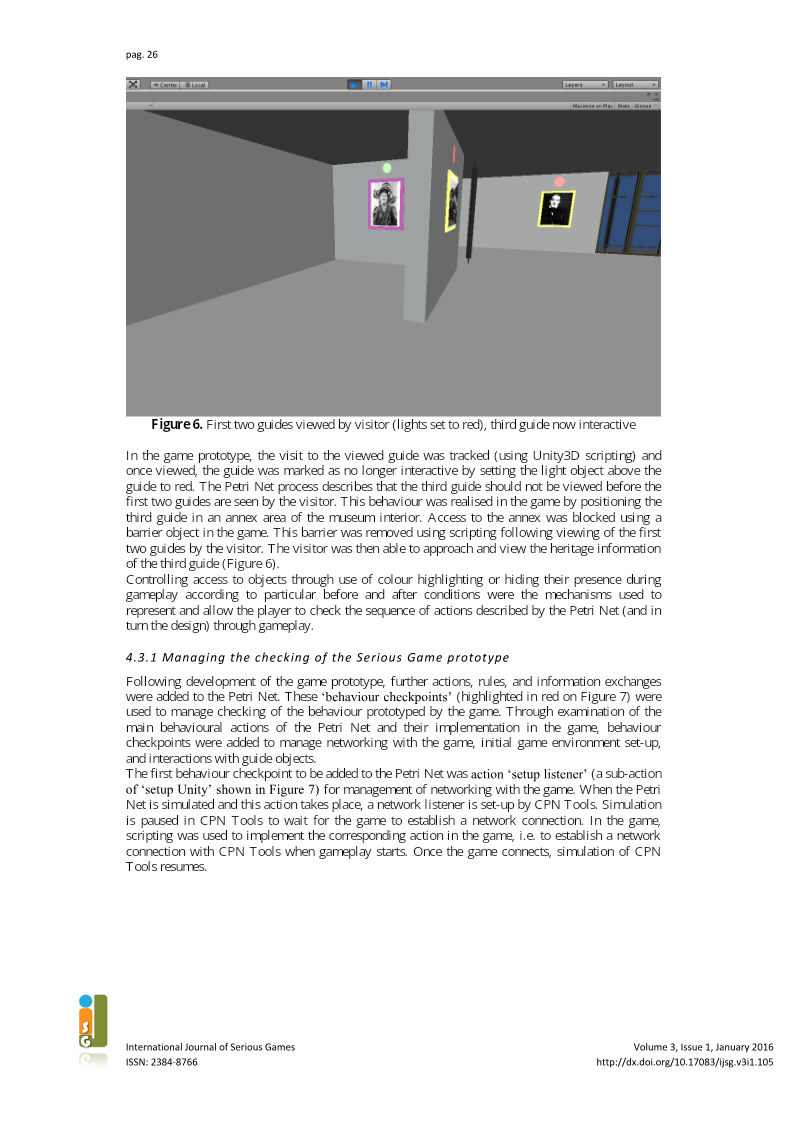
- Integrating Petri Nets with Unity3D creates a hybrid framework that combines rigorous mathematical modeling with immersive prototyping to validate complex system logic.
- Synchronizing Petri Net simulations with game-based environments via behavioral checkpoints allows for the real-time detection of sequencing errors, logic flaws, and missing information.
- This methodology bridges the communication gap between technical developers and non-technical stakeholders by transforming abstract specifications into an interactive, accessible experience.

Enhancing Surgical Team Performance with Game-Based Training
Medical errors in surgical environments are frequently linked to breakdowns in team communication and hierarchical power imbalances.
- The Safe Surgery Trainer (SST) game significantly improved both declarative knowledge and the transfer of communication skills in a study of 141 participants compared to a control group.
- Participants who played the SST game demonstrated a superior ability to apply communication strategies to novel clinical scenarios, indicating the development of accurate mental models for team interaction.
- The study utilized a randomized controlled design to evaluate the game's efficacy in addressing surgical errors caused by communication breakdowns and hierarchical power imbalances.

Framing Serious Games Development as a Matter of Business
Serious games development is fundamentally shaped by the interplay between product design and business strategy.
- Serious games development is inseparable from business strategy, as the need for consistent cash flow and market reach directly dictates a game's design, narrative, and functional maturity.
- Developers operate on a 'pendulum' model, oscillating between creating highly specific, client-tailored versions and generic, scalable frameworks to balance customization with market growth.
- Consultancy-based firms prioritize bespoke, high-touch solutions that ensure quality control but face inherent limitations in scalability.
Using Video Games to Combine Learning and Assessment in Mathematics Education
Video games function as both powerful pedagogical interventions and sophisticated assessment instruments within mathematics education.
- Digital games like Semideus and Wuzzit Trouble function as both pedagogical tools and valid, reliable assessment instruments that correlate strongly with traditional metrics like the Rational Number Test.
- Short-term game-based interventions in mathematics education have demonstrated significant performance improvements, achieving effect sizes as high as 1.61 in tasks involving density and ordering.
- Game-based assessment utilizes Evidence-Centered Design to capture granular data on complex competencies such as algorithmic reasoning, magnitude estimation, and rational number conceptualization.

A Technique for Mapping Mathematics Content to Game Design
The integration of mathematics into digital entertainment often suffers from a disconnect between educational objectives and engaging gameplay.
- A new structured mapping framework integrates mathematical concepts directly into core game mechanics rather than treating them as peripheral educational additions.
- The methodology decomposes complex curricula into manageable subtopics, specifically targeting learning objectives like identification, simplification, and transposition.
- Preliminary evaluations using the GameFlow model confirm that games developed with this framework successfully maintain player engagement, challenge levels, and sustained concentration.

Full-body Movement in Numerical Trainings: A Pilot Study with an Interactive Whiteboard
Integrating full-body movement into interactive whiteboard training significantly enhances children’s arithmetic proficiency and spatial-numerical estimation skills.
- Integrating full-body movement with interactive whiteboards significantly improves children's arithmetic proficiency and spatial-numerical estimation compared to static tablet-based or non-numerical interventions.
- The study of 27 participants confirms that experimental groups using physical movement consistently outperformed control groups in tasks such as multi-digit addition.
- Embodied learning leverages cognitive spatial mapping, creating a synergistic effect that enhances numerical associations more effectively than traditional digital interfaces.

Mathematics Learning Opportunities When Playing a Tower Defense Game
Commercial tower defense games offer a significant, underutilized platform for fostering mathematical problem-solving skills among students aged 10 to 12.
- Tower defense games like Vector Tower Defense 2 provide a natural environment for students aged 10 to 12 to practice geometric spatial reasoning, functional relationships, arithmetic, and percentages.
- Gameplay mechanics in the tower defense genre inherently require continuous cycles of observation, planning, and decision-making that align with core mathematical curricular objectives.
- Students do not spontaneously bridge the gap between intuitive gameplay and formal mathematical analysis, meaning the educational potential remains implicit without external intervention.