GREE
Game Co.192 documents
Documents
Financial8 pages
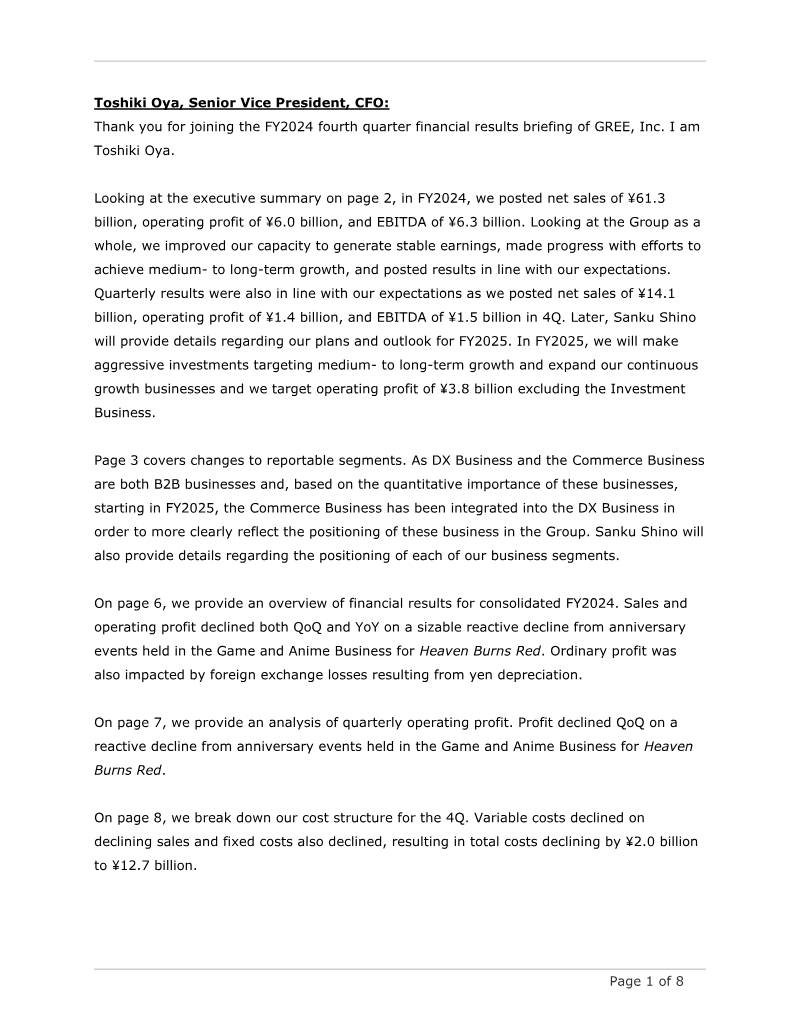
FY2024 Fourth Quarter Financial Results Briefing
The briefing presents GREE, Inc.’s FY2024 financial performance and strategic outlook. Net sales for the fiscal year reached ¥61.3 billion, operating profit stood at ¥6.0 billion, and EBITDA was ¥6.3 billion, aligning with expectations. Quarterly results for 4Q mirrored forecasts: ¥14.1 billion in sales, ¥1.4 billion operating profit, and ¥1.5 billion EBITDA. A revised dividend policy raised the year‑end payout to ¥16.5 per share, targeting a 30 % payout ratio and a dividend‑of‑earnings ratio near 3 %.
Segment restructuring is underway; the Commerce Business merges into DX Business starting FY2025 to clarify B2B positioning. Continuous‑growth businesses—Metaverse and DX—are positioned as core earnings engines, with a target CAGR of 120–140 % for operating profit. Long‑term investment businesses, notably Game and Anime, face higher volatility; FY2025 forecasts anticipate sales of ¥60.2 billion and operating profit of ¥3.8 billion, with a temporary dip in 1Q due to rising development costs.
The Metaverse segment achieved ¥6.5 billion in sales and ¥1.3 billion operating profit, driven by platform gains and a 190 % YoY rise in VTuber merchandise. DX Business reported ¥1.75 billion sales and ¥0.22 billion profit, with a shift toward SaaS solutions to replace labor‑intensive outsourcing. Investment Business generated modest profit of ¥0.15 billion in 4Q, with assets under management rising to ¥35.3 billion.
Overall, GREE projects FY2025 sales of ¥60–61 billion and operating profit around ¥3.8 billion, while medium‑term targets for FY2026 and FY2027 are moderated due to adjusted release schedules in Game and Anime. The company emphasizes stable earnings from core segments, aggressive investment in new titles, and restructuring of B2B services to secure recurring revenue streams.
- GREE, Inc. reported FY2024 net sales of ¥61.3 billion and an operating profit of ¥6.0 billion, with FY2025 forecasts projecting a slight decline to ¥60–61 billion in sales and ¥3.8 billion in operating profit.
- The company is restructuring its B2B operations by merging the Commerce Business into the DX Business in FY2025 to shift toward high-margin SaaS solutions and away from labor-intensive outsourcing.
- Metaverse and DX segments are designated as core growth engines, targeting a 120–140% CAGR for operating profit, supported by a 190% year-over-year increase in VTuber merchandise sales.
- The Game and Anime segments are categorized as long-term, high-volatility investments, with FY2025 operating profit expected to face a temporary 1Q dip due to increased development costs.
- GREE revised its dividend policy to a 30% payout ratio, resulting in a year-end dividend of ¥16.5 per share.
+1
GREE
Report1 pages
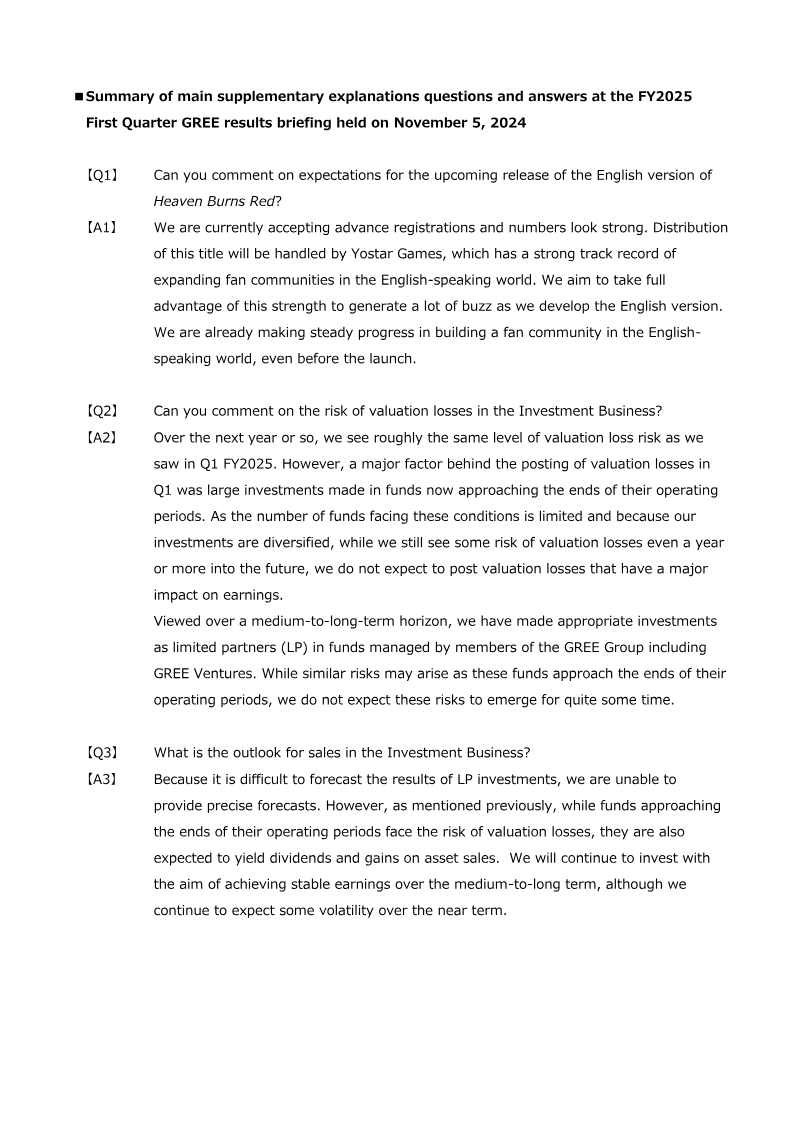
Summary of main supplementary explanations questions and answers at the FY2025 First Quarter GREE results briefing held on November 5, 2024
The briefing clarified GREE’s strategic focus for FY2025 first‑quarter results, emphasizing both gaming and investment operations. In the gaming segment, the company confirmed that advance registrations for the English version of “Heaven Burns Red” are strong and that distribution will be handled by Yostar Games, whose track record in expanding English‑speaking fan communities is expected to generate significant buzz. GREE highlighted ongoing community building efforts prior to launch, underscoring a proactive marketing approach.
Regarding the investment business, management acknowledged that valuation‑loss risk remains comparable to Q1 FY2025 levels. The primary driver of past losses was large investments in funds nearing the end of their operating periods; however, diversification and limited exposure to such funds mitigate long‑term impact. GREE maintains that while short‑term volatility may persist, medium‑to‑long‑term earnings should remain stable as funds mature and yield dividends or asset sales. The company reiterated its commitment to investing in GREE‑Group managed funds, including GREE Ventures, and expects related risks to surface only after several years.
Overall, the briefing presented a balanced outlook: aggressive growth in the gaming arm through strategic partnerships and community engagement, coupled with cautious yet steady investment practices aimed at preserving earnings stability amid inherent valuation risks.
- GREE is launching the English version of 'Heaven Burns Red' in partnership with Yostar Games, leveraging the publisher's expertise in growing English-speaking fan communities.
- The company is prioritizing proactive community building and marketing efforts ahead of the 'Heaven Burns Red' English launch to drive engagement.
- Management expects valuation-loss risks in the investment segment to remain consistent with Q1 FY2025 levels in the near term.
- While short-term volatility persists, GREE anticipates stable medium-to-long-term earnings as existing funds mature through asset sales and dividend yields.
- The company has mitigated long-term investment risk by diversifying its portfolio and limiting exposure to funds nearing the end of their operating cycles.
+3
GREE
Financial80 pages
FY2025 Full-Year Financial Results
FY2025 Full-Year (Fourth Quarter) Financial Results Executive Summary<sub>(FY25 </sub>Full-Year) ◼ Net sales ¥53.8 billion, operating profit ¥5.3 billion, EBITDA ¥5.6 billion ⁃ Profitability improved in all business segments, secured stable profit, operating profit in line with forecast FY25 Game Three consecutive hits from new titles released in 3Q; made progress in expanding development pipeline focused on major IP titles Results ...
- The company achieved net sales of ¥53.8 billion and operating profit of ¥5.3 billion in FY25, with profitability improving across all business segments and operating profit meeting forecasts.
- The Game segment had three consecutive new title hits in 3Q FY25, and FY26 forecasts stable earnings from existing titles despite increased costs from developing multiple new titles.
- The Metaverse segment saw aggressive investment in its rapidly growing VTuber business in FY25 and expects sales and profit growth in FY26, with the VTuber business projected to achieve monthly profitability in H2.
- A new IP business segment was established in FY25, focusing on expanding the anime business and launching new ventures, with a temporary profit decline expected in FY26 due to investment in new businesses.
- The DX segment actively promoted business integrations in FY25, transitioning towards a recurring-earnings model for stable earnings, and aims to complete this transition and underpin group profit with a B2B focus.
+3
GREE
Financial8 pages
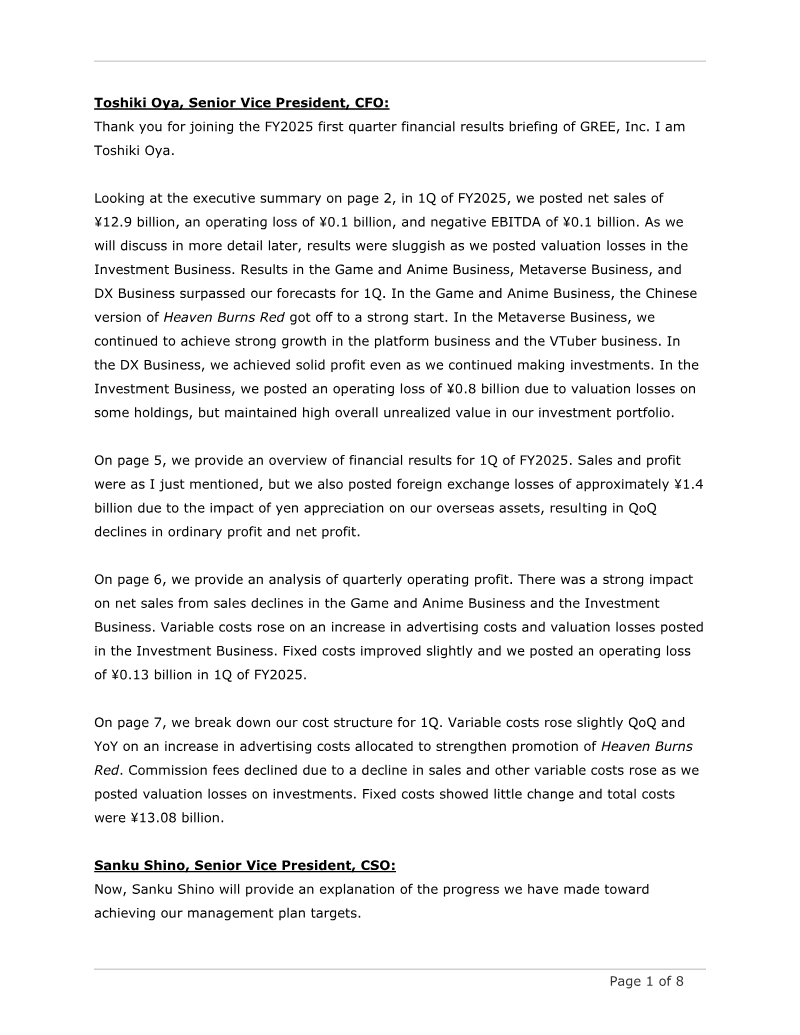
FY2025 First Quarter Financial Results Briefing
The briefing presents FY2025 first‑quarter results for GREE, Inc., highlighting a net sales figure of ¥12.9 billion and an operating loss of ¥0.1 billion, largely driven by valuation losses in the Investment Business and foreign‑exchange impacts from yen appreciation. While Game and Anime, Metaverse, and DX segments exceeded forecasts—thanks to strong performance of the Chinese version of Heaven Burns Red, continued growth in platform and VTuber services, and solid DX profitability—the Investment Business posted a ¥0.8 billion operating loss due to crypto‑asset valuation declines and write‑downs on maturing funds. Variable costs rose from advertising spend and investment losses, whereas fixed costs remained relatively stable.
Geographically, the company operates globally with significant overseas assets; the report notes a ¥1.4 billion FX loss affecting ordinary and net profit. The management plan positions Metaverse and DX as continuous‑growth businesses targeting a 120–140 % CAGR in operating profit, while Game and Anime are treated as long‑term investment assets. Medium‑term targets emphasize aggressive investment in VTuber talent and DX product development, with expectations of profitability from the VTuber segment by FY2026 and accelerated growth in DX by FY2027.
Methodologically, the briefing relies on quarterly financial statements, segment‑level performance data, and investment portfolio valuations. The Investment Business’s dual GP/LP structure is explained to contextualize volatility, with an emphasis on long‑term stability despite short‑term losses. Overall, the company projects FY2025 results in line with prior forecasts but anticipates slightly lower Game and Anime sales, offset by higher operating profit from continuous‑growth segments.
- GREE, Inc. reported Q1 FY2025 net sales of ¥12.9 billion and an operating loss of ¥0.1 billion, primarily due to a ¥0.8 billion loss in the Investment Business and ¥1.4 billion in foreign-exchange losses.
- The Investment Business loss was driven by crypto-asset valuation declines and write-downs on maturing funds, though management maintains a long-term stability outlook for the segment.
- Game and Anime, Metaverse, and DX segments outperformed forecasts, bolstered by the Chinese release of Heaven Burns Red and consistent growth in VTuber and DX services.
- Management is targeting a 120–140% compound annual growth rate (CAGR) in operating profit for the Metaverse and DX segments, positioning them as the company's primary growth engines.
- The company expects the VTuber segment to reach profitability by FY2026, with DX growth projected to accelerate by FY2027.
+4
GREE
Report2 pages
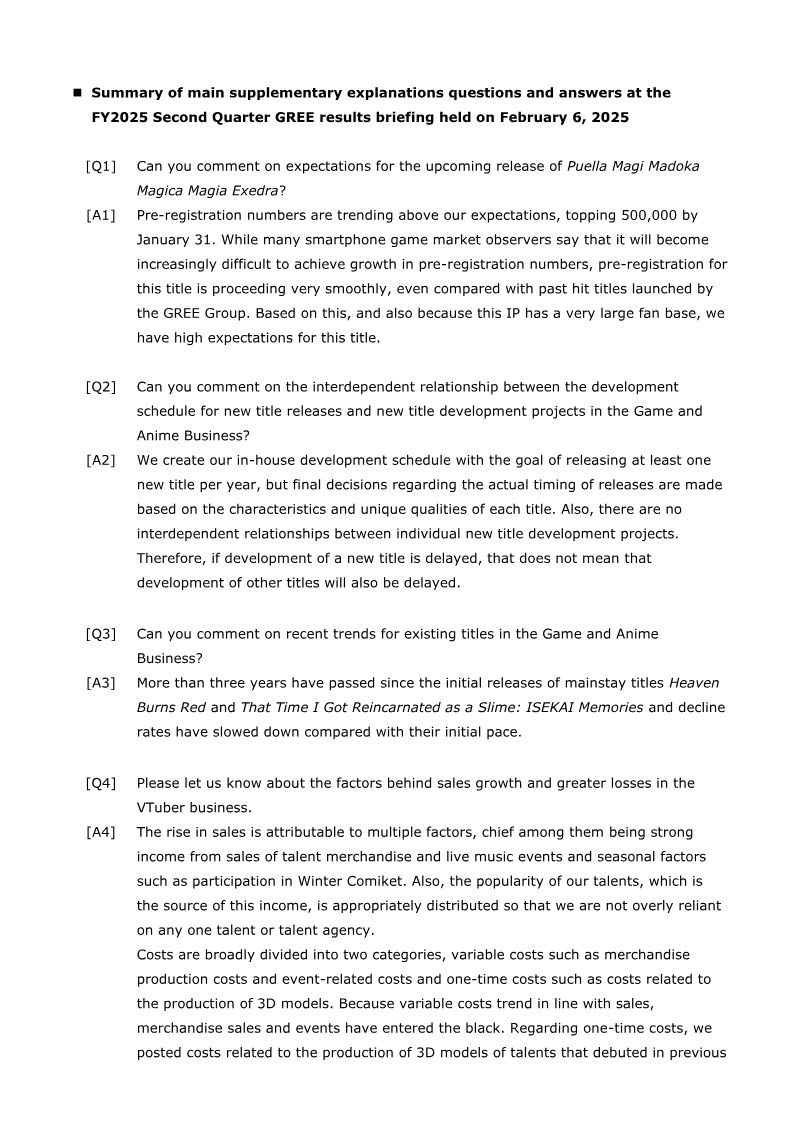
Summary of Main Supplementary Explanations Questions and Answers: FY2025 Second Quarter GREE Results Briefing
The briefing outlines GREE’s performance and strategic outlook for FY2025 Q2, focusing on game releases, existing title dynamics, and the VTuber business. Pre‑registration for “Puella Magi Madoka Magica Magia Exedra” surpassed 500,000 by January 31, exceeding expectations and reinforcing confidence in the IP’s strong fan base. The company maintains an annual release cadence for new titles, but schedules are determined independently per project; delays in one title do not cascade to others. Existing flagship games such as Heaven Burns Red and That Time I Got Reincarnated as a Slime: ISEKAI Memories have experienced a deceleration in decline rates after three years, indicating sustained player engagement.
In the VTuber segment, sales growth is driven by talent merchandise, live music events, and seasonal participation in Winter Comiket. Revenue has turned profitable as variable costs align with sales, while one‑time expenses—primarily 3D model production for new and returning talents—have increased quarterly, contributing to larger losses. Management anticipates that expanding the talent roster will stabilize one‑time costs and enhance profitability.
Looking ahead, GREE projects monthly profitability in FY2026 with annual VTuber sales near ¥3.0 billion, followed by accelerated growth targets. The briefing underscores a balanced approach to new title development, sustained performance of legacy games, and a focused strategy for scaling the VTuber business while managing cost structures.
- GREE targets monthly profitability for its VTuber segment in FY2026, with annual sales projected to reach approximately ¥3.0 billion.
- Pre-registration for the upcoming title 'Puella Magi Madoka Magica Magia Exedra' exceeded 500,000 by January 31, signaling strong market interest.
- Flagship games 'Heaven Burns Red' and 'That Time I Got Reincarnated as a Slime: ISEKAI Memories' have stabilized, showing a deceleration in decline rates after three years of operation.
- The VTuber business is currently experiencing increased quarterly losses due to one-time 3D model production expenses, though variable costs have successfully aligned with sales.
- GREE maintains an independent release schedule for new games, ensuring that project-specific delays do not impact the broader annual release cadence.
+2
GREE
Financial9 pages
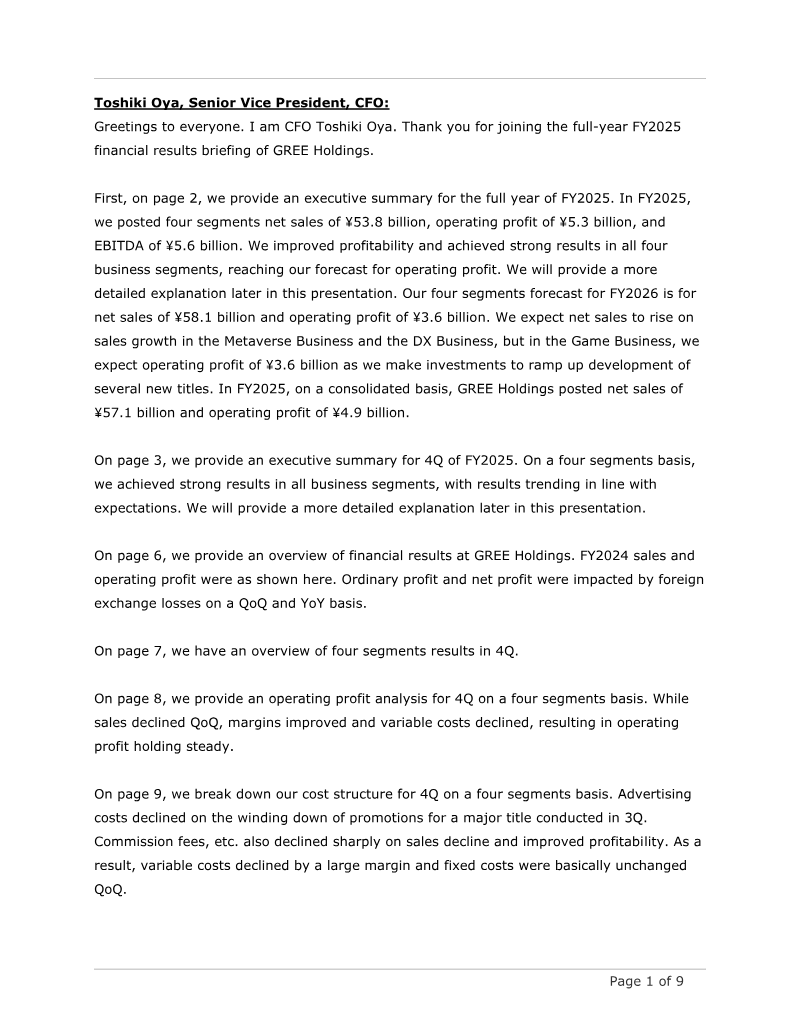
Full-Year FY2025 Financial Results Briefing
GREE Holdings delivered a full‑year FY2025 briefing that highlighted robust profitability across its four operating segments—Game, Metaverse, IP, and DX—while outlining strategic investment plans for FY2026 and beyond. Net sales reached ¥53.8 billion with operating profit of ¥5.3 billion and EBITDA of ¥5.6 billion, meeting forecasted targets; consolidated results stood at ¥57.1 billion in sales and ¥4.9 billion operating profit. The company projects FY2026 net sales of ¥58.1 billion and operating profit of ¥3.6 billion, anticipating growth primarily from the Metaverse and DX businesses, while Game investments are expected to suppress short‑term profitability.
Segment analysis shows the Metaverse business achieving a 10 % YoY sales increase but declining operating profit due to one‑off VTuber talent costs; the Game segment posted ¥9.1 billion in 4Q sales and a 18 % operating margin, with future revenue driven by new titles such as That Time I Got Reincarnated as a Slime: ISEKAI Memories. The IP business shifted focus to proprietary anime licensing and merchandising, recording a temporary loss in 4Q but forecasting recovery. The DX segment maintained flat sales at ¥1.75 billion, with consulting profits aligning forecasts while solutions investments temporarily eroded margins.
Financial discipline remains strong; equity ratio targets of 60 % and debt‑to‑EBITDA below 6× were exceeded. Dividend policy will pay ¥14.5 per share, combining a regular ¥4.5 and commemorative ¥10 share payout for the company’s 20th anniversary.
Investment activities, particularly in cryptocurrency and fund management, showed volatility but a stable long‑term cumulative profit. The firm plans to increase LP investment ratios and target an ROIC of ~10 % by FY2030, maintaining a balanced portfolio while pursuing growth in its core entertainment and technology businesses.
- GREE Holdings met FY2025 targets with ¥53.8 billion in net sales and ¥5.3 billion in operating profit, while projecting FY2026 sales to grow to ¥58.1 billion.
- FY2026 operating profit is forecast to decline to ¥3.6 billion as the company prioritizes strategic investments in the Game segment over short-term margins.
- The Metaverse segment achieved 10% year-over-year sales growth, though profitability was impacted by one-off costs related to VTuber talent.
- The Game segment remains a core revenue driver, posting ¥9.1 billion in 4Q sales with an 18% operating margin, supported by titles like 'That Time I Got Reincarnated as a Slime: ISEKAI Memories'.
- The company will issue a ¥14.5 per share dividend for FY2025, consisting of a ¥4.5 regular dividend and a ¥10 commemorative payout for its 20th anniversary.
+1
GREE
Financial7 pages
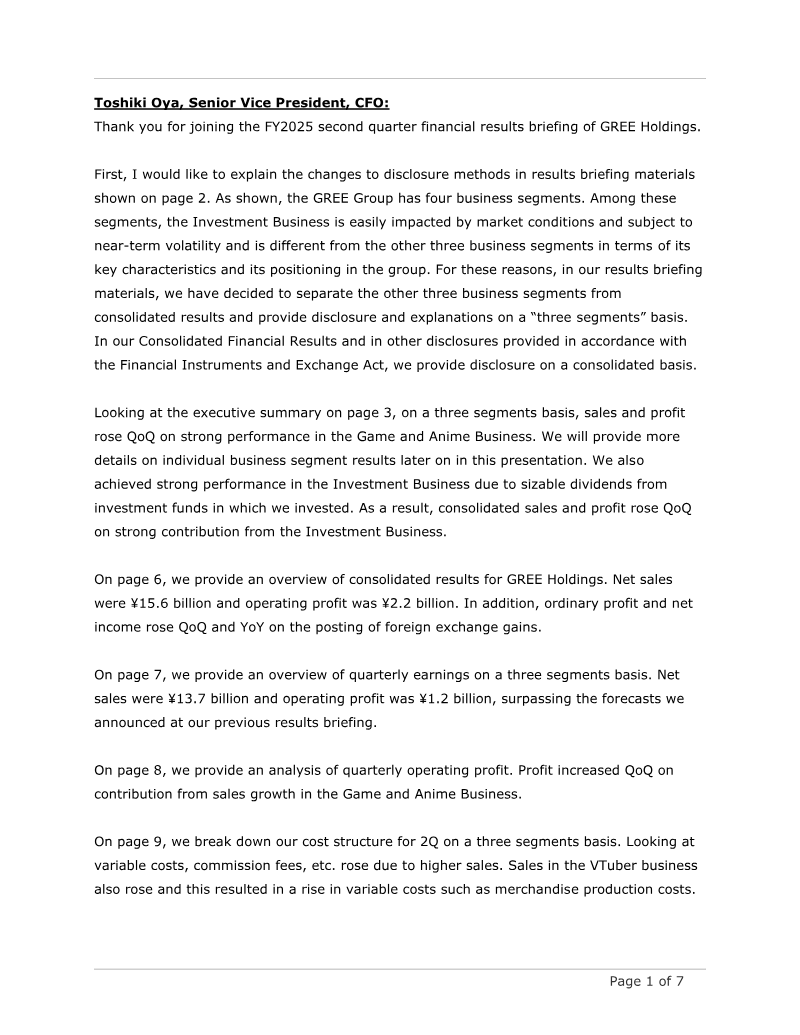
FY2025 Second Quarter Financial Results Briefing
The briefing presents FY2025 second‑quarter financial results for GREE Holdings, emphasizing a revised disclosure structure that separates the Investment Business from the other three operating segments—Game and Anime, Metaverse, and DX. Consolidated net sales reached ¥15.6 billion with operating profit of ¥2.2 billion, both up QoQ and YoY, driven by foreign‑exchange gains and strong dividend income from investment funds. On a three‑segment basis, net sales were ¥13.7 billion and operating profit ¥1.2 billion, surpassing prior forecasts.
Segment performance highlights include a record‑high ¥2.1 billion in Metaverse sales, driven by avatar and live‑streaming revenue; Game and Anime sales rose QoQ thanks to anniversary events for flagship titles, though YoY growth slowed; DX Business maintained forecasted sales of ¥1.8 billion, with a shift toward recurring SaaS and consulting services. The Investment Business posted significant gains from fund dividends, offsetting a prior quarter loss; portfolio valuation climbed to ¥36.3 billion with IRR outperforming VC benchmarks.
Management reiterated medium‑term targets: FY2027 sales of ¥17.9 billion and operating profit of ¥3.3 billion, with continued investment in Metaverse, DX recurring models, and diversified fund sourcing. The briefing covered 2025 full‑year forecasts—sales of ¥8.7 billion and operating profit of ¥500 million for Metaverse, ¥7.3 billion and ¥800 million for DX—reflecting modest sales adjustments but confidence in margin improvement. Overall, the presentation underscores robust quarterly growth across core segments and a strategic pivot toward higher‑margin recurring revenue streams.
- GREE Holdings reported consolidated Q2 FY2025 net sales of ¥15.6 billion and an operating profit of ¥2.2 billion, reflecting both QoQ and YoY growth driven by foreign-exchange gains and investment fund dividends.
- The Metaverse segment achieved a record-high ¥2.1 billion in sales, fueled by strong performance in avatar and live-streaming revenue streams.
- The Investment Business portfolio valuation reached ¥36.3 billion, with internal rates of return (IRR) outperforming standard venture capital benchmarks.
- Game and Anime segment sales increased QoQ due to successful anniversary events for flagship titles, though YoY growth rates have decelerated.
- The DX Business segment maintained its ¥1.8 billion sales forecast while successfully transitioning its revenue model toward recurring SaaS and consulting services.
GREE
Financial9 pages
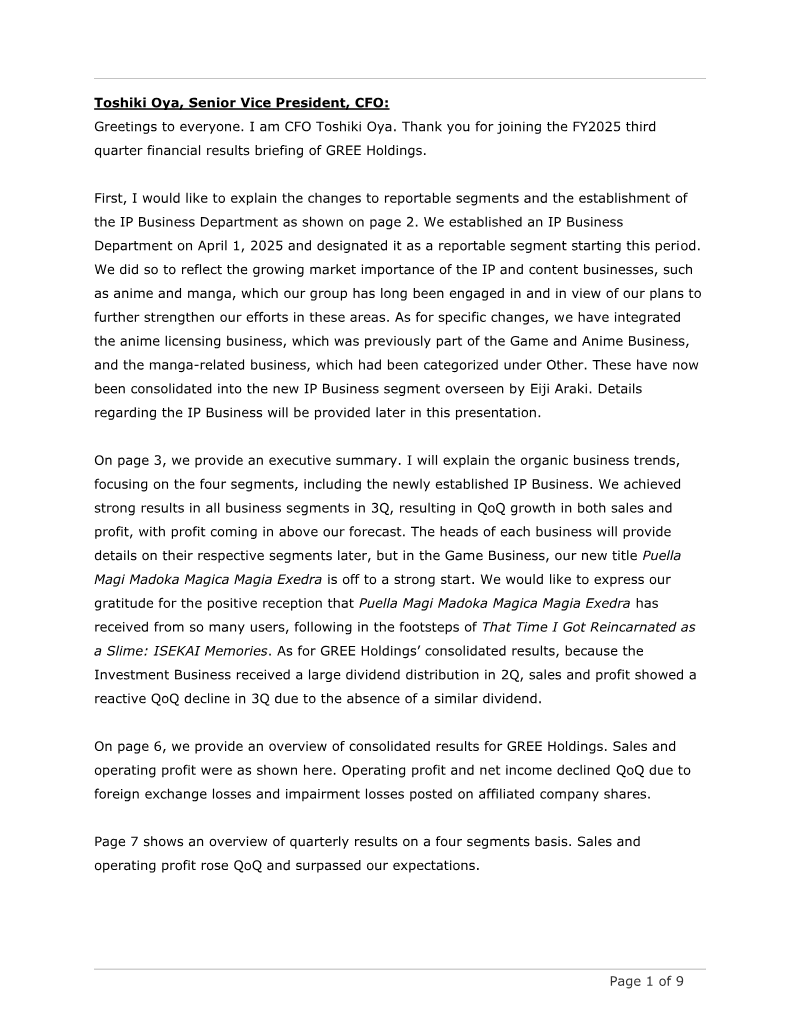
FY2025 Third Quarter Financial Results Briefing: GREE Holdings
GREE Holdings announced that the fiscal year 2025 third‑quarter results exceeded expectations, driven by robust performance across all four reportable segments. The company introduced a new IP Business segment on April 1, 2025, consolidating anime licensing and manga activities to reflect growing importance in content creation. Operating profit rose QoQ to ¥1.7 billion, with sales increasing across Game, Metaverse, IP, and DX businesses; the Investment Business recorded a ¥100 million loss on sales of ¥600 million. Foreign‑exchange and impairment losses contributed to a net income decline, yet the equity ratio remains above 60 % and debt‑to‑EBITDA stays near 3×, meeting the firm’s financial discipline targets.
Key drivers include the launch of “Puella Magi Madoka Magica Magia Exedra” in the Game Business, which is expected to contribute earnings from Q4 onward, and record‑high operating margins in the Metaverse Platform segment due to improved commission structures. The VTuber arm achieved record sales, with merchandising gaining higher margin share. In the IP Business, anime production committees continue to expand, while merchandising and entertainment‑solution SaaS are in early rollout phases. The DX Business saw a slight YoY decline but QoQ growth, with new SaaS products and consulting projects building recurring revenue streams.
Forecasts for FY 2025 anticipate a sales shortfall from delayed game releases but project operating profit above the ¥500 million target, rising to roughly ¥700 million. Medium‑term goals focus on sustaining growth in continuous‑growth segments, achieving profitability in the VTuber business by FY 2026, and expanding the IP and DX businesses into recurring‑earnings models.
- GREE Holdings reported a Q3 operating profit of ¥1.7 billion, with growth across its Game, Metaverse, IP, and DX segments despite a net income decline caused by foreign-exchange and impairment losses.
- The company established a new IP Business segment on April 1, 2025, to consolidate anime and manga activities, aiming to transition these operations into recurring-earnings models.
- The Metaverse Platform segment achieved record-high operating margins due to optimized commission structures, while the VTuber arm reached record sales driven by high-margin merchandising.
- The Game Business is positioned for Q4 earnings growth following the launch of 'Puella Magi Madoka Magica Magia Exedra,' despite an overall FY 2025 sales shortfall caused by delayed game releases.
- Financial stability remains strong with an equity ratio exceeding 60% and a debt-to-EBITDA ratio near 3×, aligning with the firm’s established financial discipline targets.
GREE
Report3 pages
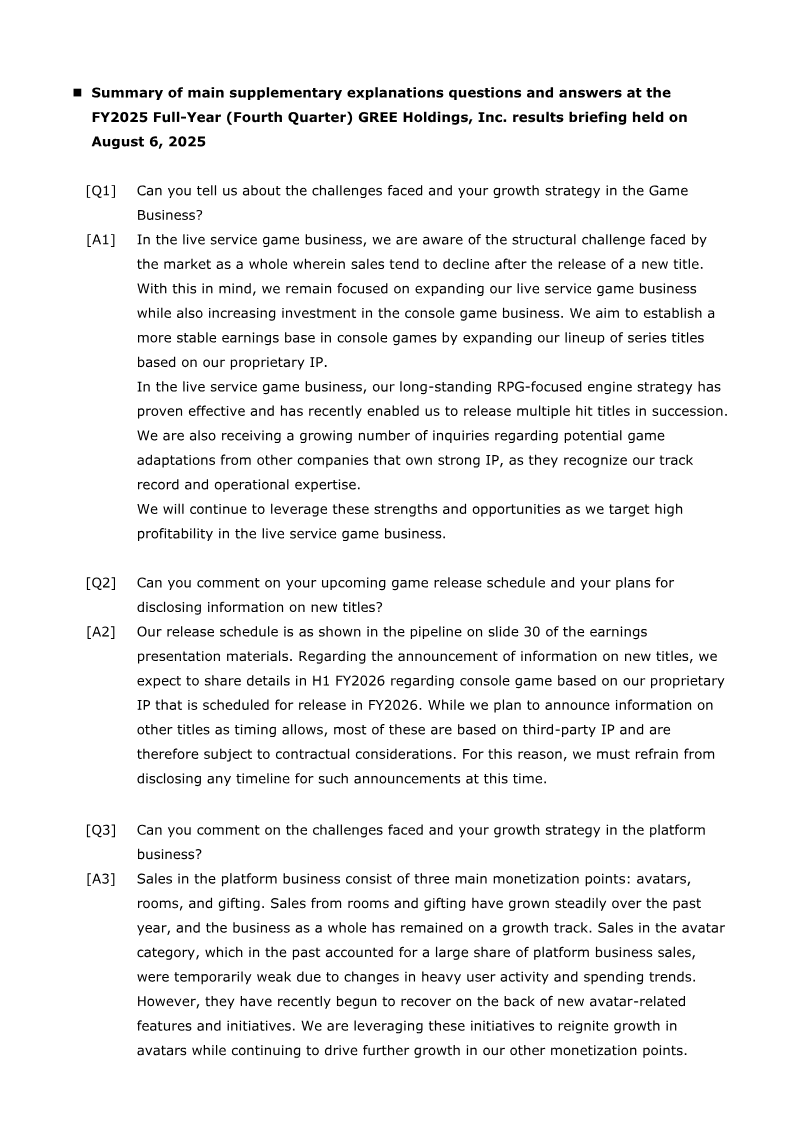
Summary of Main Supplementary Explanations Questions and Answers: FY2025 Full-Year Results
GREE Holdings outlines its FY2025 full‑year results and forward strategy across several business segments. In the game division, the company acknowledges the typical post‑launch decline in live‑service titles and counters it by expanding both its live‑service portfolio—leveraging a proven RPG engine—and investing in console games built on proprietary IP to create a steadier earnings base. The company reports multiple recent hit releases and anticipates further inquiries for third‑party IP adaptations, positioning itself to capture high profitability in the live‑service arena.
The platform business remains growth‑oriented, with steady increases in room and gifting revenue offsetting a temporary dip in avatar sales. New avatar features are expected to revive this segment, while the company continues to push other monetization channels. In the VTuber sector, GREE pursues a two‑stage growth model: first expanding its talent roster—now about 90 talents—and then boosting sales per talent through diversified merchandise channels and nascent live‑event advertising. Sales per talent have doubled since FY2024, and the company maintains a balanced portfolio to avoid over‑reliance on any single talent.
The DX business is undergoing a structural shift from one‑time project sales to recurring revenue, with modest growth projected through FY2026 as the transition completes. Investment activities in FY2026 will see increased volatility due to fund maturity and potential impairment, yet the company expects stable income streams from dividends and performance fees. Overall, GREE projects balanced returns while navigating market challenges across its diversified entertainment portfolio.
- GREE is shifting its game division strategy to balance post-launch live-service volatility by investing in console titles built on proprietary IP.
- The VTuber business has doubled sales per talent since FY2024, supported by a roster of approximately 90 talents and expanded merchandise and advertising channels.
- The DX business is transitioning from a one-time project sales model to a recurring revenue structure, with modest growth expected through FY2026.
- Platform revenue growth is currently driven by room and gifting monetization, which is offsetting a temporary decline in avatar sales.
- Investment activities in FY2026 are expected to experience increased volatility due to fund maturity and potential impairments, though stable income from dividends and performance fees is anticipated.
+4
GREE
Report3 pages
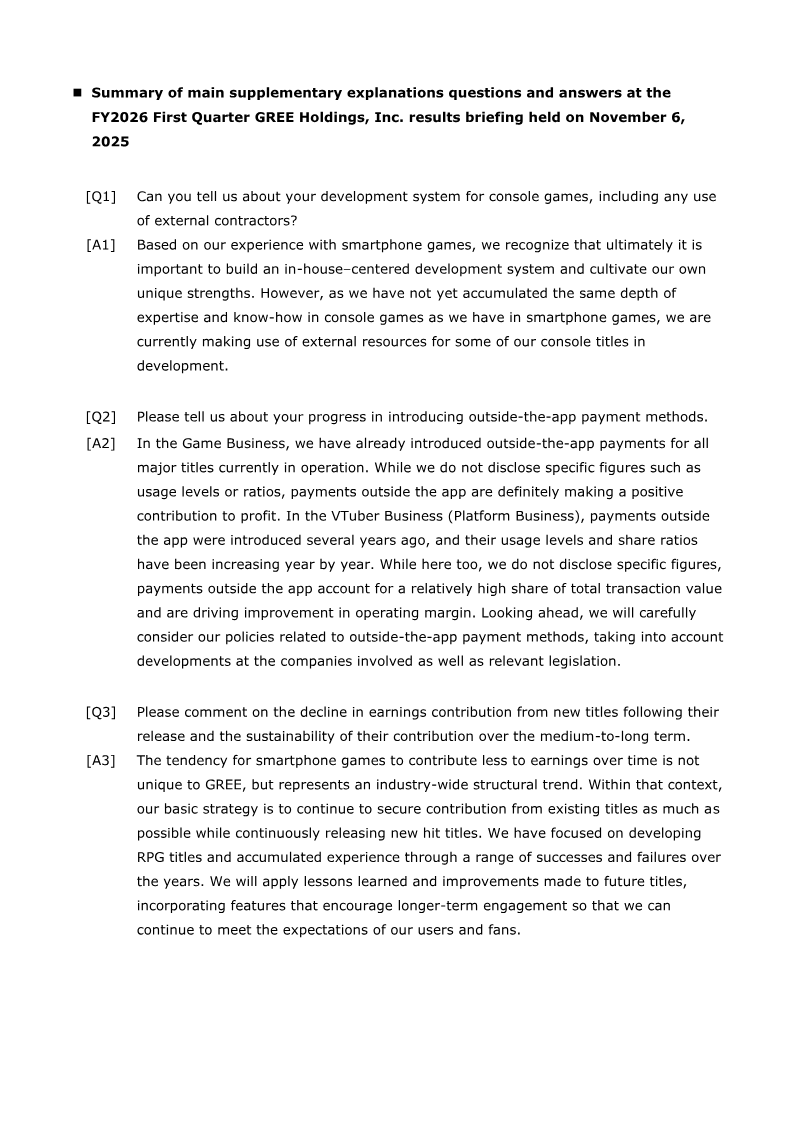
Summary of main supplementary explanations questions and answers at the FY2026 First Quarter GREE Holdings, Inc. results briefing held on November 6, 2025
GREE Holdings’ FY2026 first‑quarter briefing clarified strategic priorities across its game, VTuber, and investment divisions. The company emphasized a shift toward an in‑house development model for console titles while still leveraging external contractors to bridge current expertise gaps. In the mobile game segment, outside‑app payment methods have been fully deployed across all major titles and are contributing positively to profitability; the VTuber platform has similarly expanded its outside‑app transactions, boosting operating margins. The firm acknowledges a structural decline in earnings from new smartphone releases but plans to sustain revenue by focusing on long‑term engagement features and continuous hit title launches, particularly within the RPG genre.
Market outlooks reveal a plateau in smartphone installs but growing potential through high‑value IP and outside‑app monetization. Console gaming is viewed as a long‑term investment, with an emphasis on cultivating enduring IP series. The VTuber market is still expanding globally, especially overseas, and the company projects full‑year profitability for its VTuber production arm by FY2027 as higher‑margin merchandise and live events offset earlier talent acquisition costs.
Exit strategies for the investment business have shifted from IPOs to M&A, reflecting broader market conditions. Generative AI is being integrated across game development, VTuber content creation, and digital transformation services to enhance efficiency and service quality, though its direct earnings impact remains difficult to quantify. Overall, GREE aims to strengthen core competencies, diversify revenue streams, and adapt to evolving market dynamics while pursuing sustainable growth.
- GREE is transitioning to an in-house development model for console titles, utilizing external contractors to address current expertise gaps while focusing on long-term IP cultivation.
- Outside-app payment methods have been fully implemented across all major mobile titles and the VTuber platform, directly contributing to improved operating margins.
- The VTuber production arm is projected to reach full-year profitability by FY2027 as high-margin merchandise and live events offset initial talent acquisition costs.
- The company is shifting its investment business exit strategy from IPOs to M&A to better align with current market conditions.
- Generative AI is being integrated into game development, VTuber content creation, and digital transformation services to improve operational efficiency and service quality.
+3
GREE
Financial7 pages
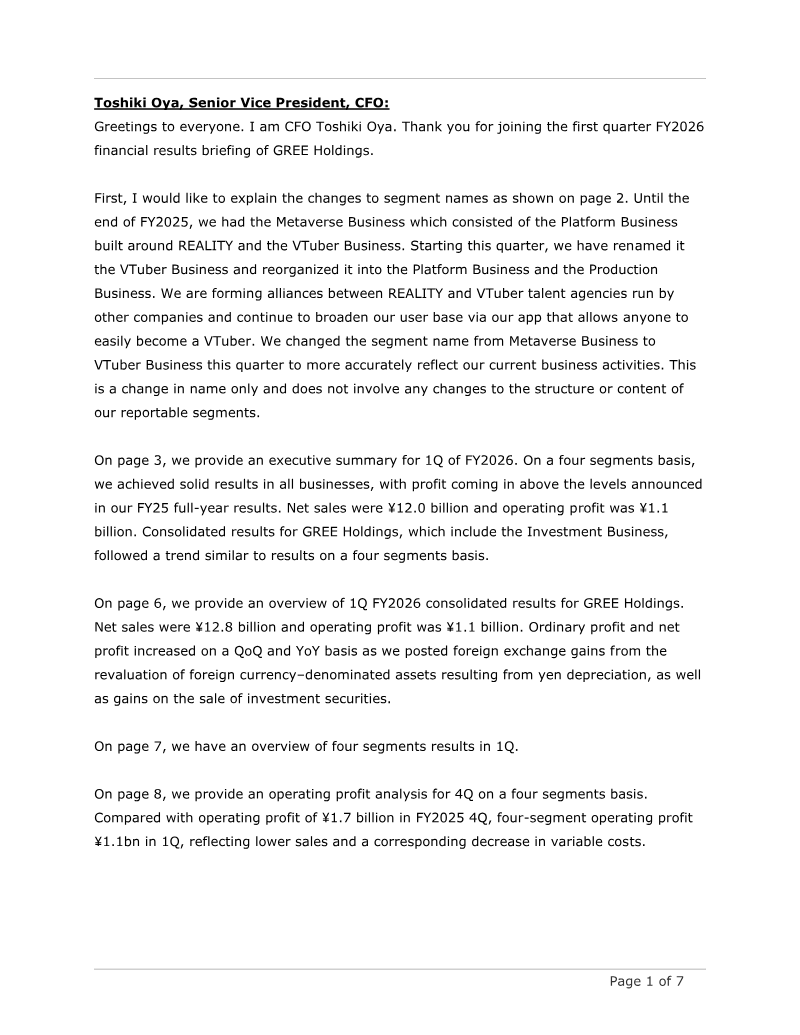
FY2026 1Q Financial Results Briefing: GREE Holdings
The briefing presents FY2026 1Q financial results for GREE Holdings, emphasizing a re‑segmentation of the former Metaverse Business into distinct Platform and Production units under the VTuber umbrella. Net sales reached ¥12.0 billion with operating profit of ¥1.1 billion, surpassing FY2025 full‑year expectations; consolidated figures including the Investment Business were ¥12.8 billion in sales and ¥1.1 billion in operating profit, buoyed by foreign‑exchange gains from yen depreciation and investment security sales. Variable costs fell due to lower advertising spend and commission fees, while fixed costs remained stable.
Segment‑level analysis shows the Game Business experiencing a temporary sales dip from declining momentum of recent titles, yet operating profit rose thanks to overseas development contracts and a live‑service game pipeline. The VTuber Business recorded a 9 % YoY sales increase and a 142 % jump in operating profit, driven by cost controls on payment processing and gradual profitability of the Production arm. The IP Business saw modest sales decline and sharper profit erosion, with Anime and Entertainment Solution units posting delayed revenue but expected to normalize in the second half. The DX Business maintained a gradual uptrend, with consulting projects offsetting outsourcing declines.
Forecasts for 2Q FY2026 anticipate sales growth but a profit decline due to console‑game development expenses. Full‑year FY2026 projections expect profits to exceed initial targets, with medium‑term goals unchanged: a profit trough in FY2026 followed by rebound in FY2027–FY2028, and a focus on recurring revenue models and M&A to drive long‑term growth.
- GREE Holdings reported FY2026 1Q net sales of ¥12.0 billion and an operating profit of ¥1.1 billion, exceeding FY2025 full-year expectations.
- The VTuber business segment achieved significant growth with a 9% YoY sales increase and a 142% surge in operating profit, bolstered by improved cost controls on payment processing.
- While the Game Business saw a temporary sales decline due to waning momentum in recent titles, operating profit increased as a result of overseas development contracts and a robust live-service pipeline.
- The IP Business experienced a decline in both sales and profitability, with Anime and Entertainment Solution units facing revenue delays expected to normalize by the second half of the fiscal year.
- Consolidated results, including the Investment Business, reached ¥12.8 billion in sales, supported by foreign-exchange gains from yen depreciation and the sale of investment securities.
+2
GREE
Financial7 pages
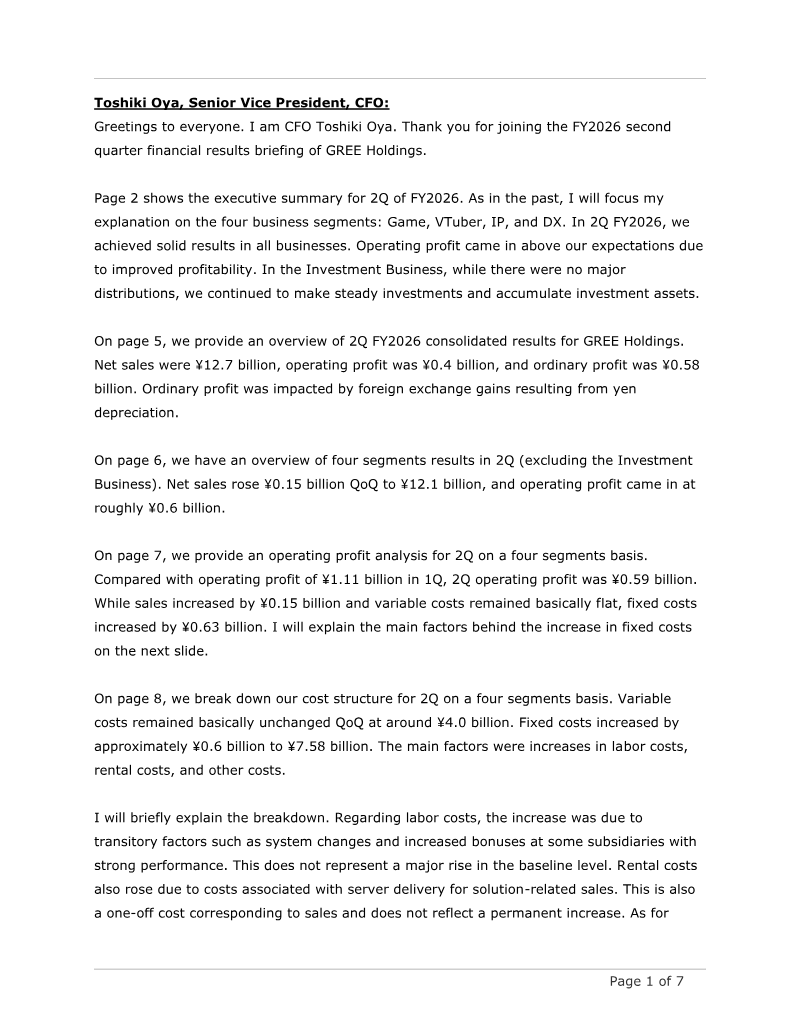
FY2026 Second Quarter Financial Results Briefing
The briefing presents FY2026 second‑quarter results for GREE Holdings, emphasizing four core segments—Game, VTuber, IP, and DX—and the Investment Business. Consolidated net sales reached ¥12.7 billion, operating profit stood at ¥0.4 billion, and ordinary profit rose to ¥0.58 billion, the latter boosted by foreign‑exchange gains from yen depreciation. Segment analysis shows net sales of ¥12.1 billion and operating profit of roughly ¥0.6 billion, with variable costs flat at ¥4.0 billion but fixed costs climbing by ¥0.63 billion due to labor, rental, and outsourcing expenses linked to console game development and VTuber production.
Operating profit fell from ¥1.11 billion in Q1 to ¥0.59 billion, reflecting higher fixed costs despite a modest sales increase of ¥0.15 billion. The Game Business delivered ¥7.1 billion in sales and ¥0.5 billion in operating profit, turning profitable after a prior negative forecast; live‑service titles and upcoming console releases are highlighted. VTuber sales hit a record high, with operating profit at ¥0.2 billion; the Production Business grew 50% QoQ, driven by events and commerce. IP sales rose 41% QoQ to ¥0.5 billion, with anime distribution and new smartphone game launches cited as key drivers. DX sales were ¥1.84 billion with operating profit of ¥0.18 billion, noting a shift toward recurring‑earnings models and planned roll‑up M&A.
Full‑year forecasts adjust sales downward due to Game Business trends but lift operating profit expectations to ¥4.4 billion, surpassing the initial ¥3.6 billion forecast through cost control. Medium‑term targets remain unchanged, aiming for a profit bottom in FY2026 followed by growth from FY2027 onward. The Investment Business recorded moderate distributions but incurred valuation losses, with a long‑term positive cumulative profit outlook and IRR above benchmarks.
- GREE Holdings reported FY2026 Q2 consolidated net sales of ¥12.7 billion and an operating profit of ¥0.4 billion, with ordinary profit bolstered by ¥0.58 billion due to yen depreciation.
- Operating profit declined from ¥1.11 billion in Q1 to ¥0.59 billion as fixed costs rose by ¥0.63 billion, driven by increased labor, rental, and outsourcing expenses for console game development and VTuber production.
- The Game Business achieved ¥7.1 billion in sales and ¥0.5 billion in operating profit, successfully returning to profitability despite earlier negative forecasts.
- VTuber segment sales reached a record high with ¥0.2 billion in operating profit, supported by a 50% quarter-over-quarter growth in the Production Business driven by events and commerce.
- Full-year operating profit expectations were raised from ¥3.6 billion to ¥4.4 billion due to aggressive cost control, even as sales forecasts were adjusted downward.
+1
GREE