GREE
Game Co.192 documents
Documents
Report2 pages
Summary of main supplementary explanations questions and answers at the FY2026 Second Quarter GREE Holdings, Inc. results briefing held on February 5, 2026
The briefing clarified GREE Holdings’ strategic priorities across its core business segments for FY2026. In the Anime Business, earnings from the newly announced “Mushoku Tensei: Jobless Reincarnation – Chronicle of Echoes” are recorded under the IP Business segment, reflecting the company’s focus on monetizing anime titles it has invested in. The Platform Business within the VTuber segment is expanding beyond traditional gifting revenue by piloting merchandise sales and event features on its REALITY platform; early feedback indicates positive reception, and the company plans to extend these monetization tools to a broader streamer base while offering corporate marketing solutions. In the DX Consulting Business, GREE emphasizes its niche in end‑user entertainment services and acknowledges that generative AI may automate routine maintenance but is unlikely to erode its creative‑driven value proposition in the short term. Regarding financial outlook, a downward revision of FY26 earnings was justified by recent softness in existing game titles; however, the company maintains confidence in its three‑year medium‑term targets (FY28) by shifting emphasis toward continuous growth businesses and reducing reliance on volatile game revenues. Finally, the Anime Business will pursue acquisition of production capabilities—through both in‑house development and M&A—within 2–3 years to secure control over high‑quality, timely anime output. These initiatives collectively aim to diversify revenue streams, strengthen creative control, and sustain long‑term growth across GREE’s entertainment ecosystem.
- GREE Holdings revised its FY26 earnings downward due to recent performance softness in existing game titles.
- The company is shifting its long-term strategy toward continuous growth businesses to reduce reliance on volatile game revenue, maintaining its medium-term targets for FY28.
- GREE plans to acquire anime production capabilities through in-house development and M&A within the next 2–3 years to secure control over output quality and timing.
- The REALITY platform is expanding its VTuber monetization model beyond gifting by piloting merchandise sales and event features, with plans to integrate corporate marketing solutions.
- Revenue from the new title 'Mushoku Tensei: Jobless Reincarnation – Chronicle of Echoes' is being categorized under the IP Business segment to reflect the company's focus on monetizing its anime investments.
+1
GREE

Financial78 pages
FY2026 Second Quarter Financial Results
Financial performance for the second quarter of fiscal year 2026 reflects a transitional period characterized by a 63% quarter-over-quarter decline in operating profit to ¥0.4 billion and a 12% year-over-year decrease in total sales to ¥12.7 billion. This downturn is primarily attributed to the absence of large-scale dividend distributions in the investment segment and underperformance within the core game business. Despite these challenges, the company maintains a robust financial position with an equity ratio of 70% and total net assets of ¥64.6 billion. Management identifies the current fiscal year as an earnings floor, projecting a significant recovery driven by a 48% profit compound annual growth rate through fiscal year 2028.
The VTuber and DX segments have emerged as resilient growth drivers, with the VTuber production business achieving record-high quarterly sales and a 105% year-over-year increase in operating profit. While the game business faced a 24% decline in sales, operational efficiencies allowed profits to exceed internal expectations. The company has revised its full-year sales forecast downward to ¥52.4 billion but remains committed to its ¥4.4 billion operating profit target through rigorous cost controls and a strategic shift toward high-margin recurring revenue in the DX and platform sectors.
Future growth is anchored in a diversified pipeline and strategic expansion into intellectual property. Key initiatives include the upcoming launch of a first-party console RPG and a major third-party IP title, alongside investments in anime production and merchandising capabilities. Although the investment business experienced a quarterly loss due to valuation adjustments, the underlying portfolio remains strong with an unrealized value of ¥22.4 billion and a 14% internal rate of return. By balancing stable management fees from its investment funds with the scaling of its digital production studios, the organization aims to transition toward a more sustainable, growth-oriented earnings structure.
- The company reported a 63% quarter-over-quarter decline in operating profit to ¥0.4 billion and a 12% year-over-year sales decrease to ¥12.7 billion, citing core game underperformance and lower investment dividends.
- Management has lowered the full-year sales forecast to ¥52.4 billion but maintains a ¥4.4 billion operating profit target by prioritizing cost controls and high-margin recurring revenue in DX and platform sectors.
- The VTuber production business is a primary growth driver, achieving record-high quarterly sales and a 105% year-over-year increase in operating profit.
- Despite current earnings pressure, the company projects a 48% compound annual growth rate for profit through fiscal year 2028, positioning the current period as an earnings floor.
- The core game business experienced a 24% sales decline, though operational efficiencies allowed profits to exceed internal expectations.
GREEFeb 2026
Financial7 pages
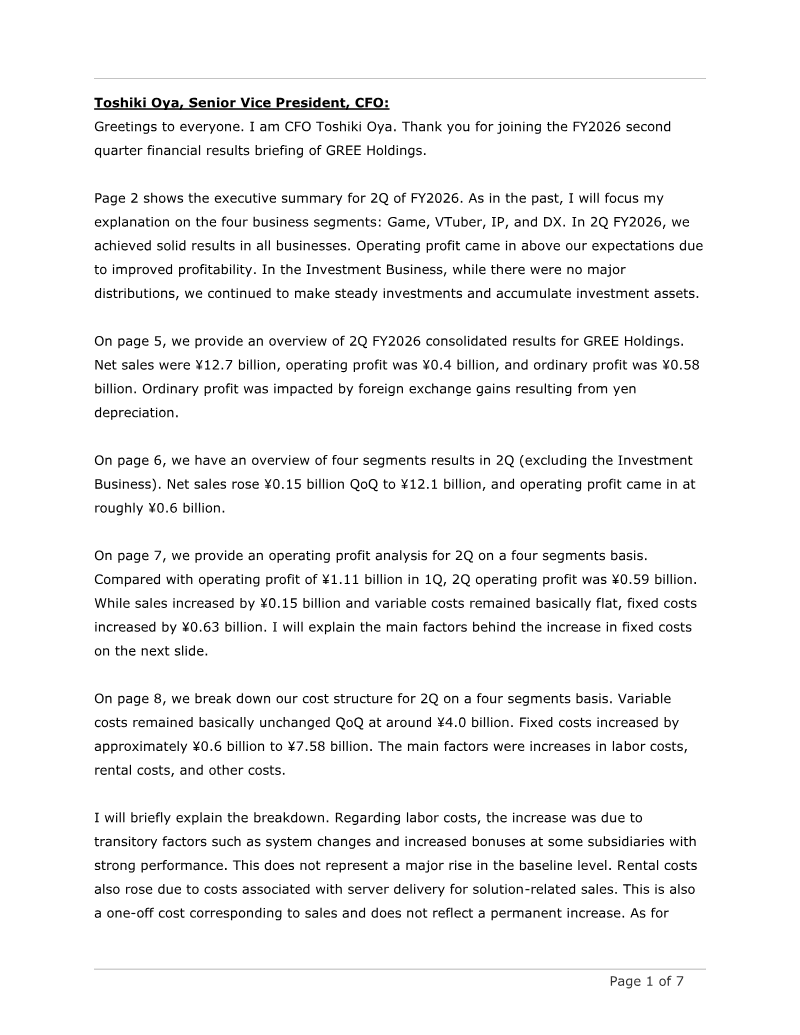
GREE Holdings FY2026 Q2 Financial Results Briefing (Transcript)
GREE Holdings reported solid financial results for the second quarter of fiscal year 2026, characterized by improved profitability across its core business segments despite a downward revision in sales expectations. Consolidated net sales reached ¥12.7 billion with an operating profit of ¥0.4 billion. While the Game Business remains a primary revenue source, the company is increasingly reliant on its "continuous growth businesses"—VTuber, IP, and DX—to drive future earnings. Management has raised the full-year operating profit forecast from ¥3.6 billion to ¥4.4 billion, citing effective company-wide cost controls and strong performance in the VTuber sector.
The Game Business generated ¥7.1 billion in quarterly sales, with existing titles performing better than anticipated and a new console game scheduled for announcement in the third quarter. The VTuber Business achieved record-high quarterly sales, driven by a 50% quarter-on-quarter increase in the Production Business. The IP Business returned to profitability due to delayed anime distribution revenue, while the DX Business focused on transitioning toward recurring earnings and potential M&A activity. Conversely, the Investment Business recorded an operating loss due to valuation losses on investee funds, though the company maintains a high-quality portfolio with steady asset accumulation.
Geographically focused on the Japanese market with expanding overseas VTuber events, the report covers the three-month period ending in the second quarter of FY2026. The methodology involves a segment-by-segment financial analysis comparing quarterly and year-over-year performance. Leadership maintains that FY2026 represents an earnings floor, with a projected return to a growth trend in FY2027 and FY2028 as new game titles and production initiatives scale.
- GREE Holdings raised its full-year operating profit forecast from ¥3.6 billion to ¥4.4 billion, driven by effective cost controls and strong performance in the VTuber sector.
- Consolidated Q2 FY2026 results show net sales of ¥12.7 billion and an operating profit of ¥0.4 billion.
- The VTuber business achieved record-high quarterly sales, fueled by a 50% quarter-on-quarter increase in the Production Business.
- The Game Business remains the primary revenue driver with ¥7.1 billion in quarterly sales, supported by better-than-expected performance from existing titles and a new console game announcement planned for Q3.
- The IP Business returned to profitability during the quarter, largely due to the realization of delayed anime distribution revenue.
GREEFeb 2026
Financial2 pages
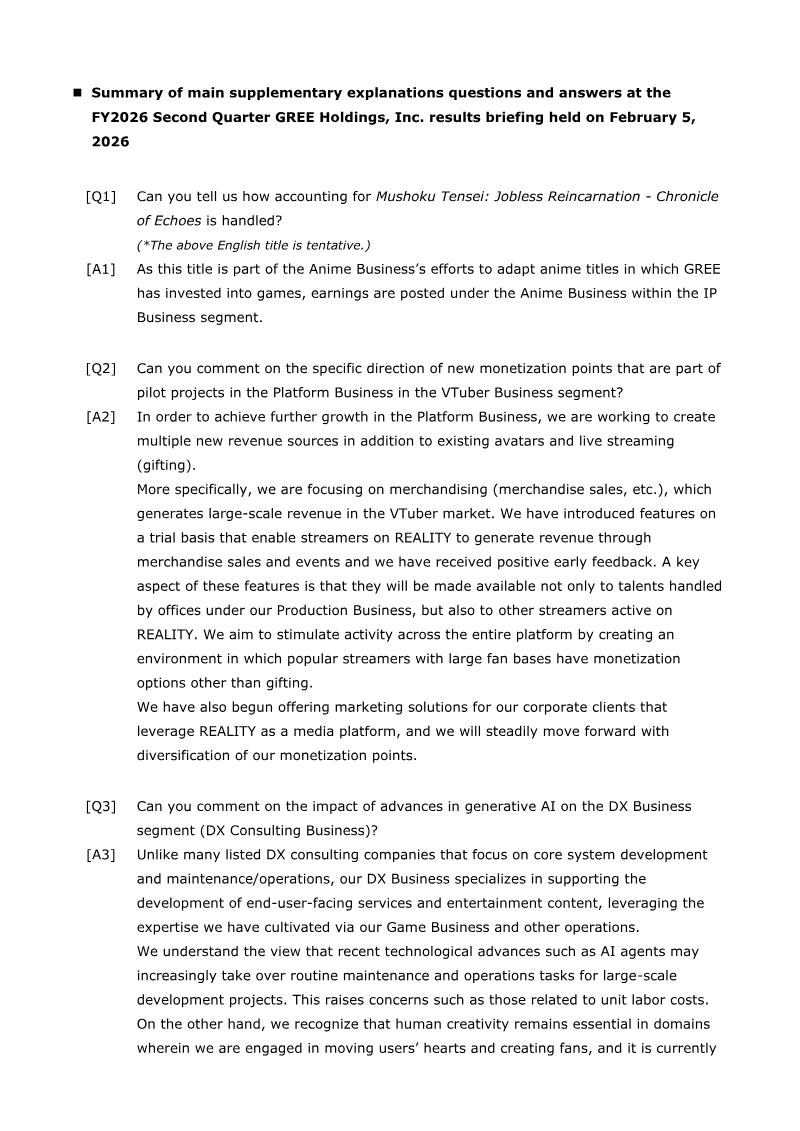
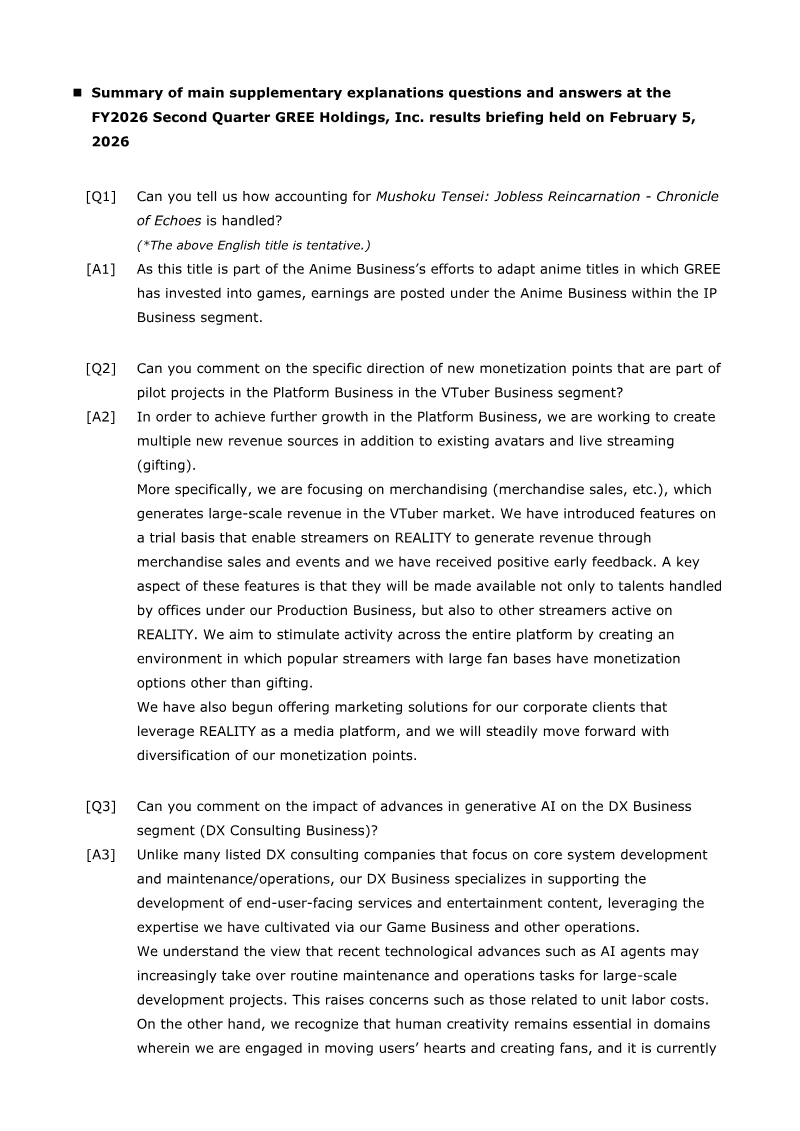
Summary of Supplementary Explanations Q&A at the FY2026 Second Quarter GREE Holdings Results Briefing
GREE Holdings, Inc. outlines its strategic direction and financial outlook following the second quarter of fiscal year 2026, focusing on a structural shift away from the volatile Game Business toward more stable, continuous growth segments. Despite a downward revision to the full-year earnings outlook for FY2026 due to the softening performance of existing game titles, the long-term medium-term targets for FY2028 remain unchanged. This stability is supported by the steady expansion of the IP, VTuber, and DX Business segments, which are intended to reduce the company's reliance on hit-driven gaming revenue.
The IP Business is diversifying through the Anime Business, specifically by adapting invested anime titles into games. To strengthen this pipeline, there is a strategic goal to acquire in-house anime production capabilities or pursue M&A within the next two to three years. This move aims to provide greater control over production quality and timing, which are viewed as essential for creating popular intellectual property. Simultaneously, the VTuber Business is expanding its monetization beyond traditional gifting. Pilot projects on the REALITY platform are testing merchandise sales and event-based revenue for both in-house talent and independent streamers, alongside new marketing solutions for corporate clients.
In the DX Business segment, the focus remains on high-value consulting for end-user-facing services and entertainment. While generative AI and automated agents are expected to impact routine maintenance and labor costs in the broader industry, the specialized nature of creating fan-driven content is seen as resilient to automation. Consequently, technological advances in AI are not expected to negatively impact the DX segment in the near term. Overall, the strategy emphasizes leveraging human creativity and platform diversification to ensure stable, long-term earnings growth across the global entertainment and digital transformation markets.
- GREE Holdings has revised its FY2026 full-year earnings outlook downward due to the underperformance of existing game titles.
- The company is shifting its strategic focus away from the volatile Game Business toward more stable, continuous growth segments to meet unchanged FY2028 medium-term targets.
- GREE plans to acquire in-house anime production capabilities or pursue M&A within the next two to three years to better control the quality and timing of its IP-to-game pipeline.
- The VTuber Business is diversifying revenue streams on the REALITY platform by expanding beyond traditional gifting into merchandise sales, event-based revenue, and corporate marketing solutions.
- The DX Business is prioritizing high-value consulting for end-user services and entertainment, with management asserting that fan-driven content creation remains resilient to generative AI automation.
+2
GREEFeb 2026
Financial3 pages
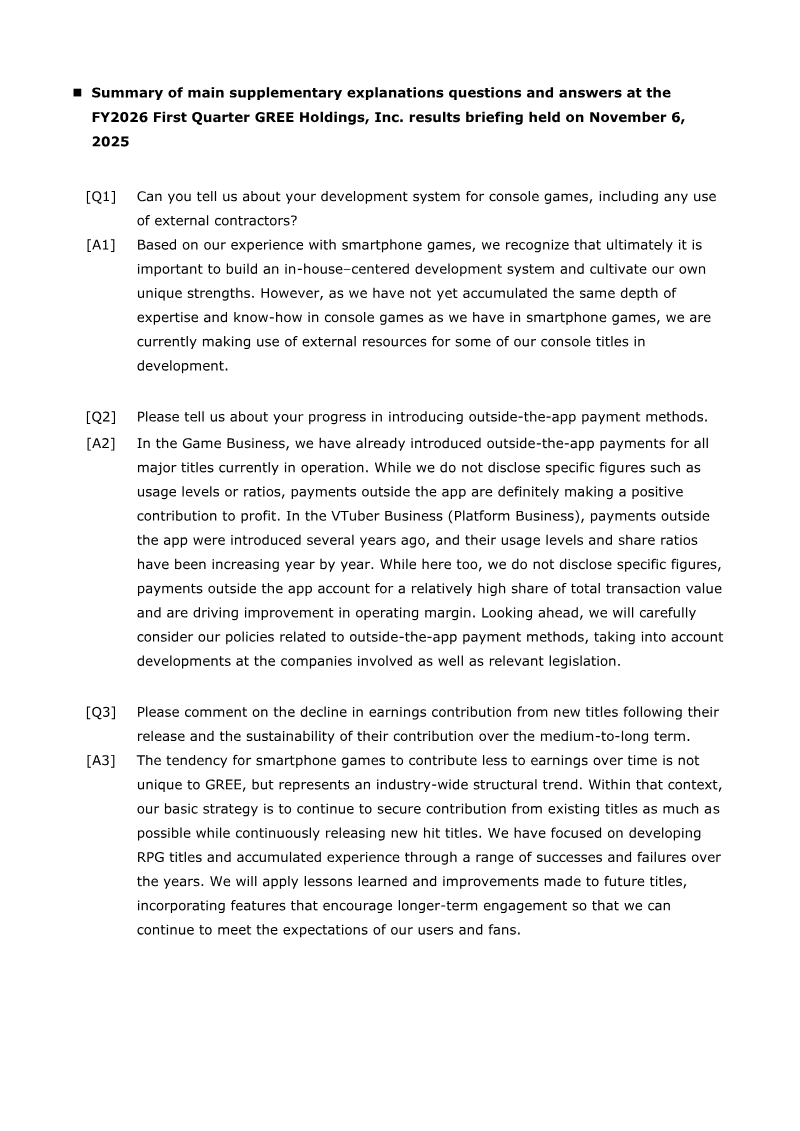
Summary of Main Supplementary Explanations Q&A at FY2026 First Quarter GREE Holdings Results Briefing, November 6, 2025
GREE Holdings provides a strategic overview of its operational performance and market outlook following the first quarter of fiscal year 2026. The primary focus centers on the structural evolution of the gaming sector and the path to profitability for the VTuber business. While the smartphone game market has reached a plateau characterized by high competition for user installs, the implementation of outside-the-app payment methods across all major titles has successfully bolstered profit margins. To ensure long-term sustainability in gaming, the strategy involves transitioning toward console development and cultivating internal intellectual property that can support multi-title series, though external contractors are currently utilized to bridge expertise gaps in the console segment.
The VTuber business represents a significant growth pillar, with the production segment expected to reach monthly profitability within fiscal year 2026 and full-year profitability by fiscal year 2027. This financial turnaround is driven by a shift from high-cost talent acquisition and 3D model production toward high-margin revenue streams, including merchandise, live events, and cross-media collaborations. Although the domestic Japanese market remains the primary revenue driver, there is a strong conviction that international fan bases will eventually surpass the domestic market in scale, mirroring the historical trajectory of the anime industry.
Broader corporate initiatives include the integration of generative AI to enhance development efficiency and service quality across the gaming and digital transformation segments. In the investment business, the strategy is adapting to a challenging IPO environment by increasingly targeting M&A as a viable exit path. Overall, the outlook emphasizes a transition from rapid expansion to margin optimization and long-term IP cultivation across both digital entertainment and platform services.
- GREE Holdings is shifting its gaming strategy from smartphone-focused titles toward console development and internal IP cultivation to ensure long-term sustainability.
- The VTuber production segment is projected to achieve monthly profitability within FY2026 and full-year profitability by FY2027.
- Profit margins in the smartphone gaming sector have been bolstered by the implementation of outside-the-app payment methods across all major titles.
- The VTuber business is pivoting from high-cost talent and 3D model production toward high-margin revenue streams like merchandise, live events, and cross-media collaborations.
- GREE is integrating generative AI across its gaming and digital transformation segments to improve development efficiency and service quality.
+1
GREENov 2025
Financial7 pages
GREE Holdings FY2026 Q1 Financial Results Briefing (Transcript)
GREE Holdings reported its financial results for the first quarter of fiscal year 2026, highlighting a period of strategic reorganization and disciplined profit management. The company achieved consolidated net sales of ¥12.8 billion and an operating profit of ¥1.1 billion. A significant structural update involved renaming the Metaverse segment to the VTuber Business, now divided into Platform and Production sub-segments to better reflect current activities. While overall sales saw a slight decline due to a slowdown in the Game Business, profits exceeded initial projections across all four core segments due to effective cost controls and reduced variable expenses.
The Game Business remains the largest revenue contributor at ¥7.5 billion, though it experienced a decline in momentum from existing titles. To offset this, the company is pivoting toward console development, with one proprietary IP title scheduled for release in FY2026. Conversely, the VTuber Business reached a historical high in operating profit, driven by a 142% year-over-year increase. This growth was attributed to reduced payment processing fees and the narrowing of losses in the Production Business, which is expected to reach monthly profitability within the current fiscal year.
The IP and DX Businesses showed mixed results; the IP segment was impacted by delayed revenue recognition in its anime division, while the DX segment benefited from large consulting orders. The Investment Business remained stable, contributing to net profit through foreign exchange gains and securities sales. Geographically focused on the Japanese market with expanding global IP interests, GREE maintains its medium-term target of reaching a profit floor in FY2026 before returning to a growth trajectory in FY2027 and FY2028. Management emphasized a shift toward recurring earnings and high-quality internal IP to drive long-term value.
- GREE Holdings reported Q1 FY2026 consolidated net sales of ¥12.8 billion and an operating profit of ¥1.1 billion, with profits exceeding projections due to disciplined cost controls.
- The VTuber Business achieved record operating profits with a 142% year-over-year increase, driven by lower payment processing fees and reduced losses in the Production sub-segment.
- The Game Business remains the primary revenue driver at ¥7.5 billion, though it faces declining momentum that the company intends to address by pivoting toward console development, including one proprietary IP title scheduled for FY2026.
- The company rebranded its Metaverse segment to the VTuber Business, restructuring it into Platform and Production sub-segments to align with current operational focus.
- The IP Business experienced revenue delays in its anime division, while the DX Business saw performance gains from large consulting orders.
GREENov 2025

Financial77 pages
FY2026 First Quarter Financial Results
The first quarter of FY2026 reflects a period of strategic transition and resilient profitability, with consolidated net sales reaching ¥12.8 billion and operating profit totaling ¥1.1 billion. While these figures represent a sequential decline in sales, they exceeded internal expectations and demonstrate a 63% year-over-year increase in operating profit. The current fiscal year is positioned as a foundational "bottom" year for earnings due to aggressive investments in a new console title, with a return to significant growth projected for FY2027. Management has revised full-year estimates upward to ¥56.4 billion in sales, anticipating a smaller profit decline than originally forecasted.
The Game segment remains the primary revenue driver at ¥7.5 billion, benefiting from overseas outsourced development and reduced advertising expenses following the wind-down of major promotions. Simultaneously, the newly rebranded VTuber Business achieved record quarterly operating profit of ¥0.4 billion, supported by steady live streaming growth and effective cost controls. While the Production and IP sub-segments currently face temporary losses due to heavy investment and delayed revenue cycles in anime, they are expected to reach profitability in the second half of the year. The DX Consulting Business emerged as a high-growth pillar, reaching record quarterly sales of ¥1.9 billion through large-scale digital marketing projects.
The Investment Business continues to provide significant financial upside, reporting a substantial year-over-year increase in operating profit to ¥1.4 billion driven by management fees and success fees from a ¥53 billion asset pool. Despite some valuation losses in specific funds, the segment maintains a high unrealized portfolio value of ¥38.9 billion. Across all segments, the group is targeting a medium-term profit CAGR of 20% to 25% through FY2028, supported by a strong 70% equity ratio and a diversified portfolio spanning gaming, virtual entertainment, and digital transformation services.
- FY2026 Q1 consolidated net sales reached ¥12.8 billion with an operating profit of ¥1.1 billion, representing a 63% year-over-year increase in profit despite a sequential sales decline.
- Management revised full-year sales estimates upward to ¥56.4 billion, positioning FY2026 as a foundational investment year before projected significant growth in FY2027.
- The Investment Business generated ¥1.4 billion in operating profit from a ¥53 billion asset pool, maintaining an unrealized portfolio value of ¥38.9 billion.
- The Game segment remains the primary revenue driver at ¥7.5 billion, while the DX Consulting Business achieved record quarterly sales of ¥1.9 billion.
- The VTuber Business reached a record quarterly operating profit of ¥0.4 billion, supported by consistent streaming growth and disciplined cost management.
GREENov 2025
Financial9 pages
GREE Holdings FY2025 Full-Year Financial Results Briefing (Transcript)
GREE Holdings reported its full-year FY2025 financial results, highlighting a period of improved profitability across its four primary business segments. The company achieved net sales of ¥57.1 billion and an operating profit of ¥4.9 billion on a consolidated basis. While the group met its operating profit forecasts, it faced some revenue headwinds, particularly in the Metaverse and DX segments. To mark its 20th anniversary, the company announced a total annual dividend of ¥14.5 per share, including a special commemorative dividend.
The strategic thesis centers on a transition toward "continuous growth businesses"—Metaverse, IP, and DX—which are projected to account for over half of total sales and profit by FY2028. The Game Business is positioned as a long-term investment vehicle. For FY2026, GREE expects net sales to rise to ¥58.1 billion, though operating profit is forecasted to dip to ¥3.6 billion. This anticipated decline is attributed to peak development costs for multiple new high-profile titles and upfront investments in the VTuber and SaaS sectors.
Segment-specific findings indicate that the Game Business maintained an 18% operating margin despite a lull in major releases. The Metaverse Business saw a 150% year-over-year increase in VTuber sales, with a goal to reach single-month profitability in FY2026. The IP Business is shifting toward proprietary anime ownership and merchandising, while the DX Business is transitioning to a recurring-earnings model. Geographically, the Investment Business continues to manage a ¥21 billion portfolio across Japan and the US, targeting a long-term ROIC of over 20%. The company maintains a strong financial position with an equity ratio exceeding its 60% target.
- GREE Holdings reported FY2025 consolidated net sales of ¥57.1 billion and an operating profit of ¥4.9 billion, meeting its profit forecasts despite revenue headwinds in the Metaverse and DX segments.
- The company projects FY2026 operating profit will decline to ¥3.6 billion due to peak development costs for new game titles and upfront investments in VTuber and SaaS sectors, despite a forecasted revenue increase to ¥58.1 billion.
- GREE is executing a strategic transition to make Metaverse, IP, and DX businesses account for over 50% of total sales and profit by FY2028, while positioning the Game Business as a long-term investment vehicle.
- The Metaverse segment achieved a 150% year-over-year increase in VTuber sales, with management targeting single-month profitability for the business in FY2026.
- The Game Business maintained an 18% operating margin during FY2025, even without the release of major new titles.
GREEAug 2025
Financial80 pages
FY2025 Full-Year (Fourth Quarter) Financial Results
GREE Group’s fiscal year 2025 financial results reveal a strategic pivot toward high-margin, continuous growth segments despite a period of consolidated contraction. The company reported net sales of ¥57.1 billion and an operating profit of ¥4.9 billion, a year-over-year decline largely attributed to valuation losses within the investment business and a 14% sales drop in the core Game segment. However, the underlying "Four Segments"—Game, Metaverse, IP, and DX—maintained stable profitability, with the Metaverse division emerging as a primary growth engine. Driven by a 181% surge in VTuber business revenue, the Metaverse segment is nearing monthly profitability and is expected to see a 177% rise in operating profit by the following year.
The strategic outlook for FY2026 and beyond focuses on a "profit-first" model, with management revising medium-term targets to prioritize a 28% operating profit CAGR through FY2028. While FY2026 is projected to be a "profit bottom" with an operating income of ¥3.6 billion due to heavy investments in new major IP titles and a transition toward SaaS-based recurring revenue in the DX segment, a recovery is anticipated by FY2027. The company intends for its continuous growth businesses—Metaverse, IP, and DX—to account for over half of total sales and profit by FY2028, reducing reliance on the volatile investment and legacy gaming sectors.
Financially, the group remains highly liquid with ¥83.9 billion in cash and a robust 74% equity ratio. This capital strength supports a 20th-anniversary commemorative dividend and an aggressive M&A strategy aimed at scaling merchandising and content operations. Despite short-term valuation fluctuations in its ¥50.9 billion investment portfolio, the group is positioning itself for long-term stability by diversifying payment options, expanding AI offerings, and leveraging stable fund management fees to offset market volatility.
- GREE Group is pivoting toward a 'profit-first' model, targeting a 28% operating profit CAGR through FY2028 by shifting focus away from legacy gaming and volatile investments.
- The Metaverse segment is the company's primary growth engine, driven by a 181% revenue surge in the VTuber business and an expected 177% increase in operating profit for the coming year.
- FY2025 results showed a 14% sales decline in the core Game segment and an overall operating profit of ¥4.9 billion, impacted by investment valuation losses.
- Management projects FY2026 as a 'profit bottom' with ¥3.6 billion in operating income due to heavy investments in new IP titles and a transition to SaaS-based recurring revenue in the DX segment.
- By FY2028, the company aims for the Metaverse, IP, and DX segments to generate over 50% of total sales and profit to reduce reliance on legacy sectors.
GREEAug 2025
Financial3 pages
Summary of Main Supplementary Explanations Questions and Answers at the FY2025 Full-Year (Fourth Quarter) GREE Holdings, Inc. Results Briefing Held on August 6, 2025
GREE Holdings outlines a multi-sector growth strategy focused on stabilizing earnings through intellectual property (IP) expansion and structural business transitions following the FY2025 full-year results. The primary thesis centers on diversifying revenue streams across live service games, console development, VTuber management, and digital transformation (DX) services to mitigate the inherent volatility of the mobile gaming market.
The game business strategy emphasizes a shift toward console titles based on proprietary IP to establish a stable earnings base, with a major release scheduled for FY2026. While the live service segment faces industry-wide structural declines post-launch, the company leverages a specialized RPG engine to secure third-party IP partnerships. In the platform segment, growth is driven by diversified monetization in virtual rooms and gifting, alongside a recovery in avatar-related sales following the introduction of new features.
The VTuber business has entered a secondary growth phase focused on increasing sales per talent, which have already doubled compared to FY2024 levels. With approximately 90 talents under management, the company is moving beyond fan base expansion into high-margin areas such as commerce, large-scale live events, and corporate advertising tie-ups. This growth is intentionally balanced across multiple agencies to avoid over-reliance on specific individuals.
Broader corporate initiatives include transitioning the DX Business from one-time project contracts to a recurring-revenue model, a process expected to moderate growth through FY2026. Additionally, the investment business anticipates increased volatility in FY2026 as several long-term funds enter their recovery and closing phases. Overall, the strategy reflects a transition toward high-profitability services and proprietary IP ownership to ensure long-term sustainability across its digital entertainment portfolio.
- GREE Holdings is shifting its core game strategy toward console titles based on proprietary IP, with a major release scheduled for FY2026 to stabilize earnings.
- The VTuber business has entered a secondary growth phase, with sales per talent doubling compared to FY2024 levels across a roster of approximately 90 talents.
- To mitigate mobile gaming volatility, the company is diversifying revenue through high-margin VTuber activities, including large-scale live events, commerce, and corporate advertising.
- The DX business is transitioning from one-time project contracts to a recurring-revenue model, a structural change expected to moderate growth through FY2026.
- The company is leveraging a specialized RPG engine to secure third-party IP partnerships to offset structural declines in the live service game segment.
+2
GREEAug 2025

Financial78 pages
FY2025 Third Quarter Financial Results
The third quarter of fiscal year 2025 reflects a strategic pivot toward diversified growth and operational efficiency, characterized by consolidated net sales of ¥14.6 billion and an operating profit of ¥1.6 billion. While consolidated net income faced a minor loss due to foreign exchange and impairment factors, the core operating segments outperformed expectations. A central development in this period is the establishment of a dedicated IP Business segment to consolidate anime, licensing, and manga operations, signaling a shift toward a recurring growth model. This structural change aims for a 41% profit compound annual growth rate through fiscal year 2027, balancing stable core earnings with high-upside investments.
The Game Business remains the primary revenue driver despite a year-over-year decline in sales. Profitability in this segment was bolstered by the successful launch of Puella Magi Madoka Magica Magia Exedra, which is expected to contribute significantly to future earnings as profit margins improve through diversified payment methods. Simultaneously, the Metaverse Business achieved record-high quarterly results, driven by the rapid expansion of the VTuber segment and high-margin merchandising. This segment is positioned for aggressive growth, with forecasts suggesting full-year profitability for the VTuber business by 2027.
Complementing these consumer-facing segments, the DX and Investment businesses provide foundational stability. The DX segment continues its transition toward a recurring-earnings model through consulting and SaaS development, while the Investment Business maintains a robust valuation of ¥36.1 billion across Japanese and US markets. Despite quarterly volatility in fund distributions, the investment portfolio continues to outperform benchmarks with a 17% internal rate of return. Overall, the organization is streamlining its workforce and reducing fixed expenses to maintain a full-year operating profit target of ¥5.1 billion, prioritizing long-term sustainability across its five core business pillars.
- The company is targeting a 41% profit compound annual growth rate through fiscal year 2027 by establishing a new IP Business segment to consolidate anime, licensing, and manga operations.
- The organization maintains a full-year operating profit target of ¥5.1 billion for FY2025 by streamlining its workforce and reducing fixed expenses.
- The Investment Business holds a portfolio valued at ¥36.1 billion with a 17% internal rate of return, consistently outperforming market benchmarks.
- The Metaverse Business achieved record-high quarterly results, with the VTuber segment projected to reach full-year profitability by 2027.
- Q3 consolidated net sales reached ¥14.6 billion with an operating profit of ¥1.6 billion, despite a minor net income loss attributed to foreign exchange and impairment factors.
+1
GREEMay 2025
Financial1 pages
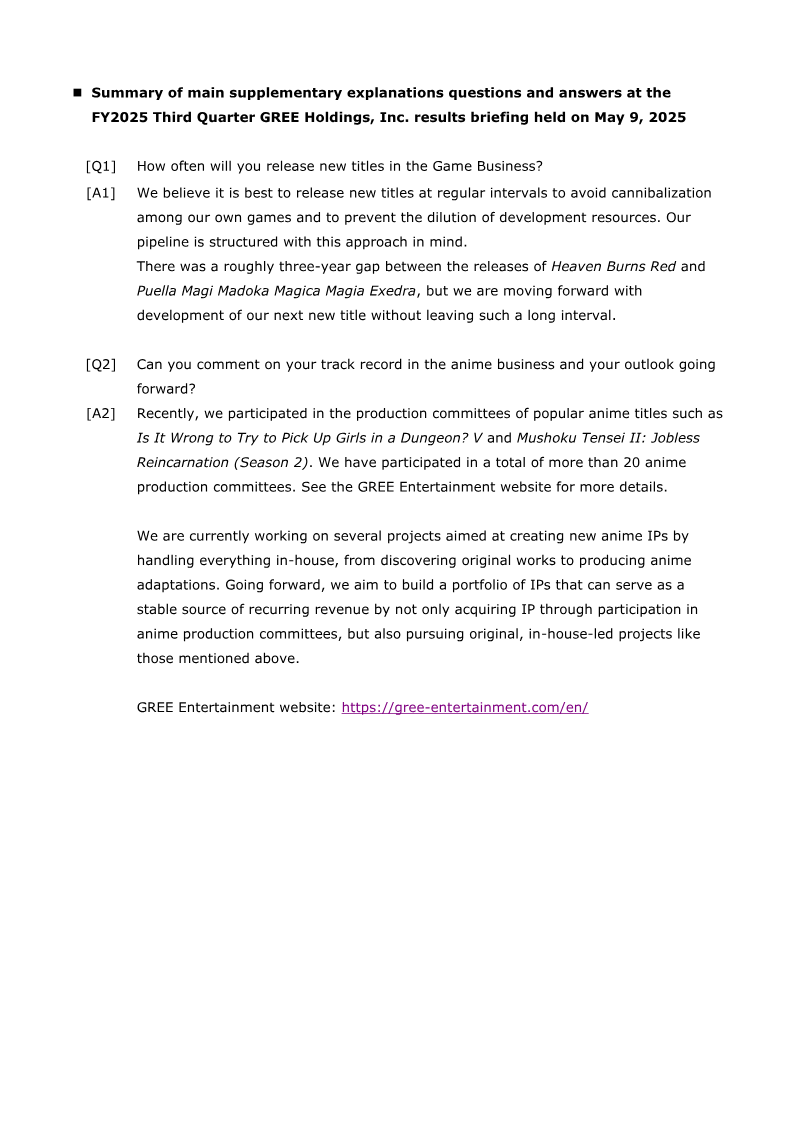
Summary of Main Supplementary Explanations Questions and Answers at the FY2025 Third Quarter GREE Holdings, Inc. Results Briefing Held on May 9, 2025
GREE Holdings maintains a strategic focus on stabilizing its release pipeline and diversifying its intellectual property portfolio to ensure long-term revenue growth. Following the third quarter of fiscal year 2025, the company emphasizes a shift toward more frequent game launches to optimize development resources and maintain market presence. While a three-year gap occurred between the releases of Heaven Burns Red and Puella Magi Madoka Magica Magia Exedra, future development cycles are structured to avoid such prolonged intervals while preventing internal competition between titles.
The company’s expansion into the anime sector serves as a critical pillar for its broader IP strategy. Having participated in over 20 anime production committees, including high-profile projects such as Is It Wrong to Try to Pick Up Girls in a Dungeon? V and Mushoku Tensei II: Jobless Reincarnation, the organization is leveraging these partnerships to build industry expertise. This collaborative track record provides a foundation for a more ambitious transition toward in-house IP creation.
The long-term objective involves managing the entire lifecycle of intellectual property, from the discovery of original works to the production of anime adaptations. By moving beyond passive participation in production committees and focusing on original, internally led projects, the company aims to establish a portfolio of IPs that generates stable, recurring revenue. This integrated approach across the game and anime segments is designed to maximize the value of owned assets and reduce reliance on external licensing, positioning the firm for more sustainable financial performance in the Japanese and global entertainment markets.
- GREE Holdings is shifting its development strategy to shorten release cycles and avoid the three-year gap experienced between 'Heaven Burns Red' and 'Puella Magi Madoka Magica Magia Exedra'.
- The company aims to transition from passive participation in anime production committees to leading original, in-house IP creation to secure long-term, recurring revenue.
- GREE has established industry expertise by participating in over 20 anime production committees, including major titles like 'Is It Wrong to Try to Pick Up Girls in a Dungeon? V' and 'Mushoku Tensei II: Jobless Reincarnation'.
- The core long-term strategy involves managing the full lifecycle of intellectual property, from initial discovery to anime production and game development.
- By integrating game and anime segments, the company intends to reduce its reliance on external licensing and maximize the value of its owned assets.
+2
GREEMay 2025