Dataspelsbranschen
Association25 documents
Documents
Article
Utbildningsrapporter: Sverige
The Swedish Games Industry Association presents a series of educational reports that chart the evolution and current state of game‑related education across Sweden. The primary purpose is to inform stakeholders—educators, industry partners, and policymakers—about trends in curriculum design, skill development pathways, and the integration of game‑based learning into formal education. The reports cover a geographic scope limited to Sweden, with comparative references to Nordic peers in the 2016 index. Time periods span from 2001 through 2024, offering longitudinal data on enrollment figures, program offerings, and industry‑academic collaborations.
Key findings highlight a steady increase in game‑education programmes, with 2016 data showing a 35 % rise in university courses that incorporate game design principles. The “Swedish Game Education: 2001‑2016” report documents that 12 % of higher‑education institutions offered at least one game‑centric course by 2016, up from 4 % in 2001. The “Nordic Game Education Index 2016” places Sweden third among Nordic countries in terms of program diversity, citing 18 distinct degree tracks. Recent 2024 releases emphasize alternative entry routes into the industry, noting that 28 % of professionals now enter through vocational training or self‑directed learning rather than traditional university degrees.
Methodologically, the reports rely on surveys of educational institutions and industry bodies, supplemented by publicly available enrollment statistics. Sample sizes vary: the 2016 index surveyed 45 institutions, while the 2024 “Fler vägar in i spelbranschen” report aggregated data from 120 industry participants. Concluding remarks stress the need for continued partnership between academia and industry to align curricula with evolving skill demands, suggesting that flexible learning pathways will be critical for sustaining Sweden’s competitive edge in the global game market.
- The percentage of Swedish higher-education institutions offering at least one game-centric course grew from 4% in 2001 to 12% by 2016.
- Alternative entry routes are gaining traction, with 28% of current industry professionals entering the field via vocational training or self-directed learning rather than traditional university degrees.
- University courses incorporating game design principles saw a 35% increase between 2001 and 2016.
- As of 2016, Sweden ranked third among Nordic countries for program diversity, offering 18 distinct degree tracks in game education.
- Sustaining Sweden's global competitiveness requires closer alignment between academic curricula and evolving industry skill demands through continued institutional partnerships.
+1
DataspelsbranschenJan 2024
Report56 pages
Fler vägar in i spelbranschen: 2024
The Swedish game industry faces a critical structural challenge as a persistent skills shortage threatens its long-term growth and international competitiveness. While the sector benefits from a robust domestic ecosystem of educational institutions ranging from vocational schools to universities, these traditional pathways are insufficient to meet the rising demand for talent. To sustain expansion, the industry must pivot toward more inclusive recruitment strategies that actively integrate untapped talent pools, including immigrants, professionals from adjacent sectors, and underrepresented groups.
A primary obstacle to this integration is the lack of established mechanisms for validating non-traditional skills and experience. Bureaucratic hurdles, such as complex work permit regulations and rigid migration policies, further complicate the recruitment of international experts. Simultaneously, a lack of industry awareness among public employment agencies and career counselors prevents potential candidates from recognizing game development as a viable career path. Addressing these gaps requires a multifaceted approach, including the implementation of micro-credentials to document specialized competencies, the creation of targeted bridge programs, and the development of flexible, part-time educational models that allow for concurrent employment.
Long-term success depends on deepening the collaboration between private studios, the public sector, and educational providers. By fostering inclusive leadership, promoting diverse role models, and simplifying administrative processes for new arrivals, the industry can effectively lower the barriers to entry. Ultimately, the transition toward a more open and welcoming professional culture is essential to harness the full potential of the available workforce, ensuring that the Swedish gaming sector remains a global leader by successfully bridging the divide between current labor market structures and the evolving needs of the digital economy.
- The Swedish game industry is facing a critical structural skills shortage that threatens its long-term international competitiveness and growth.
- Traditional educational pathways are insufficient to meet talent demand, necessitating a shift toward recruiting from untapped pools like immigrants, adjacent sector professionals, and underrepresented groups.
- Complex work permit regulations and rigid migration policies create significant bureaucratic barriers to hiring international experts.
- A lack of industry awareness among public employment agencies and career counselors prevents potential candidates from viewing game development as a viable career path.
- The industry must implement micro-credentials to validate non-traditional skills and develop flexible, part-time educational models that allow for concurrent employment.
+1
DataspelsbranschenJan 2024
Report76 pages
Game Developer Index: Sweden 2024
The analysis evaluates the health and trajectory of Sweden’s video‑game sector during 2023‑24, mapping its economic performance, creative output, ecosystem structure and emerging challenges. By quantifying sales, employment, investment and cultural impact, it argues that the industry remains a growth engine for the Swedish economy while confronting structural constraints that could limit future expansion.
Domestic net sales rose 6 % to SEK 34.6 billion (≈ EUR 3 billion, USD 3.2 billion) and total global revenue reached SEK 90.4 billion, a 4.5 % increase. The number of registered firms grew by 108 to 1,010, and Swedish‑owned companies expanded overseas to 218 subsidiaries in 54 countries, employing 15,792 staff abroad, of whom 29.5 % are women. Major titles such as Helldivers 2 (12 million copies in three months) and Satisfactory (6 million copies and a console launch) reinforced Sweden’s market presence, while Steam and Twitch data showed Swedish games accounting for over 700 million streamed hours in 2023 and nearly 500 million from January‑October 2024.
The ecosystem is heavily concentrated in Stockholm, home to 439 studios and 5,816 employees, with secondary hubs in Skåne‑Blekinge, Västra Götaland, Västerbotten‑Norrbotten and Östergötland. Educational provision spans bachelor, master and vocational programmes, serving roughly 700 students across multiple institutions. Inclusion initiatives have broadened participation, exemplified by a game‑developer camp for about 100 gender‑diverse teens and a network of scholarships and mentorships. Nevertheless, early‑stage capital has weakened, talent pipelines remain thin—with only 644 new hires in 2023 and rising work‑permit refusals—and public‑health screen‑time guidance remains ambiguous.
Capital flows revived in 2023‑24, highlighted by Embracer’s SEK 4.9 billion sale of Gearbox to Take‑Two and EQT’s SEK 28.7 billion acquisition of
- Sweden’s video-game sector grew to SEK 90.4 billion in total global revenue in 2023-24, a 4.5% increase, while domestic net sales rose 6% to SEK 34.6 billion.
- The industry’s footprint expanded to 1,010 registered firms, with Swedish-owned companies now operating 218 subsidiaries across 54 countries and employing 15,792 staff abroad.
- Major commercial successes like 'Helldivers 2', which sold 12 million copies in three months, and 'Satisfactory', which reached 6 million copies, drove significant market presence and over 700 million streamed hours in 2023.
- Capital activity remains robust, evidenced by major transactions including EQT’s SEK 28.7 billion acquisition and Embracer’s SEK 4.9 billion sale of Gearbox to Take-Two.
- Stockholm remains the primary industry hub with 439 studios and 5,816 employees, though the ecosystem faces structural challenges including a thin talent pipeline, with only 644 new hires in 2023, and rising work-permit refusals.
Swedish Games IndustryJan 2024

Report68 pages
Spelbranschens roll i den gröna omställningen
Sweden’s gaming sector is positioned as a low‑impact yet high‑potential catalyst for the nation’s green transition. Compared with other Swedish industries and the global gaming market, the sector’s carbon emissions are modest, with the majority of resource use occurring during gameplay—a phase that remains difficult to quantify. By leveraging built‑in eco‑modes, energy consumption can fall by 20‑50 % per player, yet adoption is currently around two percent; making such modes the default could raise the estimated global saving to three percent.
The report highlights how core gaming technologies—game engines, GPUs, extended reality and artificial intelligence—are already being transferred to sectors such as infrastructure, mining and climate modelling, delivering measurable efficiency gains and emission reductions. Immersive tools like AR/VR, digital twins and AI are deployed in public‑sector pilots, including Sweco’s metaverse dialogue platform, Nacka’s “Greenovation Twin” and Vasakronan’s Twinfinity, to visualise climate impacts, streamline urban planning and cut travel‑related emissions. Hackathons and serious‑game prototypes further accelerate climate‑focused solutions, while gamified training and board‑game initiatives foster behavioural change and generate transport‑usage data.
Design guidance stresses that games must promote collective action and embed climate objectives into social norms, rather than focusing solely on individual behaviour. Educational programmes and events such as the 2023 Green Game Jam, which linked gameplay to snow‑leopard conservation and generated donation‑linked purchases, demonstrate the sector’s capacity to mobilise large audiences—evidenced by the UN‑backed “Peoples’ Climate Vote” reaching thirty million mobile users.
Collaboration across more than fifty studios
- Gaming eco-modes can reduce energy consumption by 20–50% per player, yet current adoption remains at approximately two percent.
- Making eco-modes the default setting across the global gaming industry could potentially reduce total energy consumption by three percent.
- Core gaming technologies—including game engines, GPUs, AI, and extended reality—are being applied to infrastructure, mining, and climate modeling to drive measurable efficiency gains.
- Public-sector projects like Sweco’s metaverse platform, Nacka’s “Greenovation Twin,” and Vasakronan’s Twinfinity utilize digital twins and AR/VR to streamline urban planning and reduce travel-related emissions.
- The UN-backed “Peoples’ Climate Vote” demonstrated the sector's mobilization potential by reaching thirty million mobile users.
DataspelsbranschenJan 2024
Report68 pages
Spelutvecklarindex 2023: Swedish Games Industry
The Swedish games industry serves as a powerhouse of global digital entertainment, characterized by rapid revenue expansion and a vast international footprint. In 2022, the sector generated 86.5 billion SEK in global revenue, marking a 47% increase largely fueled by aggressive acquisition strategies. With 392 Swedish-owned studios operating across 59 countries, the industry employs approximately 25,000 people worldwide, including 8,445 domestic staff. This reach is immense, with Swedish-developed titles accumulating nearly 7 billion downloads and engaging roughly one-quarter of the global population.
Despite this commercial success, the industry faces structural bottlenecks that threaten long-term sustainability. A persistent talent shortage remains the primary constraint on production capacity, exacerbated by challenges regarding work permits and a lack of formal financial support structures for early-stage startups compared to European peers. To mitigate these issues, studios are increasingly leveraging productivity-enhancing technologies like generative AI, standardized game engines, and collaborative regional ecosystems that bridge the gap between specialized education and professional development.
Social and operational evolution remains a core priority for the sector. Efforts to improve gender diversity are yielding tangible results, with women accounting for nearly half of all new hires in 2022, bringing female representation to 23.4% of the workforce. Simultaneously, the industry is pivoting toward broader sustainability goals, focusing on reducing environmental footprints and fostering healthy, inclusive workplace cultures. As the sector navigates the complexities of hybrid work environments and the integration of emerging technologies, it continues to function as a vital catalyst for innovation, driving value that extends well beyond the boundaries of traditional game development.
- The Swedish games industry generated 86.5 billion SEK in global revenue in 2022, representing a 47% year-over-year increase driven largely by acquisition strategies.
- Swedish-owned studios now number 392 across 59 countries, employing 25,000 people globally with 8,445 staff based domestically.
- Swedish-developed titles have reached a massive scale, accumulating nearly 7 billion downloads and engaging approximately 25% of the global population.
- Gender diversity is improving, with women accounting for nearly 50% of all new hires in 2022, raising total female workforce representation to 23.4%.
- A persistent talent shortage and difficulties with work permits remain the primary constraints on production capacity, compounded by a lack of early-stage financial support compared to other European markets.
+2
DataspelsbranschenOct 2023
Report36 pages
Vägar in i spelbranschen: Kompetens, utbildning och konsten att skapa spel (2023)
The Swedish game industry is currently experiencing a critical talent shortage that threatens its long-term competitiveness and growth. With the sector recording 1,348 new hires in 2021 alone, domestic educational institutions are failing to meet demand, producing fewer than half of the required professionals. This imbalance is exacerbated by the rapid expansion of the industry and the lack of official recognition for game development as a formal academic discipline, which complicates data tracking and strategic planning. To sustain its global standing, the industry must bridge the gap between educational output and the evolving needs of studios, particularly in core disciplines such as programming, design, and graphics.
The Swedish educational landscape is characterized by a robust ecosystem of vocational programs and academic institutions that prioritize project-based, team-oriented learning. While these programs are highly effective at producing job-ready graduates, the reliance on international recruitment remains essential, with roughly one-third to half of the workforce originating from abroad. However, this dependency is hampered by significant bureaucratic obstacles, including restrictive work permit policies for non-EU vocational students and complex regulations regarding international remote work. Furthermore, the industry faces persistent challenges related to housing shortages and the need to improve gender diversity within the workforce.
To ensure future stability, the industry must foster closer alignment between academic research funding and practical studio requirements. Strengthening the pipeline for domestic talent while simultaneously streamlining pathways for international professionals is vital. By formalizing game development within the academic framework and addressing the administrative barriers that currently impede the retention of global talent, Sweden can maintain its position as a leading hub for game development. These systemic adjustments are necessary to transform the current recruitment bottleneck into a sustainable model for continued innovation and economic success.
- The Swedish game industry faces a critical talent shortage, with domestic educational institutions producing fewer than half of the professionals required to meet the demand of 1,348 new hires recorded in 2021.
- Between one-third and one-half of the current Swedish game industry workforce consists of international talent, highlighting a heavy reliance on global recruitment to sustain growth.
- Restrictive work permit policies for non-EU vocational students and complex regulations regarding international remote work act as significant bureaucratic barriers to maintaining the necessary talent pipeline.
- The lack of official recognition for game development as a formal academic discipline hinders effective data tracking and strategic planning for the sector.
- Industry growth is further constrained by domestic infrastructure challenges, specifically persistent housing shortages and a need to improve gender diversity within the workforce.
+1
DataspelsbranschenJan 2023
Report68 pages
Game Developer Index 2023: Sweden
The Swedish games industry reached a significant financial milestone in 2022, with domestic revenues rising 13% to €3.1 billion and total global revenue, including foreign subsidiaries, surging 40% to €8.1 billion. This growth is characterized by a massive international footprint, as Swedish-owned companies now operate nearly 400 studios across 59 countries. Large-scale acquisitions, such as Embracer Group’s multi-billion euro purchase of Asmodee, have shifted the employment landscape, resulting in Swedish firms employing nearly twice as many people abroad as they do domestically. Within Sweden, the number of active companies grew by 20% to 939, supported by a maturing ecosystem of regional hubs and specialized educational programs.
Despite this commercial success, the industry faces a critical production capacity bottleneck driven by a chronic shortage of skilled labor. While domestic employment grew to over 8,400 positions and diversity improved—with women accounting for over 44% of new entrants—the sector remains heavily dependent on foreign recruitment to sustain its trajectory. Furthermore, Swedish startups face a competitive disadvantage due to a lack of formal financial support structures compared to other European nations, forcing many to rely on organic growth or early acquisition rather than domestic venture capital.
The sector is also navigating complex structural and environmental challenges. Sustainability efforts are increasingly focused on Scope 3 emissions, which represent over 99% of the industry’s carbon footprint, while legal and ethical concerns regarding generative AI and online radicalization have emerged as new operational risks. Geopolitical instability, particularly the war in Ukraine, continues to impact global workforces. Nevertheless, the integration of the Swedish E-sports Association into the Swedish Sports Confederation and the continued dominance of major entities like King, Mojang, and Stillfront Group underscore Sweden’s position as a premier global hub for game development and digital entertainment.
- The Swedish games industry saw total global revenue reach €8.1 billion in 2022, a 40% increase driven by aggressive international expansion and large-scale acquisitions like Embracer Group’s purchase of Asmodee.
- Domestic revenue in Sweden rose 13% to €3.1 billion in 2022, supported by a 20% growth in active companies to a total of 939 studios.
- Swedish-owned game companies now operate nearly 400 studios across 59 countries, with the industry employing nearly twice as many people abroad as it does within Sweden.
- A chronic shortage of skilled labor remains a critical production bottleneck, forcing the industry to rely heavily on foreign recruitment despite domestic employment growing to over 8,400 positions.
- Swedish startups face a competitive disadvantage due to a lack of formal domestic venture capital, often forcing them to rely on organic growth or early acquisition.
DataspelsbranschenJan 2023
Report64 pages
Game Developer Index: Sweden 2022
The Swedish games industry underwent a period of rapid expansion in 2021, characterized by a 22% increase in domestic revenue to €2.7 billion and a 43% surge in global revenue to €5.8 billion. This growth was fueled by a record-breaking year of international acquisitions, with 81 public transactions led by major groups such as Embracer and Stillfront. By late 2022, Swedish-owned entities operated 197 studios across 49 countries, employing approximately 28,000 people worldwide. This international footprint is reflected in consumer reach, as an estimated one in four players globally has engaged with a Swedish-developed title, and Swedish-associated games accounted for 6% of all Twitch watchtime in 2021.
The domestic workforce grew by 17% to nearly 8,000 employees, with women representing 22.1% of the total staff and 26% of new hires. While gender diversity is improving—evidenced by 29 companies achieving at least 50% female representation—the industry continues to struggle with a severe domestic skills shortage. This talent gap has forced Swedish firms to expand their foreign subsidiaries aggressively, with over 11,000 staff members now based abroad. Although regional hubs in Stockholm and Skåne remain dominant, growth is increasingly supported by specialized educational clusters and post-secondary programs designed to cultivate local talent.
Despite its commercial success and cultural influence, the sector faces structural hurdles that could impact future scalability. Critical challenges include complex work permit processes for international recruits and a lack of early-stage financing compared to other global markets. Methodological shifts in industry tracking now prioritize national group turnover to ensure better comparability with other sectors, revealing a robust ecosystem of 785 active companies. While the industry remains a powerhouse of the Swedish economy, its long-term sustainability depends on addressing recruitment barriers and maintaining the momentum of its global acquisition strategy.
- The Swedish games industry experienced significant financial growth in 2021, with domestic revenue rising 22% to €2.7 billion and global revenue surging 43% to €5.8 billion.
- Driven by 81 international acquisitions led by groups like Embracer and Stillfront, Swedish-owned entities now operate 197 studios across 49 countries, employing approximately 28,000 people globally.
- Swedish-developed titles maintain a massive international reach, with an estimated one in four global players engaging with these games and Swedish-associated content accounting for 6% of all Twitch watchtime in 2021.
- The domestic workforce grew by 17% to nearly 8,000 employees, though the industry faces a severe skills shortage that has forced firms to employ over 11,000 staff members through foreign subsidiaries.
- Gender diversity is gradually improving, with women representing 22.1% of the total workforce and 26% of new hires, while 29 companies have achieved at least 50% female representation.
+1
Swedish Games IndustryJan 2022
Report52 pages
Swedish Games Industry 2021
The Swedish games industry experienced a transformative period of growth in 2020, reaching a record revenue of EUR 3.3 billion. This 43% increase significantly outpaced global market trends, marking the sector's twelfth consecutive year of profitability. The landscape is increasingly defined by corporate consolidation and international expansion, with 667 active companies and 19 listed entities commanding a combined market capitalization of EUR 10.7 billion. Major players such as Embracer Group, King, and Mojang have transitioned Sweden from a target for foreign acquisition into a dominant global investor, with Swedish-owned firms now employing more personnel abroad than domestically across 126 international studios.
Despite this commercial success, the industry faces a critical bottleneck regarding skilled labor. While domestic employment rose to over 6,500 positions, a severe talent shortage and a cumbersome work permit process hinder further expansion. These systemic issues are compounded by a lack of early-stage financing and tax incentives for smaller developers, who must also navigate digital regulations often tailored for larger tech platforms. Furthermore, while Swedish-developed titles like Minecraft and Candy Crush have achieved over six billion downloads, the sector continues to grapple with internal demographic challenges. Women currently represent only 21% of the workforce, and over 100 companies remain entirely male-operated, prompting a surge in diversity initiatives aimed at leveling the playing field.
Geographically, while Stockholm remains the primary hub with over 4,000 employees, regional development clusters and educational programs are expanding throughout Sweden to support the growing ecosystem. The industry is also pivoting toward long-term sustainability, addressing workplace culture and the environmental implications of energy-intensive cloud gaming. As the sector matures, its primary challenges have shifted from achieving market viability to managing rapid globalization, securing specialized talent, and fostering a more inclusive and sustainable professional environment.
- The Swedish games industry reached a record revenue of EUR 3.3 billion in 2020, marking a 43% growth rate and the sector's twelfth consecutive year of profitability.
- Sweden has shifted from an acquisition target to a global investor, with 19 listed entities commanding a combined market capitalization of EUR 10.7 billion and Swedish-owned firms operating 126 international studios.
- A severe talent shortage and restrictive work permit processes are critical bottlenecks, despite domestic employment rising to over 6,500 positions.
- The workforce faces significant demographic imbalances, with women representing only 21% of employees and over 100 companies remaining entirely male-operated.
- Stockholm remains the primary industry hub with over 4,000 employees, though development clusters are expanding regionally to support the growing ecosystem.
+1
DataspelsbranschenOct 2021
Report4 pages
Game Developer Index: Sweden 2020
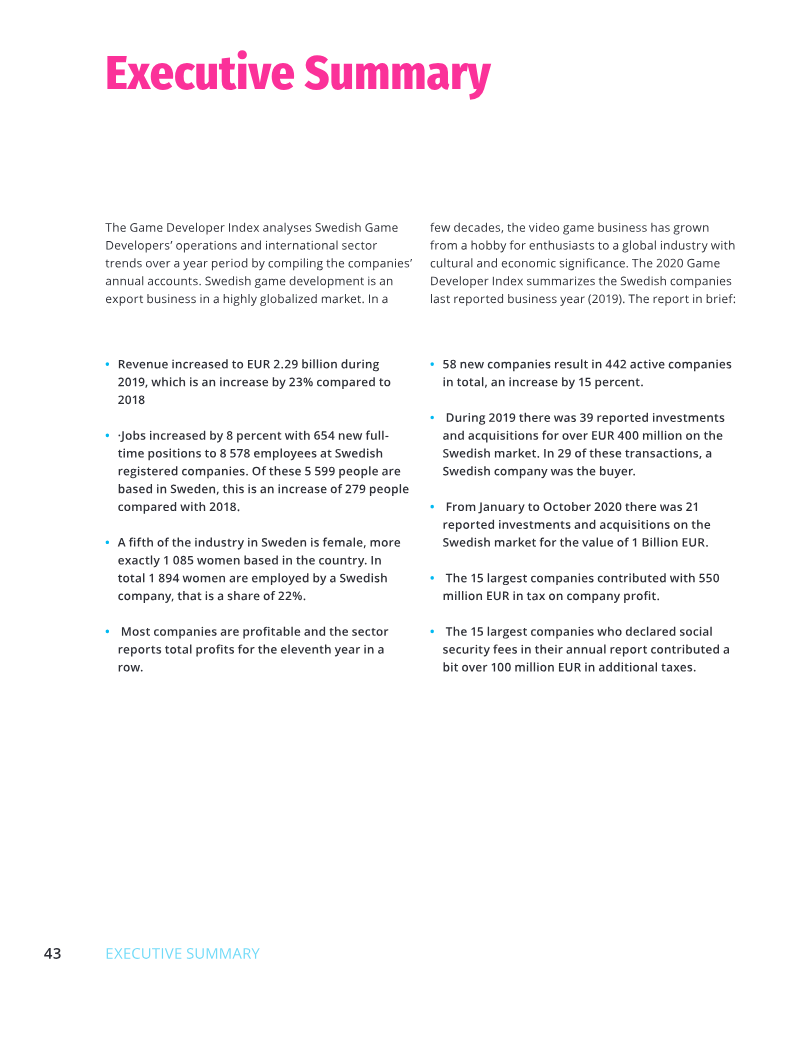
The Swedish game development industry demonstrates robust economic expansion and sustained profitability, functioning as a highly globalized export sector. By analyzing annual accounts from Swedish-registered companies, the industry reports a significant revenue increase to EUR 2.29 billion in 2019, representing a 23 percent growth over the previous year. This marks the eleventh consecutive year of total sector profitability, supported by a 15 percent increase in the number of active companies, which reached 442 by the end of 2019.
Employment trends reflect this upward trajectory, with the workforce growing by 8 percent to a total of 8,578 full-time positions. Of these, 5,599 employees are based within Sweden. While the industry continues to scale, gender diversity remains a focal point, with women comprising 22 percent of the total workforce. The sector’s economic impact extends to significant tax contributions, as the 15 largest companies alone provided EUR 550 million in corporate profit taxes and over EUR 100 million in additional social security fees.
Investment activity highlights the industry's maturity and attractiveness to capital. During 2019, the market saw 39 transactions involving investments and acquisitions totaling over EUR 400 million, with Swedish firms acting as the primary buyer in the majority of cases. This momentum accelerated into 2020, with 21 transactions recorded between January and October valued at EUR 1 billion. Despite these successes, the industry identifies ongoing challenges, particularly regarding the access to specialized talent and the navigation of complex digital market regulations. Future growth is expected to rely on regional clusters, incubators, and a continued commitment to increasing workforce diversity to maintain global competitiveness.
- The Swedish game industry generated EUR 2.29 billion in revenue in 2019, marking a 23 percent year-over-year increase and the eleventh consecutive year of sector-wide profitability.
- Investment activity surged significantly, with 39 transactions totaling over EUR 400 million in 2019, followed by 21 transactions valued at EUR 1 billion between January and October 2020.
- The industry workforce grew to 8,578 full-time positions by the end of 2019, with 5,599 of those employees based in Sweden and women representing 22 percent of the total headcount.
- The sector’s 15 largest companies contributed EUR 550 million in corporate profit taxes and over EUR 100 million in social security fees during 2019.
- The number of active game development companies in Sweden reached 442 by the end of 2019, representing a 15 percent increase from the previous year.
+2
DataspelsbranschenJan 2020

Report48 pages
Swedish Game Developer Index 2019
Published by the Swedish Games Industry Illustration, cover: Pontus Ullbors Text & analysis: Johanna Nylander The Swedish Games Industry is a collaboration between trade organizations ANGI and Spelplan-ASGD. ANGI represents publishers and distributors and Spelplan-ASGD represents Dataspelsbranschen Swedish Games Industry Magnus Ladulåsgatan 3, SE-116 35 Stockholm Contact: [email protected] KEY FIGURES 2018 2017 2016 2015 ...
- The Swedish games industry experienced significant growth in 2018, with a 33% increase in value to EUR 1.87 billion, marking its tenth consecutive profitable year with total profits exceeding EUR 335 million.
- The industry is expanding, with 41 new companies and over 600 new employees added in Sweden in 2018, an increase of 12% in new companies.
- The corporate landscape has shifted, with seven companies now having revenues over EUR 100 million; Embracer Group, after acquiring Koch Media, is the largest Swedish games company, surpassing previous dominators Mojang and King.
- Swedish game companies contribute significantly to the economy, with the 25 largest companies paying EUR 114 million in tax on profits and the 15 largest contributing over EUR 100 million in wage taxes.
- Swedish game developers are expanding globally, with 31 Swedish-owned studios employing 2,604 people outside Sweden in 2018, and notable acquisitions and investments by Swedish companies in international firms.
+1
Swedish Games IndustryJan 2019
Report48 pages
Spelutvecklarindex 2018
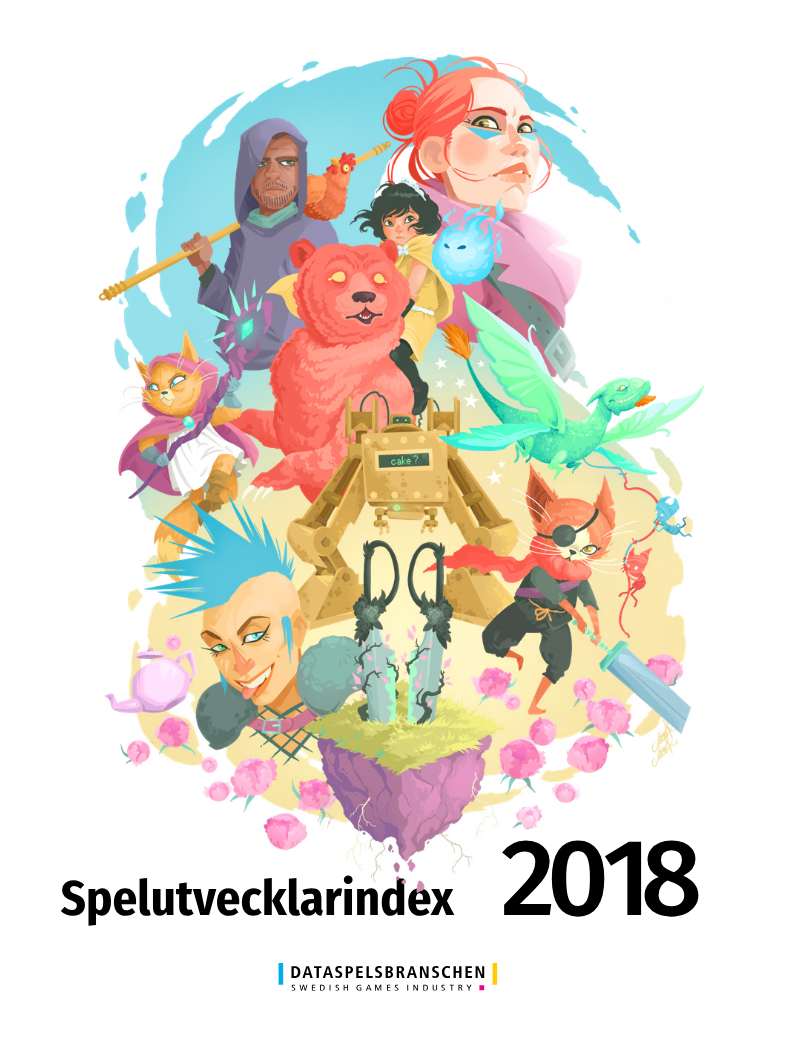
Framsida (collage) & fristående illustrationer: Anna Nilsson Text & analys: Johanna Nylander Dataspelsbranschen är en samarbetsorganisation för ANGI och Spelplan-ASGD. ANGI representerar förlag samt distributörer och Spelplan-ASGD representerar utvecklare Dataspelsbranschen | Swedish Games Industry Klara norra kyrkogata 31, Box 22307 SE-104 22 Stockholm Kontakt: [email protected] NYCKELTAL Förändring 2012-2017 Oms.
- The Swedish game industry's revenue reached 14,695 MSEK in 2017, continuing a strong growth trend from 3,715 MSEK in 2012.
- Employment in the Swedish game industry increased by 24% (1,047 full-time positions) in 2017, nearly doubling the 558 new positions from 2016, but companies still face recruitment challenges and a shortage of skilled developers.
- The number of women in the Swedish game industry has quintupled in six years, with women now making up 20% of all employees, and more women are taking leadership roles, such as Ebba Ljungerud becoming CEO of Paradox in August 2018.
- Swedish game companies are active in mergers and acquisitions, with notable examples in 2017 including THQ Nordic acquiring Black Forest Games and Pieces Interactive, and Starbreeze acquiring Dhruva Interactive and Enterspace AB.
- The industry benefits from diversified revenue streams like 'games as a service' (GaaS), microtransactions, and subscription models, leading to more stable income and higher valuations for publicly traded game companies.
+1
DataspelsbranschenJan 2018