CESA – Computer Entertainment Supplier's Association
Association16 documents
Japan's leading game industry association. Publishes annual Game Industry Reports, developer employment studies, and student game creator surveys.
Documents
Report3 pages
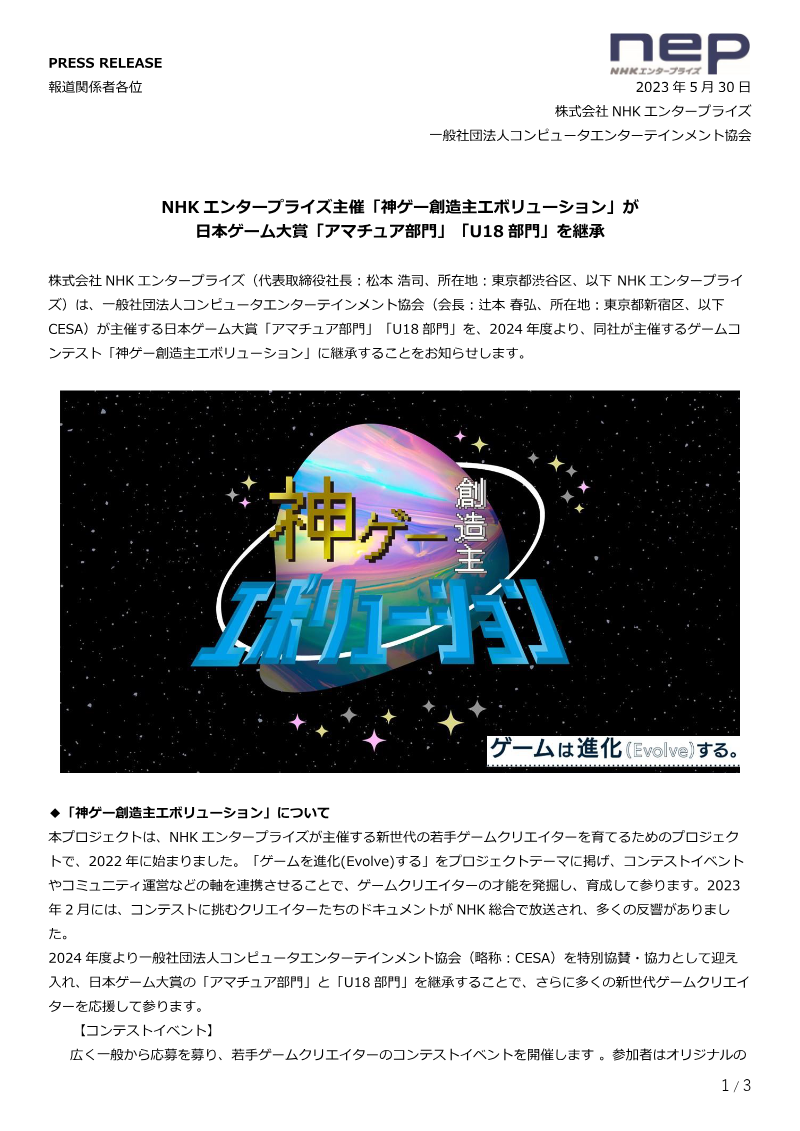
NHK Enterprise's 'Kami-Ge Creator Evolution' Succeeds Japan Game Awards 'Amateur' and 'U18' Divisions
NHK Enterprise is launching the “Kami‑Ge Creator Evolution” contest as a dedicated platform for nurturing the next generation of Japanese game developers, and from 2024 it will incorporate the Japan Game Awards’ Amateur and U18 divisions. The initiative, begun in 2022 under the theme “Evolve the Game,” seeks to discover and develop talent through a series of contest events, community support, and media exposure, including a documentary broadcast on NHK General in February 2023 that generated strong public interest.
The competition invites creators from across Japan to submit original games, which are evaluated for innovative expansion of the medium’s boundaries by a diverse panel of established game designers, media artists, and other industry figures. In addition to expert judging, a public popularity vote is conducted, and the contest awards a Grand Prize, Excellence Awards, and Honorable Mentions in the Amateur category, while the U18 category focuses on participants aged 18 or younger, reflecting the Japan Game Awards’ long‑standing commitment to youth development since 2018. The 2024 schedule begins with an entry period from 1 February to the end of April, followed by nomination, second‑round video submissions in July, third‑round game submissions in October, finalist announcements at the end of October, and a final event slated for December.
A closed Discord community supports participants with exclusive benefits, knowledge sharing, and mentorship, reinforcing the project’s role as a learning environment. Special cooperation from the Computer Entertainment Supplier’s Association (CESA) provides additional industry credibility and resources. The contest is open to individuals, teams, corporations, and organizations regardless of age, gender, nationality, or the number of entries, emphasizing inclusivity and broad outreach.
By integrating the Amateur and U18 awards, the “Kami‑Ge Creator Evolution” aims to broaden the creative framework of Japanese games, foster innovative design, and strengthen the pipeline of skilled developers. The organizers are actively seeking sponsors to sustain the project’s growth and align with NHK Enterprise’s broader commitment to sustainable development and cultural enrichment.
- NHK Enterprise has integrated the Japan Game Awards’ Amateur and U18 divisions into its 'Kami-Ge Creator Evolution' contest, effective from 2024.
- The 2024 competition timeline spans from February 1 to a final event in December, featuring a multi-stage evaluation process including video submissions in July and game submissions in October.
- The contest is open to all applicants regardless of age, nationality, or organizational status, with specific categories for general amateur creators and those aged 18 or younger.
- Participants gain access to a closed Discord community providing mentorship, knowledge sharing, and exclusive resources to support developer growth.
- The initiative is supported by the Computer Entertainment Supplier’s Association (CESA) to provide industry credibility and resources for the project.
+2
CESA – Computer Entertainment Supplier's AssociationMay 2023
Report4 pages
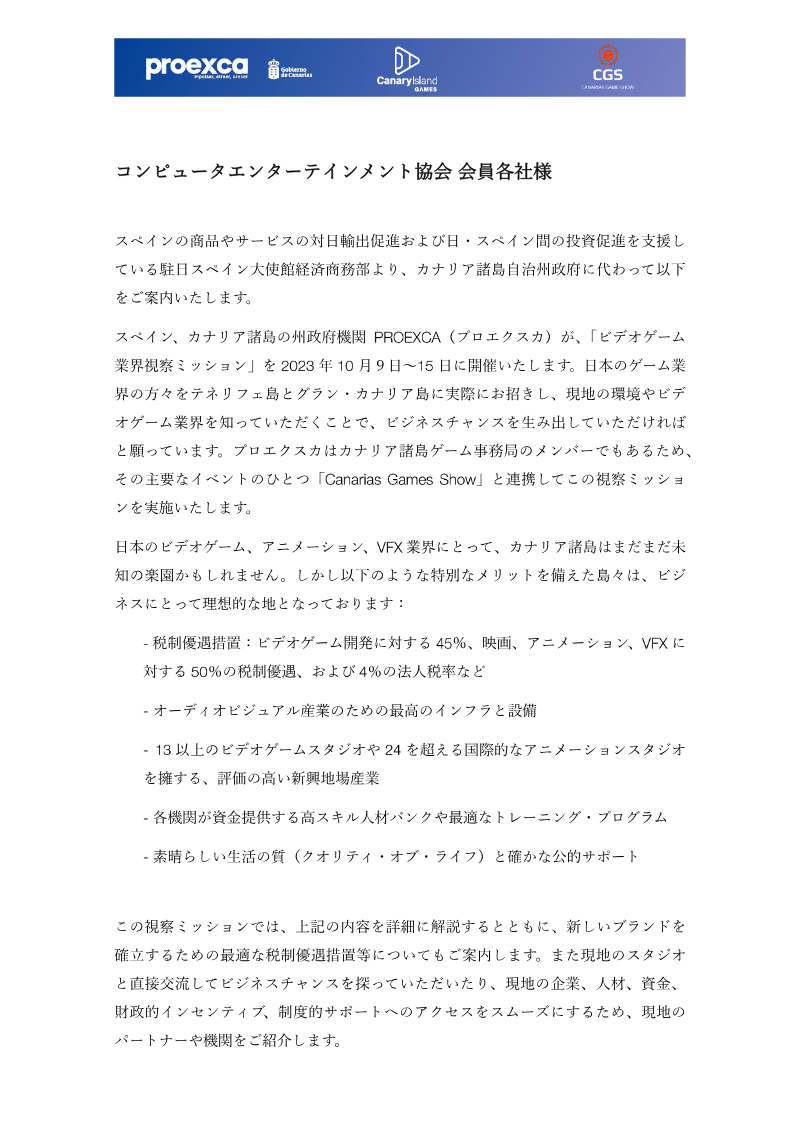
スペイン、カナリア諸島の州政府機関から「ビデオゲーム業界視察ミッション」のご案内
The invitation seeks to generate business opportunities for Japanese video‑game, animation and related audiovisual firms by showcasing the Canary Islands as a strategic production hub. It positions the archipelago as an emerging, tax‑friendly environment, highlighting preferential rates for game development, film and animation, as well as a reduced corporate tax rate, alongside high‑quality infrastructure, skilled talent pools, and strong public support. The core thesis is that direct exposure to local studios, financing mechanisms and regulatory incentives will encourage Japanese companies to establish subsidiaries, pursue co‑production agreements, or outsource projects to Canary Island partners.
The mission is scheduled for 9 – 15 October, with participants traveling from Japan to Tenerife on 9 October and returning after the final day on 15 October. The itinerary includes briefings on the regional industry and tax regime, visits to multiple development studios such as Drakhar, Foxter, The Game Kitchen, Promineo and No Brake Games, a tour of a super‑computer facility, and attendance at the Canarias Game Show on Gran Canaria, featuring B2B matchmaking, conference sessions and networking dinners. All travel costs—including economy‑class round‑trip airfare, hotel accommodation, meals and intra‑island transport—are covered by the organizers, with additional support offered for group participation.
Target participants are Japanese firms contemplating legal entity formation in the Canary Islands, joint‑development projects, or outsourcing production to local studios. The program is coordinated by the Spanish Embassy’s Economic and Commercial Section in Tokyo and the Canary Islands government agency Proexca, which also serves on the regional game office. While the embassy assists with logistics, detailed tax‑incentive information is to be obtained from the Canary Islands authorities and specialist advisors. The initiative aims to deepen Japan‑Spain investment ties within the audiovisual sector by converting the exploratory visit into concrete commercial collaborations.
- The Canary Islands government is hosting a business mission for Japanese video game and animation firms from October 9–15 to promote the region as a strategic production hub.
- The mission covers all travel expenses, including economy-class airfare, accommodation, meals, and local transport, for qualified Japanese companies interested in expansion or outsourcing.
- The Canary Islands offer a competitive business environment featuring reduced corporate tax rates and specific financial incentives for game development, animation, and film production.
- The itinerary includes site visits to local studios such as Drakhar, Foxter, The Game Kitchen, Promineo, and No Brake Games, alongside a tour of a regional super-computer facility.
- Participants will attend the Canarias Game Show on Gran Canaria, which provides dedicated B2B matchmaking, industry conferences, and networking opportunities.
+2
CESA – Computer Entertainment Supplier's AssociationMay 2023
Report1 pages
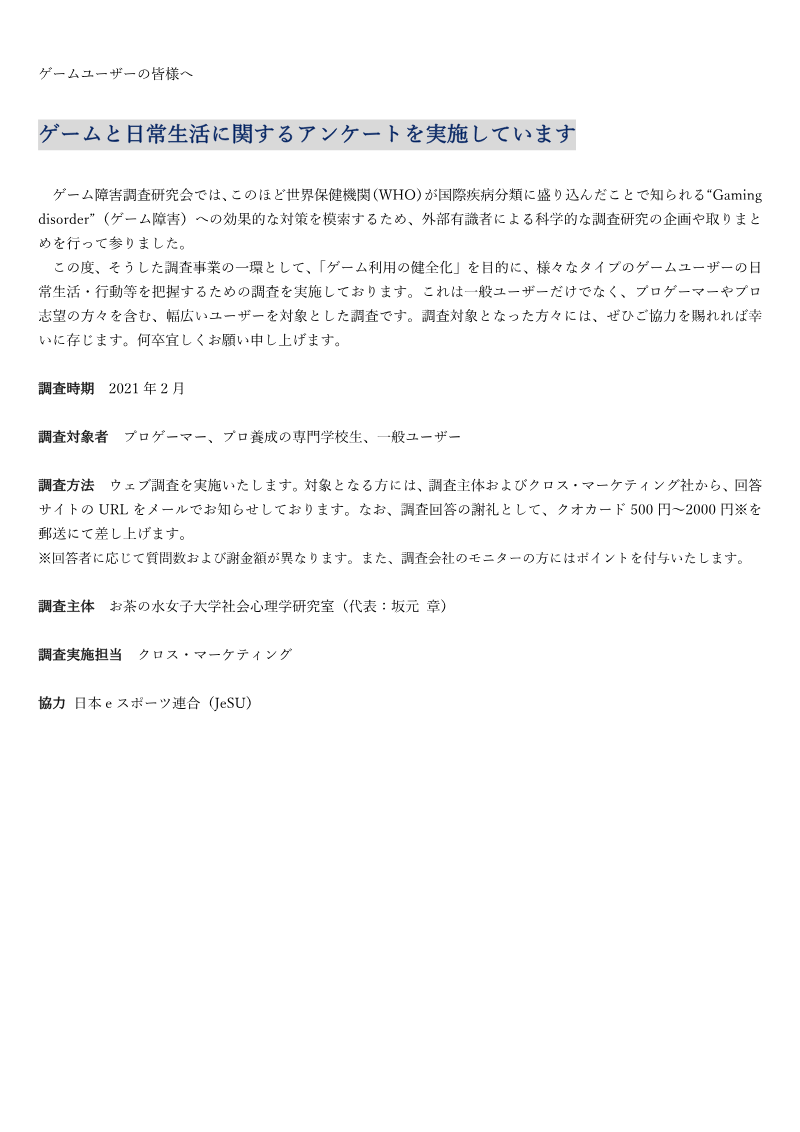
Survey on Games and Daily Life: Japan
The survey was launched to deepen understanding of how gaming activities intersect with everyday life in Japan and to inform strategies for mitigating “gaming disorder,” a condition recently classified by the World Health Organization. Its overarching aim is to promote healthier gaming habits across a broad spectrum of participants, ranging from casual players to professional gamers and students enrolled in specialized esports training programs.
Fieldwork took place in February 2021 and targeted three distinct groups: active professional gamers, individuals attending dedicated esports academies, and the general gaming public. Data were collected through an online questionnaire distributed via email by the research team and Cross‑Marketing, with respondents directed to a secure response site. To encourage participation, incentives varied from ¥500 to ¥2,000 Quo‑card vouchers, supplemented by point awards for panel members of the survey firm.
The investigation was coordinated by the Social Psychology Laboratory at Ochanomizu University, under the leadership of Professor Akira Sakamoto, with operational support from Cross‑Marketing and endorsement from the Japan eSports Union (JeSU). Although specific results are not disclosed in the excerpt, the study’s design reflects a comprehensive, mixed‑audience approach intended to generate actionable insights for policy makers, health professionals, and the esports industry regarding responsible gaming practices in Japan.
- The study, conducted in February 2021, aimed to analyze the intersection of gaming and daily life to inform strategies for mitigating gaming disorder.
- Research was led by Professor Akira Sakamoto of the Social Psychology Laboratory at Ochanomizu University with endorsement from the Japan eSports Union (JeSU).
- The survey targeted three distinct demographics: active professional gamers, students in specialized esports academies, and the general gaming public.
- Data collection was facilitated through an online questionnaire managed in partnership with the research firm Cross-Marketing.
- Participation was incentivized through a combination of point awards and Quo-card vouchers ranging in value from ¥500 to ¥2,000.
+1
CESA – Computer Entertainment Supplier's AssociationJan 2021
Legal2 pages
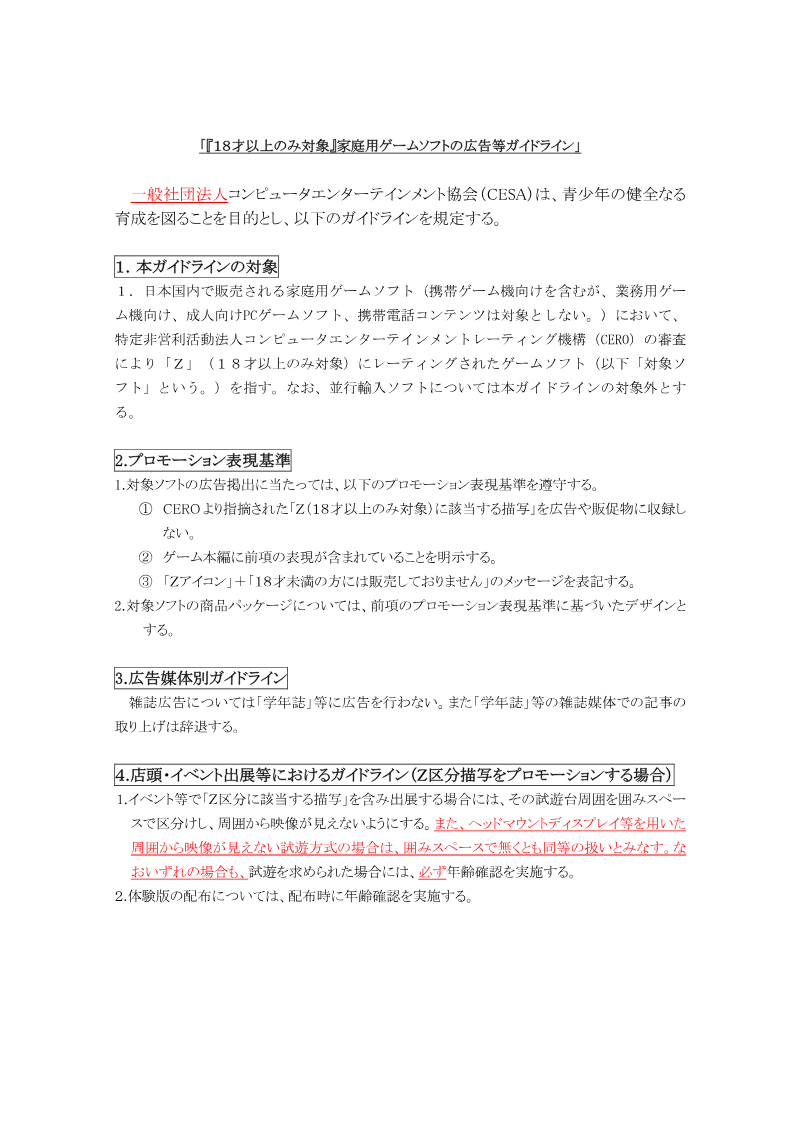
『18才以上のみ対象』家庭用ゲームソフトの広告等ガイドライン
The guideline establishes a regulatory framework for advertising and promotional activities involving home‑console video games in Japan that have received a CERO “Z” rating, indicating they are intended exclusively for players aged 18 years and older. Its primary aim is to protect youth by ensuring that any depiction classified as “Z” is excluded from public marketing materials while clearly communicating the age restriction to consumers.
Coverage is limited to domestically sold home‑console titles, including those for handheld consoles, but excludes professional arcade machines, adult PC games, and mobile phone content. Parallel‑imported software is also outside the scope. The rules apply to packaging, print media, retail displays, events, and online platforms, and they have been in force since 1 April 2008, with a revision issued on 20 June 2012. Advertising must omit any “Z” content, display the Z icon together with a statement that the product is not sold to persons under 18, and indicate that the game itself contains such material. Print ads are prohibited in school‑related magazines, and any event demo featuring “Z” content must be isolated from public view, with mandatory age verification for all trial participants and demo distributions.
Online, official game sites must label the product as “18 years or older only” on the homepage, enforce age checks for page access, and link to the CERO rating page. E‑commerce sites selling the titles must verify the buyer’s age at purchase. The guideline also mandates that any revisions be approved by the CESA board and communicated to member organizations. Overall, the framework seeks to balance commercial promotion with stringent safeguards against underage exposure to adult‑rated game content.
- The CERO 'Z' advertising guidelines, effective since April 1, 2008, and revised on June 20, 2012, mandate that all promotional materials for 18+ home-console games must exclude restricted content and clearly display the 'Z' age-rating icon.
- Advertisers must include a mandatory disclaimer on all materials stating that the product is not sold to persons under 18 and that the game contains adult-rated content.
- Public events featuring 'Z' rated demos must isolate the content from public view and enforce mandatory age verification for all participants and demo distributions.
- Online platforms must implement age-gating on official game homepages, require age verification for e-commerce purchases, and provide links to the official CERO rating page.
- Print advertising for 'Z' rated titles is strictly prohibited in school-related magazines to prevent underage exposure.
+3
CESA – Computer Entertainment Supplier's AssociationApr 2008