1 free read left. Create a free account for unlimited reading + AI research.
Create free accountArticle American Journal of Play
1 free read left. Create a free account for unlimited reading + AI research.
Create free accountArticleAmerican Journal of Play
Winther-Lindqvist's article, published in the American Journal of Play, examines how five-year-old boys use soccer to negotiate rules and social identities.
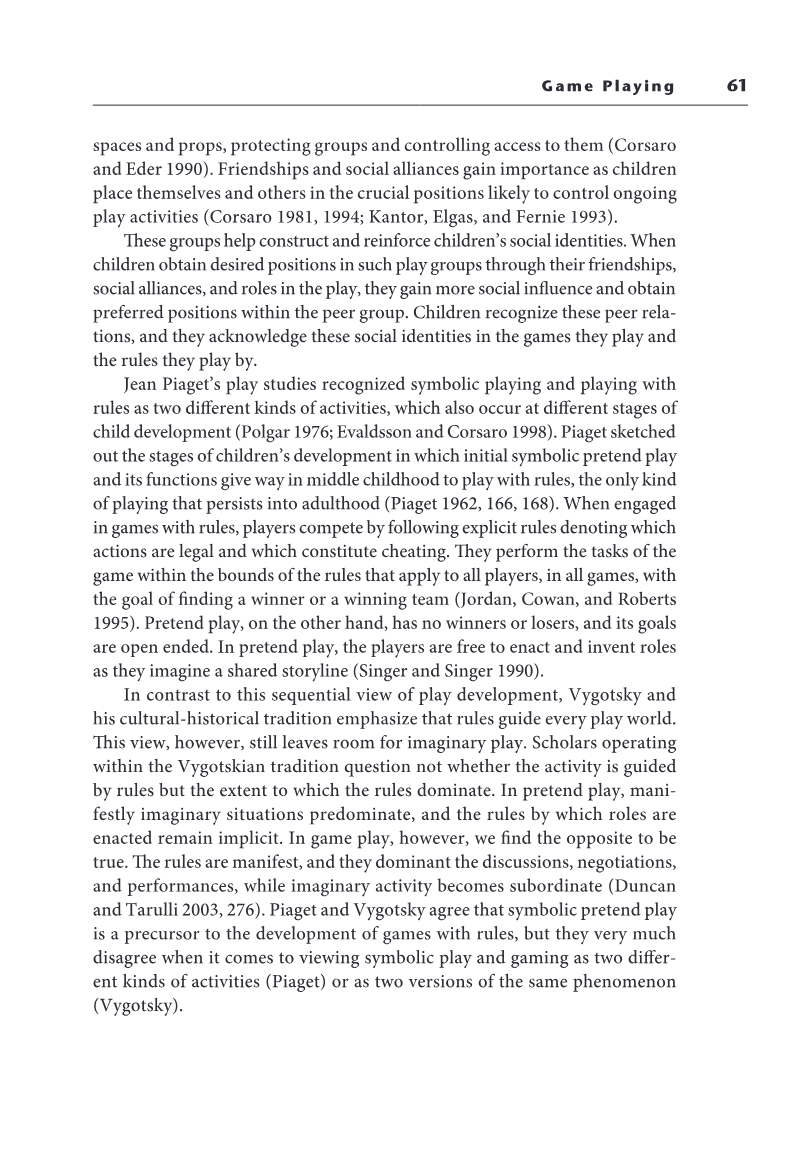
Winther-Lindqvist's study, published in the American Journal of Play in 2009, examines how five-year-old boys in a Danish kindergarten use soccer play to negotiate rules and social identities. Drawing on Vygotsky, Piaget, and Schousboe's model of three spheres of reality (imagination, staging, and physical reality), the author treats rules as negotiable social practices rather than fixed external constraints. The central thesis is that children's rule-based games and pretend play are not separate activities but different expressions of the same phenomenon, both involving subjunctive "as-if" and "what-if" reasoning and ongoing work on social belonging.
The core empirical evidence comes from fifteen unsupervised soccer matches among ten boys, observed ethnographically. These children continually created and revised their own rules, and those rules frequently diverged from conventional soccer conventions. Rulings were shaped less by abstract fairness or the quality of argument than by status and alliances. Whether a goal counted, for instance, often depended on who had scored it. Girls were largely excluded from play except under specific conditions, which the authors read as a reinforcement of gendered norms within the peer group.
The study also finds a balance of flexibility and stability. Group hierarchies were fluid over longer periods, as seen in goalkeeper Phillip's rising standing, yet remained predictable from day to day. Players took on group-assigned roles such as goalkeeper, scorer, and referee, and collectively built shared narratives of victory and defeat. These findings support Vygotsky's account of play and the view that soccer and symbolic group play share strong structural similarities. The author cautions against treating different play forms as sequential developmental stages, arguing instead that they coexist as parallel expressions of social identity work.
American Journal of Play · 2025
American Journal of Play · 2025
American Journal of Play · 2024
American Journal of Play · 2024
American Journal of Play · 2024
American Journal of Play · 2023
American Journal of Play · 2022
American Journal of Play · 2022
American Journal of Play · 2021
American Journal of Play · 2020
American Journal of Play · 2020
American Journal of Play · 2019
Extra Credits · 2026