Showing 30 of 319 results · 0.68s
NetEase 1Q26 Investor Presentation
NetEase
mobile, PC, and console games. Beyond its core gaming business, the company operates diversified segments including intelligent learning solutions through Youdao, the NetEase Cloud Music platform
Financial13 pages
Jun 2019
E3 2019 Market Analysis
SuperJoost
phase, characterized by a shift toward cloud-based services, the maturation of major franchises into competitive esports, and the expansion of gaming onto non-traditional platforms such
Article
Sep 2023
Starfield's Strategic Significance
Video Games Industry Memo
Game Pass service. The game’s performance is viewed as a litmus test for whether Microsoft’s ecosystem-focused model—which prioritizes flexible content access across cloud
Article1 pages
Apr 2026
Annual Report Pursuant to Section 13 or 15(d) of the Securities Exchange Act of 1934: Form 20-F
NetEase
research and development, particularly in proprietary game engines and artificial intelligence, while managing a diverse portfolio that includes Youdao and NetEase Cloud Music. Despite this growth, the company
Article1 pages
Jul 2021
Microsoft Form 10-K: FY2021
Microsoft
Cloud, and More Personal Computing. The Intelligent Cloud division, anchored by the Azure platform, experienced substantial expansion as enterprises accelerated the migration of workloads to the cloud
Financial1 pages
Apr 2026
German Gaming Market in 2025
GameDev Reports
Nintendo Switch 2, while PC gaming hardware and accessories also posted gains of 7% and 13%, respectively. Conversely, the subscription and cloud services segment achieved a notable milestone
Article1 pages
Apr 2025
Annual Report 2024: Fiscal Year Review
DoubleDown Interactive
platform strategy—leveraging a cloud‑based, scalable infrastructure and a three‑pillar content engine comprising licensed IGT titles, exclusive DoubleU Games slots, and proprietary in‑house development—positions
Financial1 pages
Apr 2026
Weekly Gaming Reports Recap: April 20 - April 24, 2026
GameDev Reports
focusing on the German gaming market, global sales performance, and the emerging "friendslop" genre. The German gaming market returned to growth in 2025, with total revenue increasing
Article1 pages
Jul 2026
Sony to Cease Production of Physical PlayStation Game Discs in 2028
Game File
questions about long‑term game preservation, secondary markets for used titles, and the viability of physical ownership in an era dominated by cloud‑based distribution
Article1 pages
Jan 2021
Gaming Deals Activity Report H1'2021
InvestGame
across PC/console, mobile, and cloud platforms. Venture capital activity remained robust; top 15 VC funds invested $1.1 billion in 60+ companies, with Epic Games’ $1 billion round
Report21 pages
Jan 2024
Perforce 2024 State of Game Technology Report
Perforce, JetBrains
Cloud development is also prevalent: 49 % run cloud servers, led by AWS (30 %) and Azure (18 %), while hybrid or on‑premises setups are rare. Hiring priorities across gaming
Report33 pages
Mar 2026
Google Play's Rate Cuts: Who Actually Won
Deconstructor of Fun
specific Google services, including cloud saves, achievements, and an AI-powered sidekick. The analysis characterizes the outcome as a Pyrrhic victory for Epic Games. Although the litigation successfully
Article1 pages
Feb 2026
Summary of Financial Results for Fiscal Year Ended December 31, 2025 (Japanese GAAP)
KLab
shifting toward the emerging GPU AI Cloud and AI Entertainment sectors to diversify revenue streams. The new GPU AI Cloud Business demonstrated promising initial growth, contributing ¥490.7 million
Financial19 pages
Jan 2024
2024 State of Game Technology Report
Perforce
global game technology landscape has reached a critical inflection point in 2024, characterized by the widespread expansion of game engines into non-gaming sectors such as automotive, healthcare
Report33 pages
Jun 2026
The Runtime Gap: What 25 Years Inside Game Engines Taught Andrew Bowell About Where AI Actually Matters
Deconstructor of Fun
coherence directly into game engines, positioning this as a design primitive rather than an add‑on. A key economic insight is the cost of cloud‑based inference
Article1 pages
Apr 2026
Three Years of the Digital Markets Act
Video Games Industry Memo
voices such as the European Games Developer Federation rate enforcement successes modestly and criticize gaps in data portability, lack of coverage for game‑engine gatekeeping, and slow regulatory
Article1 pages
Mar 2023
20‑F: FY2022
DoubleDown Interactive
maintains a cloud‑based platform and data‑driven monetization strategy aimed at expanding active users, deepening engagement, and optimizing acquisition spend across its unified game portfolio
Article1 pages
Jul 2021
Discovering Your Game's Regional Appeal, Pre-launch
GameDiscoverCo
global PC gaming market during the mid-2021 period, with specific mentions of the emerging Steam Deck hardware and the shifting monetization models of cloud services. Notably
Article
Jan 2024
Gaming Report 2024: Meet the Moment
Bain & Company
rise of cloud-based distribution and the demand for seamless, multi-channel experiences. As market saturation intensifies, the high failure rates observed in mobile gaming underscore the need
Report32 pages
Mar 2026
Annual Report on Form 20-F: 2025
DoubleDown Interactive
digital entertainment and gaming sector. The primary thesis centers on the company’s transition toward a platform-agnostic service model, emphasizing the integration of cloud-based infrastructure
Financial1 pages
Jan 2025
Gaming 2025 (Epyllion)
Epyllion
enabling new cloud-native experiences and third-party storefronts. By 2030, nearly one billion mobile devices will be capable of running high-fidelity console-spec games, positioning emerging
Report224 pages
Libro Blanco de la Industria Catalana del Videojuego 2021
Asociación Española de Empresas Productoras y Desarrolladoras de Videojuegos y Software de Entretenimiento
cloud‑based services, which are becoming central to new development pipelines. Methodologically, the paper draws on a mixed‑methods approach: a structured survey of 200+ Catalan game companies
Article1 pages
Annual Report 2019: Tencent Holdings Limited
Tencent
online gaming, and value‑added services—continued to expand, with monthly active users reaching 1.16 billion and subscription revenue rising to RMB 180 million. FinTech and Cloud segments
Financial274 pages
Mar 2021
Skillz Annual Report: 2020
Skillz
developers, cloud services (primarily Amazon Web Services), and open‑source software, exposing the business to operational disruptions, regulatory scrutiny, and cybersecurity threats. Regulatory uncertainty around skill‑gaming laws
Financial1 pages
Jan 2021
The Rise of Recurrent Revenue: The Next 10 Years in Gaming, Part 2
SuperJoost
used game sales for publishers. The scope of the analysis covers global market trends, specifically focusing on major incumbents like Microsoft, Sony, and Nintendo, alongside emerging cloud competitors
Article
Nov 2025
Skillz 10-K — FY2025 (November 2025)
Skillz
loss of any key game could materially harm performance. Regulatory exposure is broad: compliance with U.S., state, and international skill‑gaming laws, data‑privacy statutes (GDPR, CCPA/CPRA, COPPA
Financial1 pages
Jan 2019
New Party Who Dis?: Gaming as a Broader Vernacular to Reach Voters
SuperJoost
demographics. This shift suggests that the industry is moving beyond "serious games" into a phase where gaming literacy is a requirement for broad cultural and political engagement. Beyond
Article
Consolidated Q1 2026 Report: The Huuuge, Inc. Group
Huuuge
through cloud-based infrastructure and business continuity planning. Looking ahead, the organization is managing ongoing legal scrutiny, including class-action litigation regarding the legality of its gaming products
Financial59 pages
Jan 2025
Japan’s World of Gaming & Influencer Marketing 2025
Nintendo
RPGs and adventure titles. The ecosystem is increasingly defined by the convergence of gaming, live streaming, and broader entertainment. Esports revenue is expected to reach ¥21.8 billion
Report74 pages
Apr 2020
NetEase Annual Report: 2019
NetEase
Youdao education services, cloud music, and e‑commerce—contributed modest but growing revenue streams, with Youdao’s learning portfolio doubling in 2019 and cloud music achieving 800 million
Financial1 pages

NetEase 1Q26 Investor Presentation
13 pages2k words
Summary
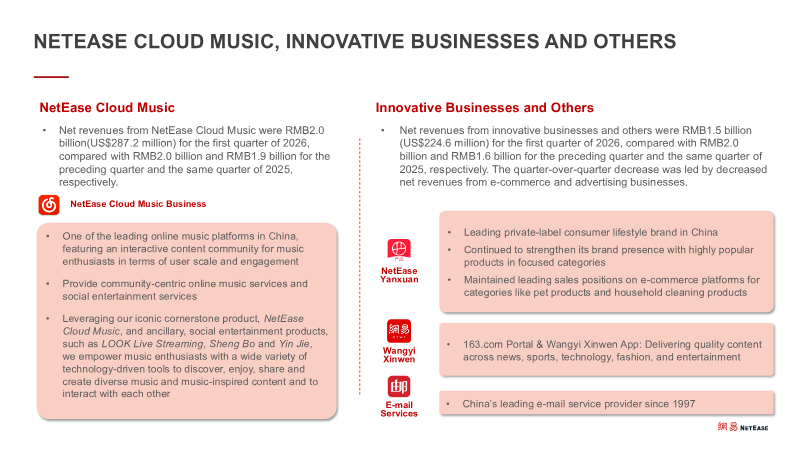
NetEase’s first-quarter 2026 investor presentation outlines the company’s financial performance and strategic positioning as a global internet and gaming services provider. The company maintains a strong focus on premium content, leveraging its extensive in-house research and development capabilities to manage a portfolio of mobile, PC, and console games. Beyond its core gaming business, the company operates diversified segments including intelligent learning solutions through Youdao, the NetEase Cloud Music platform, and the Yanxuan consumer lifestyle brand.
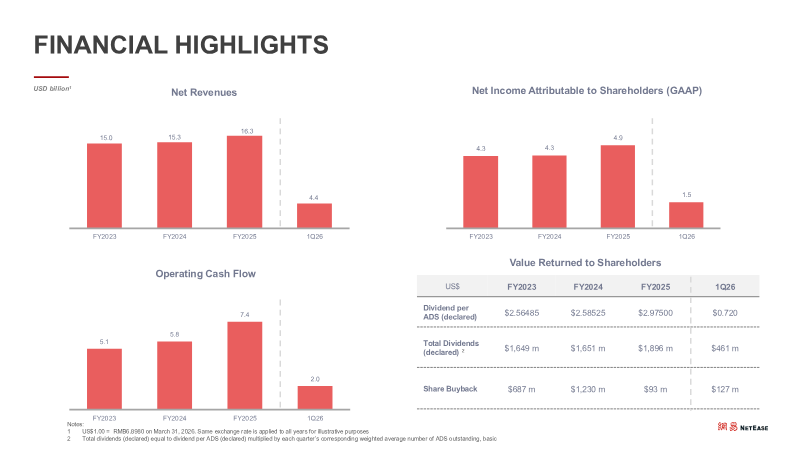
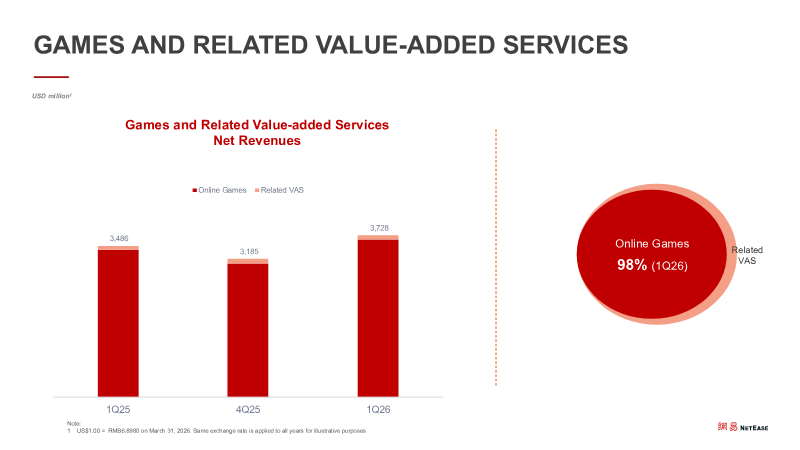
Financial results for the first quarter of 2026 reflect a stable operational environment, with total net revenues reaching $4.4 billion. The games and related value-added services segment remains the primary revenue driver, contributing $3.7 billion to the total. Net income attributable to shareholders for the quarter was $1.5 billion, supported by a gross profit margin of 69.4%. The company maintains a robust balance sheet, reporting $24.3 billion in net cash as of March 31, 2026, and continues to prioritize shareholder value through consistent dividend declarations and share buyback programs.
The company’s gaming strategy emphasizes the sustained engagement of flagship titles such as the Fantasy Westward Journey franchise, alongside the global expansion of newer offerings like Marvel Rivals and Where Winds Meet. While the company continues to benefit from stable operations of licensed titles in China, it remains cognizant of potential risks, including regulatory shifts, geopolitical tensions, and the competitive nature of the global gaming market.
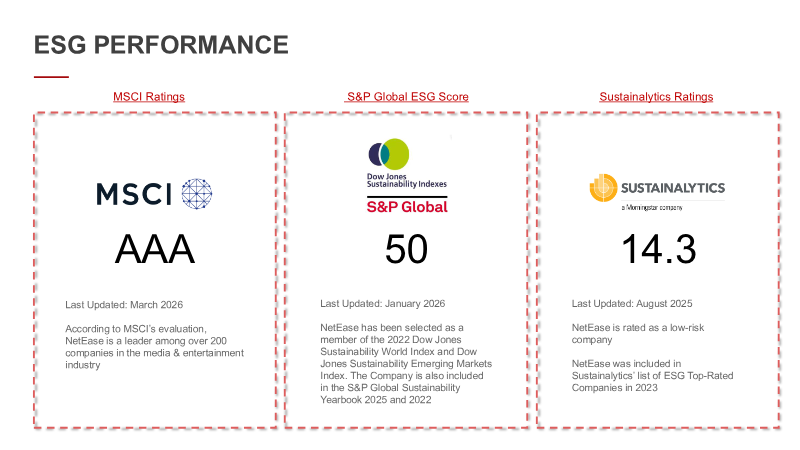
Operational highlights include the integration of artificial intelligence across the Youdao ecosystem to enhance learning services and advertising efficiency, alongside a disciplined approach to smart device profitability. NetEase also maintains a strong commitment to environmental, social, and governance standards, evidenced by an AAA rating from MSCI as of March 2026. These results underscore a strategy of balancing core gaming dominance with targeted investments in technology-driven services to sustain long-term growth.
Pages

Insights
- NetEase generated $4.4 billion in total net revenue for 1Q26, with the gaming segment contributing $3.7 billion of that total.
- The company reported $1.5 billion in net income for the quarter, maintaining a gross profit margin of 69.4%.
- As of March 31, 2026, NetEase holds a robust balance sheet with $24.3 billion in net cash.
- Gaming strategy centers on the sustained performance of the Fantasy Westward Journey franchise alongside the global expansion of new titles Marvel Rivals and Where Winds Meet.
- NetEase is integrating artificial intelligence across its Youdao ecosystem to improve advertising efficiency and learning service capabilities.
Operating Cash Flow