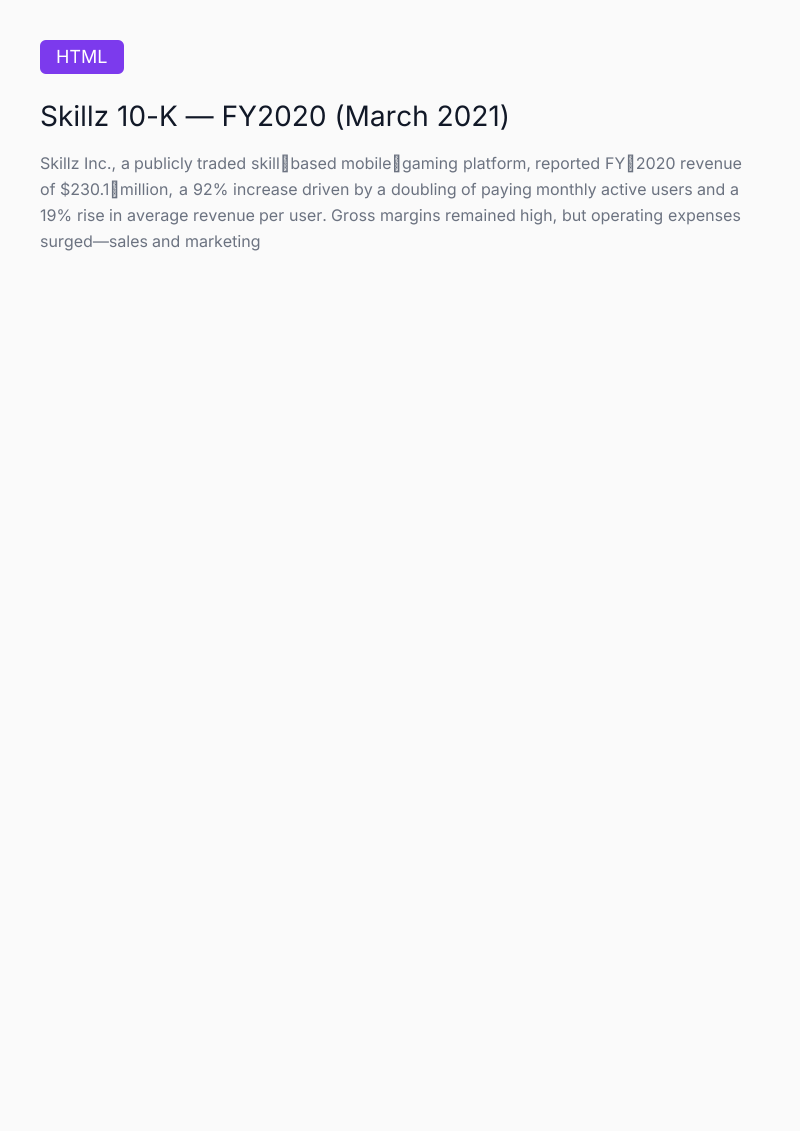
Skillz’s FY2025 filing demonstrates a company that has achieved significant revenue growth while tightening operating leverage, yet remains exposed to intense competitive, regulatory, and operational risks. Revenue rose to $1.12 billion in FY2024, a 15% year‑over‑year increase driven by higher in‑app purchase volume and an expanded partner portfolio, while the net loss narrowed to $45 million from a $120 million loss in FY2023. Cash balances of $520 million provide roughly a year’s runway at current burn rates, but the firm continues to face covenant‑breach status on its 2021 senior secured note and a $129.7 million debt due in 2026.
The company’s core monetization platform—an end‑to‑end SDK that powers prize‑based competitions for mobile games—generates the majority of revenue through entry‑fee shares and advertising. Skillz claims a technology advantage with anti‑cheat, player‑matching, and data‑science tools that enable rapid developer onboarding. However, its top titles account for nearly 60% of revenue, and the loss of any key game could materially harm performance. Regulatory exposure is broad: compliance with U.S., state, and international skill‑gaming laws, data‑privacy statutes (GDPR, CCPA/CPRA, COPPA), and evolving gambling regulations could increase costs or restrict market access.
Operationally, Skillz relies heavily on third‑party cloud services (primarily AWS) and open‑source software, creating vulnerability to outages, vendor disruptions, or licensing disputes. Internal control weaknesses in IT general controls and revenue recognition have been identified by auditors, underscoring the need for stronger governance. The firm’s dual‑class structure concentrates voting power in its CEO, potentially dampening shareholder influence and affecting liquidity if the stock falls below NYSE thresholds.
Overall, Skillz presents a compelling growth narrative in the mobile gaming monetization space but must navigate significant legal, regulatory, and operational challenges to sustain its trajectory.
Skillz · 2026
Skillz · 2024
Skillz · 2024
Skillz · 2023
Skillz · 2022
Skillz · 2021

Modern Times Group · 2026
Take-Two Interactive · 2025

InvestGame
Embracer Group
IGG

InvestGame

InvestGame · 2026
Drake Star Partners · 2026

Aream & Co · 2026

AppLovin · 2026
Aream & Co · 2026

InvestGame · 2025